Finance & Money in Panama · Part 11 of 14
Estate Planning for Gay Couples in Panama: The Post Nobody Else Writes
Panama does not recognize same-sex marriage or domestic partnerships. Without legal documents, your partner has no automatic right to your property, your bank account, your home, your medical decisions, or even your remains. This is not theoretical. It requires specific action before you close on a property or establish any significant asset in Panama.
 Brian & Kent · GayExpatsPanama.com · April 2026 Research Trip
We are going to spend the first part of this post being direct about something that most Panama relocation guides mention in a single vague sentence and then move on from. That sentence is usually some version of: “gay couples should consult an attorney about estate planning.” That is true. It is also completely insufficient. So let us say what actually happens if you do not act — and then explain exactly what you need to do, in what order, with what documents.
Brian and Kent are a gay couple. This is our specific situation. We are writing this primarily for gay couples, because the legal exposure we face in Panama is categorically different from what a married straight couple faces — and we have not found another site that explains the difference at the level of detail the situation requires. We also cover estate planning for all expats, because wills, powers of attorney, and medical directives matter for everyone. But the gay couple section is the reason this post exists.
Finance & Money in Panama Series
Fourteen articles covering everything you need to know about managing your money before, during, and after your move to Panama.
- The Real Numbers: Our 13-Part Guide to Finances, Money, and Budgeting in Panama
- Taxes in Panama: What the Territorial System Actually Means for American Expats
- Banking in Panama: The Truth Behind the Social Media Fear
- What Does It Actually Cost to Live in Panama City?
- What Buying a Home in Panama Actually Costs You
- Financing a Home in Panama
- Home & Auto Insurance in Panama
- Healthcare Costs in Panama
- Travel Within Panama: Getting Around
- ATMs, Wire Transfers, Wise, and Getting Your Income Here Reliably
- Estate Planning for Gay Couples in Panama You are here
- Can a Foundation Let My Partner Inherit Our Panama Property Without Probate
- Your Retirement Accounts Are Not Worth What You Think — RMDs, Taxes & Medicare
- Building Your Reserve in Panama: The Financial Cushion That Makes a Retirement Budget Actually Work
The Legal Reality: What Panama Does Not Recognize
Panama does not recognize same-sex marriage. It does not recognize same-sex civil unions or domestic partnerships. It does not recognize the U.S. marriage certificate of a same-sex couple as conveying any legal status in Panama. On 16 February 2023, Panama’s Supreme Court ruled — by a vote of six justices — that the phrase “between a man and a woman” in Article 26 of the family code is not unconstitutional, upholding a 2015 law that explicitly prohibits marriage between people of the same sex. The court’s own language: the prohibition is “objectively and reasonably justified in the general interest of giving precedence to those unions with the potential of establishing families, giving continuity to the human species, and, therefore, to society.” Panama continues to face criticism from international human rights bodies over the ruling, including from the Inter-American Commission on Human Rights, but as of 2026 the legal position in Panama has not changed.
What this means in concrete terms: under Panamanian law, you and your partner are legal strangers to each other. Your relationship — however long, however committed, however formally recognized in your home country — does not exist in the eyes of Panamanian inheritance law, medical law, or property law.
The Core Legal Problem — Stated Plainly
If one partner in a gay couple dies in Panama without a valid Panamanian will naming the surviving partner as an heir, the surviving partner receives nothing from the Panama-based estate. Nothing. The property goes to the deceased’s legal next of kin — children, parents, siblings — in that order, regardless of how long the couple was together, regardless of who paid for the property, regardless of any U.S. marriage or domestic partnership certificate. The surviving partner has no automatic legal claim under Panamanian intestacy law.
This is not a technicality. It is a documented, enforced reality that has created genuine financial and personal crises for same-sex couples in Panama. The fix is entirely available — but it requires deliberate, specific legal action before it matters.
What Panamanian Intestacy Law Actually Says
When someone dies in Panama without a valid will, Panamanian intestacy law — codified in the Civil Code — dictates who inherits their Panama-based assets. The hierarchy is rigid and based entirely on legally recognized family relationships:
Panama Intestate Succession Order — Who Inherits Without a Will
The “legally recognized spouse” referenced throughout Panamanian intestacy law means a spouse recognized under Panamanian law — which currently means an opposite-sex spouse in a legal Panamanian marriage, or a foreign opposite-sex marriage recognized under Panamanian private international law. A U.S. same-sex marriage does not meet this standard.
For a gay couple who owns a condo in Panama — even one who has been together for 30 years and is legally married in the United States — if one partner dies without a Panamanian will, the surviving partner has no legal claim to that condo. The deceased partner’s parents, if living, may inherit it. The deceased partner’s adult children from a previous relationship, if any, may inherit it. A sibling the deceased partner had not spoken to in a decade may inherit it. The surviving partner, without a will in place, has nothing.
“The couple’s U.S. marriage certificate is real, legally valid, and completely irrelevant to Panamanian inheritance law.”
The Additional Risks Beyond Property
Inheritance is the most obvious risk, but it is not the only one. Human Rights Watch has documented the legal disadvantages same-sex couples face in Panama — disadvantages that go beyond property and affect medical decisions, financial access, and basic dignity in a crisis.
Medical Decision-Making
If one partner is incapacitated — unconscious after an accident, in surgery, suffering a medical crisis — Panamanian hospitals will default to recognized family members for decision-making authority. Without a properly executed Panamanian medical power of attorney naming the partner as the designated healthcare decision-maker, the hospital is legally within its rights to defer to parents or siblings. The partner who knows the person best, who has been their companion for decades, who knows their medical history and their wishes, may be excluded from decisions that determine whether they live or die.
This is not hostility from Panamanian medical staff — in practice, Panama City’s private hospitals treat gay couples professionally and without obvious discrimination. It is a legal default that applies in the absence of documentation. The documentation is the fix.
Financial and Bank Account Access
Joint bank accounts in Panama require both account holders to be named on the account and to have individually executed account agreements. If one partner dies and the account is in the deceased’s name only, the surviving partner — without a will or legal authority — cannot access it. The funds are frozen pending probate. A joint account setup from the start, combined with proper estate documents, prevents this.
Property and the Right to Remain in Your Home
If a property is titled solely in one partner’s name and that partner dies without a will, the surviving partner has no legal right to remain in the property while the estate is resolved. The heirs who inherit under intestacy law — whoever they are — can demand the property, and the surviving partner has no standing to resist. This scenario is not hypothetical. It has happened to gay couples in Panama and in other countries with similar legal frameworks.
Gay Couples vs. Married Straight Couples — The Legal Gap
Married Straight Couple — No Will
Under Panamanian intestacy law, the surviving legally recognized spouse inherits equally with children. In the absence of children, the surviving spouse inherits with the deceased’s parents. Legal marriage provides automatic inheritance protection built into the law.
Medical decisions: spouse has recognized standing at hospitals by default.
Bank accounts: surviving spouse has standing to access joint accounts and claim individual accounts through established legal mechanisms.
Property: surviving spouse has recognized legal claim even without a will.
Gay Couple — No Will
The surviving partner is a legal stranger. No automatic inheritance right. Property, bank accounts, and other assets pass to the deceased’s legal next of kin — which could be parents, children from a prior relationship, or siblings. The partner receives nothing.
Medical decisions: partner has no recognized legal standing. Hospital defers to blood family.
Bank accounts: if titled in deceased’s name only, frozen and inaccessible to partner.
Property: no legal right to remain or inherit. Blood family heirs may demand it.
The contrast is stark. A married straight couple in Panama gets significant legal protections automatically — protections written into Panamanian law — that require no additional documents. A gay couple in Panama gets none of those protections automatically. Every single one must be created deliberately, with specific legal instruments, executed before they are needed.
What You Need — The Complete Legal Document Stack
Here is every document a gay couple should have in place before establishing significant assets or long-term residence in Panama. These are not optional enhancements. They are the legal infrastructure that replaces the protections that Panamanian marriage law provides to straight couples by default.
1. Panamanian Will (Testamento)
Priority: Immediate — Before Any Property Purchase
A Panamanian will is a public deed drafted by a Panamanian attorney and executed before a Panamanian notary. It must be in Spanish. It names your partner as your heir for your Panama-based assets — property, bank accounts, vehicles, and any other assets held in Panama. Panama allows testators to distribute their assets entirely as they choose; there is no “forced heirship” rule that requires a portion to go to biological family members. You can leave everything to your partner.
Each partner must execute their own separate will naming the other. One document will not protect both of you. Attorney cost: approximately $500–$1,500 depending on complexity. This is not a place to cut costs.
Critical timing: A Panamanian will should be in place before you close on any Panama property or open any Panama bank account in a single name. The risk exists from the moment the first significant asset is established.
2. Updated U.S. Will
Priority: Immediate — Covers U.S.-Based Assets
Your Panamanian will covers Panama-based assets. Your U.S. will covers U.S.-based assets — your U.S. bank accounts, investment accounts, U.S. real estate, personal property stored in the U.S. Both documents must be consistent and must not inadvertently contradict each other. An international estate planning attorney who works across both jurisdictions should review both. Critically: if you were legally married in the U.S. but your existing U.S. will was written before legal same-sex marriage in your state, review and update it. The same is true for any will written before the Obergefell decision (2015).
3. Panamanian Durable Power of Attorney (Poder Notarial)
Priority: Before Long-Term Residence — Financial and Legal Authority
A durable power of attorney executed in Panama before a Panamanian notary authorizes your partner to act on your behalf for financial and legal matters — bank transactions, property decisions, legal proceedings — if you become incapacitated, are traveling, or are unable to act for yourself. “Durable” means it remains in force even if you become mentally or physically incapacitated. Without it, your partner has no legal authority to manage your Panamanian financial affairs, even while living in your home.
Execute a broad general durable POA covering all financial and property matters. Each partner executes a separate POA naming the other. Attorney cost: approximately $300–$600 each.
4. Medical Power of Attorney / Advance Healthcare Directive
Priority: Before Any Extended Stay in Panama
This document — called “instrucciones anticipadas” (advance directives) or a “poder notarial para decisiones médicas” in Panama — designates your partner as the person authorized to make healthcare decisions on your behalf if you are unable to do so. Panama’s healthcare system is increasingly recognizing these documents; the major private hospitals (Punta Pacífica, The Panama Clinic, San Fernando) respect properly executed advance directives.
The document should explicitly name your partner as your primary healthcare decision-maker, authorize them to receive medical information, and state your healthcare preferences including end-of-life wishes. Executed before a Panamanian notary. Each partner executes separately for the other.
Carry a copy. Keep a copy with each partner’s medical records, a copy at home, and a copy in your attorney’s file. In an emergency, the document at the hospital is what matters — not the one in your attorney’s safe.
5. Updated U.S. Healthcare Directive and HIPAA Authorization
Priority: Before Any U.S. Travel or Treatment
Your U.S. healthcare directive (living will + healthcare proxy) should explicitly name your partner as your healthcare decision-maker in U.S. medical contexts. The HIPAA authorization specifically allows your partner to receive your medical information from U.S. healthcare providers — without this, your partner can be denied medical updates even by phone. Same-sex spouses have automatic HIPAA rights in the U.S., but if you are not legally married in the state of your U.S. domicile, or if there is any question about recognition, an explicit HIPAA authorization eliminates ambiguity.
6. Joint Property Titling
Priority: At Time of Purchase
The most direct way to protect a property is to title it in both partners’ names as co-owners. In Panama, real property can be titled in joint ownership (co-propiedad). Both names appear on the deed registered in the Public Registry. If one partner dies, the surviving co-owner has an established ownership interest — the property does not pass entirely through the deceased’s estate for the surviving partner’s half.
However, joint titling is not a complete substitute for a will. The deceased partner’s share still passes through their estate unless a will directs it to the surviving partner. Joint titling protects the survivor’s existing share; a will protects their right to inherit the deceased’s share. You need both.
If your property is currently titled in only one partner’s name: consult your attorney about adding the other partner to the title. This involves a deed transfer, Public Registry fees, and a potential transfer tax implication. It may also affect the property’s tax exemption status depending on the specific exemptions in place. Do not do this without legal advice.
7. Designated Beneficiaries on All Financial Accounts
Priority: When Opening Each Account
For Panamanian bank accounts and investment accounts, confirm whether beneficiary designations are available and execute them. In Panama, some bank accounts allow a “beneficiary in case of death” designation that bypasses the probate process entirely — the named beneficiary receives the funds directly. Not all accounts offer this, but ask at each institution. Your U.S. accounts — 401(k), IRA, brokerage — should already have your partner named as primary beneficiary. Verify this. These designations supersede will instructions for accounts that carry them.
8. Panama Private Interest Foundation (PIF)
Priority: When Significant Assets Are Accumulated
For expats with more complex asset situations — multiple properties, business interests, significant investment accounts held in Panama — a Panama Private Interest Foundation offers a powerful alternative to relying on wills and probate. Because the foundation, not an individual, owns the assets, they do not pass through probate when the founder dies; the foundation council instead follows the distribution plan written into the foundation’s private regulations. For gay couples specifically, those regulations are not subject to Panamanian intestacy law — there are no mandatory heirs, and you direct the assets exactly where you choose with no court intervention.
The Foundation Question Deserves Its Own Article — and Has One
Whether a Private Interest Foundation is the right structure for your specific situation — including how it interacts with the Qualified Investor Visa’s beneficial-ownership requirement — is more than a paragraph can responsibly cover. We wrote a dedicated article on exactly this: what a PIF actually does, what it costs to set up and maintain, and specifically whether it can let a partner inherit Panama property without probate while still preserving QIV eligibility for the applicant.
Foreign Wills in Panama — Important Limitations
Some expats arrive in Panama with the assumption that their existing U.S. will covers their Panama assets. This assumption is dangerous.
Panama recognizes foreign wills — but only under specific conditions. The foreign will must comply with the laws of the country where it was executed. It must be translated into Spanish by a certified translator. It must be legalized by apostille under the Hague Convention (the U.S. is a Hague member) and authenticated by the Ministry of Foreign Affairs of Panama. This process takes time, costs money, and is not guaranteed to be recognized smoothly by Panamanian courts.
More practically: a U.S. will drafted to distribute U.S. assets according to U.S. law may not cleanly address Panama-specific legal requirements — including the specific language needed for the Public Registry to transfer property title. A Panamanian will drafted by a Panamanian attorney is faster to probate, clearer in its Panama-specific legal instructions, and eliminates the authentication uncertainty entirely.
The Two-Will Strategy
The correct approach for American expats with significant assets in both countries: one U.S. will covering U.S.-based assets, and one Panamanian will covering Panama-based assets. The two documents must be carefully coordinated by attorneys in both jurisdictions to ensure they do not contradict each other and that together they cover everything. Coordinate, not duplicate — a Panamanian will should explicitly address only Panama assets; a U.S. will should explicitly address only U.S. assets. Overlap creates legal ambiguity about which document controls.
Probate in Panama — Why Avoiding It Matters
Even with a valid will, Panama’s probate process (sucesión) requires a court filing and legal representation, and Panamanian legal guides consistently describe it as time-consuming and, in many cases, running to several months at minimum — longer if any heir contests the will’s validity or a competing intestate claim is raised. One procedural detail worth knowing: intestate succession is filed in Municipal Court if the total estate valuation is B/.5,000 or less, and in District Court otherwise — and the required valuation covers not just property recorded in the Public Registry but other assets such as artwork or shares in private companies.
We have seen figures describing total probate cost and duration in more specific terms — a one-to-two-year timeline, a cost running up to 10% of estate value — repeated across expat guides, but we could not trace those specific figures to an authoritative source and are not presenting them as confirmed facts here. What is consistently confirmed: cost scales with estate size and complexity, requires attorney representation throughout, and during the process assets are effectively frozen — your partner cannot sell the property or move funds from certain accounts while working through the Panamanian court system.
The strategies that reduce or eliminate probate exposure — joint titling, beneficiary designations, and the Private Interest Foundation — exist precisely because the probate process is onerous enough that most experienced Panama attorneys recommend structuring around it wherever possible.
Estate Planning for All Expats — Straight and Gay
Everything above applies specifically to gay couples. What follows applies to all expats, regardless of relationship structure — and the needs are real even for legally married straight couples.
Panama Has No Inheritance or Estate Tax
This is worth stating clearly because it is a genuine financial advantage. Panama does not impose estate tax or inheritance tax on assets transferred at death. Property, bank accounts, and other assets passing from a deceased person to heirs in Panama are not subject to Panamanian inheritance tax. This makes Panama’s estate planning landscape meaningfully simpler than many countries — the tax question that drives much of U.S. estate planning simply does not arise for Panama-based assets.
Your U.S. estate tax situation is unaffected by living in Panama — the U.S. taxes estates of American citizens on worldwide assets above the federal exemption threshold (a figure that adjusts periodically — confirm the current amount rather than relying on any number published here). For most expats, the federal estate tax is not a practical concern. State estate taxes depend on your state of domicile.
Panamanian Probate Is Slow for Everyone
Even for a legally married straight couple with a perfectly executed Panamanian will, probate takes time and costs money. The strategies that minimize probate exposure — joint titling, beneficiary designations, and the PIF — benefit all expats, not just gay couples. The motivation is different (gay couples must act to prevent disinheritance; straight couples act to avoid delay and cost), but the tools are the same.
The Cross-Border Estate Problem
If you own assets in both the U.S. and Panama, your estate exists in two legal systems simultaneously. U.S. probate rules govern your U.S. assets. Panamanian succession rules govern your Panama assets. Your U.S. executor and your Panamanian estate administrator must coordinate — ideally with attorneys in both jurisdictions who have communicated with each other. This is why international estate planning attorneys who work across both systems are worth the investment, and why the two-will strategy is essential rather than optional for anyone with assets in both countries.
The Complete Action Checklist
| Document / Action | Who Needs It | When | Who Drafts It |
|---|---|---|---|
| Panamanian will | All expats with Panama assets — urgent for gay couples | Before any property purchase or significant Panama asset | Panamanian attorney + notary |
| Updated U.S. will | All expats with U.S. assets | Before relocation; review every 3–5 years | U.S. estate attorney |
| Panamanian durable POA (financial) | All expats — critical for gay couples | Before long-term residence established | Panamanian attorney + notary |
| Panamanian medical POA / advance directive | All expats — critical for gay couples | Before long-term residence; carry a copy | Panamanian attorney + notary |
| U.S. healthcare directive + HIPAA auth | All expats who travel to or receive care in the U.S. | Before relocation; update as needed | U.S. attorney or estate planner |
| Joint property titling | Gay couples — and all couples who want shared ownership | At time of property purchase | Panamanian real estate attorney |
| Beneficiary designations on all accounts | All expats | When opening each account | Bank / financial institution |
| Panama Private Interest Foundation | Expats with substantial Panama assets; couples wanting probate-free succession | When property is purchased or assets exceed a meaningful threshold | Panamanian attorney specializing in foundations |
| Coordination between U.S. and Panama attorneys | All expats with assets in both countries | When drafting any documents | Attorney in each jurisdiction |
Finding the Right Attorney
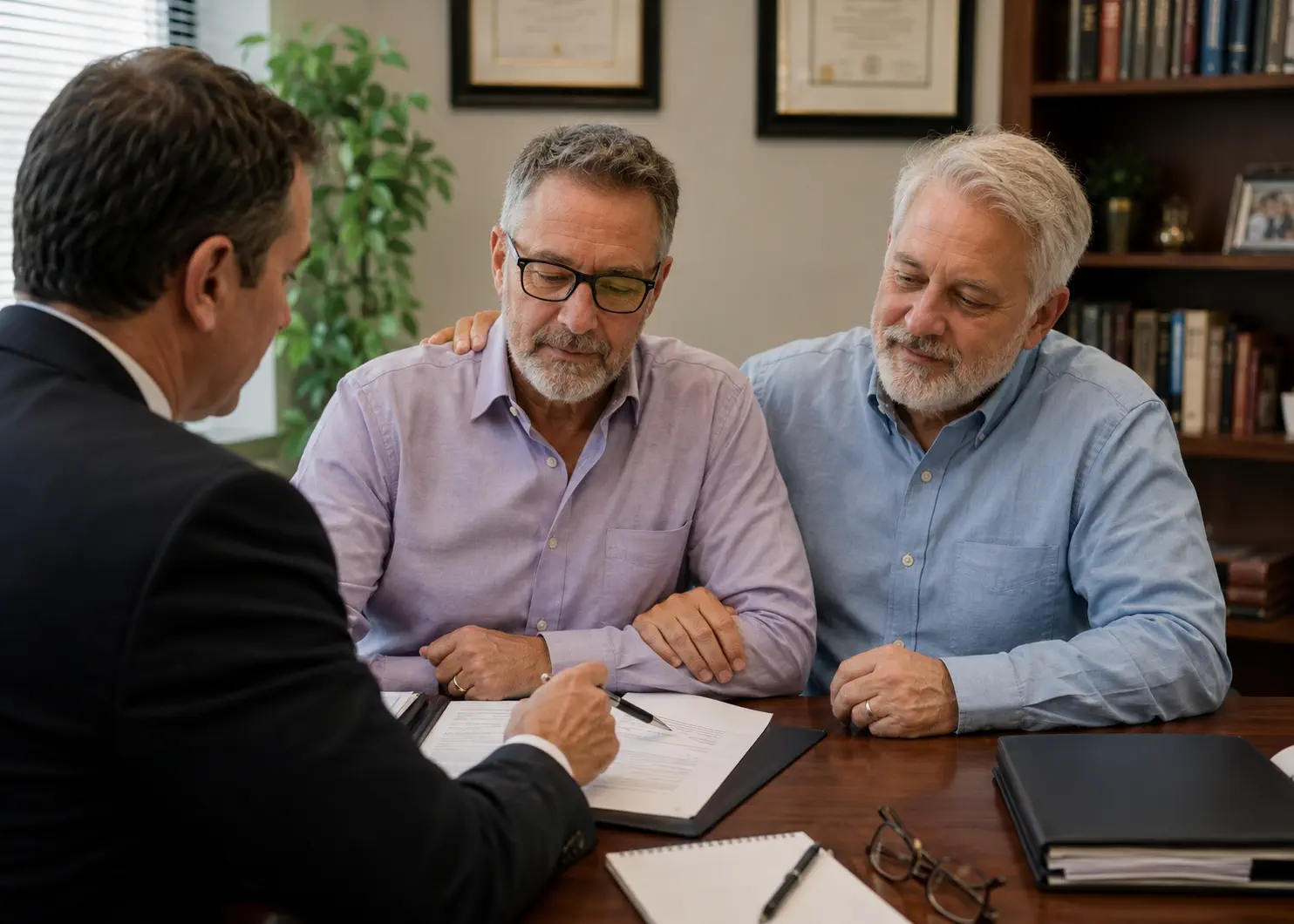
Not every Panamanian attorney has meaningful experience with gay couples’ estate planning needs. The legal field in Panama, like the broader culture, has not uniformly engaged with same-sex couples as a distinct client population with specific legal exposure. When hiring an attorney for this work, ask directly:
“Have you drafted estate planning documents for same-sex couples?” The answer tells you what you need to know. An attorney who answers yes with specifics is the right choice. An attorney who hedges, expresses discomfort, or pivots to something else should not be drafting documents that your partner’s financial security depends on.
Morgan & Morgan — the law firm we have been working with for Brian’s Pensionado visa — is Panama’s largest law firm and handles international estate planning. They are sophisticated enough to work with gay couples appropriately. Other major international law firms with Panama offices (Baker McKenzie, Arias, Fábrega & Fábrega) have the size and international perspective to handle cross-border gay couple estate matters with competence.
This Work Has a Deadline — and It Is Whenever You Close on Something
Every document in this post should be in place before you close on a property, open a significant bank account, or establish any meaningful asset in Panama. Not after. Not “eventually.” Before. The moment you own a Panama property without a Panamanian will and without joint titling, you have created a gap in your partner’s legal protection that will be very difficult to correct if the moment comes before the documents exist. Make the appointments. Do this work. It is the most important financial planning task in this entire series.
Our Situation — Where Brian and Kent Are
We are going through this in real time. Brian’s permanent residency was approved in July 2026. Kent intends to pursue the Qualified Investor Visa. We have not yet purchased property in Panama, and we have not yet finalized our estate planning documents. What we have done is understand, clearly, that before we close on any Panama property, we need both Panamanian wills, both durable POAs, both medical directives, and a plan for joint titling or a foundation structure executed and filed — the foundation route, in particular, because it can protect Brian’s inheritance interest without depending on Panama recognizing our relationship, and it appears compatible with Kent’s visa requirements rather than in conflict with them, based on what we’ve verified about the governing decree elsewhere in this series. We know what the gap looks like if we do not act. We are not going to wait until after closing to fix it.
We will update this post as we go through the actual process — attorney chosen, documents drafted, questions answered. The real-time documentation of what this actually involves, from the attorney meetings to the notary appointments to the costs, is exactly the kind of information that does not exist in any other expat guide we have found. We intend to fix that.
The Bottom Line
Panama’s legal system is genuinely favorable to expats in many ways — freehold property ownership, low property taxes, no estate or inheritance tax, a well-developed private interest foundation framework. For gay couples, however, the legal system provides exactly none of the automatic protections that Panamanian marriage law extends to opposite-sex married couples. The gap is significant, the consequences of ignoring it are serious, and the fix is completely available.
Execute the documents. Both of you. Before it matters.
Sources & Verification
- Official: Panama Supreme Court ruling of 16 February 2023 upholding Article 26 of the family code and the 2015 law prohibiting same-sex marriage, with the “objectively and reasonably justified” quotation confirmed verbatim against contemporaneous reporting (AFP/The Vibes, Washington Blade, Los Angeles Blade, Inquirer, Tico Times) and the Supreme Court’s own press release language as reported by Los Angeles Blade.
- Reported: Human Rights Watch’s documentation of legal disadvantages faced by same-sex couples in Panama (“Bittersweet Pride Month in Panama,” June 2023), and continued international criticism of the ruling including from the Inter-American Commission on Human Rights.
- Reported: Panama intestate and testate succession procedure — court filing requirement, mandatory legal representation, the Municipal Court (≤B/.5,000) vs. District Court venue split, and the requirement to value non-registry assets such as artwork and private company shares — per Kraemer & Kraemer’s published guides to probate in Panama and the International Bar Association’s Panama International Estate Planning Guide.
- Not yet verified: The specific one-to-two-year probate timeline and up-to-10%-of-estate-value cost figure repeated across expat guides. We could not trace either figure to an authoritative source and have described probate as time-consuming and cost-scaling rather than repeating unconfirmed specific numbers.
- Not yet verified: Whether the Qualified Investor Visa’s spousal co-ownership provision extends to a same-sex couple — an open question carried over from this series’ property-focused articles, relevant to any couple considering a foundation structure alongside a QIV application.
Facts in this article last verified: July 2026.
Brian & Kent
We are a gay couple based in St. Petersburg, Florida, relocating to Panama in real time. Brian’s permanent residency was approved in July 2026. Kent is the primary researcher and will pursue the Qualified Investor Visa. Everything on this site comes from what we are actually doing — the attorney meetings are recent, the prices are from this year, and the mistakes are ours.
Thank you for all the information! We are in our 60’s, and, too, are seriously thinking of Panama as a final retirement location for a number of reasons. We look forward to following your process; and, naturally, if you have any recommendations for the legalese side of the process, it’d be great to have a direction to start. Good luck and cheers!! D & J
Sorry for the late reply. Glad you find the site useful. We use Morgan & Morgan in Panama City. They are a large multi-discipline law firm. They can help us with immigration, property purchases, legal protection for gay couples, and every other legal need we have. Good luck. Brian