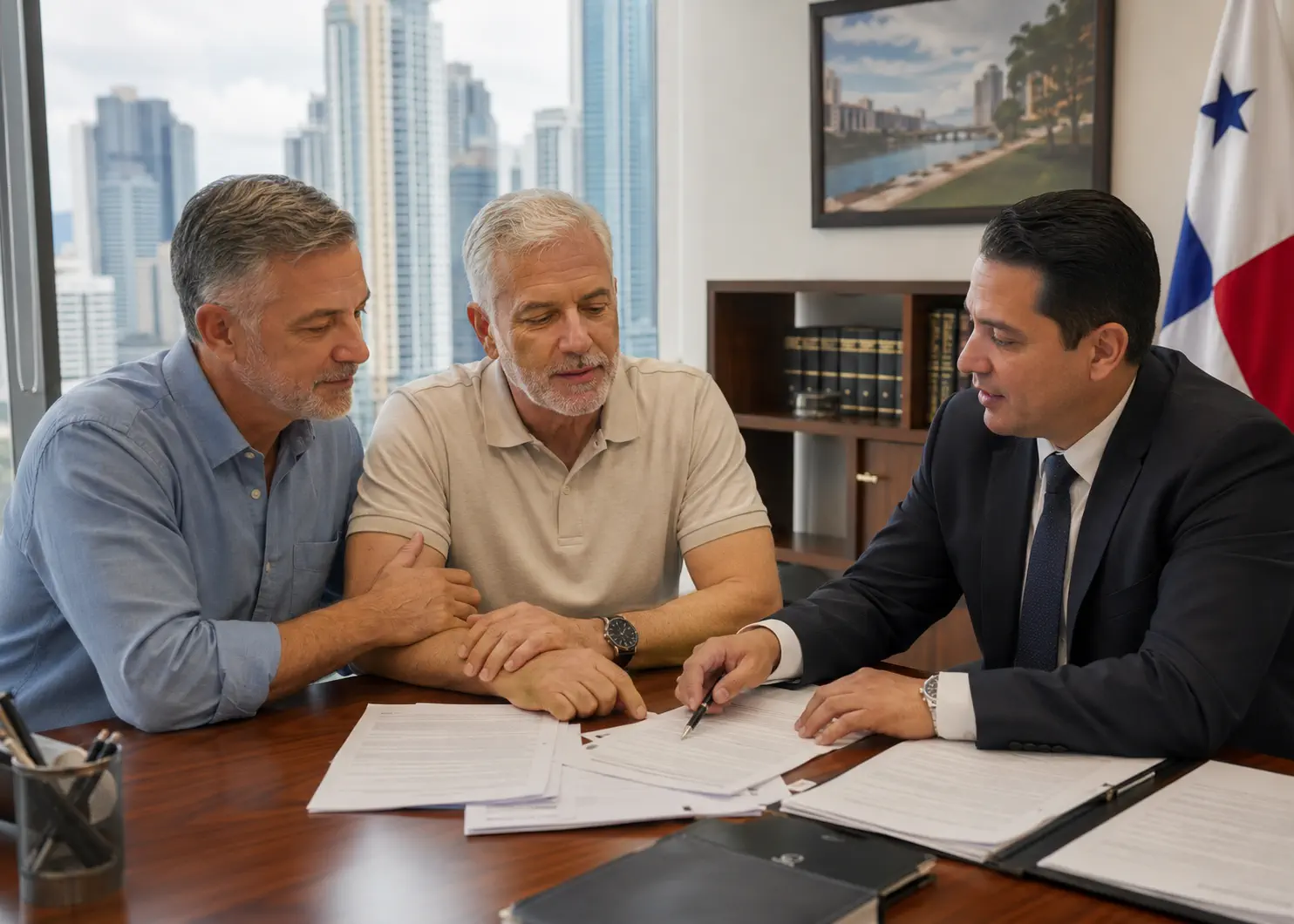
Legal Protections for Couples — Follow-Up
Can a Foundation Let My Partner Inherit Our Panama Property Without Probate — And Still Qualify for the Investor Visa?
The short answer is yes, with one rule that governs everything else: the visa applicant has to stay the 100% beneficial owner the entire time. Here’s how that actually works for a couple buying $450,000–$500,000 in property.
 Brian & Kent · GayExpatsPanama.com · April 2026 Research Trip
A reader question sent us back into our own research, building on something we’d already written about. We’d covered the basic title-structure options for gay couples in Panama — personal name, joint names, corporation, foundation — and laid out a decision matrix. What we hadn’t done is walk through one structure in enough detail to actually use it: the Private Interest Foundation, specifically for a couple where one partner is the Qualified Investor Visa applicant and the other partner is not a visa applicant on that property at all.
That’s our situation. Kent is the one pursuing the Qualified Investor Visa, using proceeds from the sale of our St. Petersburg home. If we buy in the $450,000–$500,000 range, here is the actual question: if Kent dies, does Brian own the property outright, without a Panamanian court being involved, even though Panama doesn’t recognize us as married?
We dug back into this ourselves — cross-checking immigration program rules, Panama’s foundation law, and several Panama-based law firms’ published guidance — rather than treating our earlier summary as the final word. Below is what we found. Use this to understand your options and to know what questions to bring to your own attorney. It is not a substitute for that conversation, and we have not had it ourselves yet either — we are still in the research phase, same as you.
Finance & Money in Panama Series
Fourteen articles covering everything you need to know about managing your money before, during, and after your move to Panama.
- The Real Numbers: Our 13-Part Guide to Finances, Money, and Budgeting in Panama
- Taxes in Panama: What the Territorial System Actually Means for American Expats
- Banking in Panama: The Truth Behind the Social Media Fear
- What Does It Actually Cost to Live in Panama City?
- What Buying a Home in Panama Actually Costs You
- Financing a Home in Panama
- Home & Auto Insurance in Panama
- Healthcare Costs in Panama
- Travel Within Panama: Getting Around
- ATMs, Wire Transfers, Wise, and Getting Your Income Here Reliably
- Estate Planning for Gay Couples in Panama
- Can a Foundation Let My Partner Inherit Our Panama Property Without Probate You are here
- Your Retirement Accounts Are Not Worth What You Think — RMDs, Taxes & Medicare
- Building Your Reserve in Panama: The Financial Cushion That Makes a Retirement Budget Actually Work
Related Reading
This article is a follow-up to Estate Planning for Gay Couples in Panama, which covers the full document stack — wills, powers of attorney, medical directives — that a foundation does not replace. Read that one first if you haven’t already; this piece goes deep on one structure it only summarizes.
Why Panama Doesn’t Have a “Joint Tenancy” Shortcut
If you’re coming from the U.S., you may be picturing Tenancy by the Entireties — title held by a married couple as a single legal unit, with automatic survivorship and protection from one spouse’s individual creditors. Panama has no version of this on a standard property deed, for a simple structural reason: Panama is a civil law country, not a common law one. Concepts like “right of survivorship” attached directly to a deed are common law inventions. Panama’s default property regimes come from its Family Code and Civil Code instead.
That gap matters for any married couple buying property here, but it matters more for us, because Panama’s default workaround — automatic survivorship for legal spouses — isn’t available to us at all. Panama does not recognize same-sex marriage for any purpose, including property and immigration. So even the closest thing Panama has to TBE is off the table by definition. We have to build the equivalent ourselves, using tools that don’t depend on Panama recognizing our relationship.
What a Foundation Actually Does
A Private Interest Foundation (Fundación de Interés Privado), created under Panama’s Law 25 of 12 June 1995 and further regulated by Executive Decree 417 of 8 August 1995, is a separate legal entity that owns the property — not you, not your partner. The foundation has no shareholders and no owners. It has a founder (who creates it and transfers assets into it), a foundation council (who manages it, similar to a board), and beneficiaries (who benefit from it, named in a private, unregistered document called the foundation’s regulations).
The mechanism that makes survivorship work: the foundation charter and regulations name a primary beneficiary and a secondary beneficiary. While the founder is alive, the primary beneficiary is the one who benefits and controls the asset. On the founder’s death, control and benefit pass to the secondary beneficiary automatically — by the terms of the foundation’s own private documents, not by a Panamanian court ruling on inheritance. Because the foundation itself never dies and never changes ownership, there’s nothing for a probate court to redistribute. The property was never personally yours to begin with; it was always the foundation’s.
No Probate, No Panama Inheritance Tax Either
Panama has no general inheritance, estate, or gift tax on assets transferred to heirs. That’s a feature of Panamanian tax law overall, not a special benefit unique to foundations — but it does mean the foundation route doesn’t trade a tax cost for a probate-avoidance benefit. There isn’t a Panamanian tax cost on either side of this structure.
The Rule That Decides Everything: Ultimate Beneficial Owner
Here’s the part that determines whether this works for a visa applicant specifically. To qualify for the Qualified Investor Visa through real estate, Panama’s National Immigration Service requires the applicant to be the Ultimate Beneficial Owner (UBO) of whatever holds the property — personally, through a corporation, or through a foundation. If the property sits in a corporation, the applicant must own 100% of the shares. If it sits in a foundation, the applicant must be the 100% primary beneficiary.
This is the rule that matters most for a visa applicant specifically: a “secondary beneficiary” designation for someone else is fine, as long as it doesn’t strip the applicant of 100% current ownership while the application is being processed. The foundation structure handles this cleanly, because the primary/secondary beneficiary split is exactly that — Kent holds 100% of the present beneficial interest, and Brian’s interest as secondary beneficiary only activates on Kent’s death. Nothing about naming Brian as secondary beneficiary reduces Kent’s standing as the current 100% beneficiary today.
The Constraint That Doesn’t Go Away
Panama’s immigration rules are explicit that they do not recognize unmarried partners or same-sex marriages as dependents, regardless of what a foundation or corporation says. This means two separate things stay true no matter how the property is structured:
First, Brian cannot be added as a dependent on Kent’s visa application. If Brian wants Panamanian residency, he needs his own qualifying path — in our case, his own Pensionado visa, filed and approved independently.
Second, the qualifying investment has to be funded entirely from Kent’s own foreign funds and must represent his full, unencumbered 100% beneficial ownership during the application. The foundation structure solves the inheritance problem. It does not, and cannot, solve the dependent-visa problem. Those are two separate legal questions with two separate answers.
How This Plays Out at $450,000–$500,000
This is where the math from our earlier title-structures article connects to this one. Here’s how the foundation structure applies if you’re buying above the qualifying threshold.
The visa rule only requires Kent to be the 100% beneficial owner of the qualifying investment amount. Above that line, the structure has more flexibility — but the cleanest approach for us, and the one we’re planning to use, is to put the entire property into one foundation, with Kent as 100% primary beneficiary of the whole asset and Brian as secondary beneficiary of the whole asset. The visa doesn’t require the structure to split into separate ownership tranches at the qualifying threshold; it requires that Kent’s beneficial ownership not be diluted below 100% while the application is active. A single foundation holding the full $450,000–$500,000, with Kent as sole primary beneficiary throughout, satisfies that requirement while still giving Brian the full survivorship benefit on the entire property — not just the portion above the qualifying amount.
What We Confirmed in Our Research
The $300,000 Threshold Is Not Permanent — Check It Before You Commit
As Executive Decree 193 of 15 October 2024 currently stands, the reduced $300,000 real estate minimum is a time-limited reduction scheduled to revert to $500,000 on 15 October 2026 unless extended again. Our attorney, Carolina Tejada Vaprio at Morgan & Morgan, expects it to be extended — she holds that view with a high degree of confidence, given her role chairing her bar association’s immigration committee and the reduction’s history of being extended by successive decrees. She is careful to note she cannot speak for the government, and neither can we. If you are sizing a purchase around this threshold, confirm the current position with a Panamanian immigration attorney before committing to a number, a structure, or a closing date.
Why a Foundation Rather Than a Corporation, in Our Case
Our earlier article also covered buying through a Panamanian corporation (Sociedad Anónima), where both partners hold shares and the bylaws dictate what happens to a deceased shareholder’s shares. That structure can work for the visa too — the applicant just needs to own 100% of the shares, the same UBO principle. But for our specific goal, a foundation has two advantages over a corporation.
- A foundation’s beneficiary structure is built for exactly this — primary and secondary beneficiaries with automatic succession — where a corporation’s share-transfer-on-death mechanics have to be engineered through bylaws or a private shareholder agreement that can be challenged or drafted imprecisely.
- A foundation has no owners, which means there are no shares to become a disputed asset of an estate. Corporate shares are personal property and can theoretically become entangled in a deceased shareholder’s broader estate if the bylaws aren’t airtight. A foundation’s separate-patrimony status under Panamanian law avoids that entirely.
Corporations make more sense when the property will generate rental income as an active business — Panama’s foundations aren’t built for ongoing commercial activity, while an S.A. is. For us, this is a primary residence, not a rental, so the foundation’s estate-planning strengths matter more than a corporation’s commercial flexibility.
What a Foundation Does Not Replace
If you read our piece on legal documents for same-sex couples in Panama, you already know a foundation doesn’t substitute for a will, a healthcare power of attorney, or a durable financial power of attorney. It solves the property-survivorship problem specifically. It does nothing for medical decision-making if Kent is incapacitated but not deceased — that’s what the durable POA is for. And a Panamanian power of attorney is extinguished the moment the grantor dies, so it was never a tool for this problem in the first place. Each document in our legal toolkit handles one specific failure mode. None of them overlap, and none of them can stand in for another.
“The foundation solves what happens to the house. It doesn’t solve who can visit the hospital room.”
What Setting This Up Actually Involves
- Foundation Charter. Your attorney drafts and files the public charter — name, founder, foundation council (minimum three members, can be your attorney’s firm), and broad purpose language. This document is public. It does not name beneficiaries.
- Foundation Regulations. A private, unregistered document naming Kent as primary beneficiary and Brian as secondary beneficiary, along with the specific terms governing the transition. This is where the actual estate plan lives, and it stays confidential.
- Property Transfer. The property is purchased and titled directly in the foundation’s name via public deed, the same way any Panama real estate transaction is recorded.
- Visa Filing. Kent’s Qualified Investor Visa application includes documentation proving he is the foundation’s primary beneficiary and that the foundation holds the property free of liens at or above the qualifying threshold.
One-time setup costs for a foundation generally run in a similar range to a corporation — commonly cited figures from Panama law firms put it around $1,800 to $3,000, depending on the firm, including government fees, notary costs, and the first year’s resident agent fee. Get an exact quote from your own attorney; this varies by firm and by how much customization the regulations require.
What It Costs Every Year After That — And Why
This is the part that generates the most online frustration, and it applies to foundations the same way it applies to corporations. Every year, after the setup year, you’re looking at two separate charges. The first is a government franchise tax (called the “tasa única”) — for foundations, this commonly runs around $300 to $400 per year, paid directly to the Panamanian government regardless of which law firm you use. The second is the resident agent fee, paid to whichever attorney or firm serves as your foundation’s resident agent — figures we found across several Panama firms ranged roughly from $300 to $450 per year, though some quote higher depending on the scope of service included.
Add those together and a combined annual cost in the $650–$900 range lines up with what we’ve seen people describe online — including the “around $800 a year” figure that shows up in Facebook groups, usually attached to frustration that an attorney is charging that much for what looks, from the outside, like just filing paperwork.
Why a Lawyer Has to Be Involved at All
We looked into whether this fee is set by some kind of bar association minimum — we couldn’t confirm that specifically. What we did confirm is something that explains the cost differently: Panamanian law requires every corporation and foundation to have a licensed Panamanian attorney as its resident agent, and that attorney has ongoing legal obligations under Panama’s anti-money-laundering framework — Ley 23 of 2015 and Ley 129 of 2020, which created the beneficial-ownership registry system administered by the Superintendencia de Sujetos No Financieros. The resident agent has to maintain due diligence records on the beneficial owners, keep that registry filing current, and report or update the information as required. That compliance work — not paperwork filing in the simple sense — is what the annual fee is paying for, and it’s a legal requirement attached to the entity, not an optional add-on a firm is choosing to charge for.
None of that means every firm’s fee is reasonable, or that $800 a year feels proportionate to the actual hours involved in a quiet year with no changes to report. It’s a fair thing to be annoyed about, and we don’t have enough information to tell you whether a given quote is high for the market or standard. What we can tell you is that the fee itself isn’t optional, isn’t going away once you have a foundation or corporation, and isn’t something you can shop down to zero by switching firms — you can shop the rate, but not the requirement.
Get the Order of Operations Right
Talk to your attorney about the foundation structure before you sign a purchase contract, not after. Retitling a property into a foundation after the fact is possible but adds a second transfer, a second set of registration fees, and potentially a second round of transfer tax. If you already know you want this structure, the cleanest path is to have the foundation in place and ready to take title before closing.
Bottom Line for Couples in Our Position
If you’re a gay couple where one partner is the visa applicant and you want the other partner to inherit the property without Panamanian probate, a Private Interest Foundation with your partner as primary beneficiary and you as secondary beneficiary does what you’re looking for — and it does it without disturbing the visa applicant’s 100% beneficial ownership requirement. What it does not do is get your partner residency. Those are two different problems, and Panama’s law keeps them separate no matter how the property itself is held.
This is exactly the kind of structuring decision where a real conversation with an attorney — before you sign anything — is worth far more than anything we or any other website can tell you. We’re not there yet ourselves; this article is the homework we did before that meeting, not a replacement for it. Bring something like this to your own attorney, and have them confirm the UBO mechanics for your specific numbers and draft the regulations with your actual names and percentages before you’re standing at a closing table.
Sources & Verification
- Official: Panama’s Private Interest Foundation regime under Ley 25 of 12 June 1995 (Gaceta Oficial 22,804), further regulated by Decreto Ejecutivo 417 of 8 August 1995 — confirmed against vLex Panamá, Kraemer & Kraemer, and academic legal sources. No shareholders or owners; founder, foundation council (minimum three members), and beneficiaries named in private, unregistered regulations.
- Official: Executive Decree 193 of 15 October 2024 (amending Executive Decree 722 of 2020) — the Qualified Investor Visa’s Ultimate Beneficial Owner requirement, permitting the qualifying investment to be held personally, through a corporation, or through a private interest foundation, provided the applicant maintains 100% beneficial ownership; not recognizing unmarried partners or same-sex spouses as dependents on the visa application.
- Attorney-confirmed: The $300,000 minimum investment for the Qualified Investor Visa real estate route, and the expectation — held with a high degree of confidence — that the threshold will be extended rather than reverting to $500,000 on 15 October 2026. Carolina Tejada Vaprio, Morgan & Morgan, June 2026, with the express caveat that she cannot speak for the government.
- Official: Panama’s anti-money-laundering and beneficial-ownership framework — Ley 23 of 2015 and Ley 129 of 17 March 2020 (creating the Sistema Privado y Único de Registro de Beneficiarios Finales), administered by the Superintendencia de Sujetos No Financieros, imposing ongoing due-diligence and registry-update obligations on resident agents of corporations and foundations.
- Reported: Foundation setup costs ($1,800–$3,000), annual franchise tax (~$300–$400), and annual resident agent fees (~$300–$450) — synthesised from multiple Panama law firms’ published fee information; individual quotes vary and should be confirmed directly.
- Not yet verified: Whether Decree 193’s spousal co-ownership provision extends to a same-sex couple, given Panama’s non-recognition of same-sex marriage for immigration purposes — an open question carried over from this site’s Buying Property and Finance & Money series. Also unverified: whether resident agent fees are set by any bar association minimum; we could not confirm this and have described the fee as a legal requirement of uncertain reasonableness rather than asserting a specific cause for its level.
Facts in this article last verified: July 2026.
Brian & Kent
Brian and Kent are a gay couple based in St. Petersburg, Florida, researching and relocating to Panama in real time. Brian’s permanent residency was approved in July 2026. Kent is researching and pursuing a Qualified Investor Visa. Everything on this site comes from their own direct research — what they’re finding, paying, and figuring out, not a brochure.