Getting Around Panama City
The Panama City Metro: What You Need to Know Before You Ride
Clean, fast, on schedule, and $0.35 a ride. Central America’s first metro system is one of Panama City’s genuine surprises — and one of the best deals in the city.
 Brian & Kent · GayExpatsPanama.com · April 2026 Research Trip
We didn’t expect the Metro to be a highlight of our research trip. It was. Clean stations, air-conditioned trains, two-minute frequency at peak hours, and a flat fare that costs about what a stick of gum does in Florida. After riding it multiple times across our April 2026 visit, we’ve gone from curious to genuinely enthusiastic. If you’re planning a move to Panama City, understanding the Metro is worth your time — it will likely become part of your daily routine.
What the Metro Is (and Why It Matters for Expats)
Panama City’s Metro — officially the Metro de Panamá — opened in April 2014 as Central America’s first modern rapid transit system. It’s a fully grade-separated system, meaning the trains run either underground or elevated — no street crossings, no traffic. That distinction matters enormously in a city where surface traffic can turn a two-mile trip into a 45-minute ordeal.
For expats, the Metro solves a specific problem: how do you move across a sprawling, car-centric city without owning a car or paying Uber every time? The answer, for many routes, is the Metro. It doesn’t cover every corner of Panama City, but for the neighborhoods where most expats and visitors spend time — Bella Vista, El Cangrejo, Marbella, San Miguelito, and the Albrook transit hub — it covers a lot of ground efficiently.
“Clean, fast, on schedule. We rode it multiple times and were never waiting more than two minutes at peak hours.”
The Two Lines: What Goes Where
The system currently operates two lines. Line 3, a monorail connecting Panama City to the western province of Panama Oeste via a tunnel under the Panama Canal, is under construction — but tourists and expats will primarily use the existing two lines, and those two lines cover most of what you need.
Line 1 — The North-South Spine
Line 1 runs roughly north-south, connecting the Albrook bus terminal in the southwest to San Isidro in the north. It’s the original line, opened in 2014, and it runs 13.7 kilometers through 14 stations — a mix of underground and elevated. This is the line you’ll use most.
| Station | Why It Matters for Expats |
|---|---|
| Albrook | Major bus terminal and Albrook Mall. National bus connections across Panama. Your starting point for trips outside the city. |
| 5 de Mayo | Central transit hub. Connections to Casco Viejo via bus. One of the busiest stations. |
| Iglesia del Carmen | Bella Vista and the banking district (Calle 50). The station puts you in the middle of the Calle 50 restaurant and nightlife corridor. This is the station you’ll use most for dining and evenings out. |
| Vía Argentina | El Cangrejo neighborhood — restaurants, coffee shops, hotels. One of the most walkable areas in the city. |
| San Miguelito | Transfer station between Line 1 and Line 2. The only interchange point in the current system. |
Line 2 — East Toward Tocumen
Line 2 runs eastward from San Miguelito toward Tocumen, covering 16 stations across 21 kilometers of mostly elevated track. It also has a dedicated airport spur — the Aeropuerto station opened in March 2023 and serves Tocumen International Airport directly. If you’re flying in or out of Tocumen, Line 2 can get you there for $0.50 (or $0.85 total if you’re coming from Line 1). That said, the connection is not as seamless as “airport station” implies.
The Airport Station: Connected, But Not Convenient
The Aeropuerto station exists, it works, and it’s genuinely cheap. The problem is the walk. The station is not connected to either terminal — you exit and walk outside, exposed to full Panama heat and humidity (and quite possibly rain). The signage inside the terminals is, by general consensus, close to nonexistent. People miss it regularly.
Here’s what actually helps: exiting Terminal 2, turn right. Exiting Terminal 1, turn left. The walk runs roughly 5–10 minutes. For arriving passengers without much luggage and no time pressure, the Metro is a perfectly reasonable option. For a 6 AM departure with bags and two people, we’d call an Uber.
Fares: What You’ll Actually Pay
This is where the Metro stands out. The fare structure is simple, flat, and genuinely inexpensive by any standard.
Metro Fares — April 2026
There is no cash payment on the Metro. None. The system is card-only — you tap in, you tap out, the fare is deducted automatically. No fumbling for change, no exact fare required, no exceptions. Pick up a Metro Card at any station before you try to board.
Pensionado Discount on the Metro
Panama’s Pensionado visa comes with a 30% discount on public transportation — including the Metro — under Law 6. Once Brian’s Pensionado card is issued, the discount applies. You’ll need to apply for a special discounted Metro Card at the station; the standard card doesn’t apply the discount automatically. We’ll update this post when we have firsthand experience with the process.
The Metro Card: How to Buy and Load One
We made a video walking through the entire process — buying a Metro Card from the vending machine and adding funds. It takes about three minutes the first time, and about 90 seconds every time after.
Buying a Metro Card and adding funds at a Panama City Metro station — April 2026.
A few practical things the video will clarify but are worth noting here: the machines accept both cash ($1, $5, $10, and $20 bills) and credit or debit cards, though in our experience cash is more reliable — card readers on vending machines anywhere in the world have a knack for choosing the worst possible moment to malfunction. The card itself costs $2.00 and is reusable indefinitely. Load it with enough balance for a few trips when you first buy it, then reload as needed at any station.
Tip — Same Card Works on MetroBus
The Metro Card (also called the Metro Bus card or Rapi>Pass) works on Panama City’s public bus system, MetroBus, as well. If you’re using both transit options, you only need one card.
Hours and Frequency
The Metro runs every day of the week. Hours vary by day:
Metro Operating Hours
Late Night Transfer Warning
If you’re transferring between Line 1 and Line 2 close to closing time, cut it earlier than you think you need to. There are reports of stations closing 10 to 20 minutes ahead of the posted time. Missing your connection at night is annoying — taxis and Ubers are available but it adds friction. When in doubt, don’t push the clock.
Peak hours are 7–9 AM and 5–7 PM on weekdays. During those windows the trains are genuinely crowded with commuters. At two-minute frequency the wait is never long, but the cars are full. If you have flexibility, mid-morning through mid-afternoon is a noticeably more comfortable time to ride.
What the Ride Is Actually Like
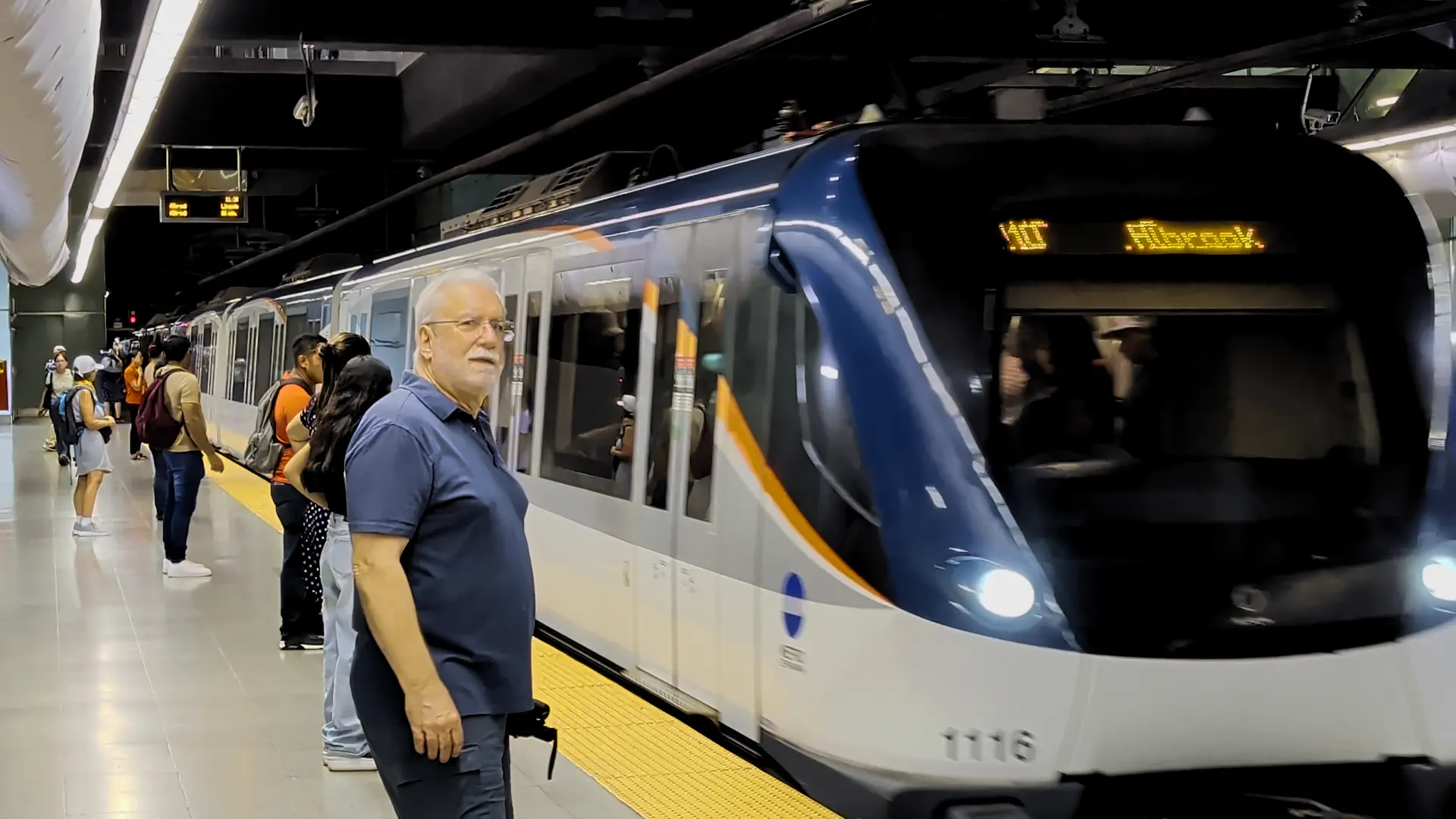
We went in with reasonable expectations and left pleasantly surprised. The trains are modern Alstom Metropolis sets — five cars, air-conditioned throughout, clean. The stations are well-lit, spacious, and maintained. Signage is in Spanish, but the system is simple enough that language isn’t really a barrier: you follow the line color and direction arrows, and that’s essentially all you need to know.
Accessibility is solid. Escalators and elevators are widely available across stations, and the system was designed with mobility in mind. If you or your partner have any mobility considerations, this should not be a deterrent to using the Metro.
The underground stations in particular have a quality that some above-ground transit systems don’t — they stay cool and dry regardless of what Panama’s weather is doing outside, which in April meant a meaningful reprieve from the heat and occasional afternoon downpour. Walking out of Iglesia del Carmen station into Bella Vista at 2 PM in April heat is a different proposition than arriving cool from a two-minute train ride.
“Walking out of Iglesia del Carmen station into Bella Vista at 2 PM in April heat is a different proposition than arriving cool from a two-minute ride.”
Safety and Comfort for Gay Travelers
We rode the Metro without incident or discomfort. Public displays of affection on transit — in Panama generally — are best kept low-key regardless of who you’re with; this is less about any specific hostility and more about reading the room in a Catholic-majority, conservative-leaning country. Two men traveling together, talking, laughing, navigating their phones: unremarkable. Making out at Iglesia del Carmen station at rush hour: we’d say save it.
The Metro environment itself is neutral — crowded, purposeful, people getting where they’re going. We never felt watched, targeted, or uncomfortable. We did feel like we needed to practice saying Vía Argentina without immediately outing ourselves as tourists, but that’s a different problem.
The Stations Most Useful for Expats and Visitors
Not every station on the map will be relevant to you. Here’s how we’d orient a newcomer to the stations worth knowing:
Iglesia del Carmen — Your home base if you’re staying in or spending time in Bella Vista. The station puts you squarely in the Calle 50 banking and restaurant corridor. Named after the striking neo-Gothic church at street level, which you’ll recognize immediately from the exit.
Vía Argentina — El Cangrejo neighborhood, which has good restaurant density, several coffee shops, and a more walkable street grid than much of the city. If you’re staying in El Cangrejo, this is your stop.
5 de Mayo — The main central hub. Useful if you’re connecting to bus routes toward Casco Viejo or the waterfront areas. Busy and chaotic at the surface level, but the station itself is fine.
Albrook — The national bus terminal and Albrook Mall. If you’re taking an intercity bus to Boquete, Chitré, or anywhere outside Panama City, you’ll pass through here. The Mall is unremarkable but air-conditioned, which in April earns points just for existing.
San Miguelito — The transfer point between Lines 1 and 2. If you’re continuing east on Line 2, this is where you change trains. Follow the signs; it’s well-marked.
The Metro Card Also Works on MetroBus
Panama City’s public bus network, MetroBus, uses the same card as the Metro. This is a meaningful quality-of-life detail: one card handles both systems. MetroBus fares run roughly $0.25 to $0.75 depending on route and distance, and the buses cover areas the Metro doesn’t reach — including Casco Viejo, Miraflores Locks, and the Amador Causeway. If you’re planning to use public transit as a primary way of getting around, one funded Metro Card is all the hardware you need.
Tip — Getting to Casco Viejo
The Metro doesn’t serve Casco Viejo directly. The most common transit approach is to take Line 1 to 5 de Mayo station, then catch a MetroBus or taxi for the remaining distance. Uber also works well and is typically inexpensive from central stations to Casco. We used Uber for Casco trips and found it reliably priced at $3–$6.
The Quick Reference: Everything in One Place
Panama City Metro — Fast Facts
One final note for context: the Metro carries roughly 420,000 passengers daily. Panama City has a metropolitan population of about two million. These are not vanity ridership numbers — people are actually using this thing. In a city that otherwise runs on cars, taxis, and rideshare, that’s meaningful. It’s built into the fabric of how the city moves, and if you’re moving to Panama City, it should probably be built into yours.
Getting Around Panama City
- 01 The Panama City Metro: What You Need to Know Before You Ride
Brian & Kent
We’re a gay couple relocating from St. Petersburg, Florida to Panama City in real time. Brian is applying for the Pensionado visa; Kent handles primary research and field observation. Everything on this site comes from what we’ve actually done, paid, and experienced — including multiple Metro rides and at least one wrong station exit in April heat.