The Master Guide — Start Here
The 2026 LGBTQ+ Panama Move Checklist
Thirteen steps, in the order that actually works — visas, money, healthcare, housing, and the specific places this process splits for gay and lesbian couples.
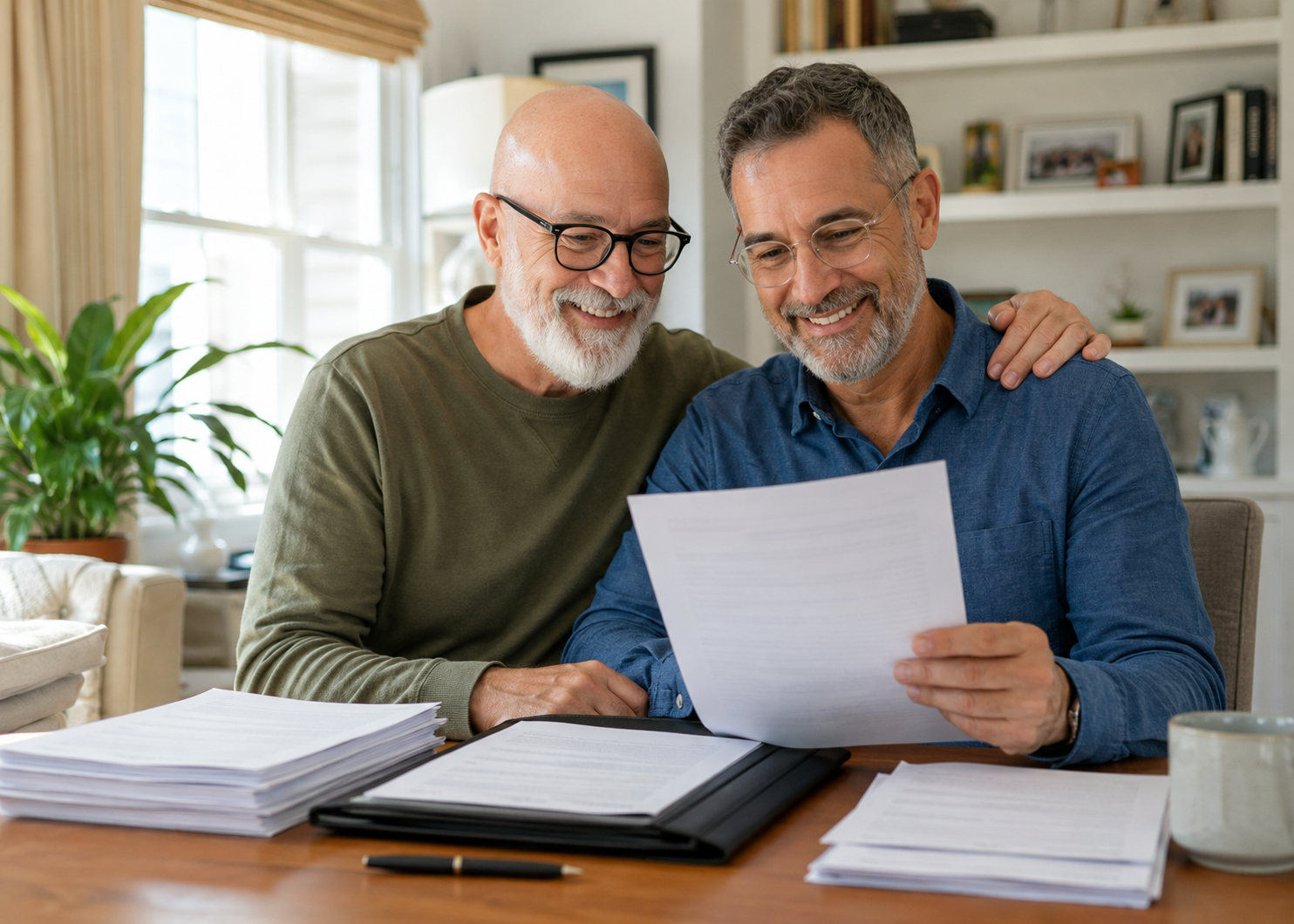
 Brian & Kent · GayExpatsPanama.com · Updated September 2026
Updated September 2026 — the Qualified Investor Visa changed
Panama issued Executive Decree No. 17, effective September 16, 2026. It keeps the Qualified Investor Visa’s $300,000 real estate minimum for new and pre-construction property but raises it to $500,000 for resale property. It also requires the qualifying investment to come from the applicant’s own traceable funds. When we first published this checklist, our attorney had confirmed that $300,000 was fixed under the law then in force. Decree 17 replaced that law. We’ve updated Step 1, Step 9 and Step 13 to reflect the change. The Friendly Nations Visa is unaffected and still starts at $200,000.
Most relocation checklists are a list of nouns: visa, bank account, apartment, health insurance. They tell you what you need without telling you what order to get it in, or why the order matters. This one is different. Every step below exists because we either did it in the wrong order ourselves, watched someone else do it in the wrong order, or had our attorney specifically warn us about the sequencing. The order is the actual value here — not the items.
One thing before we start: this checklist assumes you’re a same-sex couple, because that’s who we are and who we’re writing for. Panama does not recognize same-sex marriage — not for immigration purposes, and not for inheritance, medical decisions, or property rights either. Every visa step below that says “your spouse” for a straight couple means “you, independently, with your own qualifying income” for us, and every assumption a straight couple can make about being automatically covered for each other is something we have to ask our attorney to document explicitly. We’ll flag exactly where that split happens and what it costs you in practice — not in the abstract, in actual dollars and actual paperwork.
How to Use This Guide
Each step links to the long-form article on the topic — this page is the map, not the territory. Read the whole thing once before you do anything, because step 11 changes how you should approach step 3. Then come back to each step’s linked guide when you’re actually ready to execute it.
The one rule that matters most
Don’t buy property, sign a lease longer than six months, or commit to a school, neighborhood, or business before you’ve spent real time in Panama outside of a vacation. Everything else on this list can be reordered a little. This one can’t be undone cheaply.
Step 1 — Decide Which Visa Path You’re Actually On
This is the step that determines almost everything downstream — your timeline, your bank account requirements, your tax exposure, even where you should look for housing. Get this wrong and you’ll redo paperwork later.
For most retirees, the answer is the Pensionado visa: permanent residency for anyone receiving a lifetime pension of at least $1,000/month (U.S. Social Security qualifies), or $750/month if you also own Panamanian real estate worth $100,000 or more. Add $250/month per dependent. There’s no minimum age. Processing typically runs 3–6 months through a licensed Panamanian attorney, and by law you cannot self-file — Decree Law No. 3 of 2008, Article 28, requires attorney representation.
If you’re still working and don’t have qualifying pension income yet, there are two routes worth comparing. The Qualified Investor Visa grants permanent residency immediately in exchange for a qualifying investment, most commonly real estate. Since September 16, 2026, the minimum depends on what you buy: $300,000 for a new property bought from the developer or a pre-construction purchase, and $500,000 for a resale property, meaning anything previously occupied, rented or sold. Securities and state-bank deposits qualify at $500,000, and private-bank deposits at $750,000. When we first wrote this checklist, our attorney confirmed that $300,000 was fixed under the decree then in force. Executive Decree 17 replaced that decree and raised the resale minimum. The lesson we’d take from it: these thresholds are set by executive decree and can change without advance notice, so confirm the current number with your attorney in writing before you sign anything.
The lower-cost alternative is the Friendly Nations Visa, available to citizens of the U.S. and roughly fifty other countries with strong ties to Panama. It requires a $200,000 minimum — in real estate, in a three-year fixed-term bank deposit, or through a qualifying employment contract with a Panamanian company. It starts as a two-year provisional residency before converting to permanent, where the Qualified Investor route grants permanent residency from day one. For a lot of people who don’t need permanent status immediately, Friendly Nations is the more sensible starting point. It keeps $100,000 in your pocket compared with a new-construction Qualified Investor purchase, $300,000 compared with a resale one, and it costs far less in government fees. Decree 17 didn’t change Friendly Nations.
Where this splits for same-sex couples
Panama does not recognize same-sex marriage for immigration purposes. A straight married couple can file one spouse as the primary applicant and the other as a dependent. We can’t. Each of us has to independently qualify and independently file — meaning if we were both going the Pensionado route, we’d each need our own $1,000/month in qualifying pension income, not a combined household total.
In our case, this is why our paths diverge: Brian qualified for Pensionado on his own Social Security income, and his residency was approved in July 2026. Kent doesn’t have pension income yet, so Kent has been planning on the Qualified Investor Visa, roughly five years out — after selling our home in the U.S. and buying property in Panama. The qualifying amount would be held with Kent as the sole beneficial owner: $300,000 if we buy new construction, $500,000 if we buy resale. Brian would be added to the title only for value above that threshold. Decree 17 has reopened the question for us. If the home we buy is a resale property under $500,000, the Friendly Nations Visa becomes Kent’s more likely route.
Read the full guide
We’ve written a full step-by-step Pensionado series covering the medical certificate, the SSA pension letter, the apostille process, the FBI background check, the immigration appointment day, and how to choose an attorney. Start with our guide to finding and vetting a Pensionado attorney — it’s the actual first move, before any document collection.
Step 2 — Talk to an Attorney Before You Collect a Single Document
This sounds backwards. Most people start gathering paperwork and call an attorney once they have a folder. Don’t. The first attorney conversation tells you exactly which documents you need for your specific situation — your nationality, your income source, whether you have dependents — and saves you from apostilling something you didn’t need or formatting a pension letter incorrectly the first time.
Our first meeting with Carolina Tejada Vaprio at Morgan & Morgan was a video call, not an in-person meeting, and that was enough to map the entire process. You don’t need to be in Panama to start this.
Don’t self-file. It’s not optional.
We mention this more than once in this guide because people genuinely don’t believe it. Panamanian law requires a licensed attorney to file your residency application. This isn’t an upsell from law firms — it’s the statute. Budget for it from day one rather than treating it as a fee you might be able to avoid.
The Legal Documents This First Conversation Should Also Cover
Visa filing isn’t the only thing this attorney conversation needs to settle. Because Panama doesn’t recognize same-sex marriage, your U.S. marriage certificate doesn’t automatically give either of you the protections a straight married couple gets by default — medical decision-making, inheritance, or property rights if one of you dies or becomes incapacitated. Raise this in the same first meeting, not as a separate project for later.
Specifically, ask about:
- A Panamanian will — your U.S. will may not control Panama-based assets the way you’d assume
- A healthcare power of attorney recognized in Panama, so your partner can be the one a hospital actually listens to
- A durable financial power of attorney, separate from the healthcare one
- How property should be titled if you buy together, and what happens to that title if one of you dies or is incapacitated
- Whether any of these documents need to be translated into Spanish or notarized locally to actually be usable here
We did this in the same meeting where we mapped out our visa paths. It took maybe twenty extra minutes and it’s the difference between “we assumed we were covered” and actually being covered.
Step 3 — Get the Social Security Letter and FBI Background Check Moving in Parallel
If you’re going the Pensionado route on U.S. Social Security, the standard benefit verification letter is fine. Panama’s immigration system receives this exact letter, in this exact format, over and over — it’s accepted routinely. Your attorney already knows how to handle the language Social Security provides and how it maps to what Panama requires. This is not a problem, and it’s not worth losing sleep over.
Where the wording actually matters is if your qualifying income is a private pension rather than Social Security. Private pension letters do need to meet specific language requirements — confirming the income is permanent and paid for life — and generic benefit statements from a private plan administrator don’t always use that language by default. If this is your situation, ask your attorney up front exactly what the letter needs to say before you request it.
This is also the point to request your FBI background check, since it’s another document every applicant needs regardless of visa type, and it’s worth having in hand before you move on to apostilling anything in Step 4. Request it as soon as your attorney confirms you need it — the request itself is simple and can be done from the U.S. before you’ve finalized anything else, and having the raw background check ready means you’re not the bottleneck once it’s time to apostille.
Read the full guide
Our FBI background check and apostille guide covers exactly how to request the check itself, separate from the apostille process in Step 4.
Step 4 — Apostille Everything — It Has More Paths Than You Think
Apostilling documents feels like it should be the slow part. It often isn’t, if you know the options. There isn’t just one route through the Secretary of State — depending on your state and the document, there can be multiple valid pathways, and some are considerably faster than others. By the time you’re apostilling, your FBI background check from Step 3 should already be in hand as a PDF, which removes one of the longer waits from this stage entirely. Our full guide linked in Step 3 covers both the background check request and the apostille routes in detail, so we won’t repeat it here.
Step 5 — The Health Certificate Is Easy — Just Don’t Get It Too Early
This one sounds more complicated than it is. Most attorneys can simply direct you to a clinic or arrange the appointment for you — it’s a routine part of the process, not something you have to research or figure out on your own. Most people knock it out during the same trip when they fly to Panama to file their paperwork.
The only real thing to plan around: the certificate has to come from a Panamanian doctor, completed in Panama, within 90 days of filing. So if you’re doing an early scouting trip, don’t get it done then thinking you’re getting ahead — it’ll expire before the rest of your paperwork is ready. Just let your attorney schedule it for when you’re there to file.
Step 6 — Build Your Panama Bank Account Before You Need It
Panamanian banks have become notably more cautious about onboarding foreign account holders in recent years, and the process can take longer than people expect — sometimes weeks, with in-person visits required. Don’t wait until you’re mid-move to start this. Begin once your visa process is underway, since you’ll typically need at least a temporary residency document in hand before a bank will seriously consider you.
This is another one you don’t have to navigate alone — most attorneys can assist with the account-opening process or at least point you toward banks that are actively working with foreign clients. Ask your attorney directly whether they can help; many already have a working relationship with specific banks that makes this faster.
Read the full guide
Our Panama banking guide covers which banks were actually willing to work with us, what they asked for, and what we wish we’d brought to the first appointment.
Step 7 — Price Your Actual Cost of Living, Not the Internet’s Version
Every relocation blog has a cost-of-living number. Most of them are either outdated or describe a lifestyle that isn’t yours. Build your own number from categories that actually apply to how you live: housing in the specific neighborhood you’re considering, health insurance, the metro versus a car, groceries at the store you’d actually shop at. We did this with real receipts, not estimates.
A Few Real Numbers From Our Research Trip
Read the full guide
Our cost of living breakdown has the full category-by-category numbers, including housing ranges by neighborhood.
Step 8 — Sort Out Healthcare Before You Need It, Not During an Emergency
This is the step people most often defer, and it’s the one with the highest cost if you defer it badly. Panama has genuinely good private healthcare in Panama City, but “good healthcare exists” and “you personally have a plan for accessing it” are different facts. You need to understand health insurance options, what care actually costs by location, what an emergency looks like logistically, and — if relevant to you — how to access PrEP, PEP, and HIV care as an LGBTQ+ expat specifically, since this isn’t something every general relocation guide covers honestly.
Your spouse can’t be your only backup
If the only person who knows your medications, your doctors, your passwords, and where your documents live is your partner, your emergency plan has a single point of failure — and for a same-sex couple, that’s riskier than it sounds, since the legal protections that would normally let a spouse step in automatically aren’t guaranteed here. Pick at least one other person — a friend, a sibling, anyone — who also has access to that same information, in case you both end up needing help at the same time.
Read the full guide
We wrote an eight-part healthcare series covering insurance, care by location, emergency planning, assisted living, LGBTQ+-specific healthcare, and prescription medications. Start with our health insurance overview.
Step 9 — Learn the Property Market Before You Look at a Single Listing
Panama’s real estate market doesn’t work like the U.S. market, and the differences aren’t cosmetic. There’s no MLS, so price knowledge has to be built manually. There’s no title insurance, so legal due diligence carries more weight than it does at home. Real estate agents are typically paid by the seller, with no formal buyer’s-agent framework — meaning the person showing you the property may not be working for you, even if it feels that way. And “PH” in a listing means Propiedad Horizontal, the condo regime law — not “penthouse.”
The single most important distinction to understand before you buy anything: whether a property is titled (finca) or held under Rights of Possession (ROP). These are not the same thing with different paperwork — they’re fundamentally different categories of ownership with different risk profiles.
If you’re planning the Qualified Investor route
Know which threshold applies before you shortlist properties: since September 2026, it’s $300,000 for new or pre-construction property and $500,000 for resale. The qualifying amount has to come from the applicant’s own funds, and the applicant has to be its beneficial owner. If you’re a couple and only one of you is filing on this visa, the other partner can be added to the title only for value above that threshold — not as a co-owner of the qualifying amount itself.
That leaves the other partner without inheritance rights Panama will recognize. The fix we’re pursuing is holding the property through a Panamanian private interest foundation, with the applicant as beneficiary and the partner as successor beneficiary. Our attorney confirmed that structure is compatible with the visa under the previous decree, and we’re confirming it still applies under Decree 17. See our guide to using a foundation for survivorship and the investor visa. Get this structured correctly with your attorney before you sign anything, because unwinding an incorrect title structure later is far more expensive than getting it right at closing.
Read the full guide
Our deep-dive on buying property in Panama covers the full transaction process, closing costs, and a red-flags checklist for spotting bad deals before you’re committed.
Step 10 — Spend Two Weeks Logging How You Actually Live, Then Pick a Neighborhood
Don’t choose a neighborhood from a view or a vibe. Before you commit, track every time you leave your house for two weeks — where you went, how you got there, what was annoying about it. We made this exact mistake once before, in Spain, when we paid for a sweeping view in California and then spent two years discovering we’d never actually asked ourselves how we wanted to live day to day.
Panama-specific wrinkle: Google Maps will lie to you about walkability here. Rivers, ravines, and steep terrain create gaps between neighborhoods that look fine on a screen and are simply impassable on foot. Cul-de-sac developments often funnel onto busy arterial roads, turning a short walk into a long, circuitous, unpleasant one. Walk the actual route before you trust the map.
Read the full guide
Our neighborhood selection guide has the full two-week framework and a ten-point checklist covering noise, safety, transit, and rainy-season flooding risk.
Step 11 — Know the Gay Scene Before You Arrive, Not After
This isn’t a nightlife footnote — it’s part of evaluating whether a city will actually feel livable to you. Panama City has a real, specific gay scene: BLG (Bar Los Gatos) in Bella Vista is the iconic gay bar; XS Club is the largest gay nightclub; Maluka Panama runs drag shows; El Sotano and El Apartamento are sister gay-friendly venues, also in Bella Vista; and HamMan Sauna & Spa in Bella Vista is the only gay sauna in the city. Knowing these exist, and where, tells you something concrete about whether a given neighborhood puts you near community or isolates you from it.
Read the full guide
Our LGBTQ+ life and nightlife guide covers each venue honestly, plus what app culture and visibility actually look like here by neighborhood.
Step 12 — Learn the Metro Before You Need It on Moving Day
You will use the Metro. It’s clean, frequent, and absurdly cheap at $0.35 a ride ($0.24 with your Pensionado discount). But there are specific, learnable quirks: the airport branch requires an outdoor walk and does not connect directly into the terminal — turn right exiting Terminal 2, turn left exiting Terminal 1. Bags have to be lifted over the turnstiles both entering and exiting; station attendants are not reliably available to help. Know this before you’re standing there with luggage at 11pm.
Read the full guide
Our Panama City Metro guide covers both current lines, fares, the airport connection in detail, and what’s coming with the Line 3 monorail.
Step 13 — If You’re Buying to Remodel, Learn Panamanian Construction Before You Hire Anyone
If your plan includes buying an older property and renovating it, do this research before you fall in love with a fixer-upper. Construction methods here are genuinely different from U.S. construction — concrete-wall wiring and plumbing work differently, materials have different names and availability, and contractor licensing and payment customs don’t map onto American expectations. Walking in without this knowledge is how budgets and timelines blow up.
One visa consequence to know: a fixer-upper is always a resale property. If you’re counting on the Qualified Investor Visa, an older home now has to cost at least $500,000 to qualify, and we haven’t seen anything indicating renovation spending counts toward that amount. For a buy-to-remodel plan under $500,000, Friendly Nations at $200,000 is the more realistic visa route.
Read the full guide
We wrote a complete nine-part series on this, starting with Panama Construction 101 and ending with the attorney-review step for renovation contracts.
The Order, At a Glance
| Step | What | Why this order |
|---|---|---|
| 1 | Choose your visa path | Determines your timeline, bank requirements, and whether you need a property purchase at all |
| 2 | Talk to an attorney — visa path and legal documents | Before, not after, you collect documents — and the same conversation should cover wills and powers of attorney, not just visas |
| 3 | Get your pension letter and FBI background check moving | Social Security letters are routine and accepted — private pensions need wording checked first, and the FBI check should start now so it’s ready before Step 4 |
| 4 | Start the apostille process | More paths exist than people assume; starting early absorbs any slow path |
| 5 | Get your health certificate | Easy and routine — but has a 90-day expiration, so time it for your filing trip, not a scouting trip |
| 6 | Open a Panama bank account | Takes time and often needs residency paperwork in progress first — ask your attorney to help |
| 7 | Price your real cost of living | Informs every housing and lifestyle decision after this point |
| 8 | Sort out healthcare and a backup emergency contact | Needs to be settled before an emergency forces the decision for you — and your partner can’t be your only point of contact |
| 9 | Learn the property market | No MLS, no title insurance — you need this knowledge before you see one listing |
| 10 | Choose a neighborhood | Comes after cost-of-living and market knowledge are in place |
| 11 | Know the gay scene | Feeds directly into neighborhood choice, not a separate decision |
| 12 | Learn the Metro | You’ll need it immediately on arrival, including with luggage |
| 13 | Learn construction basics | Only relevant if buying to remodel — but essential before you hire anyone if so |
“The research is current because we’re going through it now — every price, every form, every attorney conversation on this list happened this year.”
What This Checklist Doesn’t Cover
We’re not going to pretend this is exhaustive. It doesn’t cover pet relocation, household goods shipping, or what to do with a U.S. home you’re not ready to sell yet — those are real questions we either haven’t fully solved ourselves or haven’t researched deeply enough to write about honestly. When we have, we’ll add them here. Until then, we’d rather tell you what we don’t know than pad this list with generic advice to make it look more complete than it is.
Sources & Verification
- Official: Pensionado visa income requirements and the attorney-filing requirement — Decree Law No. 3 of 2008, Article 28.
- Reported: Icaza, González-Ruiz & Alemán, “Nuevo Decreto de Residencia por Inversionista Calificado en Panamá,” September 2026 — Executive Decree No. 17, effective September 16, 2026: Qualified Investor minimums of $300,000 (new and pre-construction real estate), $500,000 (resale real estate, securities, state-bank deposits) and $750,000 (private-bank deposits); own-funds requirement.
- Reported: IMI Daily, “Panama raises investor visa property minimum to US$500,000 with a US$300,000 carve-out,” September 2026 — definitions of first-sale and resale property.
- Attorney-confirmed: Carolina Tejada Vaprio, Morgan & Morgan, 2026 — the Qualified Investor Visa’s $300,000 minimum was fixed under the decree then in force; a private interest foundation giving the non-applicant partner succession rights is compatible with the visa. Retained as history: Decree 17 later raised the resale minimum to $500,000.
- Firsthand: Brian and Kent’s own visa-path decisions (Pensionado for Brian, approved July 2026; Kent weighing the Qualified Investor and Friendly Nations routes), their attorney relationship, and the sample cost-of-living figures collected during their April 2026 research trip.
- Not yet verified: We have not reviewed the full text of Decree 17 with our attorney, including whether it keeps the previous decree’s option to hold qualifying property through a foundation or corporation. We’ll update Step 9 once confirmed.
Facts and prices in this article last verified: September 2026 (visa thresholds); April 2026 (prices).
Related Reading
- 01 Finding Your Panama Attorney: The Right Firm Changes Everything (2026 Guide)
- 02 Panama Investor Visa: $500K Resale Minimum Explained (2026)
- 03 Panama’s Friendly Nations Visa: A Gay Couple’s Real Guide
- 04 Banking in Panama for American Expats: What’s Really Hard, What’s a Myth, and How to Get It Right (2026)
- 05 Health Insurance & Costs in Panama: An Honest Guide for U.S. Expats
- 06 Buying Property in Panama: No Title Insurance, No MLS, No Buyer’s Agent — What You Need to Know
- 07 Before You Fall in Love With a View, Know How You Live: Choosing the Right Neighborhood for Your Panama Move
Brian & Kent
We’re a gay couple relocating from St. Petersburg, Florida to Panama City in real time. Brian’s Pensionado residency was approved in July 2026; Kent handles the bulk of our research, including the property and visa planning behind this guide, and is weighing the Qualified Investor and Friendly Nations routes for his own residency. We previously lived in Spain, where we built and ran a bar from the ground up — so we’ve made most of these mistakes once before, just in a different country.