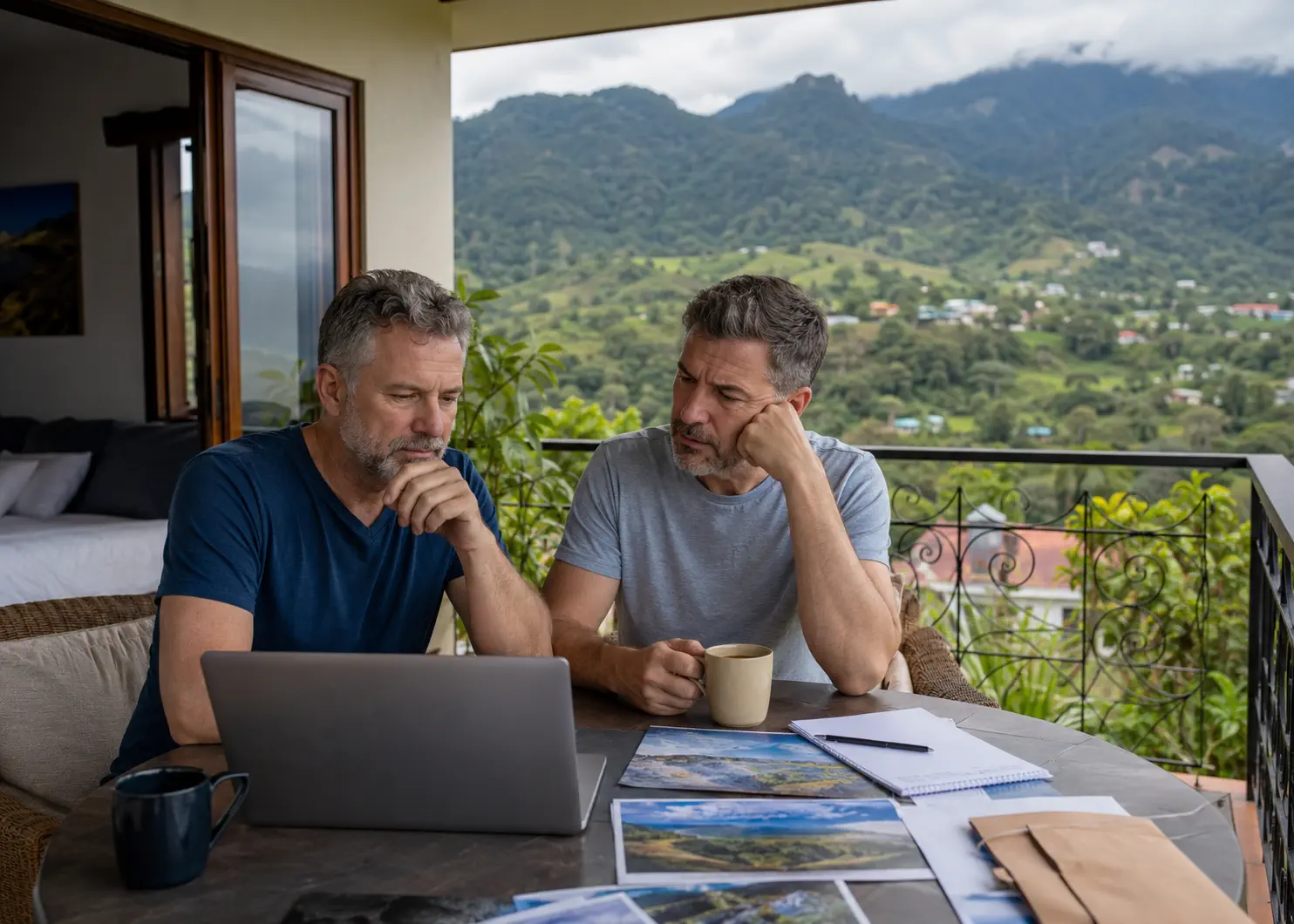
Choosing Where to Live — Panama City vs. Boquete
Panama City vs. Boquete for Gay Couples: Why We Picked the City
Boquete shows up on every “best places to retire in Panama” list. Here’s why two gay men crossed it off ours — and what we want other gay expats to know before they fall for the mountain town.
 Brian & Kent · GayExpatsPanama.com · Updated July 2026
Every general relocation guide to Panama eventually points you toward Boquete. Cooler mountain air, a huge expat population, coffee farms, a slower pace. For straight retirees, that pitch holds up fine. For us, it didn’t — and the reason has nothing to do with coffee.
Gay Life in Panama Series
What it's actually like to be a gay man moving to and living in Panama — the legal reality, the safety picture, the culture, and how to actually meet people.
- LGBTQ Life in Panama
- Is Panama Gay Friendly? The Honest Answer
- Is Panama Safe for Gay Men? Crime Data + Our Honest Take
- Panama City vs. Boquete for Gay Couples: Why We Picked the City You are here
- Should Gay Couples Move to Panama? An Honest Answer
- Will I Be Lonely in Panama?
- Grindr, Scruff, and Meeting Guys in Panama City
We get asked some version of “what about Boquete?” constantly, usually from people who’ve read three retirement blogs and seen the photos of the volcano. We’re not going to pretend Boquete is some kind of secret hostile zone — it isn’t, and plenty of gay people live there without incident. But we did our research, we read what other gay expats considering Boquete have written and asked online, and we made a deliberate choice to settle in Panama City instead. We think other gay people weighing the same decision deserve to know why.
The Boquete Pitch, and Where It Comes From
Boquete is a mountain town in Chiriquí province, a few hours west of Panama City. It’s cooler — genuinely spring-like, which after a Florida summer sounds like a small miracle — and it has one of the largest concentrations of foreign retirees anywhere in Panama. Estimates on exactly how large vary by source, since there’s no official census breakdown, but the number that comes up again and again, from longtime residents and expat-info sites alike, is around 20 percent of the town’s roughly 25,000 people. Some estimates run as low as 15 percent, some as high as a quarter. However you slice it, it’s a lot of Americans and Canadians for a small town.
That concentration is exactly what makes Boquete so easy to recommend in a general retirement guide. You don’t need much Spanish. You’ll have neighbors from Ohio. There’s a Tuesday expat market. None of that is a knock on the town — it’s a real, legitimate draw, and we understand why so many retirees land there.
What We Actually Found When We Looked Closer
Once you look past the coffee tours and the waterfall hikes, the gay-specific picture in Boquete is thinner than the general pitch suggests. There’s no gay bar. There’s no equivalent of a Bella Vista or an El Cangrejo — a neighborhood where you can reasonably expect to walk into a room and know, without asking, that you’re among your own community. What does exist is smaller and more private: word-of-mouth friend groups, a handful of gay-owned businesses, occasional informal meetups. Some longtime gay Boquete residents describe it as quietly workable — we don’t doubt that. But “quietly workable if you already know people” is a very different proposition than what Panama City offers, and it’s not the version most retirement blogs describe when they wave at Boquete in passing.
For context
Even Panama City, the most gay-friendly part of the country, doesn’t have a flourishing scene by the standards of a U.S. or European city — no neighborhood compares to a Wilton Manors or a Chelsea. What it does have is several real venues, an annual Pride with thousands of attendees, and two neighborhoods — Bella Vista and El Cangrejo — where you can find your people without having to already know someone. Boquete has none of that infrastructure. That’s the actual comparison, not “safe town vs. unsafe town.”
The Part That’s Harder to Source — and Why We’re Saying It Anyway
Here’s where we want to be careful, because this is the part that’s based on what we’ve personally seen rather than something we can hand you a citation for. In Boquete-focused expat Facebook groups and forums, we’ve repeatedly come across comment threads that go well past “we’re more conservative here” into territory that felt genuinely hostile — gun-rights posturing, dismissive or mocking comments about LGBTQ+ people, the kind of homeschool-and-“traditional values” rhetoric that, in our experience, often travels together with open hostility toward gay couples. We’re not going to pretend we did a scientific study of Boquete’s Facebook groups and we’re not going to claim some fixed percentage of the town feels this way. We can tell you what we saw, repeatedly, in spaces where Boquete’s expat community talks to itself when it thinks outsiders aren’t reading.
If that sounds familiar, it should. We’ve avoided towns in our own backyard for exactly this reason. Plenty of small, rural towns across Florida and the broader South have a visible, vocal contingent that’s loudly into gun rights, homeschooling as a culture-war stance, and open hostility toward anyone who doesn’t share their politics — and who are far more comfortable saying so in a public Facebook group than most people are in person. Lots of gay people, including us, simply route around those towns when deciding where to live in our own state. Not because every resident there shares those views — most probably don’t, and plenty would be perfectly kind to us in person — but because you don’t get to vet your literal next-door neighbor before you sign a lease, and a town where that rhetoric is loud and unchallenged online is a town where you’re rolling dice on who’s actually around you. We apply that same instinct to Panama. Boquete didn’t fail some objective safety test. It failed our test, the same one we’ve used for years, and we think it’s worth naming honestly instead of hiding behind a vague “it’s just not the right fit for us.”
And honestly, that instinct is a big part of why we’re leaving the U.S. at all. We’re not going to pretend our move is just about weather and cost of living. A real, and we suspect growing, share of gay Americans looking at relocation right now are doing it because of where the country’s politics have gone — the immigrant-bashing, the anti-gay rhetoric, the gun-rights absolutism, the open belligerence toward anyone who doesn’t fall in line, all of it amplified hard under Trump-era MAGA politics. We’d rather not trade one version of that for a smaller, mountain-town version of the same thing.
To be fair to Boquete
Gay people do live in Boquete, including some who describe forming their own small community group there and finding it workable. Panama’s culture, broadly, leans toward live-and-let-live rather than confrontation — Panamanians themselves are generally not the source of the friction we’re describing. This is not a blanket statement that Boquete is unsafe or that everyone there holds these views. It’s our honest account of a pattern we encountered, and our own choice based on it. You’re capable of weighing that for yourself.
What Panama City Gives Us Instead
Panama City isn’t a gay mecca. Nobody should move here expecting a Latin American version of South Beach. But it has actual, findable infrastructure: a real, if modest, cluster of gay venues — BLG, XS Club, Maluka, the El Sótano/El Apartamento pair, and the HamMan Sauna & Spa, the only gay sauna in the country — concentrated mostly in Bella Vista, with a second, more laid-back scene around El Cangrejo and Via Argentina. There’s an annual Pride parade every June that’s grown from a few hundred marchers in 2005 to a major event with serious civic participation. There are neighborhoods where holding hands in public doesn’t require a calculation first.
That matters more than it might sound like on paper. Visibility and density aren’t just about nightlife — they’re a rough proxy for “how many other people like us are nearby, and how normal is it considered for us to exist out loud.” Panama City has more of that than anywhere else in the country, including Boquete, and that’s the deciding factor for us.
The Legal Reality, Which Applies Everywhere in Panama Equally
One thing that doesn’t change whether you pick Panama City, Boquete, Coronado, or anywhere else: Panama does not recognize same-sex marriage, full stop. The Supreme Court ruled in March 2023 that marriage equality isn’t a constitutional right here, foreclosing the legal route entirely, and there’s no national law protecting LGBTQ+ people from discrimination based on sexual orientation or gender identity — an attempt to add those protections was blocked by the National Assembly in 2024. Same-sex couples can’t marry or jointly adopt anywhere in the country.
This is why we keep repeating, in nearly every immigration post we write, that Brian and I each have to file our own visa applications independently and separately meet our own income thresholds — Panama doesn’t treat us as a married unit for any of it, no matter how legally married we are in Florida. A straight couple moving here gets to lean on each other’s paperwork. We don’t. That’s a city-vs-Boquete-irrelevant fact — it’s a Panama fact, and it’s the single biggest practical way our experience here will differ from a straight couple’s, wherever in the country we end up.
Don’t skip the attorney conversation
Whether you land in Panama City or anywhere else, get a Panama-licensed immigration attorney before you assume anything about how your relationship will be treated on paper — property title, visa filings, medical decision-making, inheritance. We work with Carolina Tejada Vaprio at Morgan & Morgan, and she has been direct with us, every time, about exactly where the same-sex gap shows up and where it doesn’t.
So, Should You Rule Out Boquete?
That’s genuinely your call, not ours to make for you. If you already have friends there, if you’ve visited and felt fine, if a sauna and a nightlife scene aren’t things you’re going to miss — Boquete might be exactly right for you. Some gay men are more comfortable in a quieter, lower-visibility setup, and others are simply less bothered by overhearing political chatter they disagree with. We’re not telling you Boquete is off-limits. We’re telling you what we found, why it ruled the town out for us specifically, and asking you to go in with your eyes open rather than relying on a generic “best places to retire” list that’s never going to mention any of this, because it’s not written by or for gay people.
For us, the calculation was simple: we wanted to live somewhere we wouldn’t have to think about it. Panama City, imperfect as it is, gets us closer to that than Boquete does.
Sources & Verification
- Firsthand: Our own visits to Panama City’s gay venues — BLG, XS Club, Maluka, El Sótano/El Apartamento, and HamMan Sauna & Spa — during our April 2026 research trip, and our own decision-making process weighing Panama City against Boquete.
- Community: Recurring rhetoric we observed in Boquete-focused expat Facebook groups and forums — gun-rights posturing, dismissive comments about LGBTQ+ people, “traditional values” framing — presented as a pattern we witnessed repeatedly, not a measured statistic.
- Reported: Estimates of Boquete’s expat population (roughly 15–25% of ~25,000 residents) from longtime-resident accounts and expat-information sites; the growth of Panama City’s Pride parade from a few hundred marchers in 2005 to a major annual event.
- Reported: Panama’s Supreme Court ruling (decided February 2023, widely reported that March) that marriage equality is not a constitutional right, and the National Assembly’s 2024 rejection of a bill adding sexual-orientation and gender-identity protections to anti-discrimination law.
- Attorney-confirmed: That Panama does not treat same-sex couples as a unit for visa purposes — each partner files independently and meets income thresholds independently — confirmed by Carolina Tejada Vaprio, Morgan & Morgan.
Facts in this article last verified: July 2026.
Gay Life in Panama Series
- 01 LGBTQ Life in Panama
- 02 Is Panama Gay Friendly? The Honest Answer
- 03 Is Panama Safe for Gay Men? Crime Data + Our Honest Take
- 04 Panama City vs. Boquete for Gay Couples: Why We Picked the City
- 05 Should Gay Couples Move to Panama? An Honest Answer
- 06 Will I Be Lonely in Panama?
- 07 Grindr, Scruff, and Meeting Guys in Panama City
Brian & Kent
Brian and Kent are relocating from St. Petersburg, Florida to Panama City. Brian is applying for a Pensionado visa; Kent is researching the Qualified Investor route and handles most of the on-the-ground digging for this site. They write GayExpatsPanama.com as the unvarnished version of this move — real prices, real mistakes, and the parts other relocation blogs leave out.