Daily Life in Panama
Help Us Test the Emergency Wallet App for Expats
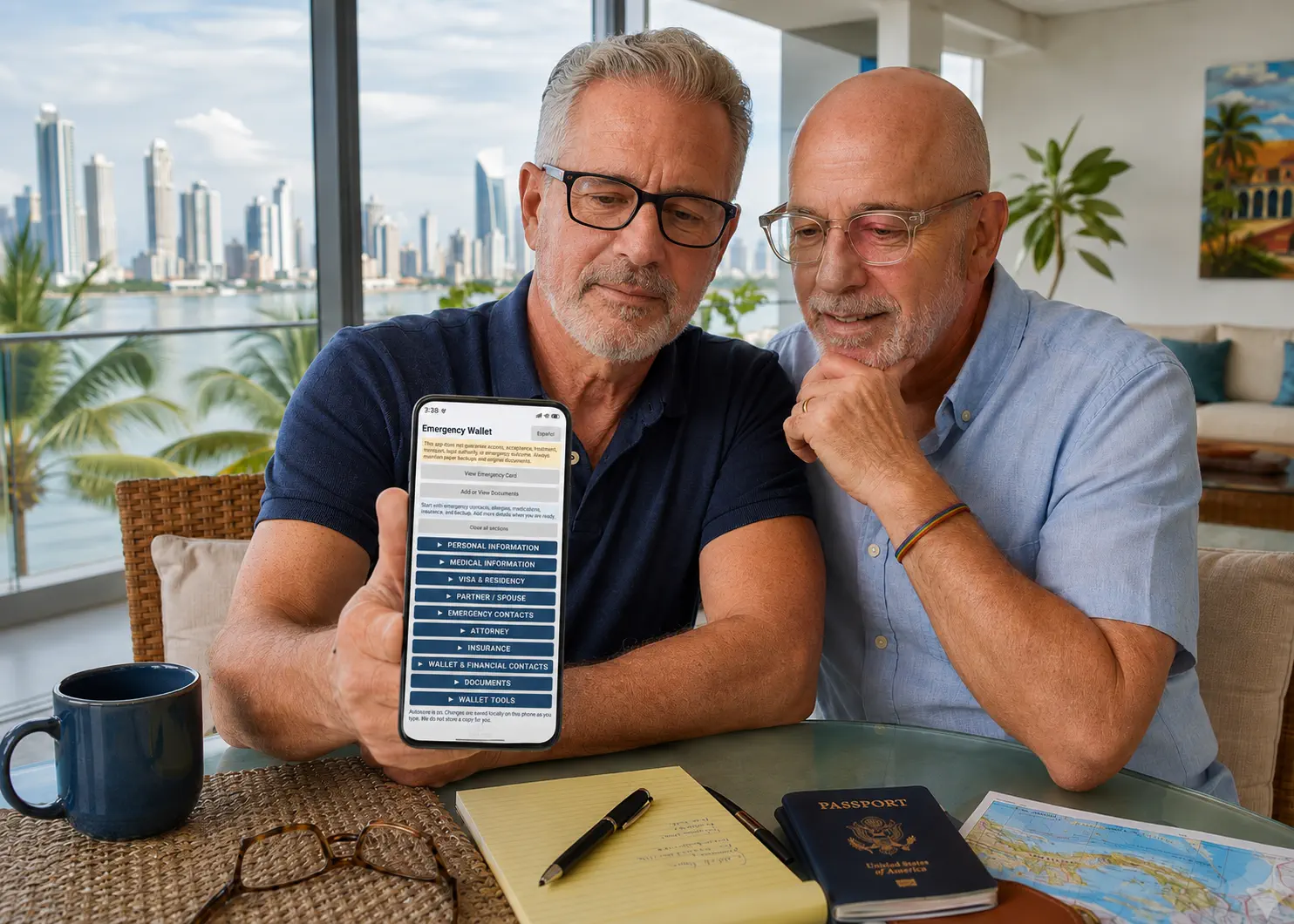
I built an app to keep emergency, medical, legal and insurance information in one place for people living abroad — and I’m looking for a small group of Android testers.
 Brian & Kent · GayExpatsPanama.com · Updated September 2026
If you live abroad, spend part of the year outside your home country, or travel frequently, there’s a practical question worth asking: if something happened to you tomorrow, could someone quickly find the information they’d need to help you? That question is what led me to create the Emergency Wallet app.
Why I Built This
I originally started building Emergency Wallet because I wanted a better way to keep important emergency information organized on my phone. As Kent and I spend more time planning for life in Panama, I kept thinking about how complicated an emergency can become when you’re outside your home country.
Your doctor may be in one country. Your insurance may be based in another. Your attorney may be somewhere else entirely. You may have local emergency contacts, family back home, passports, residency documents, prescriptions, insurance policies, and other information scattered across different apps, files, and pieces of paper. In an emergency, that’s exactly when you don’t want to be searching for everything. So I built an app to organize it — and now I’m looking for a group of Android users who would genuinely have a use for something like this to help me test it.
What Is the Emergency Wallet App?
Emergency Wallet is designed to keep the personal, medical, legal, and practical information you might need during an emergency in one organized place on your Android phone. It’s especially useful for people who:
- Live outside their home country
- Spend part of the year abroad
- Travel internationally
- Have homes or medical care in more than one country
- Are older and want emergency information readily available
- Manage information for a spouse or partner
- Have complex medical, insurance, or legal information
- Simply want to be better prepared
What This App Is Not
The idea isn’t to replace your doctor, attorney, insurer, or password manager. It’s to give you a single, organized emergency reference for when you need one.
What Information Can You Keep In It?
The app has grown considerably as I’ve been testing it and thinking through real-life situations.
Personal Information
Your basic identifying information can be kept together so it’s easy to locate during an emergency. You can also maintain multiple addresses, which is particularly useful if you have a home in the United States or Canada and another residence in Panama.
Your Spouse or Partner
You can store information about your spouse or partner and identify important relationship details that someone assisting you may need to know. That can be especially relevant for LGBTQ+ couples traveling or living internationally, where recognition of a marriage or partnership can vary by country.
Emergency Contacts
You can maintain the people who should be contacted if something happens to you. Rather than relying on someone figuring out which contact in your phone is the right person, you can clearly identify your emergency contacts.
Doctors and Medical Providers
You can store doctors, specialists, and other medical providers, including contact information, and identify which providers are particularly important. For someone with multiple physicians — or doctors in more than one country — that can make a significant difference.
Health and Medical Information
The app is intended to help organize information that may be useful when receiving emergency care. The goal is simple: make important information easier to find when you may not be in a position to explain everything yourself.
Insurance
Insurance can become surprisingly complicated when you live internationally. You may have Medicare in the United States, private insurance, travel coverage, international medical insurance, or policies issued in another country. Emergency Wallet lets you organize insurance by country, provider, and policy so you have a clearer picture of what coverage you have and whom to contact.
Attorneys and Other Important Professionals
For expats, an attorney may be almost as important an emergency contact as a physician. The app allows you to keep information about attorneys, law firms, and their areas of practice — your immigration attorney, estate-planning attorney, real-estate attorney, or another professional who may need to be contacted.
Important Documents
You can keep a record of important documents such as passports, residency documents, marriage certificates, and other records. One of the challenges of living abroad is simply remembering what documents exist, where they’re located, and when they expire. Emergency Wallet is designed to help with that.
Driver’s Licenses and Other Identification
Identification from more than one jurisdiction can also be organized in the app.
Expiration and Readiness Information
Some documents matter only occasionally — until suddenly they matter a great deal. Passports expire. Residency cards expire. Insurance changes. Emergency contacts move. Doctors retire. The app includes tools intended to help you keep your emergency information current rather than creating it once and forgetting about it.
How Your Data Is Protected — and Backed Up
Your Data Never Leaves Your Phone
Emergency Wallet has no server and no cloud account — we don’t store, see, or have access to anything you enter. The database on your phone is itself encrypted. If you want to protect a backup of real information, use Backup & Restore under Wallet Tools, where you can optionally set a password. Set that password carefully: because we have no access to the app or its data, there’s no way for us to reset or recover it if you lose it. The app lives entirely on your phone. We have access to nothing.
Because everything lives only on your device, we strongly encourage backing up. A backup kept only on your phone disappears with it — if the phone is lost, stolen, or destroyed, that backup goes too. To protect against that, Backup & Restore also lets you send an encrypted copy of your backup to an email address or by text message, so you have a copy that doesn’t depend on having that specific phone in hand. Whether it’s on your phone or sent by email or text, the backup file itself stays encrypted the whole way.
Why Not Just Keep Everything in Notes?
You certainly can. You could also keep everything in folders, spreadsheets, email messages, cloud storage, or paper files. The problem is that emergency information tends to become scattered: one document has your medications, another has your insurance, your attorney’s number is somewhere in your contacts, your passport information is in a photo, and your spouse knows some of it. That system works perfectly well right up until the moment someone needs the information quickly.
Emergency Wallet is designed specifically around one question: what information might someone need if I can’t easily provide it myself? That produces a very different kind of organization.
Why I Think This Matters for Expats
Living abroad adds layers to almost every emergency. Imagine you’re hospitalized in Panama. Someone may need to know who your spouse or emergency contact is, which doctor knows your medical history, what insurance coverage you have, whether there’s someone in the United States who should be contacted, which attorney handles your residency matters, and where your passport or residency information can be found.
None of those questions is particularly difficult. But answering five or six simple questions becomes much harder when the person who normally knows the answers is lying in a hospital bed. That’s the problem I’m trying to solve.
This App Is Being Built From Real-Life Experience
Emergency Wallet isn’t something I commissioned from a software company and then tried to figure out who might want it. I’ve been building and testing it around situations that Kent and I could realistically encounter ourselves. As I use it, I find things that need to be reorganized, simplified, or explained better — features have been added because I realized I would actually need them.
That’s also why outside testers matter. I know how I think. I need to see how you use it. You may immediately notice something that makes perfect sense to me but makes absolutely no sense to anyone else — that’s exactly the kind of feedback I want.
I’m Looking for Android Testers
The app has reached the point where it’s being distributed through Google Play’s internal testing system. I’m now looking for a limited number of readers who use Android phones and would be interested in helping test it. You don’t need to be technically sophisticated — in fact, I specifically want testers who aren’t software developers. I want people who might realistically use the app: retirees, expats, frequent travelers, couples, people with medical conditions they need to keep organized, and anyone who believes having their emergency information in one place would be useful.
As a thank-you, testers will get free access to and use of the final product.
What Would Testing Involve?
Mostly, I’d like you to use the app as you normally would: enter some information, move through the different sections, try creating contacts, doctors, insurance policies, and documents, and see whether the organization makes sense — then tell me when something doesn’t. I’m particularly interested in questions like:
- Was anything confusing?
- Was there information you wanted to enter but couldn’t?
- Were instructions clear?
- Did you have difficulty finding something?
- Was there a feature you expected that wasn’t there?
- Did something take too many steps?
- Did the app behave differently than you expected?
- Is there information an expat should be able to store that I’ve overlooked?
And, of course, I want to know if something simply doesn’t work.
While testing, you can enter fictional or sample information if you prefer — you don’t have to put sensitive personal information into the app simply to help test it. The objective is to determine whether the app works properly and whether the design makes sense to ordinary users.
Why I’m Asking Gay Expats Panama Readers First
Our readers are unusually well suited for this. Many of you already live overseas. Others are preparing to move. Many travel regularly between countries. You understand that international life can be wonderful while also adding a few administrative complications that people living their entire lives in one place rarely think about.
Our LGBTQ+ readers also understand another issue worth considering: when you’re traveling or living internationally, your spouse or partner may not always be treated exactly as you expect. Having clear emergency information available doesn’t solve every legal problem, but it can help remove ambiguity about whom you consider family and whom you want contacted.
This Is Still a Test Version
I want to emphasize that point. The app is working, and I’m using it myself, but it’s still under active development. There will be changes, there will probably be things I’ve overlooked, and there will almost certainly be features that testers suggest that I’ll wish I had thought of first. That’s the purpose of this stage — before making Emergency Wallet available more broadly, I want people with real-world reasons to use it to put it through its paces.
And if you find yourself saying, “Brian, why on earth did you design it this way?” — please tell me. That’s exactly why I’m asking you to test it.
Interested in Helping?
How to Join
If Emergency Wallet sounds like something you might personally use and you have an Android phone, I’d appreciate your help testing it. The number of testers will be limited during this stage because I want to be able to pay attention to the feedback we receive. Testers get free access to and use of the final product as a thank-you.
Sign Up to Test the App →I’ll send selected testers the information needed to join the Google Play testing program and install the app. There’s no obligation beyond giving it a try and telling me what you think.
And if you find yourself saying, “Brian, why on earth did you design it this way?” — please tell me. That’s exactly why I’m asking you to test it.
Sources & Verification
- Firsthand: Brian designed, built, and personally tested the Emergency Wallet app; as of September 2026 it is being distributed through Google Play’s internal testing program. Local device encryption, lack of server-side storage, and the encrypted email/SMS backup feature are as built and tested by Brian.
Facts and prices in this article last verified: September 2026.
Brian & Kent
Brian is a former attorney who moved to Panama on the Pensionado visa; Kent is a PharmD and the site’s primary researcher, planning to file for the Qualified Investor Visa once their Florida home sells. Brian built Emergency Wallet out of the same instinct that drives the rest of this site: solve the practical problem yourself, then share what you learned.