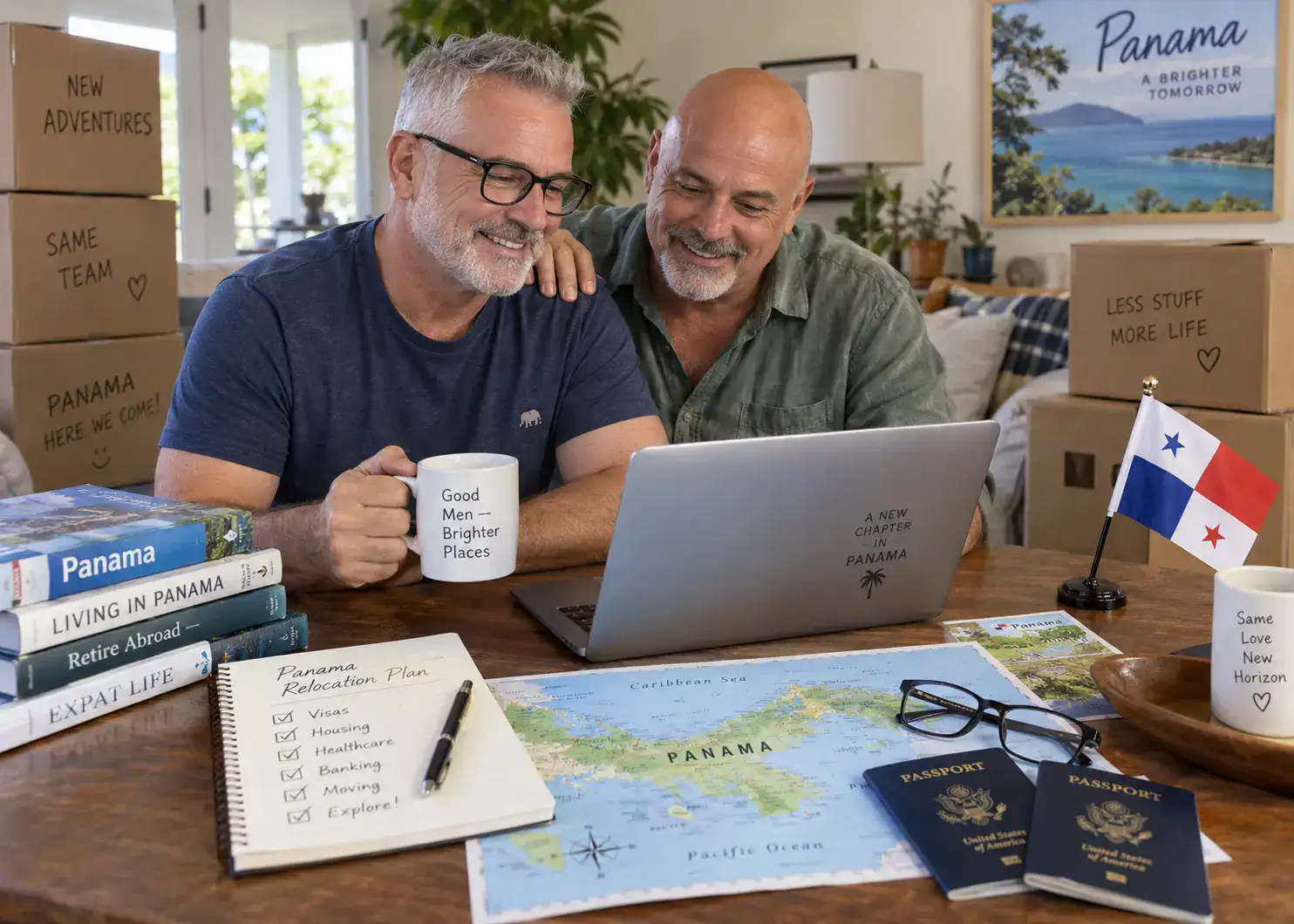
Moving & Relocation Planning
6 Months Before Moving to Panama: The Month-by-Month Checklist
The unglamorous administrative side of an international move, broken into a schedule you can actually follow.
 Brian & Kent · GayExpatsPanama.com · Updated September 2026
Moving to Panama is exciting. The six months before you move is more like running a small logistics company — immigration documents, bank accounts, prescriptions, mail, and roughly fifty online accounts that suddenly decide they need to text a verification code to the U.S. phone number you were planning to cancel.
This is the schedule we’re using for our own move, built around the two questions that trip up most people: how you’ll legally live here, and where your mail actually goes once you’re not standing at a mailbox at the end of a driveway.
Moving to Panama: The Logistics Series
The practical mechanics of getting your life from the U.S. to Panama: timing, selling, shipping, furnishing, mail, phones, and the first weeks on the ground. Written by two guys who have shipped a container overseas twice.
- 6 Months Before Moving to Panama: The Month-by-Month Checklist You are here
- Visa, Container, Lease, Flight: The Order Everything Has to Happen In Coming soon
- Should You Rent for a Year Before Buying in Panama? Coming soon
- Moving to Panama as a Gay Couple: Two Filings, Two Sets of Paperwork Coming soon
- Selling Your U.S. Home and Everything in It Coming soon
- Ship It or Sell It? What Moving Your Household to Panama Really Costs Coming soon
- Furnishing a Panama Apartment: What It Costs and Where to Shop Coming soon
- Your Car and Panama: Ship It, Sell It, or Buy There Coming soon
- Mail, Packages and Your U.S. Address After You Move Coming soon
- Your U.S. Phone Number, Two-Factor Codes and Your Digital Life Coming soon
- Bringing Pets to Panama Coming soon
- Landing in Panama: Your First Week and First Month Coming soon
6 Months Out: Confirm How You’ll Legally Live in Panama
Everything else on this list depends on this decision. If you intend to become a resident, this is the month to finalize your immigration strategy — Pensionado, Qualified Investor, Friendly Nations, or another category — with a licensed Panamanian immigration attorney, not a forum thread.
This Is Not a DIY Process
Panama law requires an attorney to file most residency applications, including the Pensionado visa (Decree Law No. 3 of 2008, Article 28). Self-filing isn’t a shortcut — it’s not legally available. Budget for an attorney from month one.
Ask your attorney specifically: which documents need to come from your home country, which need an apostille, how recently each must have been issued, whether you need an FBI background check or another police certificate, what documentation your income or investment source requires, whether translations need to be certified, and whether you need to be physically present in Panama for any part of the process.
If You’re a Same-Sex Couple
Panama’s Supreme Court ruled in March 2023 that same-sex marriages performed abroad are not recognized in Panama. That means the standard dependent-spouse provision isn’t available to you — each partner has to qualify and file independently. Don’t let an attorney unfamiliar with this rule assume your marriage will simplify anything.
Our Own Timeline, For Reference
That’s roughly three months from filing to approval in Brian’s case — but treat that as one data point, not a guarantee. Our attorney, Carolina Tejada Vaprio at Morgan & Morgan, confirmed the $300,000 Qualified Investor threshold was set permanently under the current law, with no sunset date attached — worth knowing if you’ve seen older articles warning of an imminent increase.
6 Months Out: Build a Master Document File
Keep this in two forms: a physical folder with originals and certified copies, and an encrypted digital folder with scans of everything. At minimum: passports, birth certificate, marriage certificate, divorce decrees if applicable, Social Security documentation, pension verification, criminal background checks, property deeds, bank and investment statements, recent tax returns, health insurance information, a medical summary, prescription list, vaccination records, wills and powers of attorney, driver’s licenses, vehicle titles, and pet vaccination records.
Scan both sides of anything card-shaped. Keep an encrypted cloud backup — don’t let the only digital copy live on the laptop that’s in your checked luggage.
6 Months Out: Decide What’s Coming — and Know the Duty Exemption
Walk through your house and sort everything into: take, sell, donate, give away, store, or throw away. International shipping can make cheap furniture expensive fast. Before you ship anything, ask: would I pay to ship this to Panama if I had to buy it again today? If the answer is no, don’t ship it.
Here’s the part most moving guides skip: Panama offers a real duty exemption on the household goods you do bring, and it’s worth understanding before you get quotes from movers.
Household Goods Duty Exemption (Menaje de Casa)
The exemption requires a licensed Panama customs broker to handle the filing — this isn’t something you process yourself at the port. Get quotes from international movers who can name their customs broker and confirm door-to-door pricing, who handles customs, whether port and destination charges are included, whether insurance is included, and what happens if customs inspects the shipment. Confirm the exemption’s exact terms with your immigration attorney or customs broker before you commit to a shipment — this is exactly the kind of rule that shifts without much notice.
5 Months Out: Money, Taxes, and Banking
Moving outside the United States doesn’t end a U.S. citizen’s federal tax filing obligations. Talk to a tax professional who understands Americans abroad — before you move, not the following April when you’re reconstructing what happened. Your situation may involve foreign bank-account reporting, foreign financial assets, Panama tax residency, retirement-account distributions, Social Security, Medicare, capital gains from selling a U.S. home, and state residency or domicile questions.
Make a spreadsheet of every financial institution you use: bank, account type, last four digits, login, phone number and email on file, mailing address, beneficiaries, international ATM fees, foreign transaction fees, and two-factor authentication method. Then contact each institution and confirm — don’t assume — that they’ll keep serving a customer who lives overseas. This matters most with brokerage and investment accounts.
Keep more than one bank and credit card. An international move is the wrong time to simplify down to a single debit card. Aim for two unrelated credit cards, at least two ways to access cash, a U.S. checking account, an emergency reserve, and online access you’ve actually tested before departure. Look for cards with no foreign transaction fee.
Audit Every Automatic Payment
Pull twelve months of statements and list every automatic or recurring charge you have — subscriptions, memberships, insurance premiums, automatic bill pay, anything on autopay. Decide deliberately what gets canceled, what gets transferred to a new card, and what genuinely needs to keep running. Don’t just let them keep firing on a card tied to a bank account you’re about to stop checking daily — that’s how people discover, four months in, that a gym membership or a “free trial” they forgot about has been quietly charging a soon-to-be-closed account, or worse, generating overdraft and late fees they don’t notice until a collections letter catches up with them in Panama.
5 Months Out: Review Your Healthcare Coverage
Don’t assume U.S. healthcare coverage works the same way in Panama. For Americans on Medicare specifically: Medicare generally doesn’t cover care received outside the United States except in limited circumstances. That doesn’t necessarily mean dropping it — it means understanding exactly what will and won’t be covered before you leave.
Investigate Panama private medical insurance, international health insurance, travel or evacuation coverage, self-paying for routine care, whether preexisting conditions are covered, and any age restrictions on new policies. Older expats should start early — insurance options tend to narrow with age.
Schedule anything you’ve been putting off: annual physical, dental, eye exam, hearing exam, dermatology, specialist follow-ups, vaccinations, prescription review. If your medical history is complicated, ask each physician for a concise written summary — diagnoses, major surgeries, allergies, current medications and doses, significant test results, implanted devices, relevant imaging, and contact information for treating physicians. You don’t need six hundred pages of chart notes; you need something a new doctor can actually use.
4 Months Out: Housing and the Mail-Forwarding Problem
For most people, renting for six months to a year before buying is one of the smartest decisions available. A neighborhood that felt perfect on a four-day vacation can feel completely different after three months of actually living there. Before signing a lease, check noise, traffic, walkability, flooding history, building maintenance, backup water storage, backup generator coverage, air conditioning, internet availability at that exact address, nearby grocery stores and hospitals, and pet restrictions. If you’re renting in a PH (Panama’s horizontal-property condominium system), ask for the building regulations before you sign.
Now the part that surprises almost every American: Panama has a government postal service, Correos Panamá (COTEL), but the country doesn’t run the same door-to-door residential mail system Americans are used to. Most expats route mail and packages through a private forwarding service that gives you a U.S. address — usually in Miami — and physically transports items to Panama for pickup or local delivery.
| Provider | Approx. Pricing | Notes |
|---|---|---|
| Mail Boxes Etc. (MBE) | ~$28/month for unlimited letters; first 2 kg of packages free, then ~$11/kg | Widest footprint — 20+ locations across Panama |
| Airbox Express | Premium ~$4.95/lb (2–3 days); Economy ~$2.50/lb (4–6 days) | Florida-based forwarding address |
| Priority Express | From ~$3.50/lb for 1–10 lb packages | Air and sea options for larger shipments |
Set your account up before you leave the U.S. so you can test it — mail something inexpensive through the system and confirm pricing by weight, dimensional-weight charges, customs charges, insurance, restricted items, pickup vs. delivery, and how long they’ll hold a package.
A Forwarding Address Is Not Your Legal Residence
Don’t confuse a shipping address with where you actually live. The Social Security Administration directs beneficiaries who move abroad to report their foreign residence even if benefits keep depositing into a U.S. bank account, and it restricts when someone living overseas can simply use a U.S. mailing address as though they still lived there. Use your forwarding address for packages — not to misrepresent your actual residence to a government agency.
Also decide whether shipping household goods should wait until you know your final address — a container arriving before you’ve signed a lease means storage fees while you sort out where it’s actually going.
3 Months Out: Start Disconnecting From Your U.S. Household
Pull twelve months of statements and list every recurring U.S. bill — electric, water, gas, internet, cable, mobile, alarm monitoring, landscaping, pest control, pool service, homeowners and auto insurance, storage, gym, streaming, software subscriptions, professional memberships, and anything on automatic delivery. Don’t cancel yet — just build the list so nothing gets forgotten later, and cross-check it against the automatic-payment audit from month five.
Think carefully before canceling your U.S. phone number outright. It’s likely tied to bank and brokerage two-factor authentication, the IRS, Social Security, credit cards, email recovery, and medical portals. Check whether your carrier offers an affordable way to keep the number active internationally before you decide to let it go — and verify with your financial institutions whether they’ll accept a ported internet-based number for authentication before you make that switch.
Set up a password manager if you don’t have one, and move important accounts off SMS-only verification toward authenticator apps, passkeys, or security keys wherever possible. Print or securely store backup recovery codes, and make sure your partner or a trusted person knows how to access critical accounts if you’re incapacitated.
Check your passport’s remaining validity and renew now if it’s approaching expiration — doing this in the U.S. is far easier than during your first months abroad while you’re simultaneously handling immigration paperwork.
2 Months Out: Start Building Your Panama Household
Panama’s electricity distributor depends on where you live — ENSA and Naturgy are the two major providers. Both currently allow foreign residents to establish service using a valid passport or immigration card, with renters typically also needing a lease and sometimes a security deposit or payment history. If you’re renting, find out whether the account stays in the landlord’s name or needs to be transferred to yours, and photograph the meter reading when you take possession.
Public water in many areas runs through IDAAN. Don’t just ask whether a house has city water — ask how reliable service actually is in that specific neighborhood, whether there’s a reserve tank, how large it is, and what happens during an outage. A beautiful house with no water reserve becomes considerably less beautiful during a dry-season cut.
Internet availability can vary by building, not just by neighborhood — Tigo and +Móvil are among the major residential providers. Ask the provider to confirm service for your exact address before signing a lease; “I think they have fiber here” is not confirmation.
Get a Panama SIM or eSIM sorted, and install WhatsApp before you arrive — it’s the default communication channel for deliveries, restaurants, doctors, contractors, and building security here. Many residences also use LPG cylinders rather than piped gas for cooking and hot water; ask who supplies it, who replaces the cylinder, and how you’ll know when it’s running low.
If you’ll eventually want a Panamanian driver’s license, foreign residents can pursue Sertracen’s homologation process once resident. It currently requires immigration identification, your passport, your physical foreign license, and verification of that license — put it on your post-arrival list rather than your pre-departure one.
6 Weeks Out: Change Addresses and Protect Your Mail
Update your address directly with banks, credit cards, brokerage firms, insurers, pension administrators, former employers, the IRS, Social Security, state tax authorities, professional licensing bodies, and doctors. The IRS provides Form 8822 for an individual change of address.
USPS Forwarding Has a Catch
If you’re permanently leaving the U.S., the USPS says an international change of address has to be submitted in person at a Post Office using PS Form 3575 before you leave — it isn’t eligible for the standard online change-of-address process. Even then, don’t rely on forwarding alone; update important senders individually, since government documents and replacement cards often don’t forward reliably.
1 Month Out: Medical, Pets, and Final Logistics
Refill prescriptions now, not in your last three days. Confirm with your physician and insurer how much medication you can obtain before departure, and carry a printed list with generic name, brand name, strength, dosage, and reason prescribed. Keep essential medications in their original containers and in your carry-on — never in checked luggage. Collect lab results, imaging reports, operative and pathology reports, and vaccination records, and ask whether you can get the actual imaging files, not just the radiology report.
If you’re bringing pets, this is the month timing actually matters. Panama’s Ministry of Agricultural Development (MIDA) requires health and vaccination documentation for dogs and cats with specific timing and authentication requirements, and Panama’s Ministry of Health (MINSA) runs a home-quarantine application that should be submitted at least three days before the animal’s arrival. Verify the current MIDA and MINSA requirements shortly before travel — this is one area where blog posts, including this one, go stale fast.
Have your first few days in Panama actually planned: where you’re sleeping, how you’re getting from the airport, who has the keys, and whether electricity, water, air conditioning, and internet will already be on.
Final Two Weeks: The U.S. Shutdown
Go back to the recurring-bill list from month three and start canceling or transferring: electric, water, gas, internet, cable, home security, landscaping, pest control, pool service, trash, gym, and local memberships. Schedule terminations for after you actually leave, not two days before — and save confirmation numbers and screenshots. Don’t assume an automatic debit has stopped until your statement shows it’s actually stopped; this is the same discipline as the automatic-payment audit, just at the finish line instead of the starting line.
If you’re selling a vehicle, complete the sale, transfer the title, remove plates if required, and cancel insurance only after the transaction closes. If you’re importing a vehicle to Panama instead, research that as its own project before shipping — import taxes, vehicle age limits, customs processing, and registration can change the math significantly. Panama’s Pensionado program also allows a one-time duty-free vehicle import for personal use, under Article 536 of the Fiscal Code — a separate benefit from the household-goods exemption above, worth asking your attorney about if it applies to you.
Your passports and immigration documents travel with you — not in checked luggage, not in the shipping container, not in a box marked “office.” Keep them in a carry-on document folder along with color scans of your passport identity page, immigration documents, driver’s license, and insurance cards. Don’t store unencrypted credit-card scans in an ordinary cloud folder.
Arrival Week and Your First Month
Get a Panama SIM working first — WhatsApp genuinely makes everything else easier. Confirm electricity, water, internet, gas, and air conditioning, and photograph the utility meters when you take possession. Test every air conditioner for whether it actually cools the room, not just whether it blows air — in Panama that distinction matters. Learn your building’s systems: how guests and deliveries get in, where garbage goes, pool rules, who handles repairs and emergencies, whether there’s generator backup, and what it actually powers.
Locate a primary-care physician, hospital, pharmacy, urgent care, and dentist before you need one, and save the locations in your phone. Keep following your attorney’s instructions precisely through the rest of your residency process — requirements and document validity periods change, so treat anything you read online, including this article, as a starting point rather than a final answer.
Once you’re unpacked, the first-month project becomes turning “new arrival” into “resident”: opening a Panama bank account, establishing permanent internet, moving utility accounts into your name where appropriate, getting private health insurance, establishing local doctors, and starting your Panama driver’s license process once you’re eligible. Start keeping digital copies of every Panama document from day one — you’ll thank yourself later.
The people who seem happiest living abroad aren’t the ones who planned every detail perfectly. They’re the ones who planned the important things well — and left enough flexibility to handle the rest.
The Complete Pre-Move Checklist
Here’s the refrigerator version — everything above, condensed.
Before You Fly
Sources & Verification
- Firsthand: Brian’s Pensionado visa filing date (April 17, 2026) and approval date (July 15, 2026).
- Official: Panama Supreme Court ruling (March 2023) on non-recognition of foreign same-sex marriages; Decree Law No. 3 of 2008, Article 28 (attorney requirement for residency filings); Cabinet Decree No. 41 of 2002, Article 216 (household goods duty exemption); Fiscal Code Article 536 (Pensionado vehicle import benefit).
- Official: U.S. Postal Service international change-of-address requirements (PS Form 3575); Internal Revenue Service Form 8822; Social Security Administration guidance on foreign residence reporting for beneficiaries abroad.
- Reported: ENSA and Naturgy residential service-establishment requirements; Tigo residential internet availability; Sertracen foreign driver’s-license homologation requirements; current published pricing from Mail Boxes Etc., Airbox Express, and Priority Express.
- Official: Panama Ministry of Agricultural Development (MIDA) pet import requirements; Panama Ministry of Health (MINSA) home-quarantine application procedure.
- Not yet verified: whether Panama’s 7% ITBM (VAT) applies on top of the household-goods duty exemption in every case — sources conflict; confirm with a licensed customs broker before shipping.
Facts and prices in this article last verified: September 2026.
Brian & Kent
We’re a gay couple relocating from St. Petersburg, Florida to Panama City in real time. Brian, a former attorney, holds approved Pensionado residency via Social Security. Kent is our primary researcher and is pursuing the Qualified Investor Visa once our Florida home sells.