Residency & Visas — Comparison
Which Panama Visa Should You Actually Choose? Qualified Investor vs. Friendly Nations vs. Pensionado
Not how each one works — which one makes sense for your household, your timeline, and your actual finances, with the gay-couple math nobody else runs
 Brian & Kent · GayExpatsPanama.com · Updated August 2026
Our last two articles explained how the Qualified Investor Visa and the Friendly Nations Visa actually work — the thresholds, the decrees, the marriage-recognition gap. This one assumes you’ve read those, or don’t need to, and asks a different question: given your actual finances, your actual timeline, and — if you’re part of a gay couple — the fact that Panama won’t treat you as one immigration unit, which program should you pick? That’s a household-economics question, not a statutory one, and it’s where most Panama visa content stops short.
Why This One Isn’t Just a Longer Comparison Table
Program explainers answer “how does this visa work?” This article tries to answer “which one should I pick?” — and those are genuinely different questions. Knowing that Qualified Investor requires $300,000 and Friendly Nations requires $200,000 tells you almost nothing about which is actually cheaper for your household, because the real cost isn’t the headline number. It’s what you were already planning to spend, how much waiting two years actually costs you, and — for a gay couple — whether you’re quietly paying for two residencies instead of one without realizing it going in.
One honesty note before we get into it: this article draws on the same kind of research as our other two — government decrees, immigration law firm publications, and expat community reporting — not on original interviews with multiple Panamanian attorneys or a survey of expats who’ve been through each program. Where the original brief for this piece asked for that kind of primary reporting, we’ve flagged it as something we don’t have yet rather than faking it. See the “What We Couldn’t Verify” section near the end.
The Real Question: What Are You Actually Buying?
Every Panama visa comparison leads with the investment minimum, and that number is close to meaningless on its own. Two people each looking at Qualified Investor’s $300,000 threshold can be in completely different financial positions:
Same Number, Different Decision
Person A was going to rent in Panama indefinitely and has no interest in owning property. For them, $300,000 is a new $300,000 outlay created entirely by the visa. Person B was already planning to buy a $450,000 home in Panama City. For them, the Qualified Investor threshold doesn’t cost anything extra — the house they wanted becomes the qualifying investment, and the “cost” of the visa is really just government fees, attorney fees, and the discipline of holding onto the property for five years instead of flipping it in year two.
The same logic applies to the $200,000 Friendly Nations deposit: money sitting in a three-year fixed-term account has an opportunity cost even though nothing is technically “spent.” It’s not available for a home purchase, it’s not invested in the market, and it’s illiquid for three years. That’s a real cost, even if no line item captures it.
All Three Programs, Side by Side
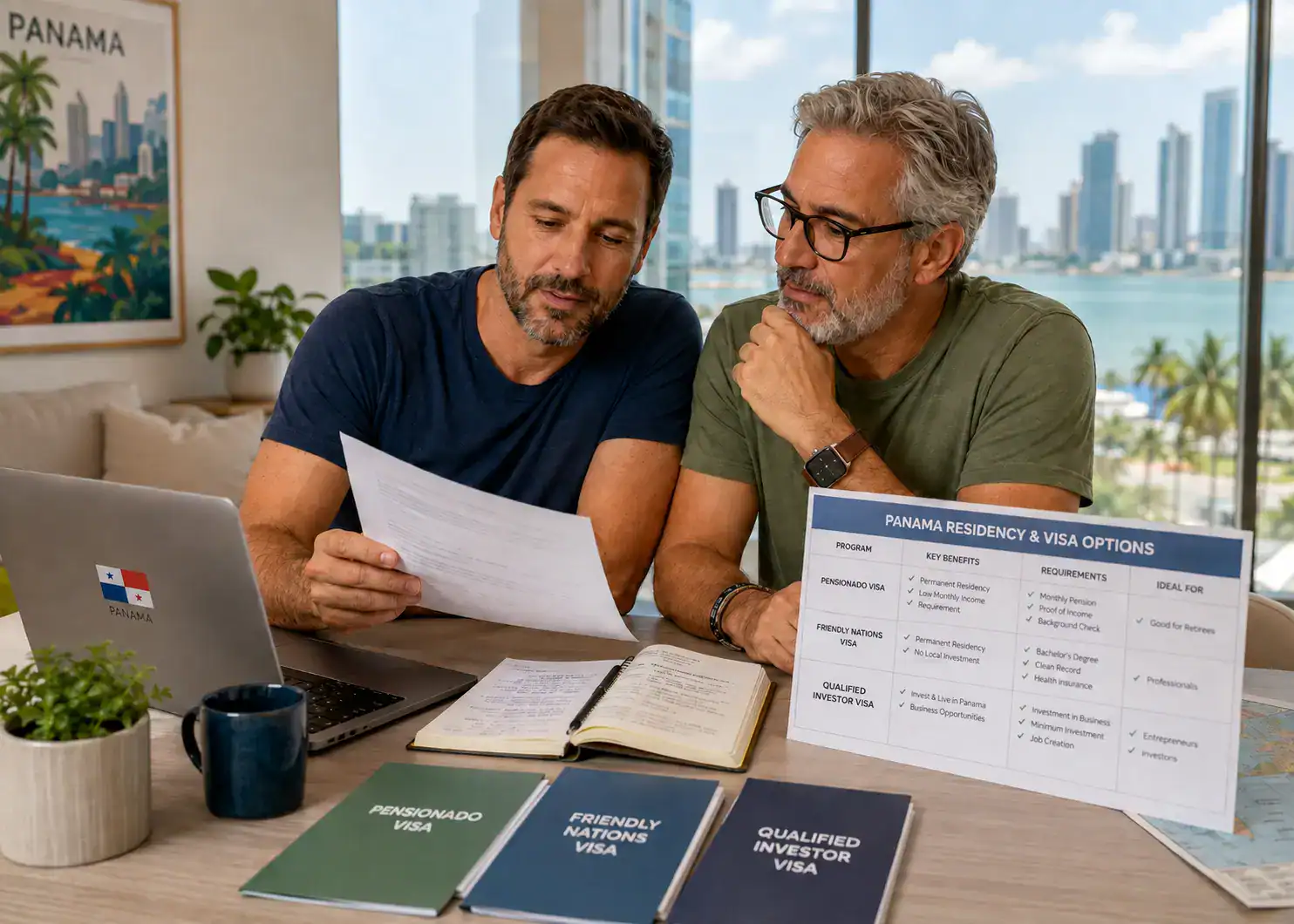
| Factor | Pensionado | Friendly Nations | Qualified Investor |
|---|---|---|---|
| Qualifying basis | $1,000+/month lifetime pension | Employment, or $200,000 property/deposit | $300,000 property (or $500K securities / $750K deposit) |
| Nationality requirement | None | Citizen of an eligible country | None |
| Residency granted | Permanent, immediately | Provisional (2 years), then permanent | Permanent, immediately |
| Realistic timeline to any status | ~3 months (our own experience) | 4–6 months to provisional card | 1–3 months in practice; 30 business days statutory target |
| Hold period on investment | Not applicable | 3 years (deposit route); real estate/employment not formally time-locked post-permanent in our sources | 5 years, with annual MICI verification |
| Work authorization | Not included | Built around employment; investment routes need a separate permit | Not automatic; separate permit, category unconfirmed |
| Government fees, principal applicant | ~$300 | $1,050 | $10,000 |
| Same-sex spouse reliably a dependent | Do not assume so | Do not assume so | Do not assume so |
Notice that the last row is identical across all three. That’s the point of this whole article’s gay-specific section: the marriage-recognition problem isn’t a Qualified Investor issue or a Friendly Nations issue. It’s a Panama issue, and it follows a gay couple into whichever program they pick.
A Decision Tree, Not a Table
Tables are good for comparing features. They’re bad at making a decision for you. Here’s roughly how we’d walk through it, question by question.
Do you have a qualifying lifetime pension of at least $1,000/month? If yes, start with Pensionado — it requires no investment at all and, in our own experience, moves faster than the others. If you’re part of a couple and your marriage will be recognized (opposite-sex, or a Panamanian legal partner), your spouse likely rides along as a dependent for very little additional cost. If you’re in a same-sex marriage, stop here and go to the gay-couple branch below before assuming that.
No qualifying pension — are you planning to work in Panama? If yes, look hard at Friendly Nations through employment, and get realistic about the Type 6A work-permit quotas and reserved professions before you count on a specific job existing.
Not planning to work — are you already planning to buy $300,000+ of real estate regardless of any visa? If yes, Qualified Investor deserves serious evaluation, because the investment isn’t really an incremental cost for you. You get permanent residency immediately instead of waiting two years, for what may functionally be the price of government and legal fees on top of a purchase you’d have made anyway.
Not buying that much property — are you willing to put $200,000 into a property or fixed deposit specifically to get residency? If yes, Friendly Nations is probably your program, with the tradeoff of two years in provisional status before permanent residency and a second filing at the end of it.
Are you part of a same-sex married couple? If yes, stop treating the household as one immigration decision. Run every branch above separately for each partner, because Panama is very likely going to require each of you to build an independent case.
Flexibility vs. Certainty — What Each Path Actually Costs You Later
The $100,000 gap between the Friendly Nations and Qualified Investor real estate thresholds gets most of the attention, but the more consequential tradeoff is time and finality, not price.
Friendly Nations gives you a lower entry price and, in principle, an easier exit if Panama doesn’t work out for you — walking away from a two-year provisional status before it converts is a smaller commitment than unwinding a five-year Qualified Investor hold. What it costs you is exactly that: two years of provisional status, a second filing, and a second round of government and attorney fees at conversion. Qualified Investor costs more upfront and locks the investment for five years with annual verification, but it never puts you through a second application, and “permanent” means permanent from day one.
If you’re genuinely unsure whether Panama will be a long-term home, that argues for Friendly Nations or even just renting through your first year or two before committing capital to either program. If you already know this is where you’re planting a flag — which describes our own household — the case for skipping the provisional stage gets much stronger.
Household Economics, Worked Through
Take a hypothetical retired couple, John and Mary, both in their late 60s. John has a qualifying Social Security pension; Mary doesn’t. Because Panama recognizes their marriage, the obvious answer is Pensionado for John with Mary as a dependent spouse — permanent residency for both of them without a $200,000 or $300,000 investment requirement of any kind.
Now change nothing except that Mary is David. Same ages, same income, same pension. John still qualifies for Pensionado on his own. But if Panama won’t recognize David as John’s spouse for dependent purposes — which, per our research on both programs, is the safer assumption absent written confirmation otherwise — David needs his own basis entirely. That could mean David pursuing Friendly Nations or Qualified Investor independently, turning what would have been a near-zero-investment household strategy into one requiring $200,000–$300,000 for David alone. Same household income, same household age, a potentially six-figure difference in what it takes to get both men legally resident.
That’s not a hypothetical edge case. It’s the default outcome for any gay couple where one partner has qualifying pension income and the other doesn’t, and it’s the single clearest illustration of why “just compare the visa programs” undersells what a gay couple is actually deciding.
Real Situations, and What We’d Actually Look At
The retiree who wants to rent indefinitely
Seventy years old, $2,500/month in Social Security, no interest in ever owning property in Panama. Pensionado, without much debate — no investment requirement exists that would ever make more sense than a program built entirely around qualifying pension income.
No pension, buying a modest condo
Sixty-two, no qualifying pension, looking at a $225,000 condo in Panama City or Coronado. That’s below the Qualified Investor floor but comfortably above Friendly Nations’ $200,000. Friendly Nations is the natural fit, with the two-year provisional stage as the tradeoff for the lower price point.
The working-age professional
Fifty-eight, still employed, planning to work remotely for a foreign employer or take a Panamanian job. If it’s a genuine Panamanian job offer, Friendly Nations through employment is worth pursuing — but check the Type 6A quota and whether the profession is reserved for citizens before counting on it. If the work is remote for a non-Panamanian employer, that’s a different visa category entirely (digital nomad), outside the scope of this comparison.
Retired couple buying a $500,000 house
Both partners already plan to spend $500,000 on a home regardless of visa considerations. Qualified Investor essentially rides along with the purchase — the qualifying $300,000 is inside the $500,000 anyway, and the couple gets permanent residency immediately rather than filing twice over two years. The incremental “cost” of the visa here is close to just the government and legal fees.
Gay couple, one qualifies for Pensionado, one doesn’t
This is the John-and-David scenario above. Our honest recommendation: don’t try to force this into a single household strategy. Let the qualifying partner file Pensionado on his own — it’s the cheapest, fastest program available to him — and evaluate the second partner’s situation completely independently, using this same decision tree from scratch.
Gay couple, neither has pension income
Now it’s genuinely a Friendly Nations vs. Qualified Investor decision for each partner, individually. If both are already planning to buy $300,000+ of property between them, look hard at whether the ownership can be structured so each partner independently holds a qualifying interest — this is the exact question we raised in our Friendly Nations article about co-ownership, and it applies to Qualified Investor’s UBO requirement too. If the household’s total real estate budget is closer to $200,000–$250,000 per partner, Friendly Nations is more realistic for both, with the two-year wait as the cost.
Gay couple buying $500,000+ property together
This is where the ownership-structuring question becomes the whole ballgame. Simply splitting title 50/50 is very unlikely to give each partner an independently qualifying interest under either program’s rules. This is not a DIY question — it needs an attorney’s sign-off on the exact structure before any purchase contract is signed.
Couple unsure whether Panama is permanent
If either partner is still testing whether this move sticks, Friendly Nations’ lower entry price and shorter effective lock period (the deposit route’s three years, versus Qualified Investor’s five) preserves more optionality — though “provisional” status for two years is its own kind of uncertainty. An even more conservative option worth naming honestly: rent for a year or two on a simpler visa category before committing capital to either investment program at all.
The wealthy investor who wants speed and certainty
No hesitation about Panama, no interest in a two-year provisional stage, capital not a constraint. Qualified Investor is built for exactly this profile — immediate permanent residency, no nationality requirement, and the field-tested processing timeline (1–3 months in practice per the sources we reviewed) beats Friendly Nations’ 4–6 months to even reach provisional status.
The Gay-Couple Fork: Two Immigration Files, Not One
Everything above points to the same structural conclusion for a married gay couple: budget and plan as if you’re filing two completely independent immigration cases, because that’s the safer assumption until a specific attorney tells you otherwise in writing for your specific facts. That has three concrete implications worth naming directly.
First, price the household total, not the per-person minimum. “Friendly Nations is $200,000” quietly becomes “$200,000 times two, or two different qualifying bases” for a gay couple who can’t rely on the dependent-spouse provision. Run the math on your actual household before assuming either program is the cheap option.
Second, the two partners don’t need matching visas. Because you’re already filing independently, there’s no requirement — and often no advantage — to both partners using the same program. One partner on Pensionado and the other on Qualified Investor, or one on Friendly Nations through employment and the other through investment, can be more economical than forcing both into the same category.
Third, property ownership structure has to be settled before closing, not after. Whether you’re trying to give each partner an independent qualifying interest in a shared property, or keeping one partner’s ownership entirely separate from the qualifying investment (our own approach, described in the Qualified Investor article), this is a conversation with your attorney before any purchase contract is signed — not a detail to sort out during the immigration filing.
What Can Actually Go Wrong — Beyond the Statute
Every program’s text reads cleanly. The practical experience reported by immigration firms and expat-focused guides we reviewed points to a consistent set of friction points that have nothing to do with which visa you pick:
Common Delay Points, Regardless of Program
Apostilles and translations. The single most frequently cited cause of delay across multiple immigration firm sources is documents apostilled incorrectly, apostilles older than six months at filing, or translations done by unauthorized translators. Background checks are typically only valid six months — an apostille that sits on a desk too long can force you to redo it.
Bank account and documentation friction. Panama’s banks have tightened compliance significantly in recent years. Foreigners can open accounts, but approval isn’t automatic, source-of-funds documentation gets real scrutiny, and some banks are simply harder to work with than others for a foreign profile. Budget real time for this, not a same-week assumption.
Mortgage terms for foreign buyers. If financing any part of a property purchase, expect a 30–40% down payment, rates roughly a point or more above what a Panamanian resident would get, and a slower, property-specific underwriting process — there’s no true pre-approval system the way U.S. buyers might expect. Terms improve noticeably once permanent residency and a Panamanian cédula are in hand, which is its own argument for programs that reach permanent status faster.
“Visa-eligible” property marketing. Developers advertising a listing as qualifying for a specific visa are making a sales pitch, not a legal guarantee. The underlying transaction — title, liens, permits, HOA obligations, developer track record — needs the same due diligence any property purchase would get, independent of the immigration angle.
None of this is specific to gay couples. But a gay couple managing two independent filings is, by definition, managing twice the exposure to every one of these friction points — twice the apostilles, twice the bank account applications, twice the timeline risk.
What We Couldn’t Verify — and Are Flagging Honestly
The most useful version of this article would include direct reporting: interviews with multiple Panamanian immigration attorneys, ideally at least one with direct experience representing same-sex couples, plus first-hand accounts from expats who’ve actually been through each program. We don’t have that yet, and we’re not going to manufacture the appearance of it.
Specifically, we do not know — and could not find documented anywhere in our research — how Panama’s National Migration Service is actually handling dependent-spouse applications from legally married same-sex foreign couples in practice, as opposed to what the statute and the 2023 Supreme Court ruling say on paper. Administrative practice can diverge from the letter of the law in either direction, and we found no published case, attorney account, or expat report addressing this specific question directly. Until we do, our guidance throughout this article — and our own household’s decision — treats “assume independent bases” as the prudent default, not a confirmed legal outcome.
This is exactly the kind of question we’d want to put to Carolina Tejada Vaprio and, ideally, one or two other Panamanian immigration attorneys directly, on the record, as a follow-up piece. If that reporting happens, we’ll update this article and link to it.
How We Actually Split Our Own Decision
Running our own household through the decision tree above: Brian has qualifying Social Security income, so the first question answered itself — Pensionado, filed and approved independently, in roughly three months. We did not attempt to add Kent as a dependent spouse on that filing, because we weren’t willing to bet Kent’s residency on an assumption Panama has never confirmed for a marriage like ours.
Kent doesn’t have qualifying pension income and current plans don’t include Panamanian employment, which took Friendly Nations’ employment route off the table. That left the property-vs-deposit question, and since we’re already planning to buy a home in Panama in the $300,000+ range regardless of any visa, Qualified Investor became the clear answer for Kent specifically: the investment isn’t incremental to what we were already going to spend, and it gets him permanent residency immediately instead of a two-year provisional wait. We described the ownership structure we’re planning — Kent as sole beneficial owner of the qualifying $300,000, with Brian added to title only for value above that — in our Qualified Investor article, and it’s a direct product of running this decision tree separately for each of us instead of trying to solve it as one household problem.
Our Bottom Line
For a straight couple, this decision is mostly arithmetic: compare investment size, timeline, and whether one partner’s basis carries the other along as a dependent. For a gay couple, it’s arithmetic plus a structural assumption you can’t skip — that you’re very likely paying for two immigration strategies, not discounting one against the other. Run the decision tree for each partner separately before you run it for the household, price out what independent filings actually cost you, and don’t let a lower headline number talk you into a program that turns out to be more expensive once you’ve priced both of you into it.
Sources & Verification
- Official: Executive Decree 722 (2020), Decree 109 (2022), and Decree 193 (2024) for Qualified Investor terms; Executive Decree 343 (2012), Decree 197 (2021), and Decree 226 (2021) for Friendly Nations terms — investment thresholds, timelines, and fee structures, as previously verified for our companion articles on each program.
- Official: Supreme Court of Justice of Panama, ruling of March 2023, on non-recognition of same-sex marriage, including marriages performed abroad.
- Reported: Multiple Panamanian immigration and real estate law firm publications and expat-focused guides, August 2026, on realistic processing timelines, common delay causes (apostilles, translations, bank documentation), foreign-buyer mortgage terms, and bank account friction for foreigners — cross-referenced across sources for consistency.
- Firsthand: Brian’s approved Pensionado application (filed April 17, 2026, approved July 2026) and our own household’s reasoning for splitting Kent’s Qualified Investor filing from Brian’s Pensionado filing rather than attempting a dependent-spouse approach.
- Not yet verified: How Panama’s National Migration Service actually handles dependent-spouse applications from legally married same-sex couples in administrative practice, as distinct from the statutory and judicial record. We found no documented case or attorney account addressing this directly and did not conduct original attorney interviews for this article.
Facts and figures in this article last verified: August 2026.
Brian & Kent
We’re a gay couple relocating from St. Petersburg, Florida to Panama City. Brian, a former attorney, has his Pensionado permanent residency approved. Kent, a PharmD, is our primary researcher and is pursuing the Qualified Investor Visa once our Florida home sells. We ran this exact decision tree on our own household before writing it up for anyone else.