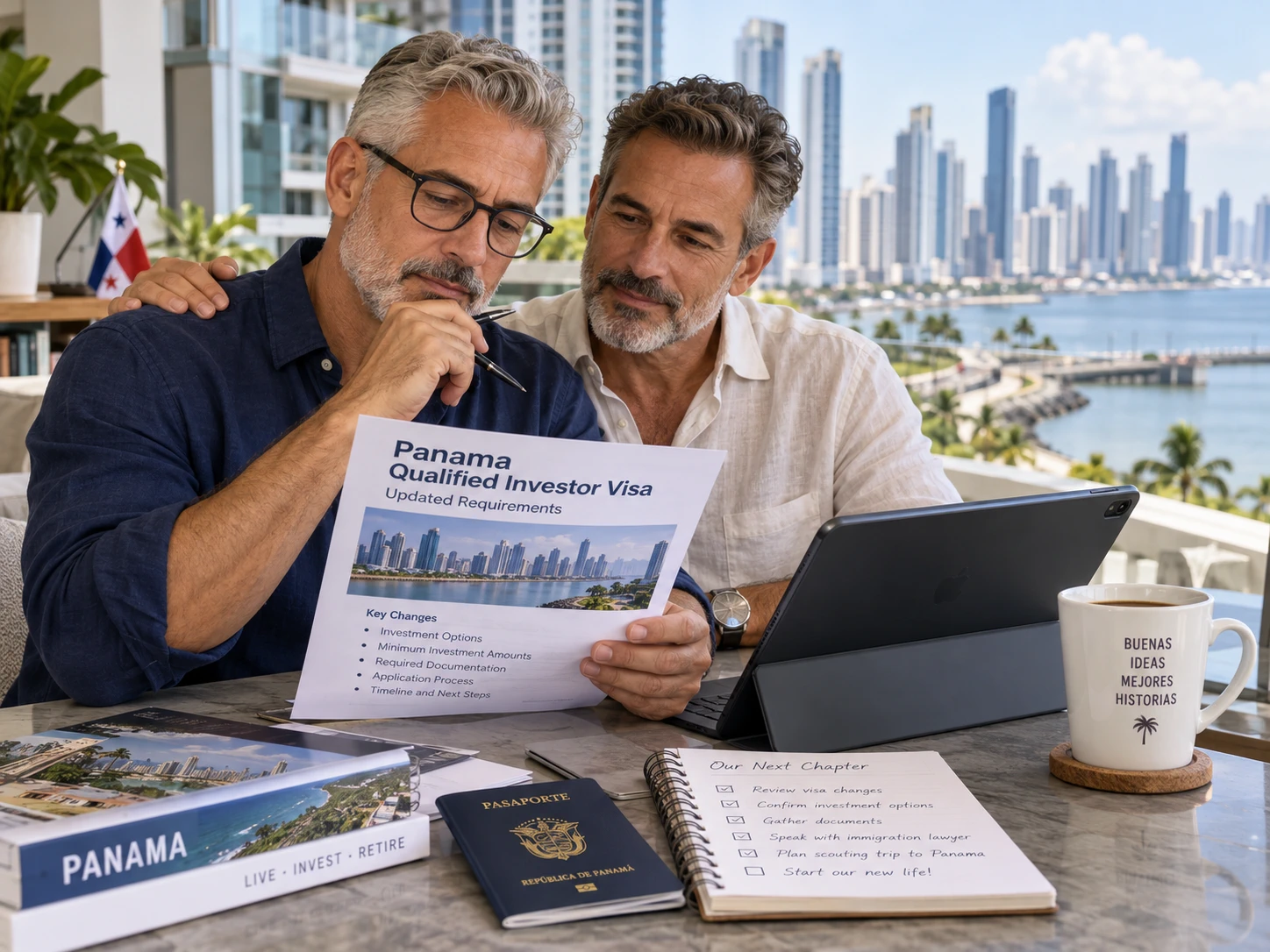
Visas & Residency · Rule Change
Panama Just Raised the Investor Visa Minimum on Existing Homes to $500,000. Here’s What Changed.
Executive Decree 17 splits the Qualified Investor real estate route in two: $300,000 still works for new construction, but resale homes now need $500,000. Friendly Nations stays at $200,000 — with a two-year catch.
 Brian & Kent · GayExpatsPanama.com · Updated September 2026
For most of this year, the question around Panama’s Qualified Investor Visa was whether the $300,000 real estate minimum would survive. We reported both sides of that: our attorney told us in June 2026 that $300,000 would stay, while the decrees on the books pointed to a reversion to $500,000 in October 2026. On September 16, 2026, Panama answered with something neither side quite predicted — a split.
Executive Decree No. 17 keeps the $300,000 minimum for brand-new and pre-construction property and raises it to $500,000 for anything that’s been lived in, rented or sold before. This is an executive order, not a new law passed by the National Assembly, and it replaces the 2020 decree that has governed the program until now. If you were planning to qualify with a $300,000 resale condo, that plan just got $200,000 more expensive — or it needs a different visa.
What Actually Changed
Decree 17 rewrites the rules for Panama’s Qualified Investor program, the route that grants permanent residency in exchange for a qualifying investment. The headline change is in real estate, where the price now depends on whether the property is new to the market.
Qualified Investor minimums under Decree 17
What counts as “resale”
This is the definition that matters. According to the reporting on the decree, a secondary-market property is one that has previously been commercialized, occupied, rented or transferred to a third party. A first-sale property is the initial acquisition of a new, unoccupied unit transferred by the developer or its successor, proven through a Public Registry certification plus construction and occupancy permits and tax records.
Read that definition carefully. A “new” unit the developer rented out for a year while it sat unsold may no longer qualify as a first sale. The label on the listing doesn’t decide it — the paperwork does.
Why Panama did it
The decree’s preamble is unusually direct. New construction, it says, reactivates the construction industry, energizes the local supply chain and reduces unsold primary inventory, while resale purchases have a substantially lower job-creation impact. In plain terms: Panama wants investor money going into new buildings, not changing hands on existing ones.
When It Took Effect — and Who’s Grandfathered
The decree was signed September 8, 2026, published in the Official Gazette (Gaceta Oficial Digital No. 30613) on September 16, 2026, and took effect on publication. There was no advance notice period. If you were house-hunting on September 15, the rules changed overnight.
There are three protections for people already in motion:
- Applications already filed before September 16, 2026 proceed under the old requirements and amounts.
- Investments or contracts made before September 16 can still use the old rules — including $300,000 for any real estate — as long as the application is filed within six months of the decree taking effect. By our math that lands around mid-March 2027, but confirm the exact deadline with your attorney.
- Investment certifications already issued by the Ministry of Commerce and Industries (MICI) remain valid until they expire.
If you closed on a resale home under the old rules
The six-month window is the whole ballgame. MICI verifies that the investment was actually made before September 16, 2026. If you bought a $300,000 resale property this summer planning to file “eventually,” eventually is now a deadline. Call your attorney this week, not next year.
The Other Changes Buried in the Decree
The resale price grabbed the headlines, but Decree 17 tightens the program in several other ways that affect how you buy, not just what you pay.
Your own money, with a paper trail
The qualifying investment must come from the applicant’s own funds, with documented ownership and traceability. Gifts and donations don’t count toward the minimum. Foreign-source funds are defined as money that entered Panama’s financial system through an international transfer. Law-firm summaries describe the expected trail as international wires via SWIFT.
The government can question your price
If the cadastral value looks misaligned with the purchase price, or if there’s reasonable doubt about market value, MICI can require an independent commercial appraisal. It has to be dated within six months before filing, prepared by an appraiser recognized by Banco Nacional and Caja de Ahorros, and you pay for it. The “$300,000 on paper” purchase of a property worth less is exactly what this is designed to catch.
Pre-construction now has guardrails — and a time limit
Off-plan purchases still qualify at $300,000, but the developer must provide an irrevocable, unconditional bank instrument (such as a standby letter of credit) guaranteeing the project. If the contract fails, you get 180 business days to substitute another qualifying investment, once. And residency based solely on promise-of-sale contracts is capped at three years total. If the building isn’t finished and titled by then, the permit can be cancelled.
Annual check-ins for five years
Residents must file an annual certification with MICI within the 30 days before each investment anniversary. Sell or swap the investment early and you have 90 days to reinvest, or the residency can be cancelled outright. Published summaries differ slightly on whether the five-year clock starts when the investment is made or when residency is granted — another question for your attorney.
The good news
Processing targets are now written down: 15 business days for MICI to issue the investment certification, and 30 business days for the National Migration Service to decide. Adding a spouse married after approval, or a new child, costs $1,000 each. And for the first time the program decree addresses naturalization, confirming that qualified investors can apply after five consecutive years of residence — with no fast track and no guarantee.
Friendly Nations: Still $200,000
We checked, because it’s the first question anyone buying a sub-$500,000 resale home should ask. Decree 17 governs the Qualified Investor program only. None of the news coverage or law-firm summaries of the decree that we reviewed mentions any change to the Friendly Nations Visa, and current 2026 legal guides still list the same three qualifying routes:
- Real estate: a property purchase of at least $200,000.
- Bank deposit: $200,000 in a Panamanian fixed-term deposit for three years.
- Employment: a formal job offer from a Panamanian company, with Ministry of Labor authorization.
The only recent Friendly Nations change we found was the addition of Ecuador to the eligible-country list by Executive Decree No. 16 of August 31, 2026 — same procedure, same costs, same stages. U.S. citizens remain eligible.
For a $250,000 or $400,000 resale condo, Friendly Nations is now the obvious path. But it isn’t the same product, and pretending it is would be doing you a disservice.
Qualified Investor vs. Friendly Nations: The Real Difference
The difference that matters most is time. The Qualified Investor Visa grants permanent residency from approval. Friendly Nations grants two years of provisional (temporary) residency first, after which you file a separate application for permanent residency. Legal guides put the full Friendly Nations path at roughly two and a half years.
| Qualified Investor | Friendly Nations | |
|---|---|---|
| Real estate minimum | $300,000 new / off-plan · $500,000 resale | $200,000, new or resale |
| Deposit option | $500,000 state bank · $750,000 private bank (5 years) | $200,000 (3 years) |
| Government fees (principal applicant) | About $10,000, including a $5,000 refundable repatriation deposit | About $1,050, plus fees again at conversion to permanent |
| Residency granted | Permanent from approval | Two years provisional, then apply for permanent |
| Time to permanent | Weeks to months (15 + 30 business-day targets) | About 2.5 years |
| Who can apply | Any nationality | Citizens of roughly 50 listed countries, including the U.S. |
| Source of funds | Own funds, traceable, from abroad; no gifts | Qualifying equity and ownership structure — confirm with attorney |
| Holding period | 5 years, with annual MICI filings | Through the provisional period (property) · 3 years (deposit) |
| Naturalization clock | Starts sooner, because permanent residency starts sooner | Starts after permanent residency is granted |
That last row is easy to overlook. Panama’s naturalization eligibility runs off years of permanent residency, so Friendly Nations’ two-year provisional stage pushes back the earliest date you could even apply for citizenship — assuming you want it. For a retiree who just wants to live here legally, the provisional stage mostly means one more application and one more round of fees. For someone who cares about the citizenship timeline, it’s two years.
The real math
On a resale home, the choice is now: invest $500,000 and get permanent residency immediately, or invest $200,000 and wait roughly two and a half years for it. For a lot of buyers, $300,000 more is a steep price for a two-year head start.
Even if you’re buying above $500,000 anyway, the Qualified Investor route still costs more to file. In our earlier guides, government fees for a principal applicant came to about $10,000 for Qualified Investor ($5,000 to the National Treasury plus a $5,000 repatriation deposit that’s refundable when your residency ends) versus about $1,050 for Friendly Nations. Add the appraisal Decree 17 can require and five years of annual filings with MICI. Friendly Nations has its own second round of attorney and government fees when you convert to permanent residency, so the gap narrows, but it doesn’t close. For some buyers, immediate permanent residency is worth that premium. It’s still a premium.
How This Changes Buying Decisions
Here’s where we think the decree actually bites. Some of this is straightforward reading of the rules; some is our judgment about where the market goes. We’ve tried to label which is which.
The $300,000–$499,999 resale band just lost its investor-visa buyers
Resale properties in that range were the sweet spot for Qualified Investor applicants — enough to qualify, no more. That buyer is now either shopping new construction, switching to Friendly Nations, or stretching to $500,000. Our read, not a prediction: sellers in that band who were counting on visa-driven demand may find fewer foreign buyers and more negotiating room for everyone else.
New construction gets a thumb on the scale
This is the uncomfortable part for us. In our own property-buying guide, we’ve argued that resale is generally lower risk for people who plan to live in the home: you can see the building’s management, the real HOA fees, the actual electricity bills and the neighbors. A brand-new building has no track record on any of that. Decree 17 now makes new construction $200,000 cheaper for anyone who wants permanent residency on day one. Don’t let the visa discount talk you into a building you wouldn’t otherwise choose — and expect some developers to price that discount into their units.
Pre-construction is cheaper, but the clock is real
Off-plan still qualifies at $300,000, with better protections than before. But the three-year cap on residency based only on a promise-of-sale contract turns a construction delay into an immigration problem. In Panama, construction delays are not a remote possibility.
Fixer-uppers and buy-to-remodel plans need a rethink
Every fixer-upper is a resale property. If your plan was to buy an older house for $300,000 and renovate, that purchase no longer qualifies for the Qualified Investor Visa. Your options are to buy at $500,000 or more, or use Friendly Nations at $200,000. We have not seen anything indicating that renovation spending counts toward the qualifying amount, so don’t assume it does.
The “rent first, buy later” trade-off shifted
Renting for a year before buying remains good advice for most people. But this decree is a reminder that the rules can change between the day you start renting and the day you buy. Anyone whose visa depends on a property purchase is carrying that risk while they wait.
The $500,000 state-bank deposit has an open question
The new $500,000 deposit option at Banco Nacional or Caja de Ahorros is a genuine alternative for someone who doesn’t want to own real estate. But in our banking research, we found that Panama’s two state banks typically require permanent residency and a cédula before opening accounts for foreigners. How a non-resident opens that deposit to qualify for residency in the first place is something we haven’t been able to confirm. Ask before you plan around it.
For couples: whose money is it?
The own-funds and no-gifts rules raise a question we haven’t seen answered anywhere. If a couple sells a jointly owned home and one partner uses the proceeds to qualify, does the other partner’s share count as that applicant’s own money, or as a gift? For a married straight couple, Panama’s recognition of the marriage may simplify this. Panama does not recognize same-sex marriage for immigration purposes, so gay couples should get a written answer from their attorney on how to document the funds before any money moves.
What This Means for Kent
Brian’s residency is already done — his Pensionado visa was approved in July 2026 and isn’t affected by any of this. Kent is the one who has been looking at the Qualified Investor Visa, and Decree 17 reopens the question of which visa he’ll actually use.
The honest context: Kent’s filing is roughly five years away. That’s long enough for these rules to change again, in either direction. So we’re not making a decision today. What the decree does change is the list of questions. If the home we eventually buy is new construction, the Qualified Investor route still works at $300,000. If it’s a resale home under $500,000, Friendly Nations becomes the more likely path, and the trade-off is the two-year provisional stage. If it’s a resale home at $500,000 or more, nothing changes except the paperwork.
A visa decision five years out shouldn’t be made on rules that are nine days old. But it should be made knowing the rules can move.
What to Do Now
- If you bought or signed before September 16, 2026: talk to your attorney immediately about filing within the six-month transition window.
- If you’re shopping a resale property under $500,000: decide whether Friendly Nations works for you before you make an offer, not after.
- If you’re shopping new construction: get the Public Registry certification and occupancy permits that prove first-sale status, and evaluate the building as a place to live, not just a visa ticket.
- If you’re considering pre-construction: confirm the developer’s bank guarantee exists and model what happens to your residency if completion slips past three years.
- Before any money moves: map the paper trail with your attorney — whose funds, which account, which wire. Gifts won’t count.
- Get it in writing: ask your immigration attorney to confirm the current threshold that applies to your specific property before you sign a promise to purchase.
This is not legal advice
We’re two guys researching our own move, not lawyers. This article is based on news coverage and law-firm summaries of Decree 17 published in September 2026. We have not yet reviewed the full decree text with our own attorney. Panama requires a licensed Panamanian attorney to file residency applications — use one, and confirm every figure here against your own situation.
Sources & Verification
- Reported: Icaza, González-Ruiz & Alemán, “Nuevo Decreto de Residencia por Inversionista Calificado en Panamá,” September 2026 — Executive Decree No. 17 of September 8, 2026, Gaceta Oficial Digital No. 30613, effective September 16, 2026; replaces Executive Decree No. 722 of 2020; real estate, securities and deposit minimums; transition rules; appraisal and source-of-funds requirements; processing times.
- Reported: IMI Daily, “Panama raises investor visa property minimum to US$500,000 with a US$300,000 carve-out,” September 2026 — first-sale definition, off-plan protections and three-year cap, annual certification and 90-day reinvestment rules, dependent fees, naturalization language, program history, government rationale.
- Reported: Expat Times, “Qualified Investor Visa 2026 Update,” September 2026 — secondary-market definition, grandfathering for pending applications and pre-decree investments, five-year maintenance rule.
- Reported: Paralelaw, “Panama Friendly Nations Visa 2026,” updated September 14, 2026 — $200,000 real estate and three-year $200,000 deposit routes, employment route, two-year temporary residency before permanent, Executive Decrees No. 197 and No. 226 of 2021.
- Reported: BorderPilot, “Panama’s Friendly Nations Visa: The 2026 Guide” — two-year provisional card, roughly 2.5 years to permanent residency, U.S. eligibility.
- Reported: LAC Legal, “Panama Immigration Updates 2026” — Ecuador added to Friendly Nations by Executive Decree No. 16 of August 31, 2026, with no change to procedure or costs.
- Not yet verified: We have not read the full text of Decree 17 in the Gaceta Oficial and have not reviewed it with our attorney, Carolina Tejada Vaprio of Morgan & Morgan. Also unconfirmed: the exact calendar deadline for the six-month transition window; whether the five-year holding period runs from the investment date or the residency grant; whether a partner’s share of jointly owned sale proceeds counts as the applicant’s own funds for a same-sex couple; how a non-resident opens the qualifying $500,000 state-bank deposit; whether renovation costs count toward any threshold; Friendly Nations financing rules under current practice; and whether Decree 17 changed any government fees. The fee figures (about $10,000 for Qualified Investor, about $1,050 for Friendly Nations) come from our earlier visa guides and have not been re-checked against Decree 17. We’ll update this article as each is confirmed.
Facts and figures in this article last verified: September 2026.
Related Reading
- 01Panama’s Qualified Investor Visa: A Gay Couple’s Real Guide
- 02Panama’s Friendly Nations Visa: A Gay Couple’s Real Guide
- 03Financing a Home in Panama
- 04The Promise to Purchase: What to Negotiate Before You’re Committed
- 05What You Must Know Before You Buy to Remodel
- 06Should You Rent for a Year Before Buying in Panama?
Brian & Kent
We’re a gay couple from St. Petersburg, Florida, documenting our move to Panama as it happens. Brian’s Pensionado residency, based on Social Security, was approved in July 2026. Kent is our primary researcher and is weighing the Qualified Investor and Friendly Nations routes for his own residency, which is still several years out.