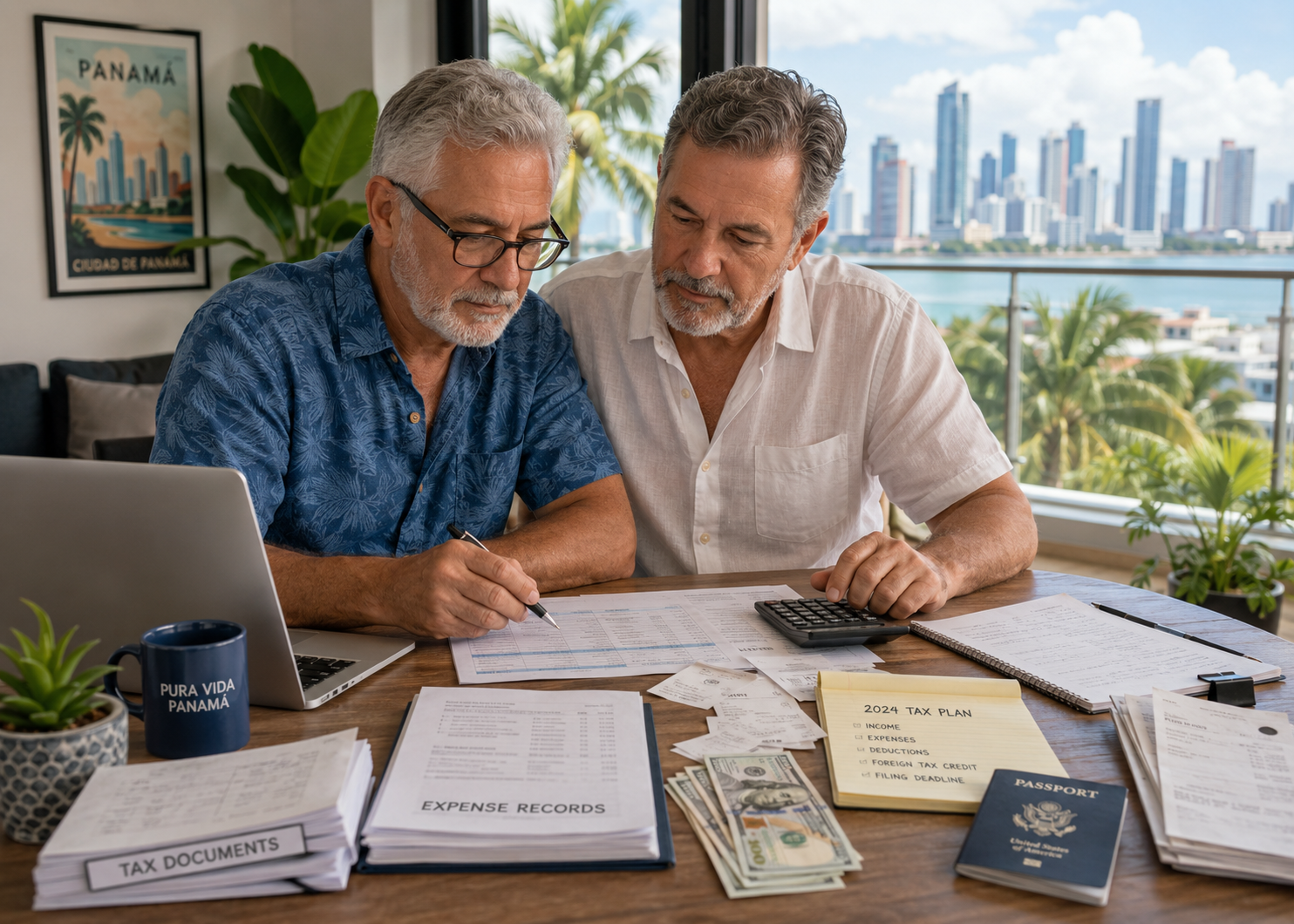
Finance & Money in Panama · Part 2 of 14
Taxes in Panama: What the Territorial System Actually Means for American Expats
The headline is real. Your foreign income is not taxed in Panama. But your U.S. tax obligations do not disappear — and the internet has been quietly omitting that part.
 Brian & Kent · GayExpatsPanama.com · April 2026 Research Trip
Panama taxes income earned in Panama. It does not tax income earned anywhere else. For an American retiree living on U.S. Social Security, a pension, or investment income from U.S. accounts, that distinction is significant — and genuinely favorable. But “Panama doesn’t tax foreign income” is not the same as “you stop paying taxes.” Understanding what Panama’s territorial system actually does, and does not do, is the foundation of any honest retirement financial plan.
This post covers every tax category that affects American expats in Panama: the territorial system itself, Panama’s income tax rates, property tax and the exemptions that make it largely irrelevant for most expats, the value-added tax (ITBMS), and the meaningful Pensionado discounts that affect what you actually pay across a wide range of services. We also cover your continuing U.S. obligations — because that is the part most expat content buries.
Finance & Money in Panama Series
Thirteen articles covering everything you need to know about managing your money before, during, and after your move to Panama.
- The Real Numbers: Our 13-Part Guide to Finances, Money, and Budgeting in Panama
- Taxes in Panama: What the Territorial System Actually Means for American Expats You are here
- Banking in Panama: The Truth Behind the Social Media Fear
- What Does It Actually Cost to Live in Panama City?
- What Buying a Home in Panama Actually Costs You
- Financing a Home in Panama
- Home & Auto Insurance in Panama
- Healthcare Costs in Panama
- Travel Within Panama: Getting Around
- ATMs, Wire Transfers, Wise, and Getting Your Income Here Reliably
- Estate Planning for Gay Couples in Panama
- Can a Foundation Let My Partner Inherit Our Panama Property Without Probate
- Your Retirement Accounts Are Not Worth What You Think — RMDs, Taxes & Medicare
- Building Your Reserve in Panama: The Financial Cushion That Makes a Retirement Budget Actually Work
Panama’s Territorial Tax System — The Actual Rule
Panama operates on a territorial basis for income tax. The law is straightforward: income is taxable in Panama only if it is produced, generated, or sourced within Panama. Income produced outside Panama — regardless of where you live, regardless of your residency status — is not subject to Panamanian income tax.
For most American retirees, this is a substantial advantage. U.S. Social Security benefits, pension payments from former U.S. employers, dividends from U.S. stocks and funds, interest from U.S. bank accounts, and rental income from a U.S. property are all foreign-sourced income. Panama does not touch any of it.
The Core Rule
If your income is earned in the United States — Social Security, a U.S. pension, U.S. investment dividends, U.S. rental income — Panama does not tax it. Period. This is not a loophole. It is how Panama’s tax system was designed.
What Panama does tax: income earned from work performed in Panama, income from a business operated in Panama, and income from Panama-based investments or rental properties.
The practical implication for a Pensionado retiree who lives on Social Security and a pension: your Panama income tax liability may be exactly zero, because you have no Panama-sourced income. That is a real and meaningful financial benefit.
Your U.S. Tax Obligations — The Part That Gets Omitted
The United States taxes its citizens on worldwide income regardless of where they live. Moving to Panama does not change that. If you are an American citizen or Green Card holder living in Panama, you still file a U.S. federal tax return every year. Full stop.
This is not a technicality or a gray area. The IRS does not care that Panama decided not to tax your income. The U.S. taxes you because you are American, not because of where the income was earned.
What This Means in Practice
For most retirees living on Social Security and pension income, U.S. tax filing looks roughly similar to what it does now. Social Security benefits may be partially taxable federally depending on your combined income. Pension income is generally fully taxable. Investment income is taxable as usual. None of this changes because you moved to Panama.
What changes — potentially — for people who work or earn income in Panama while living there. That income is subject to U.S. tax as foreign-earned income. The Foreign Earned Income Exclusion (FEIE) allows you to exclude up to approximately $130,000 (2026 figure — this adjusts annually for inflation) of foreign-earned income from U.S. tax if you meet either the bona fide residence test or the physical presence test. Passive income — Social Security, pensions, dividends, interest — does not qualify for the FEIE. Only earned income does.
You Need a U.S. Expat CPA
The interaction between U.S. and Panama tax law — FEIE, Foreign Tax Credit, FBAR reporting requirements, FATCA obligations — is not something to navigate with TurboTax and good intentions. Expat tax preparers who specialize in American retirees abroad charge $300–$600 for a typical return. That is almost certainly the best-spent money in your expat financial plan.
Firms specializing in expat returns include Greenback Tax Services, Taxes for Expats, and Bright!Tax. We are not endorsing any of them — do your own due diligence — but they represent the category of professional you need.
FBAR and FATCA — Reporting Foreign Accounts
If you open a Panamanian bank account — or any foreign account — and the total balance exceeds $10,000 at any point during the year, you are required to file an FBAR (FinCEN Form 114). Separately, if your foreign financial assets exceed certain thresholds, FATCA reporting (Form 8938) may apply. These are reporting requirements, not additional taxes — but failure to file carries substantial penalties. Your expat CPA handles both.
Panama Income Tax Rates
For the sake of completeness — and for any expats who do earn Panama-sourced income — here are Panama’s current income tax brackets for individuals:
| Annual Panama-Sourced Income | Rate | Notes |
|---|---|---|
| $0 – $11,000 | 0% | Exempt — no tax owed |
| $11,001 – $50,000 | 15% | On the amount above $11,000 |
| Above $50,000 | 25% | On the amount above $50,000 |
For context: someone earning $30,000 in Panama-sourced income would owe 15% on $19,000 (the amount above the $11,000 threshold), or $2,850. The first $11,000 is exempt entirely.
Again — for most Pensionado retirees living on U.S.-sourced income, this table is academic. Your Panama income tax bill is zero because you have no Panama-sourced income to tax.
Property Tax in Panama
Panama has property tax, but the structure is substantially more favorable for homeowners — especially primary residence buyers — than anything you encounter in Florida or most U.S. states.
Primary Residence Exemption
The first $120,000 of assessed value of a primary residence is fully exempt from property tax. Given that Panama’s assessed (cadastral) values are often significantly lower than market values, many properties that would sell for $200,000–$300,000 have assessed values below the exemption threshold. The effective property tax bill on a modest condo used as a primary residence can be zero.
New Construction Exemption (Exoneración)
New construction in Panama qualifies for a 20-year property tax exemption, regardless of value. This is a meaningful incentive for buyers of new condos and new construction homes — and one reason developer pre-sales are popular. If you buy a newly constructed property, you may pay no property tax for two decades.
Property Tax — Key Thresholds
Verify Current Rates
Panama’s property tax rates and exemption thresholds have shifted before. The figures above reflect the current law as of our April 2026 research. Verify with a Panamanian attorney before making a purchase decision.
VAT — The ITBMS
Panama’s value-added tax is called the ITBMS (Impuesto de Transferencia de Bienes Muebles y Servicios). It applies to most goods and services — you will see it on every receipt. The standard rate is 7%, which is moderate by regional standards.
| Category | ITBMS Rate | Notes |
|---|---|---|
| Most goods and services | 7% | Standard rate — groceries, restaurants, retail |
| Hotels and lodging | 10% | Applies to accommodation costs |
| Alcohol | 10% | Higher rate on alcoholic beverages |
| Tobacco | 15% | Highest category |
| Basic food items | 0% | Exempt — rice, sugar, basic staples |
| Prescription medications | 0% | Exempt |
| Health services | 0% | Doctor visits, clinical services |
At 7%, ITBMS is visible but not painful. It is already embedded in most posted prices. You will notice it on restaurant receipts, at retail stores, and on utility bills. The exemptions on basic food and health services are meaningful for budget planning.
Pensionado Tax Exemptions and Discounts
The Pensionado visa comes with a legally mandated set of discounts established under Law 6 of 1987. These are not informal courtesies — they are Panamanian law, enforced by ACODECO (the Authority for Consumer Protection and Defense of Competition), and businesses are required to honor them. The discount percentages below are what the law says. What the law says and what you actually save in practice are not always the same thing — and we cover that distinction in detail below.
| Category | Discount (Law 6, 1987) | Notes |
|---|---|---|
| Entertainment (cinema, theater, events) | 50% | Excludes charity events |
| Restaurants | 25% | Food only — not alcohol; licensed establishments |
| Fast food establishments | 15% | National and international franchises |
| Hotels — Mon through Thu | 50% | Off rack rate — see important note below |
| Hotels — Fri through Sun | 30% | Off rack rate — see important note below |
| Airline tickets (domestic & international) | 25% | Economy class in practice — see important note below |
| Intercity buses / boats | 30% | Public transport between cities |
| Routine medical consultations | 20% | Private doctor visits |
| Hospital and clinical services | 15% | Not covered by insurance |
| Dental and optometry | 15% | Not covered by insurance |
| Prescription medications | 10% | At pharmacies nationwide |
| Electricity bill | 25% | Up to 600 kWh/month |
| Personal loan closing fees | 50% | Banks and financial institutions |
| Mortgage interest rate | 1% off | On personal housing mortgage |
| Metro fare | $0.24 (vs. $0.35) | Fixed reduced fare — Lines 1 and 2 |
| Vehicle import duty | Exempt | One vehicle every two years |
| Household goods import duty | Exempt | One-time upon arrival, up to $10,000 |
| Passport fees | 50% | Panamanian passport renewal |
Discounts Require Your Card
Pensionado discounts apply when you present your residency card. Present it before payment is processed — most businesses will not apply discounts retroactively after a bill has been issued. The discount is non-transferable: it applies only to the goods or services consumed by the Pensionado. If you share a hotel room with a non-retiree partner, the law applies the discount to only half the room cost.
The Hotel Discount — What the Law Says vs. What You’ll Actually Save
The law is clear on the percentage: 50% off Monday through Thursday, 30% off Friday through Sunday. What the law does not specify is which rate those percentages apply to. And that gap is where the real-world disappointment lives.
Hotels are permitted to apply the Pensionado discount to their rack rate — the full published walk-in price, which is almost always the highest rate the property charges. In practice, most hotels maintain high rack rates specifically because discounts must be calculated from them. A hotel with a $200/night rack rate giving you 50% off charges you $100. That same hotel may be bookable for $80 on Expedia or Booking.com tonight.
The Hotel Discount Reality Check
The 50%/30% Pensionado hotel discount is real and legally mandated. But it applies to the rack rate — the hotel’s highest standard price — not to whatever rate you might find online. In many cases, especially at larger hotels and international chains, you will get a better price by shopping Booking.com, Expedia, or the hotel’s own website than by presenting your Pensionado card.
Our recommendation: price it both ways before you check in. At smaller Panamanian-owned hotels and lodges — particularly outside Panama City — the rack rate is often closer to the going rate, and the Pensionado discount is more likely to be genuinely valuable.
This is not a flaw in the law. It is how rack-rate discount systems work everywhere in the world. The Pensionado benefit is real. The question is whether it beats the market rate on any given night — and the answer requires checking.
The Airline Discount — What the Law Says vs. What Airlines Apply
Law 6 of 1987 mandates a 25% discount on airline tickets for both domestic and international flights on all public or private carriers. The law does not restrict this to any particular fare class. In practice, however, airlines — most notably Copa Airlines, the primary international carrier based in Panama — apply the discount to economy class fares only.
Business class is generally excluded in practice, regardless of what the law’s text says. Promotional fares and sale fares may also be excluded. The discount applies to the base fare only — not to taxes, airport fees, or fuel surcharges — so the headline 25% figure overstates the bottom-line savings.
The Airline Discount: Economy Class in Practice
The law says 25% off all flights. Airlines say economy class only. Business and first class fares are routinely excluded. The discount applies to the base fare, not the total ticket price — taxes and fees are not reduced. The actual savings on a round-trip to the U.S. is meaningful but less dramatic than “25% off your flight” sounds.
For Copa Airlines specifically, the Pensionado discount cannot be booked online. You must hold a reservation and then call Copa or visit an office to have the discount applied manually before paying. Once your credentials are in their system, future bookings are easier. The process works — it just requires a phone call.
Facebook groups and expat forums have circulated claims that the airline discount only applies to the highest published fare on the route — essentially making it unusable for anyone who shops for deals. We could not verify this as a firm Copa policy in writing, and firsthand accounts from expats who have used the discount suggest it applied to the economy fare they selected, not a premium fare. That said, it is worth confirming directly with Copa at the time of booking. Airline discount application policies can shift without public announcement.
The Discounts That Do Work Cleanly
While the hotel and airline discounts require some navigation, several Pensionado benefits are genuinely straightforward and deliver exactly what they promise:
The restaurant discount — 25% off food at licensed restaurants — is the one that consistently earns praise from long-term expats. Show your card, get 25% off the food portion of the bill. It works. Over a year of regular dining out, it adds up to a meaningful sum in a country where eating out is already inexpensive.
The healthcare discounts — 20% off doctor visits, 15% off hospital services, 10% off medications — apply cleanly at virtually all private clinics and pharmacies. We used the medication discount ourselves at pharmacies in Panama City and it was applied without question.
The entertainment discount — 50% off cinema, theater, and public events — works at every cinema we visited. No negotiation. No rack rate issue. Half price.
The Capital Gains Question
Panama does have a capital gains tax on real property sales — 10% on the gain, or alternatively a 3% transfer tax on the sale price, whichever applies in the specific situation. The calculation is more nuanced than a simple flat rate, and the specifics depend on how the property was held and how long you owned it. We will cover this in detail in the Buying a Home post.
For financial investments — U.S. stocks, funds, ETFs held in U.S. accounts — there is no Panamanian capital gains tax. Those gains are foreign-sourced income. The U.S. taxes them as it always has. Panama does not.
No Estate or Inheritance Tax
Panama does not have an estate tax or inheritance tax. Assets held in Panama are not subject to Panamanian estate tax upon death. This is another genuine financial advantage, particularly for retirees with Panama-based real estate holdings. However — and this is critical — U.S. estate tax rules still apply to American citizens on worldwide assets above the federal exemption threshold. And for gay couples, Panama’s lack of same-sex partnership recognition creates estate planning complications that require specific legal attention. We cover this thoroughly in the Estate Planning post.
For Gay Couples: Estate Planning Cannot Wait
Panama does not legally recognize same-sex partnerships or marriages. In the absence of proper estate documents, Panamanian law does not automatically transfer a deceased partner’s assets to the surviving partner. This is not a theoretical risk. It requires specific legal action — both Panamanian and U.S. documents — before you close on a property or establish significant assets in Panama. Post 12 in this series covers exactly what to do.
Putting It Together: A Simplified Tax Picture for a Pensionado Retiree
Here is how the tax landscape typically looks for a retired American couple living in Panama on U.S. Social Security and pension income:
Tax Snapshot — Retired American Couple, Panama-Based, U.S. Income
Florida Residents Have One More Advantage
Florida has no state income tax. If your domicile remains Florida during your Panama years — or if you formally establish Florida as your domicile before moving — you have no state income tax obligation on top of federal. States like California and New York are more aggressive about taxing former residents who maintain connections to the state. This is worth a conversation with a tax attorney if you are coming from a high-tax state.
The Bottom Line on Panama Taxes
Panama’s territorial tax system is a real and significant financial advantage for American retirees living on foreign-sourced income. The savings are genuine. But the picture is incomplete without acknowledging that U.S. tax obligations continue, that professional tax help is not optional, and that the FBAR and FATCA reporting requirements are real compliance obligations with real penalties for failure.
The Pensionado discounts are similarly real — and similarly more nuanced than the brochure version suggests. The restaurant and healthcare discounts work cleanly. The hotel discount requires comparing against online rates before assuming you’re getting a deal. The airline discount works for economy class and requires a phone call to apply. Know the actual rules, and the benefits are genuinely valuable.
The financial case for Panama is strong. We did not come this far in our research to pretend otherwise. But a strong case deserves an honest presentation, not a marketing pitch. The territorial system saves you money on Panama taxes. It does not save you from the IRS.
Finance & Money in Panama — 12-Part Series
Next: Banking in Panama
Why opening an account is harder than it sounds, which banks actually work with Americans, what documents you need to bring, and whether you need a Panamanian account at all.