Getting Around Panama City
The Panama City Metro: What You Need to Know Before You Ride
Central America’s only metro system is clean, cheap, and genuinely impressive — with a few things nobody tells you before you show up at the airport with luggage.
 Brian & Kent · GayExpatsPanama.com · April 2026 Research Trip
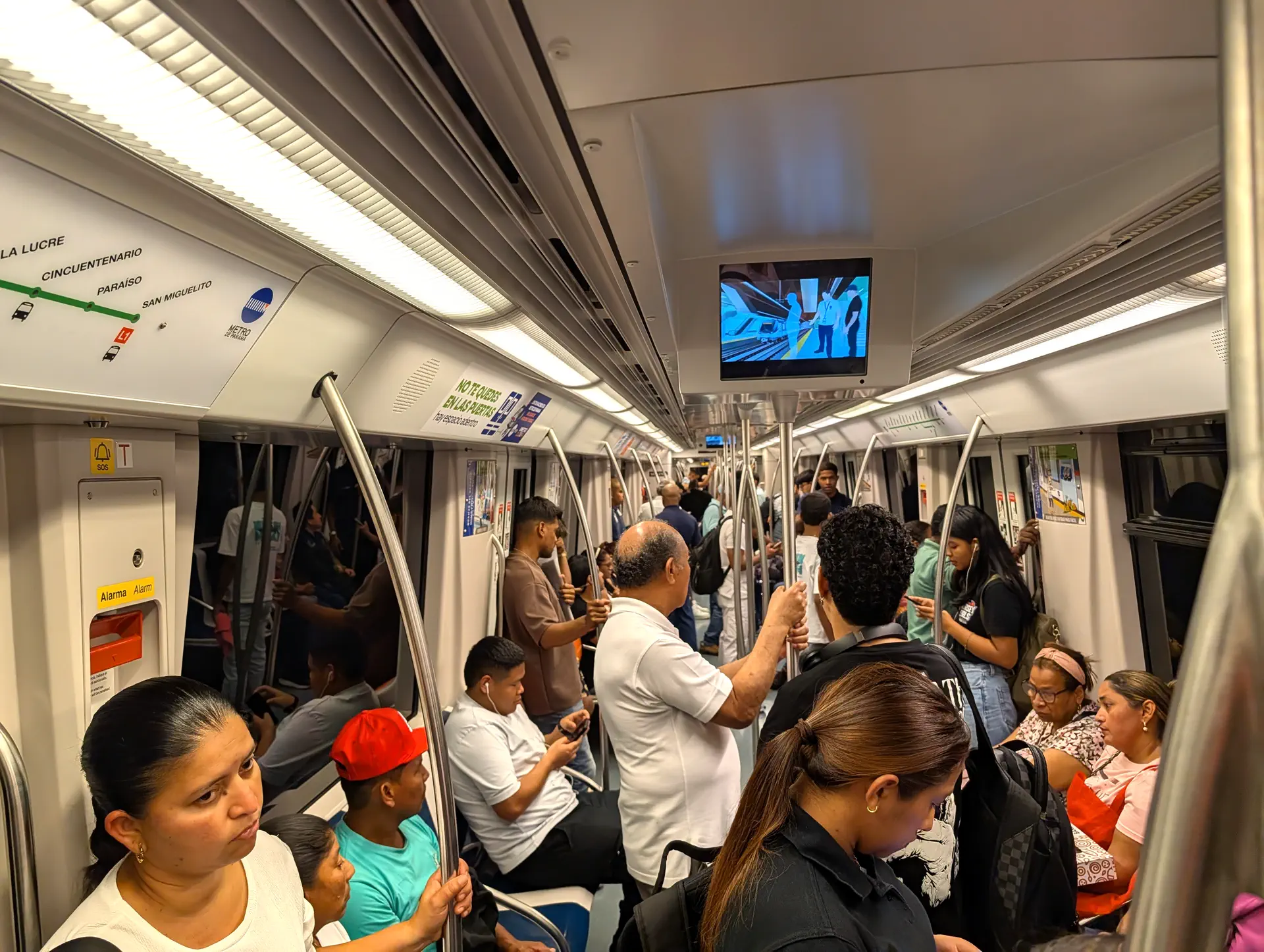
We rode the Metro several times during our April 2026 research trip — here’s what it actually looks like.
Panama City’s Metro surprised us. We arrived expecting a functional but basic transit system — something to tolerate rather than appreciate. What we found was a two-line rapid transit network that runs clean, runs on time, and costs $0.35 a ride on Line 1 and $0.50 on Line 2. If you’re serious about living here, you’ll use it constantly. And if you’re arriving for the first time at Tocumen International Airport, there’s something important you should know before you haul your bags off the plane.
We rode the Metro multiple times during our April 2026 research trip — from the airport into the city, across to Albrook, and back again. What follows is what we actually observed, combined with everything we’ve been able to verify about where the system is going.
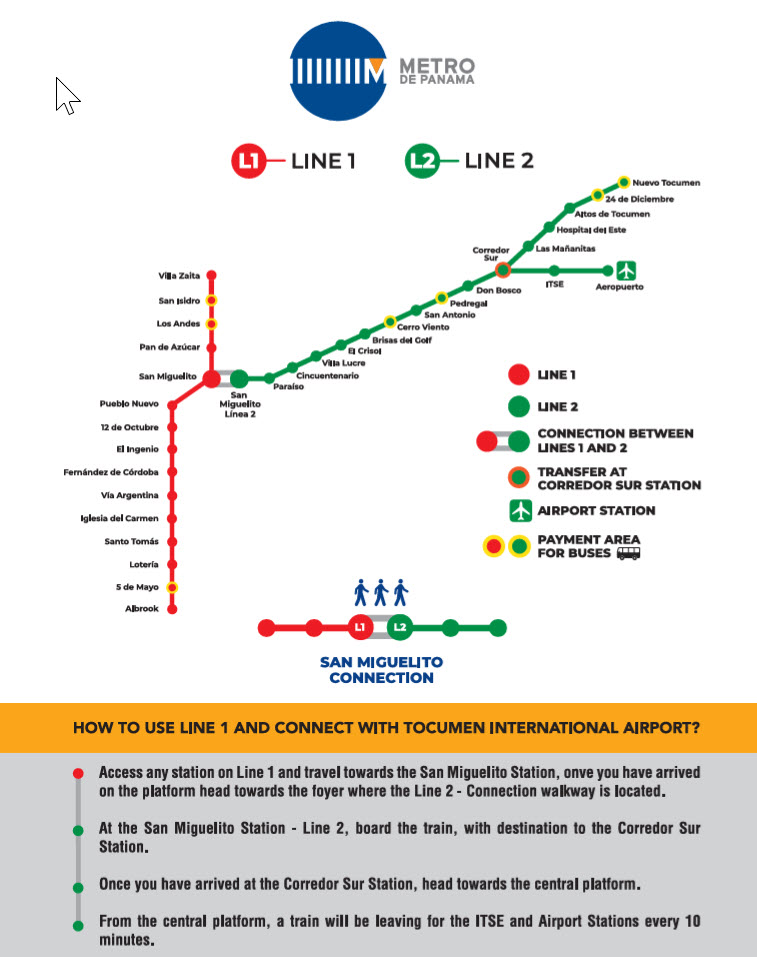
Courtesy of El Metro de Panamá. For navigation and real-time information, visit elmetrodepanama.com.
The Basics: Two Lines, 33 Stations, One Card
The Metro de Panamá is Central America’s first and only rapid transit system. It opened in 2014 with Line 1, added Line 2 in 2019, and as of our April 2026 trip was carrying roughly 420,000 passengers per day. For context: Panama City’s entire population is somewhere around 1.5 million. This is not a novelty. People actually use it.
Line 1 (yellow) runs roughly north-south, connecting the Albrook bus terminal in the south — which is also the main intercity bus hub — with Villa Zaita in the north. The southern segment runs underground through the older, denser part of the city before emerging elevated as it heads north. Key stops for expats include Iglesia del Carmen (near El Cangrejo and Via Argentina), 5 de Mayo (Casco Viejo access), and Albrook (buses, shopping mall). The line covers 18.1 kilometers across 14 stations.
Line 2 (red) runs mostly east-west on an elevated guideway, connecting San Miguelito in the west to an airport branch in the east. It intersects with Line 1 at San Miguelito. Key stops include Cincuentenario (near major shopping), Don Bosco, and Corredor Sur, where you transfer to the airport branch. The main line covers 21 kilometers across 16 stations, with a 2-kilometer airport spur added in 2023.
Metro at a Glance — April 2026
What We Actually Noticed on the Trains
The trains are genuinely clean. Not “clean for a transit system” clean — actually clean. Air-conditioned, well-lit, and quiet enough to have a conversation. We never waited more than a few minutes for a train during peak hours; at busy times the interval was around two minutes, which is competitive with any major city system we’ve used. The trains run driverless — fully automated — using a communications-based train control system.
The rolling stock is the Alstom Metropolis model, manufactured at Alstom’s factory in Barcelona. The same Alstom Metropolis platform is used in metro systems across Europe, Latin America, and Asia, so these are not budget equipment. Five-car trainsets, four doors per car, with capacity for 1,000 passengers per train. The system uses standard gauge track — the same as most of Europe’s mainline railways.
“We never waited more than a few minutes. At busy times the interval was around two minutes — competitive with any major city system we’ve used.”
One thing that took some adjustment: above-ground and elevated stations are not air-conditioned. The platforms are open to the elements — which in Panama means heat and humidity. Underground stations have full air conditioning, and you’ll feel it the moment you descend the escalators. If you’re waiting on an elevated platform in the middle of the day, move into whatever shade exists and accept that you’re going to be warm. The trains themselves are cold, so it balances out quickly once you board.
Fares, Cards, and Contactless Payment
The base fare is $0.35 per ride on Line 1 and $0.50 on Line 2. If you transfer between the two lines in a single journey, the combined fare is $0.85. Those are genuinely low numbers — we’re talking about getting from one side of the metropolitan area to the other for less than a dollar.
Metro Fares — 2026
The MetroBus Card
The system uses a prepaid card called the MetroBus card — a chip card you load with money and tap at the turnstile. The card costs $2.00 to purchase and can be bought at Metro stations, at select supermarkets (Super 99, Riba Smith), and at kiosks in major shopping malls including Albrook Mall, Multiplaza, and MetroMall. You top it up at station machines or, in some cases, through mobile banking apps — though any digitally loaded funds typically need to be activated at a kiosk.
The card is per person. You cannot swipe one card for two people. No cash is accepted at turnstiles or on MetroBus. If you’re traveling as a couple, each of you needs a loaded card.
Contactless Credit Card Option
You don’t actually need the MetroBus card if you have a contactless Visa or Mastercard. The Metro accepts contactless bank cards and mobile payments (Apple Pay, Google Pay) directly at the turnstile — at the standard fare rate. This is excellent news for first-time visitors who haven’t had a chance to buy a card yet. Note: if you have a discounted Pensionado card, contactless credit cards charge the full standard fare, not the discounted rate.
Senior and Pensionado Discounts
The discounted fare of $0.24 applies to seniors, Pensionado visa holders, and people with disabilities — but it requires a personalized card, not the standard MetroBus card. The senior age threshold under Panamanian law is 55 for women and 60 for men. Importantly, all Pensionado visa holders qualify for the transit discount regardless of age, as the Pensionado discount package under Law 6 includes a 30% reduction on public transportation including the Metro. If you’re on another visa type and meet the age requirements, you also qualify for the senior discount.
One Card Per Person — No Exceptions
You cannot tap one card twice at the same turnstile to pay for two passengers. Each person needs their own loaded card or their own contactless payment method. This catches a lot of first-time visitors off guard at the turnstile.
Getting to and from the Airport — The Part Nobody Tells You
The airport Metro connection opened in March 2023, which was widely celebrated as a major quality-of-life improvement for Panama City. The branch — known as El Ramal — extends 1.96 kilometers from the main Line 2 at Corredor Sur to the Aeropuerto station, which sits adjacent to Tocumen International Airport. The fare from downtown (Line 1 + Line 2 transfer) is $0.85 total.
Here’s what the celebratory press releases left out: the Aeropuerto station does not connect directly into the terminal building. When we arrived with luggage in April 2026, we got off the train at the Aeropuerto station and then had to walk outside — in the heat and humidity — to reach the terminal. The station was built with provision for a future covered walkway to Terminal 2, but that connection does not exist yet. In the meantime, you’re walking outside with your bags, which in Panama’s climate is not a minor inconvenience.
Airport Metro — Walk Outside Required
The Aeropuerto Metro station is not directly connected to the terminal. You will walk outside in the heat and humidity to reach the arrivals or departures hall. For a quick trip without luggage this is fine. Arriving or departing with suitcases in Panama’s weather is a different calculation — factor this in when deciding between the Metro and a $5 Uber.
Additionally, signage inside the terminal directing you to the Metro station is, by most accounts, poor to nonexistent. When leaving arrivals, head toward the inter-terminal corridor connecting Terminal 1 and Terminal 2 — the Metro station is along that route. When in doubt, ask someone.
Getting to the airport by Metro from downtown: take Line 1 or Line 2 to San Miguelito, transfer to Line 2 heading east, ride to Corredor Sur, then transfer to the airport branch and ride one stop to Aeropuerto. The total travel time from downtown is roughly 45 minutes — considerably longer than an Uber, but $0.85 versus $15–25. The practical choice depends on how much luggage you have and how much you care about the heat.
One more note on airport Metro logistics: service doesn’t start until 7:00 AM on Sundays. If you have an early Sunday flight, check the schedule. The last train on weekdays runs at 11:00 PM. Late-night flights generally mean Uber.
Line 3: The Monorail Crossing the Canal
Line 3 is the Metro project everyone in Panama is talking about, and the engineering involved is genuinely remarkable. When it opens, it will become the first transit line to cross beneath the Panama Canal, connecting the city center with the fast-growing communities on the western side.
Where Line 3 Goes
The line runs from Albrook Station — where it will connect directly with Line 1 — westward through Arraiján and along the Pan-American Highway, terminating at Ciudad del Futuro in the Arraiján district of Panamá Oeste province. Phase 1 covers approximately 24.5 kilometers with 14 stations. Phase 2 will extend the line further west to La Chorrera.
The route includes a 5.3-kilometer tunnel running beneath the Panama Canal at depths reaching over 60 meters — the first tunnel of its kind under the Canal. Once through the tunnel, the line emerges as an elevated structure and continues west. At its maximum height, the elevated viaduct reaches 31.6 meters above ground.
Why a Monorail?
Line 3 will not use conventional rail tracks. It’s a straddle-beam monorail — the kind of system where each train straddles a single elevated beam rather than running on two rails. The choice was deliberate. The western terrain through Arraiján is significantly hillier than the relatively flat corridor Lines 1 and 2 run through, and a conventional heavy rail system would have struggled with the grade changes. Monorail technology handles steep elevation changes more efficiently, requires a smaller infrastructure footprint (the beam is narrower than a conventional viaduct), and was available through Japanese engineering expertise that Panama was already working with.
The rolling stock is the Hitachi Monorail 3000 Series, supplied by a consortium of Hitachi and Mitsubishi under a subcontract from the primary Korean construction consortium (Hyundai Engineering & Construction, POSCO, and Hyundai Engineering). It marks the first implementation of large-scale Japanese monorail technology in Central America. The line’s color is purple.
Line 3 — Key Numbers
When Will It Open?
This has slipped repeatedly. Original targets ranged from 2025 to early 2026. As of May 2026, overall construction progress stands at 75% — the elevated western section between Ciudad del Futuro and Panamá Pacífico is about 81% complete and test runs have begun on that segment, but the underground section beneath the Canal is only around 42–53% complete. The current planned opening is 2028, though that too could shift. If you’re making long-term housing decisions based partly on Line 3 access, treat 2028 as the optimistic scenario.
The significance of the line for everyday residents is hard to overstate. The western suburbs of Panama City — Arraiján and the surrounding communities — have been growing rapidly for decades but have had essentially no rapid transit connection to the city center. Commuters currently sit in traffic on the Bridge of the Americas, one of only two crossing points over the Canal, for an average of 85 minutes each way. Line 3 will cut that to 45 minutes. The line is expected to serve over 500,000 residents of Panamá Oeste province.
The Long-Term Vision: Eight Lines by 2040
Panama Metro’s master plan envisions a network of eight lines covering Panama City and its metropolitan area — San Miguelito, Arraiján, and La Chorrera — with 90 stations total, by approximately 2040. Lines 1 and 2 are operational. Line 3 is under construction. Lines 4 and 5 are in feasibility study phases. Lines 6, 7, and 8 are planned as trams or light rail for medium-demand corridors.
| Line | Status | Route (summary) | Type |
|---|---|---|---|
| Line 1 (yellow) | Operational | Albrook → Villa Zaita (north-south) | Heavy rail |
| Line 2 (red) | Operational | San Miguelito → Tocumen Airport (east-west elevated) | Heavy rail |
| Line 3 (purple) | Under construction | Albrook → Ciudad del Futuro / La Chorrera (west, under Canal) | Monorail |
| Line 4 | Feasibility study | Central & southern Panama City corridor | Underground heavy rail |
| Line 5 | Feasibility study | Financial district / Via España / Costa del Este | Underground heavy rail |
| Lines 6–8 | Planned | Various medium-demand corridors including Casco Antiguo | Tram / light rail |
Line 5 is the one most expats currently living in the city’s financial district or along Via España would care about. It would run from Iglesia del Carmen (currently on Line 1) through the banking area, 50th Street, and out to Costa del Este. That corridor is almost entirely served by taxis and Uber right now. The 2040 target is aspirational — these are plans, not commitments — but the direction is clear.
Why This Matters for Expat Home Buying
If you’re evaluating Panama City neighborhoods for a long-term base, proximity to an existing Metro station is worth real weight. Bella Vista, El Cangrejo, and Marbella neighborhoods sit within reasonable reach of Line 1 stations. If Line 5 eventually materializes along Via España and the financial district, much of the corridor where expats currently concentrate would gain direct Metro access. Nothing to bank on, but interesting to track.
Practical Tips for Using the Metro
Luggage
Technically allowed — the prohibition on luggage was lifted when the airport extension opened in 2023. In practice, it’s more complicated than that. Standard checked-size suitcases do not fit through the turnstiles. We watched people navigate this repeatedly: one person goes through the turnstile first, then the luggage gets lifted and handed over to them on the other side. It works, but it requires a second person and some muscle. Solo travelers with large bags are in a genuinely difficult position.
Some stations have attendants who can open a wider gate for oversize items — but we wouldn’t count on finding one when you need it. And don’t forget: you go through turnstiles on the way out of the Metro as well, not just entering. Same problem applies at both ends of your trip. If you’re arriving at Tocumen with full-size luggage and already facing a walk outside in the heat to reach the terminal, the $5 Uber starts looking very reasonable.
Accessibility
All stations have elevators and are wheelchair accessible. The system was built to modern standards and the infrastructure shows it — this isn’t a retrofit situation.
Safety
The Metro itself was consistently clean and felt safe during our April 2026 trip. Video surveillance throughout stations and trains. The transit system has its own security presence. We saw no issues in our time using it.
Getting Around Outside Metro Hours
The Metro closes. Weeknights at 11:00 PM, Saturdays at 10:00 PM, Sundays and holidays at 10:00 PM — and some riders report trains occasionally stopping service slightly earlier than published. If you’re heading out for the night, plan your return with Uber in mind rather than banking on catching a late train.
Real-Time Info
The official Metro de Panamá app (elmetrodepanama.com) provides real-time arrivals and route planning. It’s in Spanish, but the interface is straightforward enough. Google Maps also routes Metro trips, though several travelers have noted it occasionally misses the airport branch — use the official app for airport routing.
Can You Top Up Your Card Digitally?
Some banks, including Banco General, allow digital card top-ups through their mobile apps — but those balances typically need to be activated at a Metro kiosk before they appear on your card. So yes, digital top-up is possible in theory, but plan to visit a station kiosk as part of the process for now.
Sources & Verification
- Official: Metro de Panamá system specifications — opening dates for Lines 1 and 2, station counts, system length, rolling stock (Alstom Metropolis, Hitachi Monorail 3000 Series), fare structure, the Pensionado/senior transit discount under Law 6, the airport branch (El Ramal) opening and length, and Line 3’s route, tunnel depth, and master plan through 2040.
- Reported: Line 3 construction progress figures (75% overall, 81% on the western elevated section, 42–53% on the Canal tunnel section) as of May 2026, and the 2028 target opening — recent construction-progress reporting, not independently verified by us on-site.
- Firsthand: Our April 2026 experience riding Lines 1 and 2, including train cleanliness and frequency, elevated-platform heat, turnstile behavior with luggage, and the walk from the Aeropuerto station to the terminal.
- Not yet verified: Reports that trains occasionally stop service slightly earlier than the published schedule, and that Google Maps occasionally omits the airport branch from routing — both circulate among riders but we could not confirm either directly.
Facts and prices in this article last verified: May 2026.
Related Reading — Getting Around Panama City
- 01 The Panama City Metro: What You Need to Know Before You Ride
Brian & Kent
We’re a gay couple documenting our relocation from St. Petersburg, Florida to Panama City in real time. Brian is in the process of applying for a Pensionado visa with attorney Carolina Tejada Vaprio at Morgan & Morgan. Kent is the primary researcher and rides transit systems enthusiastically. Everything we write is from firsthand experience — prices, observations, and opinions are all our own.