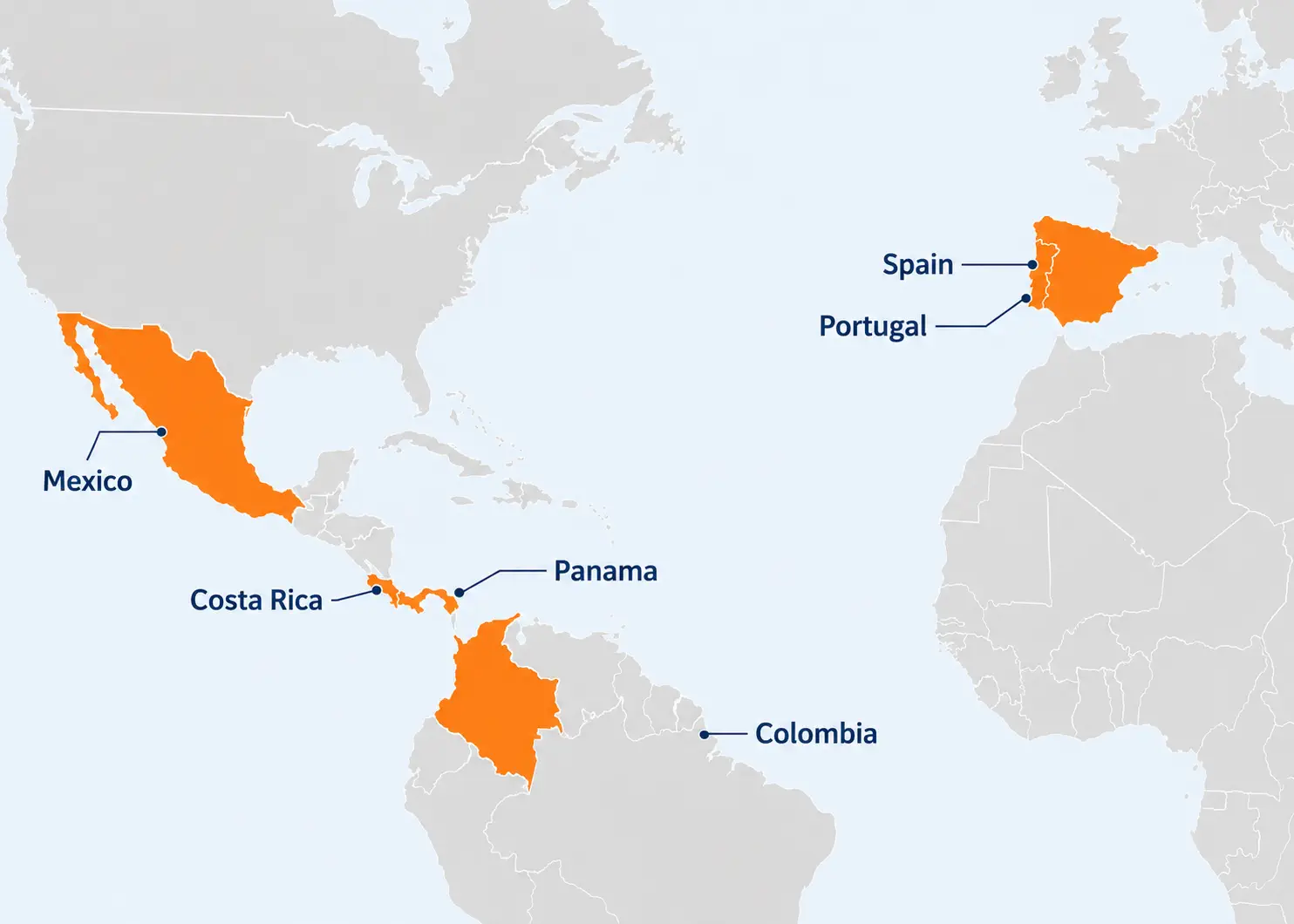
Part 1 of 6
Panama vs. Mexico, Costa Rica, Colombia, Portugal & Spain: A Gay Man’s Honest Comparison
We lived in Spain — full marriage equality, the works — and we’re choosing Panama anyway. Here’s the comparison we actually ran, with 2026 visa numbers, the factor most articles bury, and who should pick somewhere else.
 Brian & Kent · GayExpatsPanama.com · Updated September 2026
Every gay man researching an escape from the United States runs the same short list: Mexico, Costa Rica, Colombia, Portugal, Spain — and Panama. We ran it too. And we ran it with an advantage most people don’t have: we already lived the European option. We spent years in Spain, ran a bar there, and know exactly what full legal equality feels like when it’s your everyday life rather than a bullet point in a listicle.
We’re choosing Panama anyway. This article is the honest math behind that decision — not because Panama is the right answer for everyone (it isn’t, and we’ll tell you exactly who should pick somewhere else), but because most destination comparisons are written by people who’ve never had to ask the one question that splits this list in half.
Updated September 2026 — Panama’s investor visa threshold changed
Earlier versions of this article described Panama’s Qualified Investor Visa minimum as a permanently fixed $300,000. That was accurate under the decree in force when we wrote it. On September 16, 2026, Panama’s Executive Decree No. 17 kept the $300,000 minimum for new and pre-construction property but raised it to $500,000 for resale property. We’ve updated the Panama references below. None of the other countries’ figures in this comparison were affected.
Panama vs. the World: A Gay Man's Comparison Series
The honest, gay-specific comparison of Panama against the destinations on everyone's shortlist — starting with the overview, then going deep on each head-to-head.
- The Overview: Panama vs. Everyone You are here
- Panama vs. Mexico
- Panama vs. Costa Rica
- Panama vs. Colombia
- Panama vs. Portugal
- Panama vs. Spain — From Two Guys Who Lived There
The Question That Splits the List: Can Your Partner Come With You?
Here’s what the generic comparison articles bury in row nine of a table, and what we’re putting in paragraph three: Panama is the only destination on this list that will not recognize your marriage for immigration purposes.
Spain (marriage equality since 2005), Portugal (2010), Colombia (2016), Costa Rica (2020), and Mexico (nationwide since 2022) all recognize same-sex marriage — which means in all five, one qualifying partner can bring the other as a spouse or family member. One income requirement. One primary application. Your marriage does the legal work it was designed to do.
In Panama, your marriage evaporates at the border. Each partner must qualify for residency independently — separate applications, separate income thresholds, separate attorney fees. We know because we’re doing it: Brian qualified through the Pensionado visa on Social Security income, approved in July 2026. Kent has been planning on the Qualified Investor Visa after we sell our Florida home — roughly five years out. Since September 2026, that visa requires $300,000 in new or pre-construction property, or $500,000 for a resale home. If we buy a resale home under $500,000, the Friendly Nations Visa at $200,000 becomes his more likely route. We wrote the full breakdown in “Should Gay Couples Move to Panama?”
The Make-or-Break Test
If both of you can independently qualify for a Panamanian visa, the whole list stays open and this comparison is about lifestyle, cost, and climate. If only one of you qualifies, Panama drops off your list before you compare a single grocery price — and the other five destinations become your list. That single legal fact filters more couples than every other factor combined.
How We’re Scoring This
Two tiers. First, the gay-specific factors: legal recognition and what it cascades into (immigration, inheritance, hospital rights), day-to-day acceptance, the size and reality of the gay scene, and gay men’s healthcare — PrEP and HIV care specifically. Second, the factors everyone weighs but we’ll run through a gay lens: visa income thresholds (2026 numbers, not the stale ones), cost of living, healthcare, climate, and distance from the people you love in the States.
Sourcing, per our usual standard: Panama observations are firsthand from our April 2026 research trip and ongoing relocation. Spain is firsthand from years of actually living there. Mexico, Costa Rica, Colombia, and Portugal are research-based — current, verified, but not lived. We label it that way because that’s what it is.
Mexico: The Biggest Scene, the Rising Bar
On pure gay infrastructure, Mexico wins this list and it isn’t close. Puerto Vallarta is the gay beach capital of Latin America — a genuine gayborhood in the Zona Romántica, dozens of bars, and a critical mass of gay American retirees that no other destination here can match. Mexico City’s scene is world-class. Marriage equality is nationwide, and a married couple can apply for residency as a family unit on one partner’s income.
The catch is that Mexico quietly stopped being the cheap ticket. The 2026 numbers: temporary residency requires roughly $4,400/month in income or about $74,000 in savings, permanent residency roughly $7,300/month or about $294,000 in savings — and government processing fees doubled in January 2026. A retiree living on Social Security alone will likely need the savings route rather than the income route. Compare that to Panama’s $1,000/month Pensionado threshold and the gap is stark: Mexico’s residency bar is now more than four times Panama’s.
Mexico — The 2026 Numbers
Choose Mexico over Panama if: the gay community itself is your first criterion, you have the income or savings to clear the higher bar, and you want your marriage to legally exist where you live. If your dream retirement involves walking to a gay beach bar at sunset surrounded by people like you, Puerto Vallarta is that dream, and Panama has nothing equivalent. Honest is honest.
Costa Rica: The Legal Winner Next Door
Costa Rica is Panama’s neighbor and, on paper, its opposite. Same-sex marriage has been legal since 2020 — the first in Central America — and the Pensionado program requires the same $1,000/month lifetime pension as Panama’s. But here’s the difference that matters: in Costa Rica, that one $1,000 pension covers the couple, because your spouse rides along as a dependent. In Panama, it’s $1,000 each, plus two sets of attorney fees.
So why isn’t Costa Rica the automatic answer? Three honest reasons. First, cost: Costa Rica’s affordability reputation is a decade out of date — expats consistently report prices creeping toward U.S. levels in the expat corridors, while Panama’s dollar economy still delivers the $0.35 metro ride and the $20–$70 doctor visit we’ve priced ourselves. Second, residents must enroll in the CAJA public health system, with mandatory income-based contributions, whether they use it or not. Third, infrastructure: Panama City is a genuine metropolis with a metro system and world-class private hospitals; Costa Rica’s equivalent, San José, isn’t in the same league, and the gay scene there is modest — friendly country, small scene.
Choose Costa Rica over Panama if: only one of you has qualifying income — that single fact makes Costa Rica the obvious Central American choice for many couples — or if legal marriage recognition in your country of residence is non-negotiable and you want to stay in this hemisphere and this time zone.
Colombia: The Cheapest Equality on the List — With an Asterisk
Colombia is the value surprise. Marriage equality since 2016, a partner beneficiary visa that covers spouses and permanent partners, and a pension visa requiring three times the Colombian minimum wage — for 2026 that’s about COP 5,252,715/month, roughly $1,400 USD, with your partner attached to your application rather than filing separately. Medellín has a real gay scene, springlike weather year-round, and a cost of living that undercuts everything else on this list. On a spreadsheet, Colombia might win.
Now the asterisk, stated plainly because this is a site that states things plainly: Medellín has a documented, serious problem with criminals targeting foreign men through dating apps — druggings and robberies, some fatal, serious enough that the U.S. Embassy has issued specific warnings about dating-app meetups there. This isn’t a reason to strike Colombia from the list; thousands of gay expats live there happily with sensible precautions (meet in public, watch your drink, don’t bring strangers to your home early). But it’s a real, gay-specific risk that the “Medellín is paradise” articles skip, and the threshold precaution level is simply higher than in Panama City, where we walked for twelve days as an obvious couple without a moment’s concern beyond normal big-city awareness.
One more honest note: the pension visa’s income bar is fixed in pesos, not dollars, so exchange-rate swings can move your qualifying math — a wrinkle Panama’s dollar economy simply doesn’t have.
Choose Colombia over Panama if: budget is your binding constraint, you want marriage recognition, and you’re comfortable managing the app-safety reality with adult precautions. On pure cost-per-quality-of-life, it’s the strongest challenger here.
Portugal: Europe’s Easy Button — If You Can Get In Line
Portugal is the destination every gay retirement listicle crowns, and the fundamentals are real: marriage equality since 2010, deep social acceptance, Lisbon’s genuine gay scene, safety, and a D7 passive-income visa with a shockingly low bar — pegged to the minimum wage, currently about €920/month for the main applicant plus roughly half that for a spouse. A couple can qualify on less than Panama requires from the two of you combined.
The honest counterweights: the famous NHR tax break that made Portugal a fiscal paradise for foreign retirees was closed to new applicants — the tax picture for newcomers is now ordinary European taxation, which for many Americans means real tax planning. The wave of migration Portugal absorbed has driven Lisbon housing costs up dramatically and processing backlogs at immigration are legendary. You’re also signing up for the Atlantic distance: six-plus time zones from U.S. family, transatlantic flights for every visit and every emergency. And you’ll be a tax resident of a country that will want to discuss your worldwide income.
Choose Portugal over Panama if: Europe is the point — the culture, the walkability, the legal equality — and the distance from the States is a feature rather than a bug. For a couple where one partner carries the income, the D7’s family math beats Panama’s two-application reality decisively.
Spain: We Lived It. Here’s the Truth.
This is the one destination on the list we can compare to Panama from lived experience, because Spain was our home. We ran a bar there. We know what it feels like when your marriage is simply real everywhere — the hospital, the tax office, the notary — and what it’s like to hold hands in public without running the calculation first. Spain’s acceptance isn’t a Pride-month performance; it’s structural, and after Panama’s legal invisibility it’s worth being clear-eyed that we are giving something up.
The 2026 mechanics: the Non-Lucrative Visa requires passive income of €2,400/month (€28,800/year) for the main applicant plus €600/month for a spouse — about €36,000/year for a couple, roughly $3,250/month at recent exchange rates. Your spouse is included in one application, because of course they are. The Golden Visa is gone (suspended April 2025), the NLV prohibits all work including remote work, and renewal requires 183+ days per year of physical presence — which makes you a Spanish tax resident, with Spanish taxation of your worldwide income and, above certain thresholds, Spain’s wealth-tax regime looking at your global assets.
So why aren’t we going back? Mostly it is simply the money math — Spanish tax residency on top of a higher income bar changes the retirement arithmetic in ways a Pensionado budget doesn’t. And partly because we’ve already had that chapter. But we’ll say this without hedging: if legal equality is the thing you cannot compromise on, Spain is the best answer on this list, and we’re the last people who would talk you out of it.
“We know exactly what full equality feels like — we lived it in Spain. Choosing Panama means trading that for a shorter flight, a dollar economy, and legal paperwork. Make that trade with your eyes open, because we did.”
The Scorecard
| Factor | Panama | Mexico | Costa Rica | Colombia | Portugal | Spain |
|---|---|---|---|---|---|---|
| Same-sex marriage | Not recognized | Legal (2022) | Legal (2020) | Legal (2016) | Legal (2010) | Legal (2005) |
| Partner rides on one visa? | No — each qualifies alone | Yes (family unit) | Yes (dependent) | Yes (beneficiary) | Yes (family) | Yes (family) |
| Retirement visa income, 2026 | $1,000/mo each (Pensionado) | ~$4,400/mo or ~$74k savings | $1,000/mo covers couple | ~$1,400/mo covers couple | ~€920/mo + ~€460 spouse | €2,400/mo + €600 spouse |
| Gay scene | Real but small (capital only) | Best in Latin America | Modest | Strong (Medellín, Bogotá) | Strong (Lisbon, Porto) | World-class |
| Currency | U.S. dollar | Peso | Colón | Peso | Euro | Euro |
| Flight time / zone vs. U.S. East Coast | ~3 hrs, same zone as EST | 2–5 hrs, close zones | ~3 hrs, close zone | ~4 hrs, same zone as EST | 7–8 hrs, +5–6 zones | 8–9 hrs, +6 zones |
| Tax posture for U.S. retirees | Territorial — foreign income untaxed | Tax residency at 183 days | Territorial-leaning; CAJA contributions | Tax residency at 183 days | Standard EU taxation (NHR closed) | Worldwide income + wealth tax exposure |
These numbers move — verify before you plan
Visa thresholds change: Mexico’s are recalculated annually, Colombia’s rise with each January’s minimum wage, Portugal’s tracks its minimum wage, and Spain’s IPREM can jump whenever a national budget finally passes. The figures above are verified for mid-2026. Confirm the current numbers with the relevant consulate — or an immigration attorney — before you build a plan on them. Tax situations are individual; talk to a cross-border tax professional before choosing a country based on the tax row.
So Why Panama? Our Honest Math
After all that, here’s why two guys who could go back to full-equality Spain are moving to the one country on the list that won’t recognize their marriage.
- The dollar economy. No exchange-rate anxiety, no conversion math on your Social Security deposit, no watching your qualifying income shrink because a currency moved. Panama is the only destination here where a U.S. retirement income is simply… the money.
- The lowest real income bar for two qualifying partners. $1,000/month each. Both of us clear it independently — and if you both can too, Panama’s threshold is the gentlest on this list.
- Three hours from Florida, zero jet lag. Same time zone as the East Coast. When family needs us — or we need them — it’s a morning flight, not a transatlantic production. At our age, we weighted this heavily and we don’t apologize for it.
- Healthcare we’ve actually priced. $20–$70 private doctor visits, no referrals, world-class private hospitals in the capital — and PrEP through a national program we detailed in our PrEP in Panama guide.
- Pensionado benefits with teeth. Panama’s discount regime for retirees — transport, entertainment, medical, and more — is a genuine, legislated program, not a marketing line.
- A capital city that fits how we actually live. A real metro, real restaurants, a real (if small) gay scene, and a live-and-let-live culture we tested on foot for twelve days. We covered that in full in “Is Panama Gay Friendly?”
And the price of all that, stated one more time so nobody can say we buried it: our marriage will not exist in Panama, so we’re rebuilding its protections by hand — independent visas, wills, powers of attorney, and the structures in our estate planning guide. That’s the trade. We’re making it deliberately.
The Short Version, by Reader
- Both partners have qualifying income, want U.S. proximity and dollar simplicity: Panama.
- Only one partner qualifies: Costa Rica or Colombia in this hemisphere; Portugal if Europe calls. Panama is off your list — that’s the law, not our opinion.
- The gay community is the whole point: Mexico — Puerto Vallarta specifically — and nothing else on this list is close.
- Tightest budget with full legal equality: Colombia, with the app-safety precautions taken seriously.
- Legal equality is non-negotiable and Europe appeals: Spain if the income and tax picture works; Portugal if you want the lower bar and can live with the backlog.
- You need to be loudly, visibly out everywhere, always: Europe. We said it in our gay-friendliness piece and we’ll say it again here — Panama will feel like a ceiling.
The head-to-head deep dives are coming — Mexico first — with the granular numbers each comparison deserves. Until then: run the partner-immigration test before you run any other math. It’s the question that decides which list you’re actually choosing from.
Sources & Verification
- Firsthand: Panama City, April 2026 — prices, transit, and daily life as a couple; years living in Spain, where we built and ran a bar.
- Attorney-confirmed: Panama Qualified Investor Visa minimum of $300,000, fixed under the decree then in force — Carolina Tejada Vaprio, Morgan & Morgan, Panama City. Retained as history: Executive Decree 17 (September 16, 2026) later raised the resale minimum to $500,000.
- Reported: Icaza, González-Ruiz & Alemán, “Nuevo Decreto de Residencia por Inversionista Calificado en Panamá,” September 2026 — Executive Decree No. 17: Qualified Investor real estate minimum of $300,000 for new and pre-construction property and $500,000 for resale; Friendly Nations Visa unaffected at $200,000.
- Official: Mexican consulate financial requirements for residency (2026); Spain non-lucrative visa income requirements (IPREM-based, 2026); Portugal D7 minimum income tied to the 2026 minimum wage; Colombia M pension visa requirement, three times the 2026 minimum wage; Costa Rica Pensionado program requirements; Panama Pensionado requirements (Decree Law No. 3 of 2008).
- Reported: U.S. Embassy Bogotá security alerts regarding dating-app meetups in Medellín; press coverage of Spain’s Golden Visa suspension (April 2025) and Portugal’s NHR closure to new applicants.
Facts and prices in this article last verified: September 2026 (Panama Qualified Investor Visa); July 2026 (all other figures).
Panama vs. the World: A Gay Man's Comparison Series
- 01 The Overview: Panama vs. Everyone
- 02 Panama vs. Mexico
- 03 Panama vs. Costa Rica
- 04 Panama vs. Colombia
- 05 Panama vs. Portugal
- 06 Panama vs. Spain — From Two Guys Who Lived There
Brian & Kent
We’re a gay couple relocating from St. Petersburg, Florida to Panama City — and documenting every step of it here. Brian’s Pensionado visa, based on Social Security income, was approved in July 2026; Kent handles the on-the-ground research and is weighing the Qualified Investor and Friendly Nations routes for his own residency after we sell our Florida home. We previously lived in Spain, where we built and ran a bar — so when we compare destinations, we’re comparing to a life we actually lived. Everything on this site comes from our own research, our own attorney meetings, and our own mistakes.