The Big Question
Should Gay Couples Move to Panama? An Honest Answer From a Couple Doing It
No legal recognition, a live-and-let-live capital, real reservations about the highlands — and a checklist for protecting yourselves before you get on the plane.
 Brian & Kent · GayExpatsPanama.com · Updated April 2026
This is the question underneath every other question we get. Not “how much is the metro” or “which visa should I pick” — but the bigger one: should a gay couple actually do this? We’re a married gay couple relocating from St. Petersburg, Florida to Panama City, so we’ve had to answer it for ourselves, with our own money and our own marriage on the line. The honest answer is yes — with eyes open, paperwork done, and a hard look at exactly where in Panama you land.
Here’s the first hard fact up front: the moment your plane lands at Tocumen, Panama does not consider you married. Not “married with fewer rights.” Not married at all. And here’s the second: where you settle inside Panama matters enormously, because the difference between Panama City and the expat towns of the interior isn’t just climate and cost — it’s who your neighbors are, and what they brought with them.
Gay Life in Panama Series
What it's actually like to be a gay man moving to and living in Panama — the legal reality, the safety picture, the culture, and how to actually meet people.
- LGBTQ Life in Panama
- Is Panama Gay Friendly? The Honest Answer
- Is Panama Safe for Gay Men? Crime Data + Our Honest Take
- Panama City vs. Boquete for Gay Couples: Why We Picked the City
- Should Gay Couples Move to Panama? An Honest Answer You are here
- Will I Be Lonely in Panama?
- Grindr, Scruff, and Meeting Guys in Panama City
The Legal Reality: Your Marriage Doesn’t Travel
Let’s not sugarcoat this, because the brochure sites do. Panama’s Family Code defines marriage as between a man and a woman, and the country’s Code of Private International Law explicitly refuses to recognize same-sex marriages performed abroad. In March 2023, Panama’s Supreme Court ruled — after seven years of stalling — that there is no constitutional right to same-sex marriage, closing the courtroom door for the foreseeable future. This despite a 2018 Inter-American Court of Human Rights opinion saying member states should recognize these marriages. Panama read the opinion and declined.
There’s also no national anti-discrimination law that explicitly covers sexual orientation. An effort to add it was blocked in the National Assembly in 2024, with legislators claiming existing law implicitly covered it. Whether you find that reassuring probably depends on how much you enjoy relying on “implicitly.”
What “No Recognition” Means in Practice
Your U.S. marriage certificate has no legal effect in Panama. You cannot sponsor your spouse for a visa. You do not automatically inherit from each other. You have no automatic hospital next-of-kin status. Each partner must qualify for residency independently and file a complete, separate application. Two applications, two sets of documents, two sets of attorney fees.
This is exactly our situation. Brian is applying for the Pensionado visa based on his Social Security income. Kent doesn’t get to ride along as a spouse the way he would in Spain or Portugal — he needs his own path, which for us will be the Qualified Investor Visa in a few years, after we sell our St. Petersburg home. Two visas, two strategies, two timelines. A straight couple moving here gets to lean on each other’s paperwork. We don’t. Plan for it from day one.
“Panama won’t recognize your marriage. But a good attorney can rebuild most of what marriage gives you — one document at a time.”
The workaround isn’t romance; it’s paperwork. Panamanian wills, powers of attorney, healthcare directives, and — for property — structures like the Private Interest Foundation can recreate much of the legal protection your marriage certificate provided back home. None of it is automatic. All of it is doable. We cover the details in our Legal Protections for Couples series, and yes, this is a place where you hire an attorney rather than winging it with a forum post from 2019.
Why You’re Leaving Matters as Much as Where You’re Going
We’re not going to pretend our move is just about weather and cost of living, and if you’re gay and reading this in 2026, yours probably isn’t either. A real — and we suspect growing — share of gay Americans looking at relocation right now are doing it because of where the country’s politics have gone: the anti-gay rhetoric, the immigrant-bashing, the gun-rights absolutism, the open belligerence toward anyone who doesn’t fall in line, all of it amplified hard under Trump-era MAGA politics. That’s part of our reason for leaving, and we’ve heard the same from readers over and over.
Why does that matter for a “should you move to Panama” article? Because if escaping that culture is part of your motivation, then where in Panama you land is not a minor detail. It’s possible to fly 1,200 miles and end up living in a smaller, mountain-town version of exactly what you left. More on that in a moment.
Panama City: Pretty Much Live and Let Live
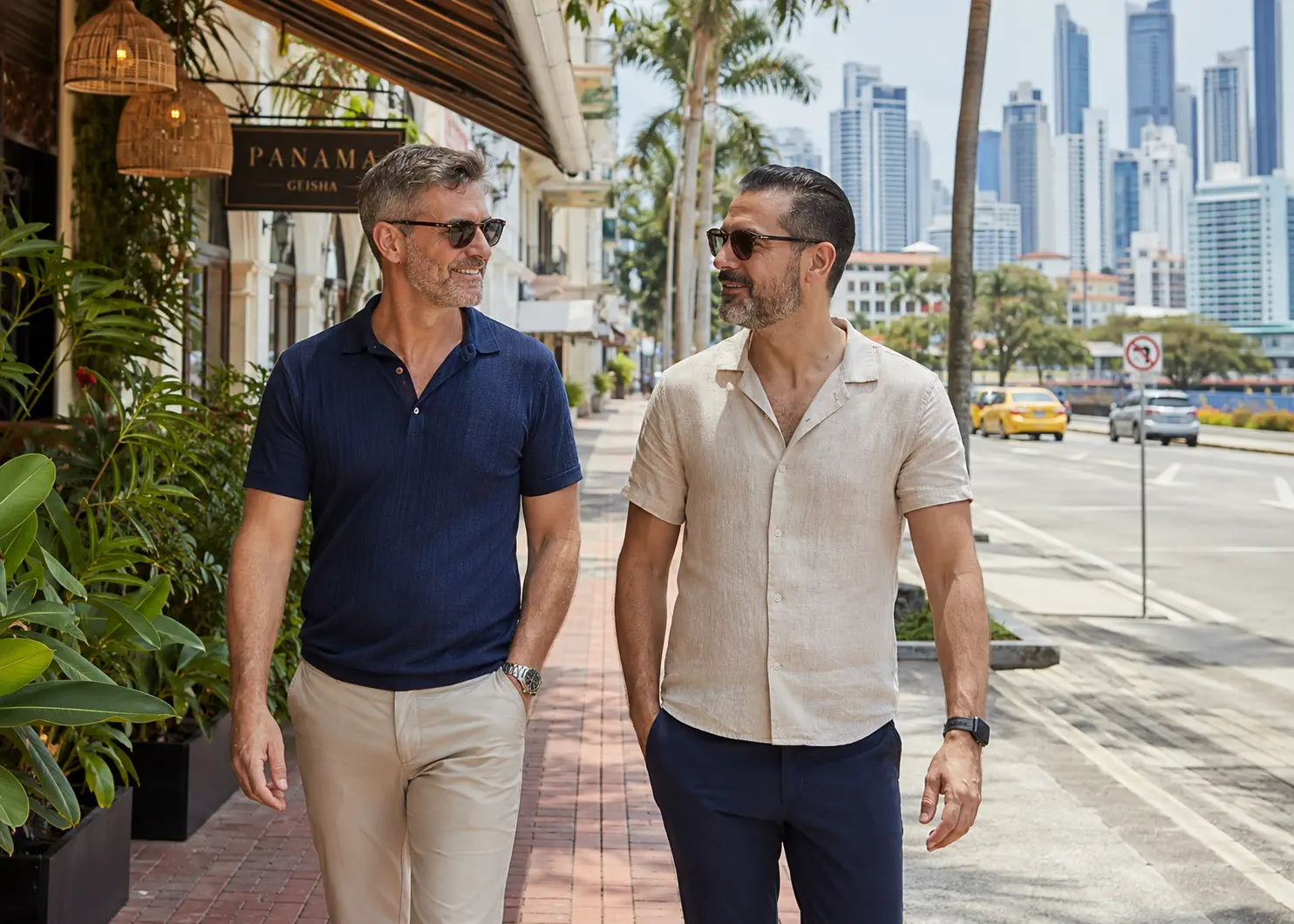
In Panama City, being a gay couple is largely a non-event. We spent our April 2026 research trip moving through the city as two obviously-together American men — restaurants, hardware stores, the metro, attorney offices, clinics — and the reaction was a consistent, city-wide shrug. Not celebration. Not hostility. Indifference, which for daily life is exactly what you want.
The city has actual, findable gay infrastructure, too. BLG in Bella Vista is the iconic gay bar. XS Club is the big nightclub. Maluka has drag shows. El Sotano and El Apartamento are the gay-friendly sister venues, and HamMan is the only gay sauna in the country. Pride happens every June and has grown into a major event. It’s not Madrid — we ran a bar in Spain, so we have a calibrated sense of what a big-league scene looks like — but it’s a real, functioning gay social world, concentrated mostly in Bella Vista and El Cangrejo. Crucially, those are neighborhoods where you can find your people without already knowing someone.
Calibrate Your Expectations
Panama’s gay scene is real but low-key. Public affection between anyone — straight couples included — is more restrained here than in the U.S. Holding hands in Casco Viejo won’t cause a scene; a full make-out session at a neighborhood fonda would raise eyebrows regardless of who’s kissing whom.
Boquete: Why We Looked Hard and Said No
Every general retirement guide eventually points you toward Boquete — cooler mountain air, coffee farms, and one of the largest concentrations of North American retirees in Panama, commonly estimated at somewhere around 15 to 25 percent of a town of roughly 25,000 people. For straight retirees, that pitch holds up fine. We looked hard at it, and we ruled it out. You deserve to know why, because no “best places to retire” list is going to tell you.
Start with the infrastructure, because there isn’t any. Boquete has no gay bar. No equivalent of a Bella Vista or an El Cangrejo — no place where you can walk into a room and know, without asking, that you’re among your own community. What exists is small and private: word-of-mouth friend groups, a handful of gay-owned businesses, occasional informal meetups. Some longtime gay residents describe it as quietly workable, and we don’t doubt them. But “quietly workable if you already know people” is a very different proposition from what Panama City offers.
Then there’s the part that’s harder to source, and we’re going to say it anyway because that’s the point of this site. Spend real time in Boquete-focused expat Facebook groups and forums — we have — and you’ll repeatedly hit comment threads that go well past “we’re more conservative here” into territory that felt genuinely hostile: gun-rights posturing, dismissive or mocking comments about gay people, the homeschool-and-“traditional values” rhetoric that, in our experience, tends to travel together with open hostility toward couples like us. We didn’t run a scientific study of Boquete’s Facebook groups, and we won’t pretend to know what percentage of the town thinks this way. We can tell you what we saw, repeatedly, in the spaces where Boquete’s expat community talks to itself when it thinks outsiders aren’t reading.
If that pattern sounds familiar, it should. Plenty of small towns across Florida and the broader South have the same visible, vocal contingent, and gay people — including us — simply route around those towns when deciding where to live. Not because every resident shares those views; most probably don’t, and plenty would be perfectly kind to us in person. But you don’t get to vet your literal next-door neighbor before you sign a lease, and a town where that rhetoric is loud and unchallenged online is a town where you’re rolling dice on who’s actually around you. We apply the same instinct to Panama. Boquete didn’t fail some objective safety test. It failed our test — the one we’ve used for years — and we’d rather name that honestly than hide behind a vague “it wasn’t the right fit.”
The irony is hard to miss: a big part of why we’re leaving the U.S. is to get away from exactly this culture. We’re not going to trade it for a smaller, prettier version of the same thing with a volcano view.
To Be Fair to Boquete
Gay people do live in Boquete, including some who’ve formed their own small community group and find it workable. Panamanians themselves are generally not the source of the friction we’re describing — Panama’s own culture leans live-and-let-live. This is not a claim that Boquete is unsafe or that everyone there holds these views. It’s our honest account of a pattern we encountered, and the choice we made because of it. You’re capable of weighing it for yourself.
The Rest of the Interior
Outside the expat towns, rural Panama is traditional and Catholic, and attitudes skew older and quieter. Most residents almost certainly don’t care what two retired American men do — open hostility from Panamanians toward expats is genuinely rare, and the local mode is not-my-business rather than confrontation. But you won’t find gay venues, being visibly “out” is less common, and the support structures simply don’t exist. That’s tolerance, not acceptance, and if you’ve lived your adult life somewhere you never had to think about the difference, you’ll feel it.
| Location | What Gay Couples Can Expect |
|---|---|
| Panama City | Live and let live. Gay bars, clubs, the country’s one sauna, Pride in June. Bella Vista and El Cangrejo are neighborhoods where you can find community without already knowing someone. |
| Boquete | No gay infrastructure — no bar, no visible community, only private word-of-mouth networks. A vocal right-wing contingent within the expat population shows up loudly in the town’s online spaces. Workable for some; we passed. |
| Beach towns (Coronado, Bocas del Toro) | Expat- and tourist-driven tolerance. Gay-friendly in the casual sense, but no dedicated venues or organized community. |
| Rural interior | Traditional and conservative. Most residents likely indifferent to expats’ private lives, but discretion is the norm and support structures don’t exist. Tolerance, not acceptance. |
What Gay Couples Need to Consider Before Deciding
Beyond “will the neighbors like us,” there are structural questions every gay couple should work through before committing to Panama. These are the ones we worked through ourselves.
1. Can you both qualify for residency independently?
This is the make-or-break question. Since Panama won’t recognize your marriage for immigration, each of you needs your own qualifying basis — a lifetime pension of at least $1,000/month for the Pensionado, a $300,000 investment for the Qualified Investor Visa, or another program entirely. If only one of you qualifies, you need a plan for the other before you move, not after.
2. What happens if one of you dies?
Without recognition, there’s no automatic spousal inheritance under Panamanian law. Property titled in one partner’s name does not simply pass to the other. This is solvable — Panamanian wills, and for real estate, structures like a Private Interest Foundation with survivorship built in — but it must be deliberately constructed. This is arguably the single most important legal task on your list.
3. Who speaks for you in a hospital?
Next-of-kin status isn’t automatic either. Healthcare powers of attorney, executed in Panama under Panamanian law, close this gap. Do it early, not after the first emergency.
4. Who are you actually moving next to?
Panamanians are, in our experience and by broad reputation, not the problem. The variable is the expat community you’re embedding yourselves in — and expat communities import their politics. If part of your reason for leaving the U.S. is the culture war, research the specific town’s expat population with the same rigor you’d research its water pressure. The general retirement blogs will never do this for you, because they’re not written by or for gay people.
5. How “out” do you need your daily life to be?
Be honest with yourselves. If you’ve spent decades somewhere you never think twice about mentioning your husband to a stranger, the interior’s quieter norms may chafe more than you expect. Panama City will feel closest to what you’re used to. This is a temperament question, and only you can answer it.
6. Are you okay with the legal trajectory?
Panama is not on the verge of marriage equality. The 2023 Supreme Court ruling foreclosed the judicial route, and the legislature has shown no appetite for it. Public attitudes are shifting generationally, and advocacy groups like Fundación Iguales keep pushing — but if you’re moving, move for the Panama that exists now, not the one activists are working toward.
The Checklist: What Gay Couples Need to Do
Here’s the working list we built for ourselves. Every item on it exists because Panama’s law treats you as two legally unrelated individuals who happen to share an address.
- Confirm each partner’s independent visa path — Pensionado, Qualified Investor, or another program. Two complete applications, two sets of fees.
- Hire a Panamanian immigration attorney — required by law for the Pensionado anyway, and doubly valuable for a couple filing separately. We work with Carolina Tejada Vaprio at Morgan & Morgan, who has been direct with us, every time, about exactly where the same-sex gap shows up and where it doesn’t.
- Get apostilled documents for both partners — FBI background checks, income or pension letters, everything in duplicate because nothing is shared.
- Execute Panamanian wills for both partners — your U.S. will is not enough; without a local will, your partner may inherit nothing.
- Set up healthcare powers of attorney and directives in Panama — hospital next-of-kin status will not be assumed.
- Plan property ownership deliberately — decide whose name goes on the title and how the other partner is protected, whether through a foundation, the will, or both.
- Vet the expat community, not just the town — spend a few weeks reading the local expat Facebook groups and forums before you commit anywhere. That’s where a town tells you who it really is.
- Keep your U.S. estate documents current too — you’ll likely retain U.S. assets, accounts, and legal ties for years.
- Name each other on everything that allows it — bank accounts, insurance beneficiaries, emergency contacts. Redundancy is your friend.
- Visit before you commit — and rent first — Panama City and rural Chiriquí are different countries in everything but passport. Don’t buy anywhere you haven’t lived.
One Thing We’d Tell Every Couple
Do the estate planning before the furniture shopping. It’s tempting to spend your first months on apartments and appliance prices — we certainly have — but the wills and powers of attorney are what actually protect your relationship here. They’re also cheaper than a refrigerator.
So — Should You?
If what you need is legal equality, Panama will disappoint you, full stop. Your marriage becomes invisible at the border, and no amount of friendly neighbors changes what the Family Code says.
But if what you need is a place where two men can build a comfortable, affordable, largely unbothered life — with real healthcare, a dollar economy, a functioning gay scene in the capital, and legal tools that can reconstruct most of what marriage provides — Panama clears that bar. We wouldn’t be moving here otherwise. Just be deliberate about the second decision, the one the retirement blogs skip: not just whether Panama, but where in Panama. For us, the calculation was simple. We wanted to live somewhere we wouldn’t have to think about it. Panama City, imperfect as it is, gets us closer to that than anywhere else in the country.
Eyes open. Documents signed. Then come on down.
Sources & Verification
- Official: Panama’s Family Code and Code of Private International Law on non-recognition of same-sex marriage; the March 2023 Supreme Court ruling against a constitutional right to same-sex marriage; the 2024 National Assembly effort to add sexual orientation to anti-discrimination law, which was blocked.
- Firsthand: Brian and Kent’s own experience moving through Panama City as a visibly gay couple during their April 2026 research trip, and their direct reading of Boquete-focused expat Facebook groups and forums (explicitly not a scientific study — an honest account of a repeated pattern they personally observed).
- Community: The estimate that North American retirees make up roughly 15–25% of Boquete’s population, and general characterizations of gay community infrastructure (or its absence) in Boquete, beach towns, and the rural interior.
Facts and prices in this article last verified: April 2026.
Brian & Kent
We’re a gay couple relocating from St. Petersburg, Florida to Panama City — and documenting every step as we go. Brian, a former attorney, is applying for the Pensionado visa based on Social Security income; Kent handles the on-the-ground research and plans to apply for the Qualified Investor Visa after we sell our Florida home. Everything on this site comes from our own research, our own attorney meetings, and our own mistakes.