Gay Men’s Health in Panama
PrEP in Panama: Can You Actually Get It? (Yes — Here’s How)
We’re both on PrEP, and staying on it is a line item in our own relocation plan — right next to the visa and the movers. Here’s everything we’ve verified about getting PrEP in Panama, and what we’re still confirming on the ground.
 Brian & Kent · GayExpatsPanama.com · Updated July 2026
Let’s start with a disclosure most relocation blogs would never make: we’re both on PrEP. Have been for years. So “can we keep getting PrEP in Panama?” isn’t an abstract research question for us — it’s on the same planning list as Brian’s Pensionado application and the sale of our Florida house. A gap in coverage isn’t an inconvenience; it defeats the entire point of the medication.
If you’re a gay man on PrEP considering Panama, you’ve probably searched this exact question and found almost nothing useful. Here’s what we’ve verified — including one piece of genuinely surprising good news — plus the honest gaps we’re still confirming in person.
The Short Answer
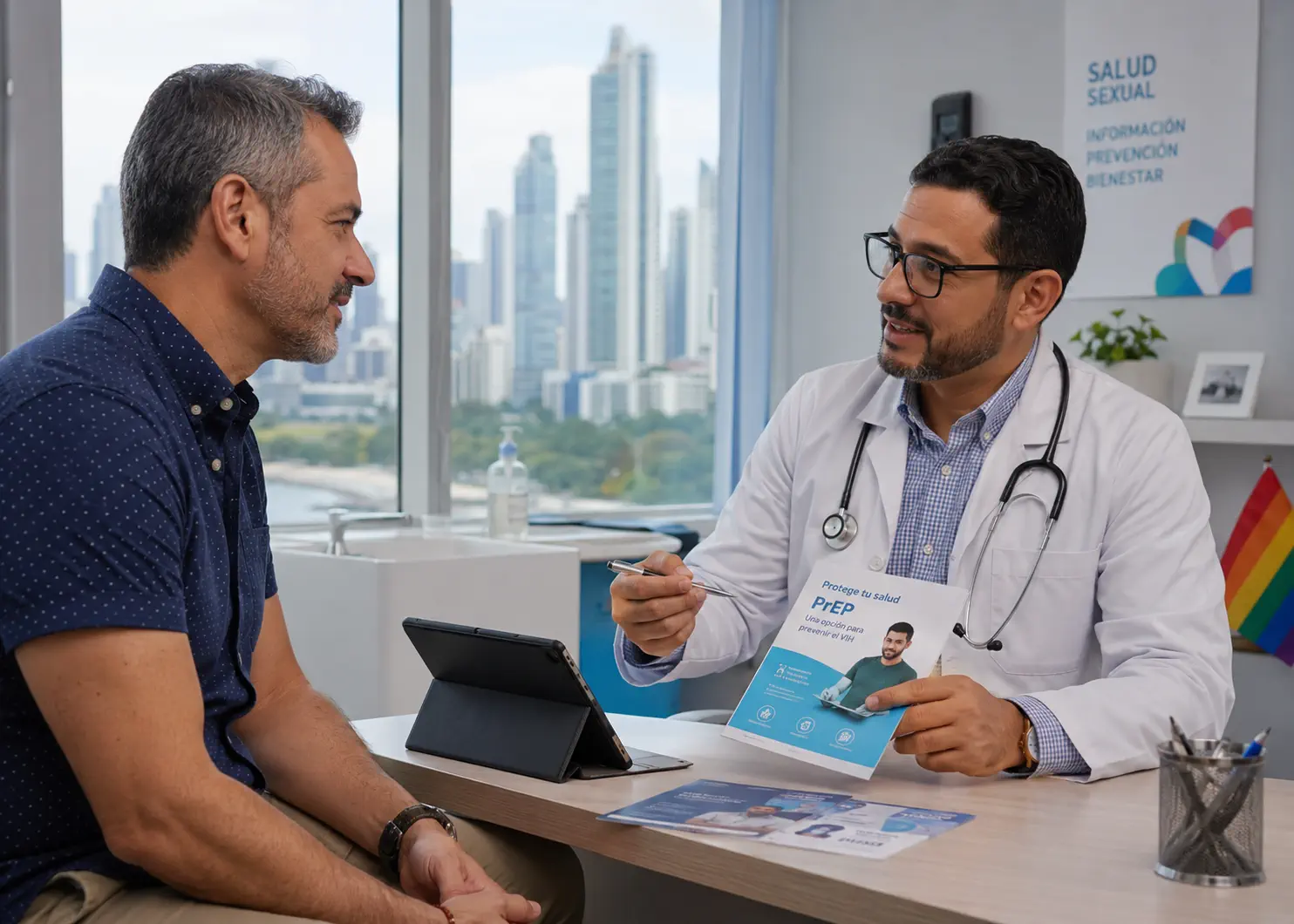
Yes, PrEP exists in Panama — and it’s more established than you’d expect. Panama was the first country in Central America with a national PrEP program, and the Ministry of Health now offers it free at 13 public health centers across nine regions. Generic Truvada is also a prescription medication here, available through the private system. What you should not do is assume the transfer is seamless: bring a bridge supply, get established with a doctor early, and plan the handoff like the medical logistics it is.
The Surprise: Panama Has a National PrEP Program
We’ll admit our expectations were low. Panama has no marriage equality, no anti-discrimination protections, and a legislature that blocked adding sexual orientation to the anti-discrimination law as recently as 2024 — we covered all of that in “Is Panama Gay Friendly?” So we assumed PrEP access would be a private-pharmacy workaround at best.
Wrong. Panama’s Ministry of Health (MINSA) launched a PrEP pilot in 2022, formalized a national regulatory framework for it in 2023, and became the first country in Central America with a national PrEP strategy. The public health system now dispenses PrEP free of charge at 13 health centers spread across nine regions of the country. As of April 2026, more than 3,000 people have gone through the program and roughly 1,800 are actively enrolled.
It’s the same public health system that explicitly names hombres que tienen sexo con hombres — men who have sex with men — as a priority population for the program. The law won’t recognize your marriage, but the health ministry will hand you HIV prevention medication for free. Panama’s contradictions run in both directions, and this one runs in ours.
PrEP in Panama — The Numbers (April 2026, MINSA)
Those last two rows belong together. Panama recorded 1,750 new HIV cases in 2025, roughly 1,300 of them men, concentrated in the Panama City metro region. If you were looking for a reason to stay on PrEP after you move rather than quietly letting it lapse, that’s the reason. The epidemiology here is not an abstraction.
Where the Public Program Operates
The 13 centers span nine regions. The ones most relevant to expats: in the Panama City metro area, the health centers at Las Mañanitas, Río Abajo, and El Chorrillo; in Panamá Oeste, Altos de San Francisco and Artemio Jaén in Arraiján. The interior is covered too — including centers in Veraguas, Chiriquí (relevant if you’re eyeing the Boquete area despite our reservations), and Bocas del Toro.
The honest caveats about the public program
First: this is a public health program built for Panamanians in priority populations, and we have not yet verified how it handles foreign residents — whether a cédula or residency card is required for enrollment, or how a Pensionado-visa holder is processed. We’ll test this ourselves and update this page.
Second: it’s small. Roughly 1,800 active enrollees nationwide is a program with real capacity limits, not a walk-in pharmacy counter. Third: it runs in Spanish, in public clinics, in working-class neighborhoods like El Chorrillo. None of that is a problem — but it is a different experience from your telehealth app mailing a bottle to your door, and you should walk in knowing that.
The Private Route: A Prescription and a Pharmacy
The route most American expats will actually use, at least at first, is the private one — and it runs through Panama’s private healthcare system, which we’ve written about extensively in our healthcare series. A private doctor visit costs $20–$70, no referral needed. An infectologist or any physician comfortable with sexual health can evaluate you, order the baseline labs (HIV test, kidney function), and write the prescription.
Generic tenofovir/emtricitabine — generic Truvada, the standard daily PrEP — is a prescription medication in Panama, the same active combination dispensed by the MINSA program. Panama’s pharmacy system is genuinely good, with well-stocked national chains and accessible pharmacists.
Here’s where we stop and refuse to make up a number: we do not yet have a verified retail price for generic Truvada at a Panamanian pharmacy counter. Regional online pharmacies ship generics to Panama, and prices across Latin America for generic tenofovir/emtricitabine run dramatically below U.S. list prices — but “dramatically below” is not a dollar figure, and this site doesn’t publish prices we haven’t confirmed. Kent is pricing it at Arrocha, Metro Plus, and Farma Value counters, and this section will be updated with real receipts. That’s a promise, not a placeholder.
Ask by the generic name
At a Panamanian pharmacy or doctor’s office, “Truvada” may draw a blank stare while tenofovir con emtricitabina gets an immediate nod. Bring your prescription and medical records with the generic names on them. This applies to every medication you take, not just PrEP — brand names are the least portable part of American healthcare.
Our Actual Continuity Plan — Steal It
This is the plan we’re executing for ourselves. It assumes nothing works quickly, which is the correct assumption for any medical logistics in a new country.
- Land with a bridge supply. Before we move, we’re each arriving with the maximum supply our U.S. prescriptions allow — aim for 90 days — in original labeled bottles, with a copy of the written prescription and our medical records. Personal-use medication with documentation is the standard, boring way to enter a country; a plastic baggie of loose blue pills is how you create a very bad day at Tocumen.
- Get established with a doctor in the first month — not the month the bottle runs low. A $20–$70 private visit, baseline labs, and a local prescription while we still have 60+ days of runway. The goal is that the Panamanian supply chain is proven before the American one runs out.
- Choose the ongoing route. Private prescription and pharmacy for convenience, or the free MINSA program if enrollment as foreign residents proves straightforward. We’ll report back on both.
- Set the monitoring rhythm. PrEP isn’t just a pill, it’s a testing schedule — HIV testing and kidney-function labs on a regular cycle. Panama’s private labs make this easy and cheap by U.S. standards; the discipline of actually booking it is on you.
One thing we’re deliberately not counting on: our U.S. telehealth PrEP services. Those subscriptions are built around U.S. pharmacies and U.S. addresses, and international mail-order of prescription antiretrovirals into Panama is exactly the kind of gray-zone workaround that fails the month you need it most. The durable solution lives in Panama, not in a U.S. app.
“A gap in PrEP coverage isn’t an inconvenience — it defeats the entire point of the medication. So we planned the handoff like we planned the visa.”
What PrEP Doesn’t Do — And What’s Coming Next
MINSA has been making a public point of this lately, and it’s worth repeating: PrEP is protection against HIV, full stop. It does nothing for gonorrhea, chlamydia, syphilis, or herpes. If your PrEP routine in the States came bundled with regular full-panel STI testing, rebuild that bundle here — the private labs and $20–$70 doctor visits make it entirely doable.
And a genuinely encouraging note for the future: Panama is working with international health organizations to acquire lenacapavir, the new long-acting injectable PrEP recommended by the WHO and approved by the FDA. A country that was first in its region to adopt daily oral PrEP and is already maneuvering to get the twice-yearly injectable is a country treating HIV prevention as real public health policy, not a box to check. Credit where due.
The Bottom Line
Panama will not recognize your marriage, but it will help you stay HIV-negative — for free, if the public program works out, and cheaply through the private system if it doesn’t. Of all the compromises this country asks gay men to make, PrEP access turns out not to be one of them. Bring a bridge supply, connect with a doctor early, insist on generic names, and keep your testing rhythm. We’ll be doing exactly that, and everything we learn at the pharmacy counter and the clinic ends up on this page.
How we source this article
The program details, statistics, and center locations come from Panama’s Ministry of Health and Panamanian press reporting, current as of April 2026. We have not yet filled a PrEP prescription in Panama ourselves — that’s coming, and this page gets updated with firsthand prices and process notes as we do. Nothing here is medical advice; your prescribing doctor is the right person for dosing and monitoring questions.
Sources & Verification
- Official: Panama Ministry of Health (MINSA) statements on the national PrEP program — 13 dispensing centers across nine regions, 3,000+ people served, ~1,800 currently enrolled (April 2026); MINSA 2025 HIV statistics.
- Reported: Panamanian press coverage of the PrEP program and Panama’s lenacapavir acquisition efforts (2026).
- Not yet verified: Firsthand PrEP experience in Panama — we have not yet filled a prescription here. Pharmacy pricing and enrollment-process updates will be added from our own experience.
Facts and prices in this article last verified: July 2026.
Related Reading — Healthcare in Panama
- 01 PrEP in Panama: Can You Actually Get It?
- 02 LGBTQ+ Healthcare: PrEP, PEP, HIV Care, Affirming Doctors & Privacy
- 03 Health Insurance & Costs: An Honest Guide for U.S. Expats
- 04 Medical Emergencies, Medicare & What Every Expat Needs to Plan
- 05 Is Panama Gay Friendly? The Honest Answer
Brian & Kent
We’re a gay couple relocating from St. Petersburg, Florida to Panama City — and documenting every step of it here. Brian is applying for the Pensionado visa based on Social Security income; Kent handles the on-the-ground research and plans to apply for the Qualified Investor Visa after we sell our Florida home. Everything on this site comes from our own research, our own attorney meetings, and our own mistakes.