Healthcare in Panama · Part 3 of 8
If Something Goes Wrong: Medical Emergencies, Medicare, and What Every Expat Needs to Plan Before It Happens
The conversation nobody wants to have — and the one that could save your partner’s ability to make decisions for you.
 Brian & Kent · GayExpatsPanama.com · Updated April 2026
Here is the thing nobody’s blog post prepares you for: if one of us ends up in a Panamanian hospital, unable to communicate, the other one has no automatic legal right to be in that room, make decisions, or even be told what’s happening. Not because Panama is hostile to gay men — it mostly isn’t — but because Panama doesn’t recognize our relationship. At all. Legally, we are strangers.
We are writing this post because the medical emergency planning piece of the relocation puzzle gets collapsed into a few cheerful sentences about “excellent private hospitals” and “$20 doctor visits.” Those things are true. But they are not the full picture. Panama’s healthcare system impressed us. The legal exposure for an unmarried same-sex couple in a medical emergency did not.
This is the post we wish existed before we started researching.
Healthcare in Panama: The Complete Expat Guide
Eight articles covering every healthcare decision a Panama expat needs to make — from choosing insurance before you move to knowing when it's time to go back to the US for care.
- Health Insurance & Costs: An Honest Guide for U.S. Expats
- Healthcare by Location: What You Can Count On in Every Region
- Medical Emergencies, Medicare & What Every Expat Needs to Plan You are here
- Aging Well in Panama: Assisted Living Options for Expats
- Assisted Care by Location: A Region-by-Region Guide & Hiring Checklist
- When Do You Go Back? The Question Every Panama Expat Will Eventually Ask
- LGBTQ+ Healthcare: PrEP, PEP, HIV Care, Affirming Doctors & Privacy
- Prescription Medications in Panama
First: What Medicare Does and Does Not Do in Panama
Let’s clear this up completely, because we have seen a lot of confusion about it in Facebook groups.
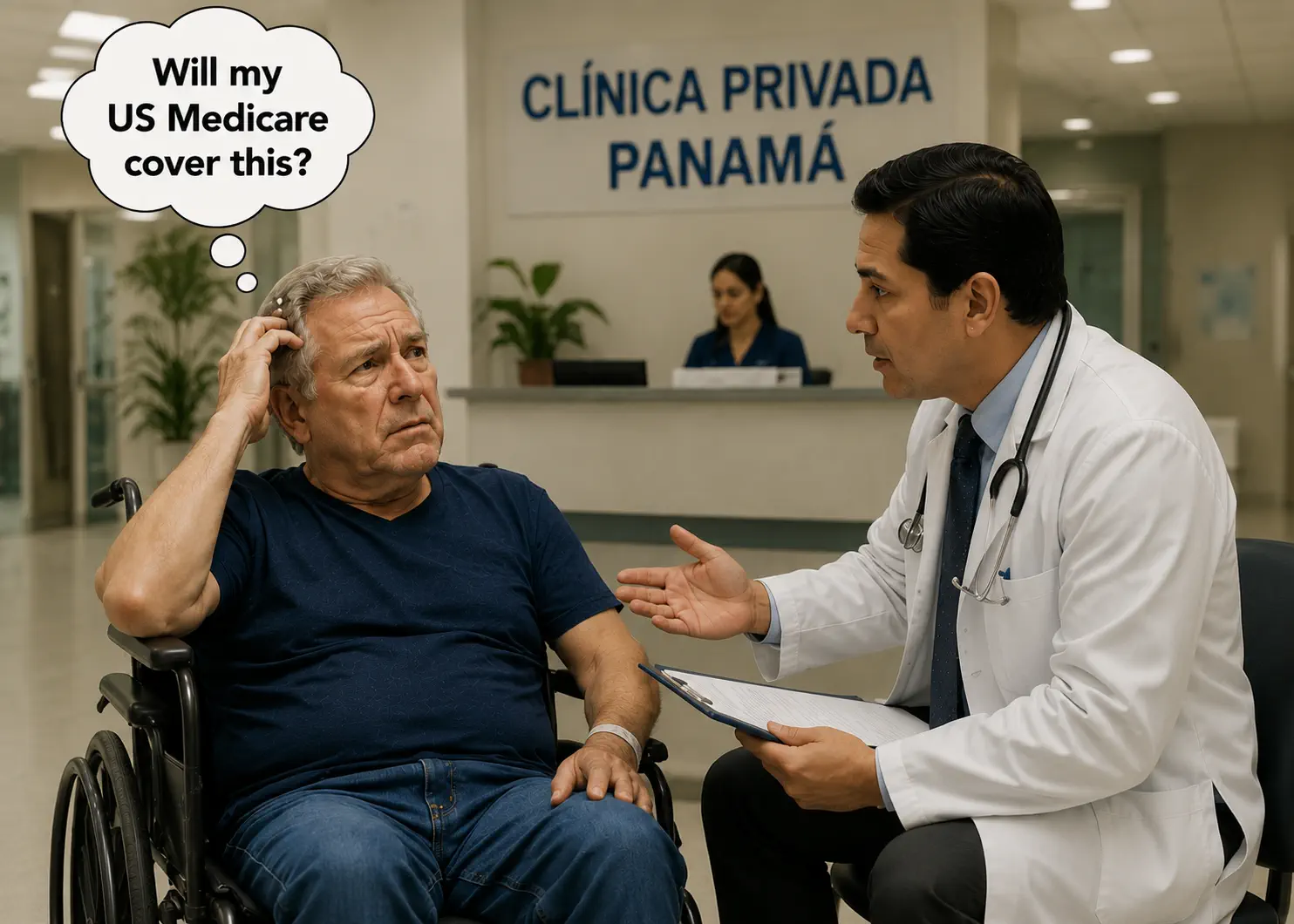
Traditional Medicare — Parts A and B — does not cover medical care outside the United States. That includes Panama. If you go to a private hospital, a clinic, or a pharmacy in Panama, your standard Medicare will not pay the bill. Not a reimbursement. Not a percentage. Nothing.
The Straight Answer
Traditional Medicare (Parts A and B) covers you in the U.S. only — all 50 states, U.S. territories, and certain very specific situations involving travel through Canada or Mexico. Panama is not on that list. The bill is yours.
This catches people off guard because Medicare feels so fundamental. You’ve paid into it for decades. You get it automatically at 65. It must cover you. It does not. Not here.
Should You Drop Medicare If You Move to Panama?
Almost certainly not, for two reasons. First, if you ever return to the U.S. — even temporarily, even for care — Medicare is your coverage there. Second, dropping Part B and then re-enrolling later triggers a lifetime penalty of 10% for every 12 months you were not enrolled. If you’re out for five years and come back, you’re paying 50% more for Part B permanently. Most expats keep Medicare active as a safety net and arrange separate coverage in Panama.
Part A is premium-free for most people who worked 10 or more years in the U.S. There’s virtually no reason to drop it. Part B costs around $185/month in 2025 ($206.50 in 2026) — a real number to weigh against the penalty math if you’re relocating permanently and plan never to return.
The Medicare Advantage Question — And the Legal Risk Nobody’s Talking About
Here is where it gets interesting, and where you need to read carefully.
Facebook groups have been buzzing about Medicare Advantage plans working in Panama. Some of this is true. Some of it is legally complicated in ways that could expose you to real risk.
What’s True: Some Advantage Plans Cover International Emergencies
Many Medicare Advantage plans include a worldwide emergency benefit. In a genuine medical emergency — think heart attack, stroke, serious accident — some Advantage plans will cover emergency care abroad, typically up to a lifetime cap (often $50,000–$250,000 depending on the plan) after a deductible. You generally pay upfront, then submit receipts for reimbursement. This is not the same as routine care — it’s emergency-only coverage.
What’s Also True: The Panama Clinic Now Accepts Some Advantage Plans Directly
In August 2025, The Panama Clinic — one of Panama’s most advanced private hospitals — announced that it now accepts Medicare Advantage plans, making healthcare more accessible for U.S. retirees and expatriates. This is real. The same announcement confirmed acceptance of GEHA and Federal Blue Cross and Blue Shield plans as well.
This is genuinely significant. Instead of paying the full bill out of pocket and filing for reimbursement later, Advantage plan members can present their insurance card at The Panama Clinic and be billed directly. The Panama Clinic also accepts TRICARE, FMP, and CHAMPVA with direct billing. It is the only hospital in Panama with a rooftop helipad, and it holds TEMOS international accreditation for medical excellence.
The Panama Clinic — Insurance Pre-Registration
Medicare Advantage members can pre-register by sending a photo of the front and back of your insurance card to se*****@*************ic.com or WhatsApp to +507-6313-3778. Do this before you need it.
This is a genuine development and we do not want to undersell it. But it applies to one hospital in Panama City. It does not apply to every hospital, every plan, or anywhere outside Panama City. Not all Advantage policies are accepted, and you must confirm with both the hospital and your insurer before assuming coverage applies.
What’s Legally Complicated: The Residency Requirement
Here is the part of the conversation that tends to get glossed over, and we think it deserves direct treatment.
Read This Before You Assume Your Advantage Plan Covers You as a Permanent Panama Resident
Medicare Advantage plans have a legal residency requirement. Under federal regulation (42 CFR 422.50(a)(3)), enrollment requires that you maintain your primary residence within the plan’s U.S. service area. If you relocate to Panama permanently, you may no longer meet the legal definition of a plan member in good standing.
Under 42 CFR 422.50(a)(3), enrollment in a Medicare Advantage plan requires permanent residence within the plan’s service area. The CMS Medicare Managed Care Manual defines this as your “primary residence” and permits MA organizations to verify it through voter registration, driver’s licenses, tax records, or utility bills.
The consequences of extended absence from your service area are codified in 42 CFR 422.74(d)(4): an MA plan must disenroll any member who has “left the service area for more than 6 months.” The 12-month visitor/traveler exception applies only when the beneficiary remains within the United States. Foreign travel does not qualify.
What this means in plain terms: if you move to Panama permanently and maintain a U.S. address just to keep your Advantage plan — even a family member’s address or a mail forwarding service — you are misrepresenting your residence to a federal program. Medicare Fraud, Waste and Abuse laws apply. No CMS-approved Medicare Advantage plans exist for Americans living permanently abroad.
We are not saying this to be alarmist. We are saying it because we have seen people in expat Facebook groups advise each other to “just use your mom’s address in Ohio.” That advice has legal consequences. You should understand them before you follow it.
“Just use a U.S. address” is advice worth understanding — including the federal statute it may put you in conflict with.
The practical reality: many people do this, nothing happens, and they get on with their lives. Plans don’t automatically audit your residency. But if you file a large claim and the plan decides to verify your primary residence, your claim could be denied and your enrollment terminated. In a worst-case medical scenario, that is a catastrophic outcome.
Medicare Supplement Plans (Medigap) — The Other Option People Get Wrong
If Medicare Advantage is the plan type with the residency fraud problem, Medigap — Medicare Supplement insurance — is the one with the 60-day misunderstanding. Both matter, and they work very differently for expats.
What Medigap Actually Is
Medigap plans (labeled A through N, though not all letters are active) are sold by private insurance companies to fill the gaps in traditional Medicare — covering things like copayments, coinsurance, and deductibles that Medicare doesn’t pick up. Several Medigap plans also include a foreign travel emergency benefit. The plans that include it are C, D, F, G, M, and N. Plans C and F are no longer available to new enrollees after 2020, so for most people relocating now, Plan G and Plan N are the relevant options.
The Foreign Travel Benefit — What It Actually Covers
Medigap Foreign Travel Emergency Benefit — Exact Terms (2026)
The 60-Day Rule Is a Hard Stop
If you move to Panama and stay longer than 60 days — which, as a resident, you will — the Medigap foreign travel benefit provides zero coverage for any emergency after day 60. This is not a soft limit or a gray area. It is a hard cutoff built into the federal benefit structure. A plan that sounds like a $50,000 international safety net is, for a permanent resident, essentially no safety net at all after the first two months.
There is also the $50,000 lifetime cap to reckon with. A single serious hospitalization — a cardiac event, a significant surgical complication, a stroke with ICU time — can consume that entire lifetime maximum in one admission. Once it is spent, the foreign travel benefit is permanently exhausted regardless of what you continue paying in premiums.
The Medigap Residency Question — And Here’s the Good News
Medicare Advantage plans have a federal residency requirement — you must maintain your primary U.S. residence within the plan’s service area or face disenrollment. Medigap plans work differently. You must be a resident of a U.S. state when you first purchase a Medigap plan, but after that, the plan continues in force for as long as you pay the premiums — regardless of where you live. There is no federal residency requirement for maintaining an existing Medigap policy.
Medigap and Expat Residency — The Legal Distinction
Maintaining a Medigap plan while living permanently in Panama is legally straightforward, as long as you purchased the plan while you were a U.S. state resident and continue paying premiums. You do not need to maintain a U.S. address to keep the plan active. There is no residency fraud concern with Medigap — unlike Medicare Advantage.
The best time to purchase Medigap is during your initial Medicare enrollment period, when you have guaranteed-issue rights — meaning insurers must sell you a plan and cannot charge more for pre-existing conditions. If you skip Medigap at enrollment and try to purchase it later, you may face medical underwriting, higher premiums, or outright denial depending on your health.
Does Any Panamanian Hospital Accept Medigap Directly?
No. Medigap is a supplement to Medicare, not a standalone insurance product — it was never designed to interface with foreign hospitals independently. The process is always the same: pay the full bill at the hospital, collect itemized receipts, and submit a reimbursement claim when you return. Keep originals and make copies before you submit anything.
The Honest Summary on All Medicare Options in Panama
| Coverage Type | What It Actually Does in Panama | Our Take |
|---|---|---|
| Traditional Medicare (Parts A & B) | Nothing in Panama. Zero reimbursement. | Keep it as a safety net for U.S. visits. Don’t drop Part A. Weigh Part B against the penalty math. |
| Medigap — Foreign Travel Benefit | Emergency care only. 80% after $250 deductible. $50,000 lifetime cap. First 60 days only. No direct billing. No evacuation. | Not a solution for permanent residents. Useful for U.S. coverage and guaranteed-issue rights. No residency fraud concern. |
| Medicare Advantage — Emergency Benefit | Emergency care only at participating hospitals. Direct billing at The Panama Clinic. Caps and deductibles apply. | Legitimately useful at The Panama Clinic. But comes with the residency compliance issue. |
| Medicare Advantage — Full-Time Resident | Technically out of compliance with federal residency requirements if Panama is your permanent home. | Understand the legal risk clearly before relying on this. Consult a Medicare specialist who works with expats. |
| Local Panama Health Insurance | Covers routine and emergency care at participating Panamanian hospitals. Pre-existing conditions typically excluded. | Best option for routine care. Get it early — enrollment becomes harder after age 74. |
| International Expat Health Insurance | Covers you in Panama and other countries. More expensive but more portable. | Worth considering if you travel frequently or want coverage beyond Panama’s borders. |
The Coverage Stack We’re Building
After our April 2026 research, this is the coverage approach we’re planning for ourselves:
Our Planned Coverage Stack
Medical Evacuation: The Number You Need to Know
Panama City has excellent private hospitals. If you’re in Panama City and reach one of them, you will likely be well cared for. The scenario that makes expats most vulnerable is being seriously ill somewhere outside Panama City — the interior, the coast, the highlands near Boquete — where local facilities may not have what a serious situation requires.
Based on data from past air ambulance transfers, the average emergency medical flight to the U.S. costs $50,820. Evacuations from some areas cost significantly more — between $80,000 and $250,000 without coverage. A commercial medical stretcher flight still runs $25,000–$30,000. Annual medical evacuation membership through a service like MedJet typically costs a few hundred dollars per year. There is no version of this math where skipping that membership makes financial sense.
Medical Evacuation — What to Get
MedJet Assist and Global Rescue are the two most-cited services among expats. MedJet will transport you to a hospital of your choice — not just the nearest facility — which matters if you want to end up at a specific U.S. institution. Verify that your plan covers Panama specifically and confirm enrollment age limits. These are not travel insurance substitutes; they are evacuation-only services.
The Legal Problem Gay Couples Need to Solve Before They Need It
This is the section most healthcare guides skip entirely. We are not skipping it.
Panama does not recognize same-sex marriage. The Panamanian Supreme Court ruled in 2023 that there is no constitutional right to same-sex marriage, and the country’s Family Code explicitly prohibits it.
Here is what that means in a medical emergency: if Brian is unconscious in a Panamanian hospital, Kent has no automatic legal standing. Not as a spouse. Not as next of kin. The hospital staff may allow him in the room out of human decency — many will. But they are not required to. And they are not required to share medical information with him, accept his decisions, or defer to his judgment on Brian’s care. That authority defaults to blood relatives, even if those relatives are estranged, unhelpful, or on another continent.
This is not hypothetical. It is the legal reality, and it is also correctable.
The Documents You Need — Before You Move
Legal Documents Every Gay Couple Needs for Panama
We are asking our attorney — Carolina Tejada Vaprio at Morgan & Morgan — about the correct Panamanian forms for healthcare directives at our next meeting. We’ll update this post when we have specifics.
Do This Before You Pack
Execute both a U.S. healthcare power of attorney and a Panamanian one. The U.S. document may not carry legal weight in a Panamanian hospital. A document executed under Panamanian law — notarized, properly witnessed — gives your partner the clearest legal footing. This is not expensive. It is the most important thing on this list.
What Happens in an Actual Emergency in Panama City
Panama’s emergency number is 911. It works. Ambulance response in Panama City is generally reasonable. Outside the city, response times vary significantly — another reason evacuation coverage matters more in the interior.
| Hospital | Notes | Insurance |
|---|---|---|
| The Panama Clinic | TEMOS-accredited. Rooftop helipad. 30+ specialties. Best international patient services. Panama City. | Medicare Advantage direct billing, GEHA, Federal BCBS, TRICARE, CHAMPVA, FMP |
| Hospital Punta Pacífica | JCI-accredited. Johns Hopkins affiliation. Panama City. | Widely accepted by international insurers — verify with your plan |
| Hospital Nacional | Strong general hospital. Bella Vista, Panama City. | Verify with your plan |
| Hospital Mae Lewis | Top private hospital in western Panama. Serves Boquete and surrounding areas. David. | Accepts Aetna, Cigna, and TRICARE with direct billing |
The standard operating procedure at most Panama hospitals: you pay upfront, then file for reimbursement with your insurer. The Panama Clinic and Hospital Mae Lewis are notable exceptions with certain plans. Keep receipts. Make copies before submitting them.
The Scenario Nobody Wants to Think About
If one of us has a massive stroke or is in a serious accident, the other one needs to be able to: get into the hospital room; speak with doctors; make decisions about care; access bank accounts to cover bills; and — if it comes to it — make end-of-life decisions in accordance with what we’ve discussed privately for years.
None of that is automatic in Panama. All of it is achievable with the right legal documents in place ahead of time. The documents cost a few hundred dollars. The evacuation membership costs a few hundred dollars annually. The insurance stack costs money every month. The alternative — being the person standing outside a hospital room with no legal authority — costs something that doesn’t have a dollar amount.
The documents cost a few hundred dollars. The alternative is standing outside a hospital room with no legal authority while someone you love is inside.
We are not catastrophizing Panama. The hospitals are good. The costs are low. The care, in our experience researching, is genuinely impressive. We are simply saying: make the plan while you can, not while you need it.
The Action List
Before You Relocate — Medical Emergency Checklist
One More Thing
Tell someone in the U.S. — a sibling, a trusted friend, an attorney — where your documents are and what your wishes are. In an extreme emergency, your partner may need backup. Make that backup reachable.
Sources & Verification
- Official: Traditional Medicare (Parts A/B) foreign coverage exclusions; Medicare Advantage residency requirements under 42 CFR § 422.50(a)(3) and disenrollment rules under 42 CFR § 422.74(d)(4); Medigap foreign travel emergency benefit terms (deductible, coverage percentage, lifetime maximum, 60-day limit).
- Official: Panama’s 2023 Supreme Court ruling against a constitutional right to same-sex marriage, and the Family Code’s prohibition on same-sex marriage.
- Community: The Panama Clinic’s August 2025 announcement of Medicare Advantage, GEHA, and Federal BCBS acceptance; hospital-by-hospital insurance acceptance details; medical evacuation cost ranges; local and international insurance premium figures.
- Firsthand: Brian and Kent’s planned personal coverage stack, developed from their April 2026 Panama research.
- Not yet verified: The specific Panamanian legal forms for healthcare power of attorney and advance directives — we are asking Carolina Tejada Vaprio at Morgan & Morgan directly and will update this article once confirmed.
Facts and prices in this article last verified: April 2026.
Brian & Kent
A gay couple based in St. Petersburg, Florida, researching and relocating to Panama in real time. Brian is applying for a Pensionado visa. Kent is the primary researcher. The research is current, the attorney meetings are recent, and the prices are from this year.