Daily Life & Practical Panama
Can You Drink the Tap Water in Panama?
The honest, location-by-location answer — from Panama City to Bocas del Toro and everywhere in between.
 Brian & Kent · GayExpatsPanama.com · April 2026 Research Trip
Before our April 2026 research trip, one of our most-Googled questions about Panama was also the most basic: can you drink the tap water? The answer we found before we left was maddeningly inconsistent — some sources said yes everywhere, some said no everywhere, and a few made it sound like drinking from a Panamanian faucet was roughly equivalent to swimming in it. None of them gave us what we actually wanted: a clear, location-by-location breakdown with honest caveats.
This is that article. The short answer is that Panama City’s municipal water is genuinely safe by most standards — something that surprises a lot of American expats — while water safety in rural areas, small beach towns, and the islands is a more complicated story. Where you land in Panama matters enormously, and the reasons behind those differences are worth understanding.
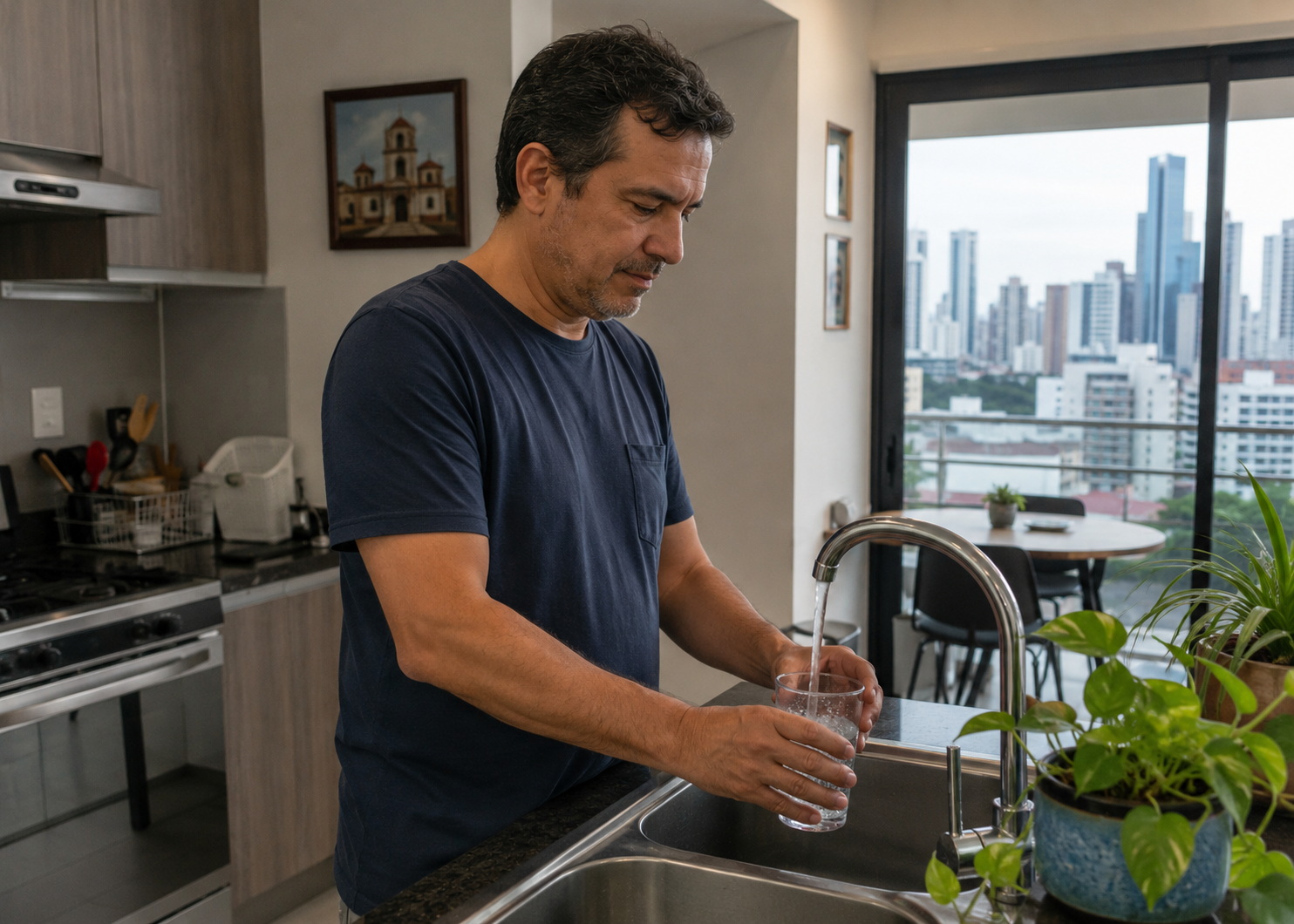
But let me be crystal clear, during our 13-day stay in Panama City in April 2026, we routinely drank tap/faucet water in our hotel. We never had any problems.
Panama’s Water System: The Basics
Panama’s urban water supply is managed by IDAAN — Instituto de Acueductos y Alcantarillados Nacionales, the government agency created in 1961 and responsible for water and sanitation in all urban areas with populations above 1,500. If you’re living in Panama City, David, or another mid-sized city, you’re almost certainly on IDAAN water. In rural areas, roughly 3,300 separate community water systems operate independently, managed by local Rural Water Boards (called JAARs) or health committees — with widely varying levels of infrastructure and oversight.
Panama City’s supply comes primarily from Lago Alajuela (also known as Madden Lake), fed by the Chagres River. The treatment infrastructure has roots going back to the Canal Zone era, when the United States built and maintained a water plant to high American standards. That legacy — combined with subsequent investment — means the capital’s water treatment process is genuinely solid by Latin American standards. By most independent assessments, the treatment itself is comparable to what you’d find in a U.S. municipal system.
What IDAAN water actually goes through
Panama City’s treatment process involves sedimentation, filtration, chlorination for disinfection, pH adjustment with lime to reduce pipe corrosion, and the addition of zinc orthophosphate to form a protective coating inside distribution pipes. It’s a multi-stage process — not just “add chlorine and ship it.”
Panama City: Safe from the Treatment Plant — Mostly
The honest consensus from long-term expats, engineers who’ve toured IDAAN facilities, and independent assessments is this: Panama City’s municipal water treatment is good, and most people drink it from the tap without problems. Several expats on forums like Expat.com report drinking Panama City tap water daily for years without incident. One member described having an American chemical engineer friend review an IDAAN treatment facility: his conclusion was that the process was as good as anything in the United States.
That said, “good treatment” and “safe at your faucet” are not automatically the same thing. The treatment plant does its job. What happens between the plant and your tap is a different question.
“The problem may not be the water treatment plant — it’s the pipes that bring the water to you.”
Older buildings in Panama City — particularly in areas like El Cangrejo, Bella Vista, and the former Canal Zone — can have aging internal plumbing. Some buildings use roof-mounted storage tanks (called tanques), which collect treated water and hold it until it flows down to apartments. If those tanks are not cleaned regularly, they can introduce contamination that has nothing to do with IDAAN’s treatment process. A building’s tank maintenance schedule is something worth asking about before you sign a lease.
The roof tank issue
Many Panama City apartment buildings store municipal water in rooftop cisterns before distributing it through the building. If those tanks go uncleaned for months or years, bacterial contamination becomes a genuine risk — independent of how clean the municipal supply is. Ask your building administrator or landlord how frequently the tanks are cleaned and whether there are records. In newer construction, this is less of a concern.
There’s also an occasional boil-water advisory situation. Panama, like every city in the world, issues advisories when there’s a water system disruption. Heavy rainfall causing landslides — which happens during rainy season — can temporarily compromise the Chagres River supply, and has on at least one notable occasion left Panama City residents without reliable potable water for weeks. These events are the exception, not the rule, and when they happen the public is notified (the same way cities in the U.S. handle it). But they’re worth knowing about.
The chlorine taste is real, too. Several expats describe Panama City water as noticeably chlorinated — perfectly safe, but not pleasant if you’re used to filtered water at home. Many expats in Panama City use a countertop or under-sink filter purely for taste, not for safety reasons.
Panama City Tap Water — What to Know
Other Urban Areas: David, Boquete, Chitré, Coronado
The picture in Panama’s other cities is generally positive, with one significant exception. David, Chitré, and Coronado receive consistent IDAAN service and are broadly considered safe for tap water by the expat community. Boquete — the mountain town in Chiriquí province popular with North American retirees — manages its own water supply independently (it’s the only municipality in Panama exempt from IDAAN’s jurisdiction), and opinions on its water are genuinely mixed.
In Boquete, the water is generally described as clear and cold, coming from the highlands, and many long-term expats drink it without issue. But the area has had documented bacterial contamination episodes — including one reported incident where hundreds of people were sickened and an emergency public health warning was broadcast across local radio. The cause was not the water source itself but contamination introduced during maintenance work on the distribution system, when dirt and bacteria entered the pipes during repairs. This isn’t unique to Boquete — it can happen anywhere — but the Boquete water system has had enough of these episodes that cautious expats there tend to filter restaurant drinking water even when they’re comfortable with their own home supply.
The maintenance contamination problem
Across Panama, one of the more common causes of water quality incidents isn’t the treatment plant — it’s what happens when the distribution system is repaired. When pipes are opened for maintenance, contaminants can enter the system before it’s flushed and re-pressurized. In established expat communities like Boquete, experienced residents often switch to bottled water for a few days after a visible water main repair in their neighborhood.
Bocas del Toro: A Different Situation Entirely
Bocas del Toro is where the answer changes definitively. The archipelago is one of the few places in Panama where the unanimous advice — from expats, travel sources, and even the Smithsonian Tropical Research Institute station on Isla Colón — is to not drink the tap water. Bocas Town has a water treatment facility, but the system is old, the infrastructure is island-limited, and the distribution pipes are in variable condition. Even people who describe the treated water as technically passable note that it can pick up contaminants between the treatment point and the faucet.
The practical reality in Bocas is that most long-term residents don’t use tap water for drinking at all. The two most common alternatives: five-gallon refillable water containers (purchased from refill stations around town at roughly $0.25 per refill in Bocas Town), and rainwater collection systems with multi-stage filtration. One resident described their rainwater setup: water from the roof washes through a “roof washer” that removes initial debris, then into a storage tank, then through a string filter, then through a second filter, and finally through a micro-filter in the kitchen. Three filtration stages, because the system is that unreliable.
The other islands in the Bocas archipelago — Bastimentos, Carenero, Solarte — are even more variable. Many rely entirely on rainwater collection with no connection to any municipal system. The advice here is simple: ask your host specifically, and when in doubt, use bottled or filtered water for everything including teeth brushing.
Bocas del Toro — Non-Negotiable
Do not drink the tap water in Bocas del Toro. This applies to the main island (Isla Colón) and to all the surrounding islands. Use bottled water or refill stations for drinking, and for brushing teeth if you’re being cautious. Ice in drinks is a separate question — ask whether it’s made from purified water. Many hotels that have been in Bocas a while have figured this out and filter their own ice and drinking water; many newer or cheaper spots haven’t.
San Blas (Guna Yala), Darién, and Remote Communities
Panama’s most remote regions — the San Blas islands, the Darién, indigenous territories — are a different category entirely. There is no IDAAN infrastructure here. Water comes from rainwater collection, streams, rivers, or localized purification systems. Some communities in the Guna Yala region have solar-powered purification systems developed specifically to serve island communities where grid infrastructure doesn’t exist. The quality varies community by community and season by season.
For any travel to these areas, bottled water is the baseline. Purification tablets or a quality filter bottle (the kind rated for protozoa and bacteria) are worth packing. This isn’t alarmism — it’s the same approach you’d take anywhere without verified centralized water treatment.
Why Rural and Island Water Is Less Reliable: The Actual Causes
It’s worth understanding the mechanics here, because “the water isn’t safe” without context doesn’t help you make decisions.
Aging and limited distribution infrastructure
Even where treatment exists, older pipes can leach contaminants — lead, iron, sediment — into the water before it reaches your tap. In island settings, pipes may run above ground, exposed to heat and physical damage. Some of the distribution infrastructure across Panama dates back decades with inconsistent maintenance histories.
Combined sewer systems
In older parts of Panama — including some areas of Colón — stormwater and wastewater run through the same pipe system. During heavy rainfall, the system can be overwhelmed, and raw sewage can enter waterways that feed into the supply chain. In 2025, the U.S. Army Corps of Engineers was actively working with Panama on Colón’s stormwater and wastewater system — which should tell you something about the scale of the infrastructure gap there.
Rainwater collection without adequate filtration
In areas without piped water, rainwater collection is common. On a zinc roof — standard construction across rural and coastal Panama — the first rain after a dry spell washes off whatever has accumulated: dust, bird droppings, zinc particles. Without a roof washer and multi-stage filtration, that water goes directly into the storage tank. Many homes have no filtration beyond the tank itself.
Agricultural and environmental runoff
In agricultural regions, runoff from farms can enter surface water sources. Panama has had documented water quality issues in areas where agricultural runoff reaches rivers and streams that communities draw from. This is more of a concern in the Azuero Peninsula and interior farming regions than in cities.
The “traveler’s gut” factor
There’s also a physiological dimension that’s easy to overlook. Even where water is technically safe by local standards, your gut microbiome may not be acclimatized to the microbial environment in Panama’s water. Long-term residents can often drink tap water that causes issues for visitors because their systems have adapted. This is why some expats report no problems with Panama City water while newly arrived visitors get sick — the water hasn’t changed, but who’s drinking it has.
What Expats Actually Do: The Practical Solutions
Five-gallon water jugs (bidones)
This is the most common solution across all of Panama, including in areas where tap water is technically safe. Five-gallon purified water jugs are available everywhere — supermarkets, dedicated water stores, and delivery services. Pricing we’ve seen referenced from the Panama expat community for delivered or store-purchased bidones typically runs around $1.50 to $3.00 per five-gallon jug, which for a two-person household covers drinking water comfortably for a week or more. A water dispenser (the standard hot/cold unit) sits on your counter, the jug loads into it, and that’s your drinking water. Simple, cheap, no infrastructure required.
Five-Gallon Water Jug — Approximate Panama Pricing
Note on those Bocas prices: we’re flagging these as reported by expats in the community, not prices we paid ourselves during our April trip. We didn’t visit Bocas. Treat those numbers as directionally accurate, not verified firsthand.
Under-sink and countertop filtration systems
In Panama City, where the tap water is safe but tastes heavily chlorinated, an under-sink reverse osmosis system is a popular choice for expats who don’t want to deal with jug deliveries. These filter chlorine, chlorination byproducts, and most other contaminants, producing water that tastes clean. A basic countertop pitcher filter (Brita-style) addresses the taste issue at a lower upfront cost. For areas with genuinely compromised water, a reverse osmosis or multi-stage filtration system is the serious option.
Rainwater collection with multi-stage filtration
In places like Bocas where the infrastructure is limited, some expats who own property set up rainwater systems with roof washers (which divert the first flush of water off the roof before collection) and then run it through a series of filters — sediment, carbon, and finally a micro-filter. This is a capital investment but eliminates ongoing jug costs for a household that stays put. It also dramatically reduces plastic waste, which in island communities with limited recycling infrastructure is a real consideration.
Refill stations
Throughout Panama, including in smaller towns and beach communities, you’ll find vending-machine-style water refill stations where you can fill any container with purified water. These are cheap and common. In Bocas Town specifically, several are available around town at the $0.25 per five-gallon price. They’re the economic middle ground between buying sealed bottled water (expensive and plastic-heavy) and full home filtration investment.
The Quick-Reference Summary by Location
| Location | Tap Water Safety | What Most Expats Do |
|---|---|---|
| Panama City | Generally safe; chlorine taste is notable; building tank age matters | Drink tap or use countertop filter for taste |
| David / Chitré / Coronado | Generally safe; IDAAN service | Drink tap; some use filters for taste |
| Boquete | Usually safe at home; restaurant water is more variable; occasional contamination events | Home tap is usually fine; bottled or filtered water at restaurants |
| Bocas del Toro (Isla Colón) | Not reliably safe — do not drink from tap | Five-gallon jugs or refill stations; filter for home use |
| Bocas — outer islands | Variable; mostly rainwater collection with no central treatment | Ask your host specifically; assume bottled/filtered |
| San Blas / Darién / remote areas | No centralized treatment; highly variable | Bottled water; bring filter or tablets |
| Rural interior | Depends on local JAAR system; highly variable | Ask locally; don’t assume; bottled as default |
A Few Things Worth Mentioning That Most Articles Skip
Ice
In Panama City and other cities with reliable tap water, restaurant ice is generally fine — it’s made from the same municipal supply. In Bocas and rural areas, the ice question is real: if you wouldn’t drink the tap water, the ice made from it is the same problem. Better hotels and established restaurants in Bocas have adapted and filter their ice water. Smaller spots may not have. Asking isn’t paranoid — it’s practical.
Brushing teeth
In Panama City, brushing your teeth with tap water is widely considered fine. In Bocas and remote areas, if you’re in the cautious camp (or a brand-new arrival with an unadapted gut), using filtered or bottled water for teeth brushing is reasonable. We’re not going to tell you it’s mandatory everywhere — that’s overcautious for the capital — but in Bocas it’s the sensible call.
Produce washing
In Panama City, produce is generally washed with municipal water, and this doesn’t appear to be a significant issue. In remote areas where water safety is genuinely uncertain, washing produce with bottled or filtered water — or using a diluted vinegar rinse — is standard expat practice.
Rainy season disruptions
Panama has a pronounced rainy season (roughly May through December). Heavy rainfall, particularly events severe enough to cause landslides, can temporarily affect water treatment capacity — Panama City has experienced this, and when it happens, the city issues advisories and recommends bottled water. Keeping a few days’ worth of bottled or jug water on hand during severe weather is sensible, the same way you’d keep bottled water for a hurricane in Florida.
Our actual plan for Panama City
For Panama City, where we’re planning to spend most of our time, we’re not going to stress about the tap water for things like cooking, coffee, or washing produce. We’ll likely put a countertop filter in the kitchen — not because we’re worried about safety, but because heavily chlorinated water makes bad coffee, and that’s a non-negotiable. For drinking water at home, we’re open to either filtered tap or a dispenser with delivered bidones, depending on what the building’s setup looks like when we’re actually there.
Sources & Verification
- Official: IDAAN’s role and history as Panama’s urban water authority (established 1961), and the multi-stage municipal treatment process for Panama City.
- Community: Water quality reports and practices for Panama City, Boquete, Bocas del Toro, and rural areas — including the Boquete contamination episode, Bocas refill station pricing, and jug/filtration cost ranges — synthesized from expat forums and community accounts.
- Firsthand: Drinking Panama City tap/faucet water without issue during our 13-day stay in April 2026.
- Not yet verified: Bocas del Toro water jug and refill pricing — reported by the expat community, not confirmed firsthand, since we did not visit Bocas during our April 2026 trip.
Facts and prices in this article last verified: April 2026.
Related Reading — Daily Life in Panama
Brian & Kent
We’re a gay couple relocating from St. Petersburg, Florida to Panama City in real time. Brian is applying for a Pensionado visa; Kent handles primary research. We document what we actually find — including the things that contradict what the relocation blogs say. GayExpatsPanama.com is written for LGBTQ+ expats and anyone else who wants the unvarnished version.