The Big Question
Is Panama Gay Friendly? The Honest Answer
The law says one thing, the street says another, and the brochures say nothing useful. Here’s what we actually found — as a gay couple who spent twelve days finding it.
 Brian & Kent · GayExpatsPanama.com · Updated July 2026
If you type “is Panama gay friendly” into a search engine, you’ll get two kinds of answers. Travel sites will tell you it’s a tropical paradise where everyone’s welcome. Rights databases will tell you it’s a country with no marriage equality, no anti-discrimination protections, and a Supreme Court that ruled against gay couples in 2023. Both are technically describing the same country. Neither tells you what it’s like to actually be here.
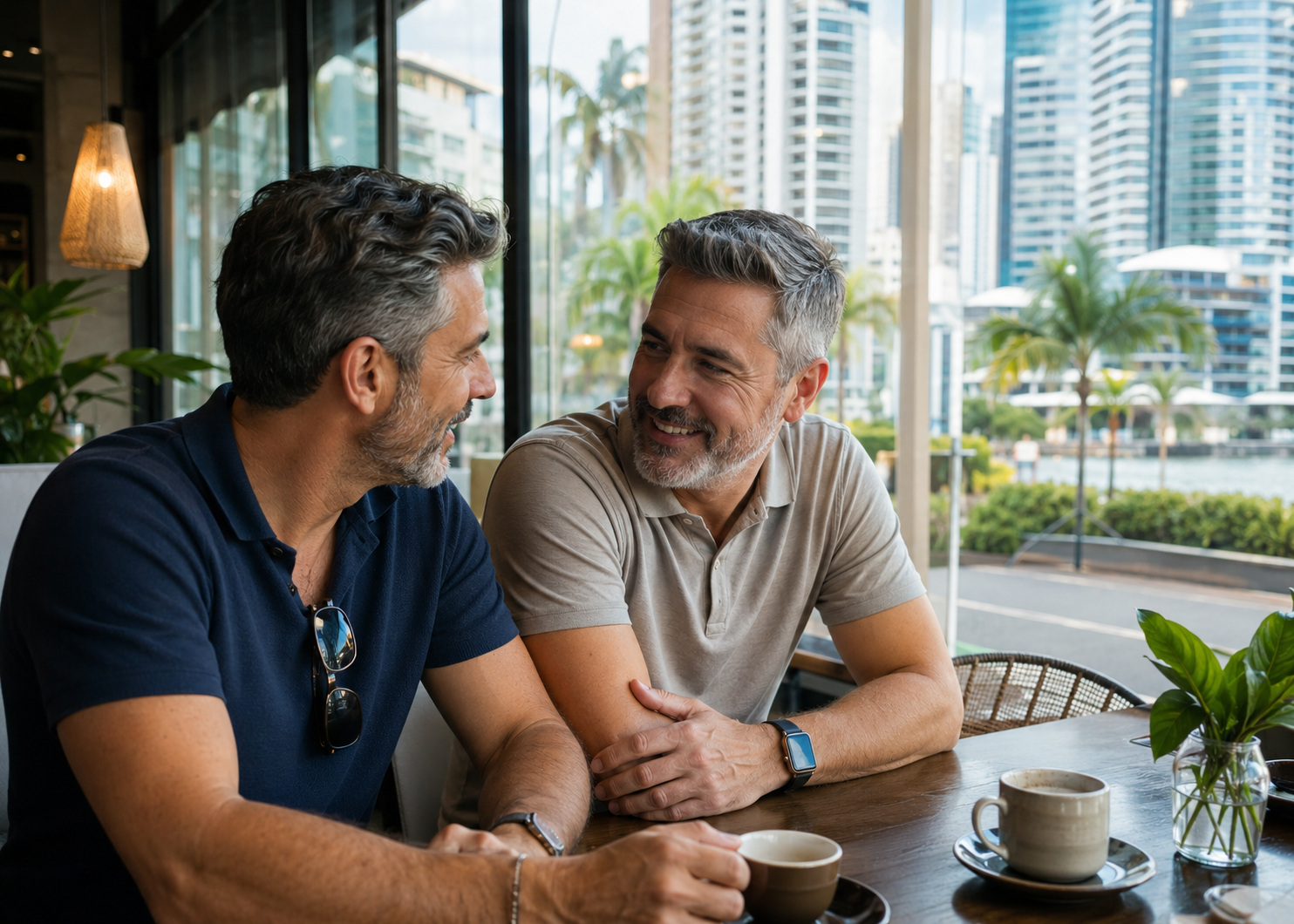
We can. We’re a gay American couple in the middle of relocating to Panama City, and we spent twelve days in April 2026 walking the city as a visibly together couple — restaurants, the Metro, hardware stores, gay bars, attorney offices. This is the answer we’d give you over coffee.
Gay Life in Panama Series
What it's actually like to be a gay man moving to and living in Panama — the legal reality, the safety picture, the culture, and how to actually meet people.
- LGBTQ Life in Panama
- Is Panama Gay Friendly? The Honest Answer You are here
- Is Panama Safe for Gay Men? Crime Data + Our Honest Take
- Panama City vs. Boquete for Gay Couples: Why We Picked the City
- Should Gay Couples Move to Panama? An Honest Answer
- Will I Be Lonely in Panama?
- Grindr, Scruff, and Meeting Guys in Panama City
The Short Answer
Panama City: yes, with a real gay scene, a live-and-let-live culture, and a Pride march that just celebrated its tenth year. The legal system: no — your marriage doesn’t exist here, and there are no laws protecting you from discrimination. The interior of the country: tolerance, not acceptance. Whether Panama is “gay friendly” depends entirely on which of those three things matters most to how you live.
What the Law Says — And Doesn’t
Let’s get the legal reality on the table first, because it’s the part the travel sites skip and the part that actually affects your life if you move here rather than visit.
Being gay is legal in Panama. It has been since 2008 — which, for context, made Panama the last Spanish-speaking country in the Americas to decriminalize it. That’s worth sitting with for a second. The law changed less than twenty years ago, within the adult lifetime of everyone reading this site.
Same-sex marriage is not legal, and it’s not recognized. Article 34 of Panama’s Family Code limits marriage to a man and a woman, and in 2023 Panama’s Supreme Court ruled — after seven years of stalling on the cases — that there is no constitutional right to same-sex marriage. That ruling also declined to recognize marriages performed abroad. So if you married in the United States, the moment your plane lands at Tocumen, Panama considers you two legally unrelated men. Not divorced. Not domestic partners. Strangers.
There are also no anti-discrimination protections. Panama’s general anti-discrimination law does not include sexual orientation, and when advocates pushed to add it, the National Assembly blocked the effort in 2024. There are no hate crime laws covering anti-gay violence. Same-sex couples cannot jointly adopt.
Panama’s Legal Status for Gay People — July 2026
If that fact card were the whole story, the answer to “is Panama gay friendly” would be a flat no, and this would be a very short article. It isn’t the whole story. Because here’s the strange thing about Panama: the law and the culture are having two completely different conversations.
What Daily Life Actually Feels Like
We spent twelve days in Panama City in April 2026 as an obviously together couple in our sixties. We ate breakfast together every morning, rode the Metro, sat side by side in restaurants, walked through Bella Vista and El Cangrejo, priced light switches at Do-It Center, and met with our immigration attorney — together, as a couple, which she treated as completely unremarkable.
Nobody cared. Not performatively-inclusive-corporate-Pride-campaign didn’t care. Actually didn’t care. Panamanian culture in the capital runs on a deep current of not-my-business. Waiters, drivers, clerks, and neighbors registered us as two American men and moved on to the part where we were customers.
“The law pretends we don’t exist. The city, mostly, just lets us exist. Those are very different things, and you feel the difference every day — in a good way and a bad way.”
We want to be precise about what we’re claiming, because precision is the whole point of this site. We are not claiming Panama is free of homophobia — Panamanian gay organizations report real problems, including family rejection and school bullying, and they march every June precisely because the legal protections don’t exist. We’re claiming that as adult foreign gay men living openly-but-not-loudly in Panama City, we experienced zero friction in twelve days of trying. That’s a data point, not a verdict for every gay person in every situation. But it’s a firsthand data point, which is more than most articles on this question can offer.
How we source this article
Everything about Panama City comes from our own April 2026 research trip and our ongoing relocation. Everything about the interior, Boquete, and the beach towns is research-based — we say so where it applies, and we’ll update this page as we get more ground truth of our own.
Gay Friendly Where, Exactly?
“Panama” is the wrong unit of measurement. The honest answer changes dramatically depending on where you’re standing.
Panama City
The capital is where the answer is genuinely yes. There’s a real gay scene — BLG (Bar Los Gatos) in Bella Vista is the iconic gay bar, XS Club is the largest nightclub, Maluka runs drag shows, and HamMan Sauna & Spa is the country’s one gay sauna. We cover all of it honestly, including what a drink actually costs, in our gay bars and nightlife guide.
And the community is visible beyond nightlife. In June 2026, Panama Pride marked its tenth anniversary with a march through Casco Antiguo that drew thousands — on the same day Panama played England in the World Cup, so organizers invited everyone to march in the national team’s red. Pride, fútbol, and drag artists sharing one afternoon in the historic district: that’s a real snapshot of where the capital’s culture actually is, whatever the Family Code says.
Boquete and the Expat Towns
Here’s where we’ll be blunter than most sites. Boquete has no gay infrastructure — no bar, no visible community — and when we vetted its expat social media spaces, we found a vocal right-wing contingent loud enough that we ruled the town out for ourselves. Not because Boquete is dangerous, but because we’ve already done the math on living somewhere the loudest neighbors resent people like us. It’s the same calculation we make in the United States. We wrote the full comparison in our Panama City vs. Boquete piece, and we’d point any gay reader considering the highlands there first.
The Rest of the Country
Rural Panama is traditional and Catholic. Research-based, not firsthand: open hostility toward foreigners is genuinely rare, and the prevailing mode is not-my-business rather than confrontation. But there are no gay venues, being visibly out is uncommon, and support structures don’t exist. That’s tolerance, not acceptance — and if you’ve spent your adult life somewhere you never had to think about the difference, the interior of Panama is where you’d learn it.
The Part That Follows You Everywhere: The Paperwork
Social acceptance is what you feel day to day. Legal non-recognition is what ambushes you at the worst possible moment — a hospital, a border, a funeral. This is where “is Panama gay friendly” stops being a vibes question and becomes a planning question.
Because Panama doesn’t recognize your marriage, none of the automatic legal machinery married couples take for granted exists here. No spousal visa sponsorship — each partner qualifies for residency independently, which is exactly what we’re doing: Brian through the Pensionado visa, Kent through the Qualified Investor Visa. No automatic inheritance. No default hospital visitation or medical decision-making authority. Every one of those protections has to be deliberately rebuilt with Panamanian legal documents.
Don’t skip this if you’re a couple
The rebuilt-by-hand legal toolkit — wills, powers of attorney, healthcare directives, and in some cases a Private Interest Foundation — is not optional homework. We walk through the documents in our estate planning guide for gay couples in Panama, and the full decision framework in “Should Gay Couples Move to Panama?”
One more thing worth naming: the immigration professionals we’ve dealt with have been entirely matter-of-fact about us as a couple. Our attorney at Morgan & Morgan has structured both of our independent visa paths without a blink. The system doesn’t recognize gay couples, but the people operating the system, in our experience so far, are not the obstacle.
Who Panama Works For — And Who It Doesn’t
We told you we wouldn’t sell you the brochure, so here’s the sorting that most articles refuse to do.
Panama can work well for you if:
- You’re comfortable being openly gay without needing to be loudly, visibly out in every context
- You’re planning to live in or near Panama City, where the community and venues actually are
- You (and your partner, if you have one) can each qualify for residency independently
- You’re willing to do the legal paperwork that substitutes for marriage recognition
- Your measure of “friendly” is how people treat you at the pharmacy, the clinic, and the corner restaurant — because in the capital, that treatment has been consistently fine
Panama is probably the wrong choice if:
- Legal equality is non-negotiable for you — Spain, Portugal, and much of Western Europe recognize your marriage; Panama does not, and after the 2023 Supreme Court ruling, that isn’t changing soon
- You need a large, established gay community — Panama City’s scene is real but small; it’s a handful of venues, not a gayborhood
- You’re drawn to small-town or highland living and an active gay social life at the same time — outside the capital, you can’t have both
- Being fully, visibly out everywhere you go is core to how you live — men who need that tell us they feel the ceiling here, and we believe them
We lived in Spain for years, and we ran a bar there, so we know exactly what full legal equality feels like day to day. We’re choosing Panama anyway, with our eyes open, because the whole package — the capital’s live-and-let-live culture, the healthcare, the costs, the proximity to family in the States — works for us. That’s the honest shape of the decision: not “is Panama gay friendly, yes or no,” but “is Panama’s particular mix of real social ease and real legal invisibility a trade you’re willing to make.”
Our Verdict
Panama City is gay friendly in the way that matters most to daily life: you can live here openly, as a couple, with a community around you and remarkably little friction. Panama the legal system is not gay friendly at all, and pretending otherwise would be malpractice. Panama the country in between — the highlands, the beaches, the interior — is somewhere on the spectrum from indifferent to quietly conservative, and you should choose your town with that in mind.
We’re betting our own retirement on the first part being true and the second part being manageable with good legal work. Ask us again in a year — we’ll be living the answer, and we’ll keep this page updated with what we find.
Sources & Verification
- Firsthand: Twelve days in Panama City, April 2026, as a visibly together couple — neighborhoods, venues, transit, restaurants, and attorney meetings.
- Official: Panama Family Code, Article 34; Corte Suprema de Justicia de Panamá ruling on same-sex marriage (published March 2023); 2008 decriminalization decree.
- Reported: Panamanian press coverage of Panama Pride’s 10th anniversary march, Casco Antiguo (June 27, 2026), and of the National Assembly’s 2024 rejection of adding sexual orientation to the anti-discrimination law.
Facts and prices in this article last verified: July 2026.
Gay Life in Panama Series
- 01 LGBTQ Life in Panama
- 02 Is Panama Gay Friendly? The Honest Answer
- 03 Is Panama Safe for Gay Men? Crime Data + Our Honest Take
- 04 Panama City vs. Boquete for Gay Couples: Why We Picked the City
- 05 Should Gay Couples Move to Panama? An Honest Answer
- 06 Will I Be Lonely in Panama?
- 07 Grindr, Scruff, and Meeting Guys in Panama City
Brian & Kent
We’re a gay couple relocating from St. Petersburg, Florida to Panama City — and documenting every step of it here. Brian is applying for the Pensionado visa based on Social Security income; Kent handles the on-the-ground research and plans to apply for the Qualified Investor Visa after we sell our Florida home. Everything on this site comes from our own research, our own attorney meetings, and our own mistakes.