Practical Expat Life · Mail & Addresses
So You’re Moving to Panama and Want to Give Friends Your Address — About That
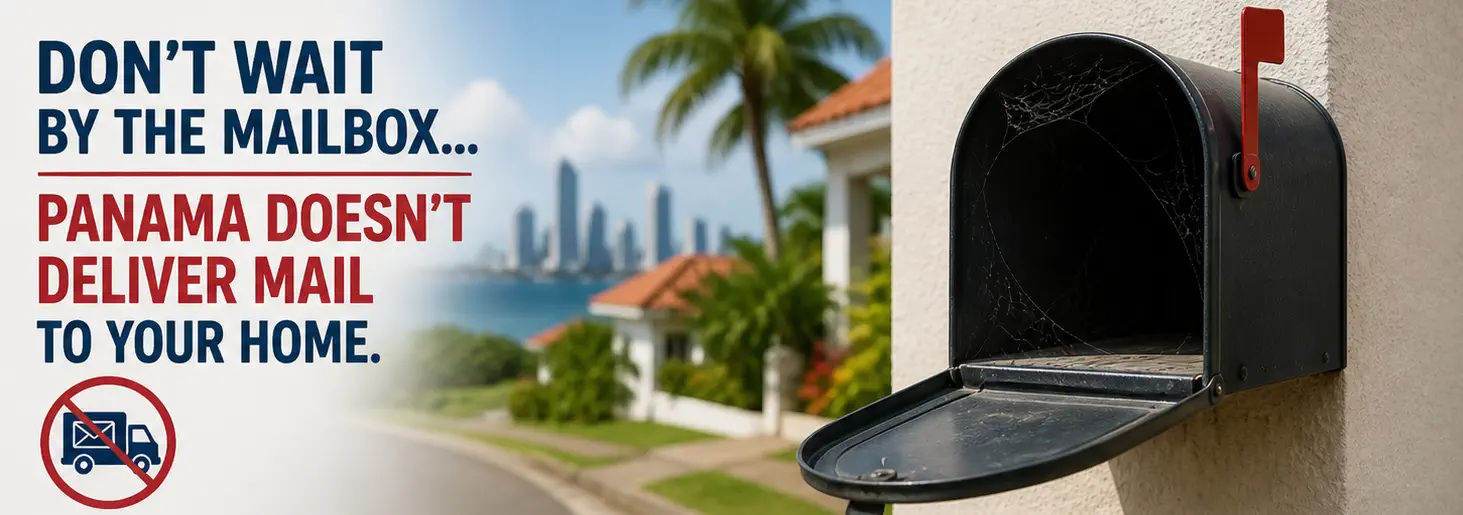
Panama doesn’t have a functioning home postal delivery system. Many streets have no house numbers. The official postal service is widely regarded as unreliable. And yet people live here, receive packages, pay bills, and find their friends’ houses. Here’s how it actually works.
 Brian & Kent · GayExpatsPanama.com · April 2026 Research Trip
Before we went to Panama, and deep into our research on what relocating there would actually involve, we kept running into a fact that didn’t compute at first: Panama doesn’t have home mail delivery. Not in the way Americans are used to — the carrier who shows up at your door six days a week, deposits the credit card offers and the occasional actual letter, and moves on. That system doesn’t exist here.
We filed this under “interesting quirk” and kept reading. Then Kent spent days walking through Panama City neighborhoods in April 2026, and the picture became more specific and more interesting. Some houses had numbers on them. Others had no numbers at all. Some streets had clear signage; others had none. There was clearly some kind of address system in operation in certain parts of the city — and essentially none in others. Which raises a collection of genuinely practical questions for anyone considering a move.
How do you receive packages? How do you get mail from home? How do your utility bills find you? How do you tell someone where you live? And how, on a Sunday afternoon, do you actually find a friend’s house in a neighborhood where nobody has put a number on anything?
The answers are more workable than the premise suggests — but they require understanding a system that operates completely differently from what most Americans have ever dealt with.
The State of Panama’s Postal System — Honestly
Panama has a national postal operator called Correos de Panamá (previously known as COTEL). It exists. It operates around 110 post offices nationwide. It is technically capable of receiving and sending mail. But asking whether Panama has a postal service is a bit like asking whether Panama has a home delivery postal service — and the answer to the second question is clearly no.
There is no mail delivery to your door in Panama. Everything through Correos de Panamá must be collected in person — from a PO box (called an apartado postal) or via General Delivery (Entrega General) at a post office. A general rule of thumb is that mail addressed to a home address will likely never arrive. Any Panamanian will warn you off this service — it’s good for almost nothing, they say.
The receiving experience is no better than the sending. Packages shipped from North America can take 2 to 6 weeks, with letters taking even longer. Some things arrive. Others do not. The variance is significant enough that most experienced expats simply don’t use Correos de Panamá for anything they actually need.
The PO Box Situation
You can rent a PO box from Correos de Panamá for $20 per year ($15 for seniors). The problem: PO boxes are difficult to obtain as they are in limited supply. You may need to request to be put on a waiting list, and boxes typically only become available when someone fails to renew — usually in February. Waiting lists are indefinite and can move slowly — it can take months or even years before receiving a box. This is not a reliable strategy for someone arriving next month who needs a mailing address.
The Address Problem — What Kent Actually Saw on the Ground
Walking miles through Panama City neighborhoods in April 2026, Kent noticed something that didn’t match the common description of “Panama has no addresses.” Some houses — particularly in established residential neighborhoods like San Francisco, parts of Bella Vista, and some of the ridge neighborhoods — had visible numbers. Streets had signs. The infrastructure of an address system existed.
In other areas, nothing. No numbers on buildings, no street signs visible, and the general impression that finding a specific house would require local knowledge rather than a map application.
Both things are true simultaneously, and understanding why requires a brief explanation of how Panama’s address situation actually developed.
Panama introduced a four-digit postal code system in 2007 to identify locations for mail sorting and delivery. The system remains largely unimplemented and non-mandatory in practice. Panama City’s code is 0801. David is 0401. Colón is 0301. These codes technically exist and are recognized by the Universal Postal Union. They are not, in practice, part of how most Panamanians give or receive their location.
The reason some neighborhoods have numbers and some don’t comes down to when they were developed and by whom. Modern developments, gated communities, and newer residential areas tend to have more formal addressing. Older neighborhoods, informal settlements, and areas that grew organically over decades tend to have less. It is not a consistent system across the city.
Panama City has some of the most sophisticated financial infrastructure in Latin America, and a postal system that still largely runs on landmark directions. Both things coexist without apparent tension.
How Panamanians Actually Give Directions
If you ask a Panamanian for their address, you are unlikely to receive a street number followed by a zip code. You are more likely to receive something like this: “From the El Rey supermarket on Via España, walk two blocks toward the mountain, then turn left at the yellow building, we’re the third house on the right with the green gate.”
This is not a quirk or an informal workaround. It is the actual system, and Panamanians are extraordinarily good at it. Landmarks, cardinal directions, and relative positions are the native language of addressing here. The landmark might be a well-known supermarket, a church, a school, a prominent building, or even a business that closed years ago but that everyone still uses as a reference point. “Two blocks from the old Blockbuster” is a real category of direction in Latin American cities, and Panama is not an exception.
Google Maps and Waze work reasonably well in Panama City for navigation — far better than the address system alone would suggest — because the map data has been built up through community contribution rather than formal addressing. Drop a pin and share it. This is how Panamanians invite each other to their homes, and it is the fastest thing to adopt as a new resident.
How to Tell Someone Where You Live in Panama
Drop a pin in Google Maps or WhatsApp and send it. This is the universally understood method. Supplement it with a landmark-based description: the nearest supermarket or pharmacy, a major intersection, something visible from the street. Building name and apartment number matter more than street address for deliveries to specific units. Save your own pin — you’ll share it more often than you expect.
Receiving Packages from the U.S. — the Real System
This is where things get genuinely practical, and where the expat community has built a working infrastructure around a government gap. The solution is the Miami forwarding address.
Several private companies operate as intermediaries between U.S. retailers and Panama residents. The mechanics are the same across all of them: you get a Florida mailing address (usually Miami or near Miami) that you use for all U.S. shopping and correspondence. Items ship to their Florida warehouse. They consolidate, handle customs documentation, and ship to Panama — either to their Panama offices for pickup, or delivered to your door. Delivery time for packages is typically two to four business days once the shipment is received at the forwarding company’s Miami warehouse, and some providers offer free delivery to your home or office within Panama City limits.
| Service | What It Offers | Best For |
|---|---|---|
| Airbox Express | Miami PO box address; pickup at Panama offices (El Cangrejo, Calle 50, Albrook, others) or home delivery in Panama City. Offices also in Colón, David, Boquete, Changuinola, Coronado. Free home delivery within Panama City limits. Online tracking. | Most expats — widest coverage inside Panama, including outside Panama City |
| Mail Boxes Etc. (MBE) | Physical Florida address (not just PO box) plus a local Panama pickup location. Considered the gold standard for those in or near Panama City — uses warehouses in Florida to give you a true street address, not just a PO box. | Anyone who needs a real street address for banking, subscriptions, or retailers that don’t ship to PO boxes |
| Miami Express | Similar Florida forwarding model to Airbox; pickup-based in Panama | Alternative if Airbox or MBE locations don’t work for your area |
| DHL / FedEx / UPS | Direct international courier delivery to your door. Expensive but reliable; useful for high-value or time-sensitive items | One-off shipments where cost doesn’t matter and reliability does |
| Uno Express | Domestic courier service within Panama. For sending things from one place to another inside the country | Sending documents or packages within Panama |
Set Up Your Forwarding Service Before You Move
Both Airbox Express and Mail Boxes Etc. allow you to set up your account online before arriving in Panama. Do this early — give your new Miami forwarding address to family, update magazine subscriptions, and use it for any U.S. online shopping you plan to ship to Panama. The infrastructure works reliably once it’s in place; the setup is straightforward.
What Your Miami Address Looks Like
When online forms insist on a zip code and you’re giving a Panama address, there are two approaches. For your forwarding service address, use whatever zip code they assign to their Miami warehouse — typically in the 33xxx range. For a direct Panama address on a form that won’t accept a Panama address but demands a zip code, put five zeros. It has never failed.
Brian Kent
Edificio El Central, Apt 4B
Calle 50, El Cangrejo
Panama City, 0801
República de Panamá
For most local deliveries, the building name and apartment number matter more than the street address. Include a phone number — couriers will call when they arrive.
Brian Kent
Box #[your account number]
9500 NW 79th Ave
Medley, FL 33166
This is your U.S. shipping address — use it for Amazon, U.S. retailers, subscriptions, banks. Items arrive in Florida, get consolidated and cleared, then shipped to Panama.
How Your Bills Find You — Utility Delivery in Panama
This is one of the stranger practical realities of Panama life, and it’s worth knowing before you arrive. Your electric and some other utility bills will be delivered to your home. It is the utility company that delivers these bills, not the postal service. In one long-term resident’s case, they slip the bill into the fence. If the delivery person sees you, they will give it to you directly. It is not a reliable system. Bills have been found months later buried in leaves in a corner of the yard.
The practical approach: don’t wait for paper bills. Set up online accounts with your utility providers immediately on arrival. Know when your bills are due and pay them proactively — either online where the option exists, or in person at the office or at a payment kiosk. Farmacias and certain supermarkets accept utility payments, which removes the need to go to the utility office directly.
Don’t Rely on Paper Utility Bills Arriving Reliably
The bill may arrive. It may not. It may arrive in a way that means it was there for three weeks before you noticed. Set up online payment for every utility as soon as you have the account numbers, and calendar the due dates. This is less about the postal system and more about how utility delivery in Panama actually works in practice.
Government and Legal Documents
Important correspondence from Panamanian government agencies — immigration, tax authorities, and others — is generally not mailed reliably. For anything that matters legally, follow up in person or through your attorney. Brian’s visa process, for example, has been handled entirely through our attorney at Morgan & Morgan, who communicates directly with the Immigration Authority. Waiting for the government to mail you something official in Panama is not a strategy we’d recommend.
For banking: Panamanian banks know the situation and are accustomed to account holders who use forwarding addresses or PO boxes. Your Miami forwarding address is a legitimate banking address. Some banks will accept your home address described in landmark terms for their records, supplemented by a phone number for actual contact.
Finding a Friend’s House — and Finding Buildings That Have No Address at All
This comes up more often than you’d expect in a city where landmark-based directions are the norm and building numbers are inconsistently applied. But it goes beyond social visits. Some of the most important buildings you’ll need to visit in Panama — government offices, immigration services, legal offices — have no street number whatsoever. Here’s what actually works.
WhatsApp location pin. Panama runs on WhatsApp — more thoroughly than almost anywhere else we’ve encountered. When a Panamanian wants you to come over, they send a WhatsApp location pin. You tap it, it opens in Google Maps, you navigate there. This is the standard practice, not a workaround. You’ll receive and send pins constantly once you’re living here.
Google Maps dropped pin. For anyone you’re giving your address to, drop a pin on your home in Google Maps and share the link. It works across all devices, requires no street address, and is accurate to the door. Make it a habit: drop your home pin the first day you move in and keep it saved.
Building name over street number. In apartment and condo buildings — which is where the majority of expats in Panama City live — the building has a name. “Edificio Torre del Sol, Apartment 8C, El Cangrejo” is more useful and more findable than a street address, because the building name is visible, the security desk knows it, and Google Maps usually has it.
Landmark anchoring. “Three blocks north of the El Rey on Via Argentina, the blue building on the left” is not vague to a Panamanian. It is precise. You’ll start giving directions this way within weeks of arrival, because it works.
Plus Codes — the System Designed for Exactly This Problem
Here is a concrete example of why all of this matters beyond social visits. When Brian’s attorney sent him the location of the National Immigration Service building — the office every Pensionado visa applicant must visit — the address she sent was this:
2F98+PH2
Vía Ricardo J. Alfaro, Panamá
Provincia de Panamá, Panama
That alphanumeric code — 2F98+PH2 — is a Plus Code. You type it directly into Google Maps like a regular address and it takes you straight to the front door of the building. Because the building has no street number. This is not unusual in Panama. It is common.
Plus Codes are a free, open-source digital address system developed by Google that works for any location on Earth, including places with no formal street address. They are based on latitude and longitude coordinates, but compressed into a short alphanumeric code that is easy to share, type, and use. The code 2F98+PH2 identifies a specific area roughly 14 meters by 14 meters — precise enough to pinpoint a building entrance.
How Plus Codes Work in Practice
To use a Plus Code someone sends you: Type it directly into the Google Maps search bar exactly as written, including the plus sign. Google Maps resolves it immediately and navigates you there. It works in the app and in a browser.
To find the Plus Code for your own address: Open Google Maps on Android, tap the blue dot that represents your location, and swipe up — your Plus Code appears there. On desktop, right-click your location and select “What’s here?” — the Plus Code appears in the info card at the bottom.
Offline functionality: Plus Codes don’t require an internet connection to generate or decode once you have them — useful in areas with patchy signal.
Key practical situations in Panama where Plus Codes matter:
Government and immigration offices. The National Immigration Service building, where every Pensionado visa applicant goes for their residency card, has no street number. Your attorney will send you a Plus Code or a WhatsApp pin. Keep it saved — you’ll need it more than once during the visa process.
Businesses in unmarked commercial areas. Many smaller businesses, professional offices, and services operate in buildings or areas where the street address is ambiguous or non-existent. Asking for a Plus Code or pin has become entirely normal here, in the same way giving your apartment number would be normal elsewhere.
Sending your own location for deliveries. When a courier or Uber Eats driver needs to find you, dropping a pin in WhatsApp is faster and more accurate than any description. For Airbox Express home deliveries within Panama City, include your building name, apartment number, and a WhatsApp pin when setting up your delivery preferences — this gets packages to your door without the driver calling you three times.
Meeting points in large open areas. Parque Omar, the Cinta Costera, the Albrook Mall complex — large areas where “meet me at the entrance” is not sufficient. Drop a pin on the exact spot. Panama has made this second nature.
Build Your Panama Location Toolkit Before You Arrive
Before you land: save a copy of Google Maps offline for Panama City (Settings → Offline Maps → Select an Area). Drop a pin on your accommodation as soon as you arrive. Save the Plus Code for the Immigration building if you’re starting a visa process. Set up WhatsApp if you haven’t already — it is the primary communication infrastructure of Panama and sharing locations through it is universal. Within your first week, you will use location pins more than you have in your entire previous life.
Panama Addressing — The Practical Summary
The Broader Picture — and What It Tells You About Panama
Panama is a country that has built extraordinary financial infrastructure — one of the world’s major banking centers, a global trade hub, a canal that moves 5% of world maritime trade — while simultaneously never fully solving the problem of how to deliver a letter to someone’s door. This is not as contradictory as it sounds. The financial system doesn’t need home postal delivery. The canal doesn’t need it. The international business community routes around it. And ordinary Panamanians have spent generations developing workarounds that function well enough that the underlying gap doesn’t cause daily friction.
For an expat arriving from the U.S. or Europe, where the postal system is infrastructure so deeply embedded that you’ve never had to think about it, the adjustment is real. It requires setting up systems before you move, not after. It requires shifting from “my address is X” to “here’s my pin.” It requires knowing which bills to proactively pay rather than waiting for a statement.
None of this is hard. It just requires knowing, in advance, that the system you’ve relied on your entire life isn’t going to be there — and that what replaces it, once you understand it, works.
Sources & Verification
- Official: Correos de Panamá’s structure and PO box fees, the 2007 four-digit postal code system, and Panama City’s postal code (0801).
- Reported: Miami mail-forwarding and courier service details (Airbox Express, Mail Boxes Etc., Miami Express, DHL/FedEx/UPS, Uno Express) — published service terms from each provider.
- Firsthand: Kent’s direct observation of Panama City street addressing during his April 2026 research walks, and the Plus Code example from Brian’s own attorney correspondence for the Immigration Service building.
Facts and prices in this article last verified: April 2026.
Brian & Kent — Gay Expats Panama
We’re documenting the real process of researching and moving to Panama — costs, neighborhoods, the gay scene, and Brian’s Pensionado visa. Questions? he***@*************ma.com