Healthcare in Panama · Part 6 of 8
When Do You Go Back? The Question Every Panama Expat Will Eventually Ask
Panama’s healthcare is genuinely good. But it isn’t everything. Here is how to think through the decision nobody plans for — before you need to make it.
 Brian & Kent · GayExpatsPanama.com · Updated April 2026
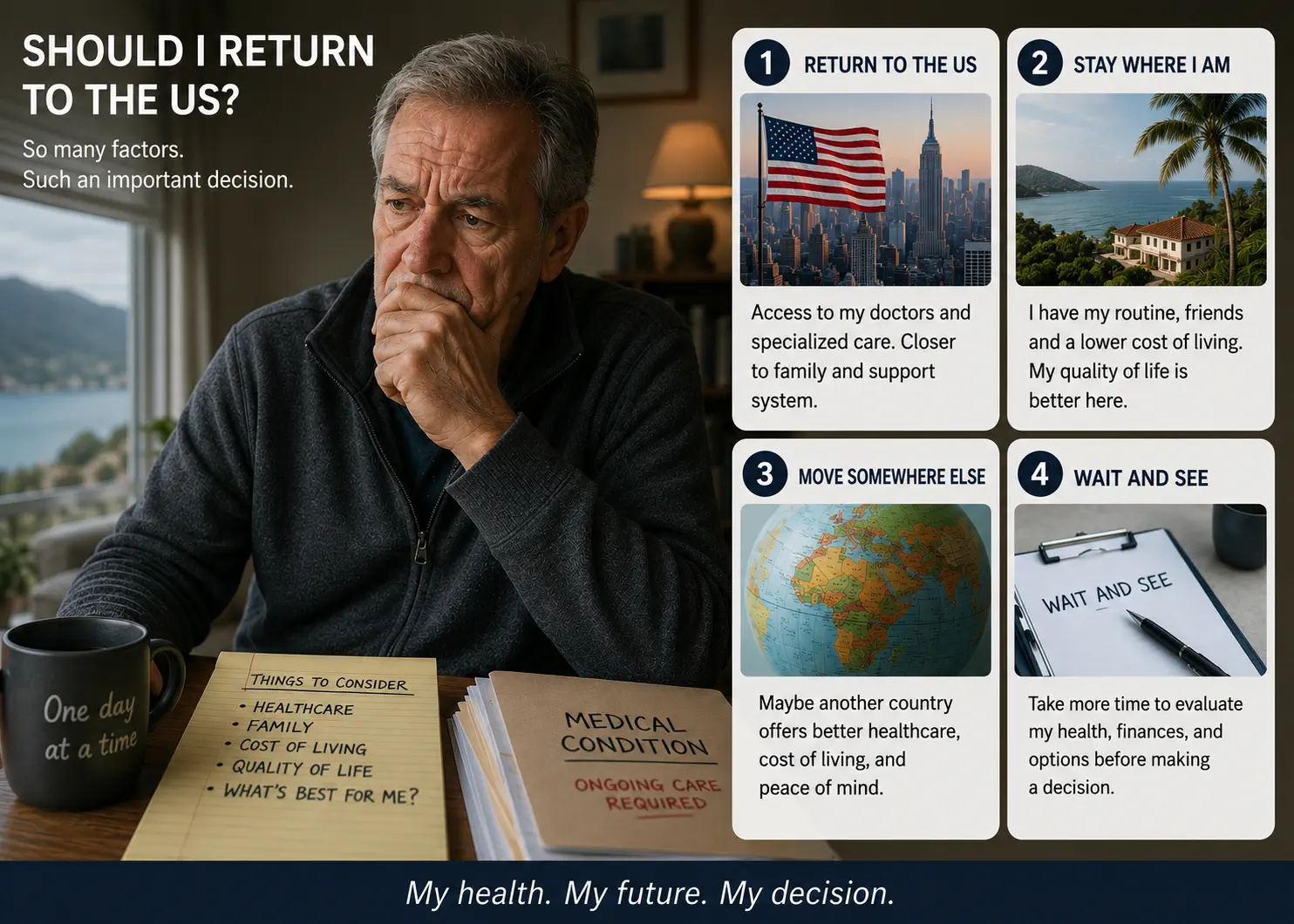
Nobody moves to Panama thinking about going back. You research the weather and the cost of living and the visa requirements and the hospitals. You imagine the life you want. You do not picture yourself three years in, sitting with a diagnosis that makes you wonder whether the right answer is to pack up and return to a country you left on purpose.
And yet this is a real conversation that real expats have, and almost no relocation guide touches it honestly. The cheerful ones skip it entirely. The cautious ones bury it in a sentence about “serious illness” and move on. We think it deserves a full conversation — including the parts that are uncomfortable, the parts that are more nuanced than they first appear, and the parts where the answer is genuinely “it depends on you.”
This is that conversation.
Healthcare in Panama: The Complete Expat Guide
Eight articles covering every healthcare decision a Panama expat needs to make — from choosing insurance before you move to knowing when it's time to go back to the US for care.
- Health Insurance & Costs: An Honest Guide for U.S. Expats
- Healthcare by Location: What You Can Count On in Every Region
- Medical Emergencies, Medicare & What Every Expat Needs to Plan
- Aging Well in Panama: Assisted Living Options for Expats
- Assisted Care by Location: A Region-by-Region Guide & Hiring Checklist
- When Do You Go Back? The Question Every Panama Expat Will Eventually Ask You are here
- LGBTQ+ Healthcare: PrEP, PEP, HIV Care, Affirming Doctors & Privacy
- Prescription Medications in Panama
First: What Would Actually Trigger This Question?
People do not usually ask “should I go back?” in the abstract. They ask it in response to something specific. Based on what expats report and what we have researched, the triggers tend to fall into a few categories.
A Serious New Diagnosis
Cancer is the most common one. A cardiac condition that needs ongoing specialist management. A neurological diagnosis. Something that, in the U.S., would immediately plug you into a specific specialist, a specific treatment center, a specific protocol — and where you find yourself wondering what the Panama equivalent looks like, and whether it is equivalent enough.
This is the clearest case where the return question becomes real. Panama’s private hospitals in Panama City handle a meaningful range of oncology, cardiology, and neurology cases. Pacífica Salud has a cancer treatment program. Hospital San Fernando covers oncology. The Panama Clinic has performed bone marrow transplants. These are not trivial capabilities.
But there are procedures, drugs, and clinical trials that Panama simply does not have. The newest targeted immunotherapy for a specific cancer subtype. A highly specialized surgical procedure performed by a small number of surgeons in the U.S. A clinical trial at MD Anderson or Mayo Clinic that represents your best option. For conditions where treatment specificity matters — and it often does in cancer — the question is not whether Panama has “good” oncology. The question is whether Panama has your oncology.
A Condition Requiring Extended Ongoing Management
Some conditions are not acute events but sustained management needs. Dialysis, three times a week, for the foreseeable future. Chemotherapy on a regular cycle. A condition that requires a specialist you have not been able to find in Panama who speaks English, who knows your history, who you trust.
Panama’s public health system (CSS) actually handles catastrophic, long-term treatments — dialysis, transplant preparation — at essentially no cost. That is a genuine advantage. But the experience is not the private hospital experience most expats plan around, and the language, wait time, and coordination realities are different. For some people it is workable. For others, particularly anyone managing a complex chronic condition with significant quality-of-life implications, the accumulated friction of doing it in Panama starts to weigh differently than it did at the beginning.
One Partner’s Health Changes While the Other Is Well
This is the scenario that is hardest to plan for and the one most guides do not address at all: what happens when one of you gets sick and the other one doesn’t?
You moved as a couple. The life you built in Panama is a shared life — the apartment, the routines, the friendships, the community you found. Now one of you has a diagnosis that tilts the calculation. Does the sick partner go back to the U.S. for treatment while the well partner stays? Do you both go? If you go back temporarily, what happens to the apartment, the visa, the life you have been building?
For gay couples specifically, this scenario has additional legal dimensions. We have written about the power of attorney and healthcare proxy documents that establish your partner’s legal standing in a Panamanian hospital — documents that are essential regardless of circumstances. But if one of you returns to the U.S. for extended treatment, those U.S. documents matter equally: the ability to be at each other’s bedside, to make decisions, to navigate insurance and treatment choices as a unit. Same-sex couples who married in the U.S. have federal marriage recognition for Medicare and Social Security purposes. Make sure your U.S. legal documents are current and accessible from Panama.
Cognitive or Functional Decline
Dementia and significant cognitive decline represent a separate and particularly important scenario. Panama has memory care in Panama City — Insignia is the most frequently cited dedicated facility — and options are gradually developing. But outside Panama City, specialist dementia care is very limited. More significantly, dementia is a condition where social support networks, familiar language and environment, and proximity to family often matter as much as the medical care itself.
An expat who develops dementia in Panama faces a specific set of complications: navigating a healthcare and administrative system in a second language while cognitive capacity decreases; potential isolation from family in the U.S.; and the practical reality that care needs escalate over time in ways that may exceed what Panama’s current infrastructure can handle at a distance from family. This is not a reason not to move. It is a reason to think about it explicitly before you need to.
The Partner Who Is Left
The quietest version of this question is the one that follows a death. One partner dies. The surviving partner is in a country where they chose to live as a couple, in a life that was built for two. Some people stay. Some people find that the reason they moved no longer applies in the same way. Both are legitimate outcomes. It is worth having this conversation before it becomes necessary.
The Case for Staying in Panama
Let us be honest about this side of the ledger, because the case for staying is stronger than most people give it credit for when they are not actually facing the situation.
Panama’s Private Hospitals Are Genuinely Good
Pacífica Salud is Johns Hopkins-affiliated and JCI-accredited. About 90% of specialists at Panama City’s major private hospitals trained in the United States. Specialist consultations run $20–$65. A standard MRI costs $500–$600, compared to $1,500–$3,000 in the U.S. without insurance. Hip replacement: approximately $12,000–$15,000 in Panama versus $35,000–$45,000 in the U.S. Cardiac catheterization in David at Hospital Chiriquí. A knee replacement for $12,000–$15,000 against $35,000–$50,000 stateside.
For a very broad range of conditions — including many that initially trigger the “should I go back?” question — the honest answer is that treatment in Panama City’s private system is medically equivalent to treatment in the U.S., faster to access (no referral bureaucracy, no weeks-long waits for specialist appointments), and dramatically cheaper.
Medicare Does Not Make the U.S. Automatically Cheaper
Medicare covers a lot, but it does not cover everything. The U.S. has deductibles, co-pays, 20% cost-sharing on Part B services, and coverage gaps that, for a significant medical event, are not trivial. Medicare’s 2026 Part B deductible is $283. The Part A hospital deductible per benefit period is $1,676. For someone who maintained Medicare while living in Panama, returning to use it is absolutely a viable financial strategy for major care — but it is not free, and for many conditions the out-of-pocket cost in Panama’s private system may be genuinely comparable.
The financial case for return is strongest for conditions that are extraordinarily expensive and extended — multi-year cancer treatment, dialysis, complex rehabilitation — where the cumulative uncovered costs in Panama would substantially exceed what Medicare covers in the U.S. For a single procedure or a defined course of treatment, the math is often not as clear-cut as people assume.
The Life You Have Built Has Value
You moved to Panama because you wanted a life there — the community, the cost of living, the climate, the pace. A medical decision that uproots that life is not just a healthcare decision. It is also a quality-of-life decision. Neither the choice to stay nor the choice to return is wrong. But the decision is not only about which country has better treatment — it is about which country you want to be in while you go through this.
The Case for Going Back — When It Is the Right Answer
When You Need Something Panama Doesn’t Have
Certain subspecialties, certain procedures, and certain drugs are simply not available in Panama. CAR-T cell therapy for specific cancers. Highly subspecialized neurosurgery. A clinical trial at a National Cancer Institute-designated center — MD Anderson, Sloan Kettering, Mayo Clinic — for which you qualify and which represents your best treatment option. Proton radiation therapy. Bone marrow transplants are available at The Panama Clinic as of 2025, but the depth of support infrastructure and post-transplant follow-up available at a major U.S. transplant center is different. If what you need is not available in Panama, the answer is clearer.
When Cognitive Decline Makes Navigation Too Hard
Managing a complex healthcare situation in a country where you are not fluent in the language, where your support network is an ocean away, and where navigating administrative systems requires cognitive resources that your condition is depleting — that is a real and serious challenge. The practical case for returning is strongest when the patient’s capacity to manage a foreign system is itself compromised.
When Your Financial Situation Makes Medicare the Right Tool
If you are facing years of expensive treatment — complex oncology, dialysis, major rehabilitation — and you have maintained Medicare, the cumulative financial benefit of using it in the U.S. may substantially outweigh the costs of return. The math needs to be done specifically, not assumed, but for extended high-cost conditions it often points toward the U.S.
When Your Family Is in the U.S. and You Need Them
This is not a medical reason but it is a real one. Being seriously ill in a foreign country while family members are eight hours away by air is different from being ill close to them. Some people find expat community and partner support sufficient. Others find that proximity to their original network matters in ways they did not fully anticipate. There is no wrong answer here — there is only the honest answer about what you actually need.
The Financial Mechanics of Going Back
Medicare Re-Enrollment When You Return
If you maintained Medicare Parts A and B while in Panama, you can use Medicare immediately upon returning and establishing U.S. residency. There is no re-enrollment delay if you kept them active.
If you dropped Part B while in Panama, you face a special enrollment period upon return that begins the month you return and lasts through the following two months. Miss that window and you wait until the General Enrollment Period (January 1–March 31 annually), with coverage not starting until the following July 1 — and a permanent Part B late enrollment penalty of 10% per 12 months you went without coverage. Five years without Part B means your monthly premium is permanently 50% higher.
For Medigap: returning expats do not automatically have a Medigap open enrollment period. You may face medical underwriting when trying to purchase Medigap after returning, meaning insurers can charge more or decline coverage based on your health history — a significant consideration for anyone returning with a diagnosis.
The Single Most Important Medicare Decision Before You Move
Keep Part B. The $206.50/month (2026) may feel like you are paying for something you cannot use in Panama. But if you return — planned or unplanned — you step straight back into full Medicare coverage with no gap, no penalty, and no waiting period. Dropping Part B to save money abroad and then needing to return is one of the most expensive mistakes expats make. The penalty is permanent. Read our full Medicare article: Medical Emergency Planning in Panama →
What Going Back Actually Costs
Approximate Costs to Consider When Returning to the U.S.
How to Think About This Before You Need To
The time to work through these questions is now, not when one of you has just received a diagnosis. A few questions worth talking through with your partner, explicitly, before you move:
What conditions would trigger a return for each of you?
Be specific. “Anything serious” is not a plan. Cancer of what type, treated how? Dementia? Cardiac failure requiring ongoing management? If one of you gets sick but the other does not, what does that look like? Would you both go back, or would one of you stay while the other seeks treatment?
Where would you go if you went back?
To family? To which family, whose family? Do you have a state of legal residence for Medicare purposes? For gay couples this is not always a simple question — family relationships can be complicated, and the welcome may vary. Think this through in advance rather than in crisis.
What does the financial picture look like for each scenario?
If you return temporarily, can you afford to maintain your Panama housing while also paying for U.S. treatment and accommodation? If you return permanently, what does that transition cost, and what do you have to fund it?
Do your legal documents work on both sides?
The Panamanian healthcare power of attorney that names your partner as your decision-maker is essential in Panama. But if you return to the U.S. for treatment, U.S. healthcare directives and powers of attorney govern. Make sure both exist, both are current, and both are accessible from wherever you are. Keep digital copies in a shared cloud folder both of you can access.
Kent’s Note — The Conversation We Actually Had
We did have this conversation before writing it for the site. The honest answer is that neither of us had a fully worked-out position when we started. We had vague instincts — Brian said he thought he would want to come back for anything “really serious,” and when we pressed on what that meant, neither of us could define it cleanly.
What we landed on after a real discussion: Brian would keep his Medicare Supplemental Plan G and of course, Part B regardless. Kent is leaning to the same approach, but he has time to decide. We would make sure our U.S. documents and Panama documents are both current before we move. We would revisit the question of return any time a significant health event changed the picture. And we would have the harder conversation — the one about what happens if one of us gets sick and the other doesn’t, and what we each actually want in that scenario — while we are both well enough to think clearly about it.
We are not publishing that answer here because it is ours. But we are publishing the fact that we had it, because we think you should too.
What the Numbers Actually Say
| Scenario | Panama Private (Approximate) | U.S. with Medicare (Approximate Out-of-Pocket) | Honest Assessment |
|---|---|---|---|
| Knee replacement | $12,000–$15,000 total | $1,676 Part A deductible + 20% of surgeon fee + supplemental gaps | Panama is often cheaper all-in, faster to schedule, and equivalent quality at JCI hospitals. |
| Hip replacement | $12,000–$15,000 total | $3,000–$8,000 out-of-pocket depending on coverage | Similar to knee. Panama competitive. Consider where you want to recover. |
| Cardiac catheterization / stent | $8,000–$18,000 depending on complexity | $1,676 Part A deductible + 20% coinsurance if no supplemental | Hospital Chiriquí (David) has a cath lab. Panama City hospitals handle complex cardiac work. U.S. may be preferred for complex multi-vessel disease. |
| Early-stage cancer (defined protocol) | Varies by type — Panama has oncology but not all subspecialties | Medicare covers most standard chemotherapy/radiation; significant co-pays possible | Common cancers on standard protocols may be handled in Panama. Rare or aggressive cancers often benefit from U.S. subspecialty centers. |
| Extended dialysis (ongoing) | CSS covers at near-zero cost; private rates significantly higher | Medicare covers dialysis comprehensively under ESRD program | Clear U.S. Medicare advantage for most people. Extended dialysis in Panama’s private system is expensive and exhausting long-term. |
| Complex cancer requiring clinical trial or subspecialty center | Not available in Panama | Available at NCI-designated centers; Medicare covers most treatment costs | Return is the right answer. Not a close call. |
The Honest Bottom Line
Most expats who move to Panama will never face a situation that forces a permanent return for medical reasons. Panama’s private hospitals handle the full range of conditions that most people encounter in retirement, at a fraction of U.S. costs, with care that is often more personalized and faster to access.
But some expats will face something that Panama cannot fully address — a condition that needs a subspecialty center, a cognitive decline that makes navigating a foreign system untenable, a family situation that makes the U.S. the right place to be. For those situations, having planned in advance — maintaining Medicare, keeping legal documents current on both sides, having the conversation with your partner about what each of you actually wants — is the difference between a decision made clearly and a decision made in crisis.
You do not plan for the return because you expect it to happen. You plan for it because you want to be able to choose clearly if it does.
Panama is a genuinely good place to be, including during difficult chapters. The question of whether to stay or go is not a question about whether Panama is good enough. It is a question about what you need, what is available, and what kind of life you want to live — which is, ultimately, the same question you asked when you decided to move in the first place.
Sources & Verification
- Official: Medicare 2026 Part B deductible ($283), Part A hospital deductible per benefit period ($1,676), Part B monthly premium ($206.50), Part B late-enrollment penalty structure, and Medicare Special/General Enrollment Period rules for returning residents.
- Community: Panama hospital treatment capabilities (Pacífica Salud, Hospital San Fernando, The Panama Clinic, Hospital Chiriquí), procedure cost ranges in Panama vs. the U.S., and CSS catastrophic-care coverage. Synthesized from expat accounts and hospital information cross-referenced against multiple sources.
- Firsthand: Kent’s account of the conversation he and Brian had about their own return-decision framework, including their planned Medicare approach.
Facts and prices in this article last verified: April 2026.
Brian & Kent
A gay couple based in St. Petersburg, Florida, researching and relocating to Panama in real time. Brian is applying for a Pensionado visa. Kent is the primary researcher. The research is current, the attorney meetings are recent, and the prices are from this year.