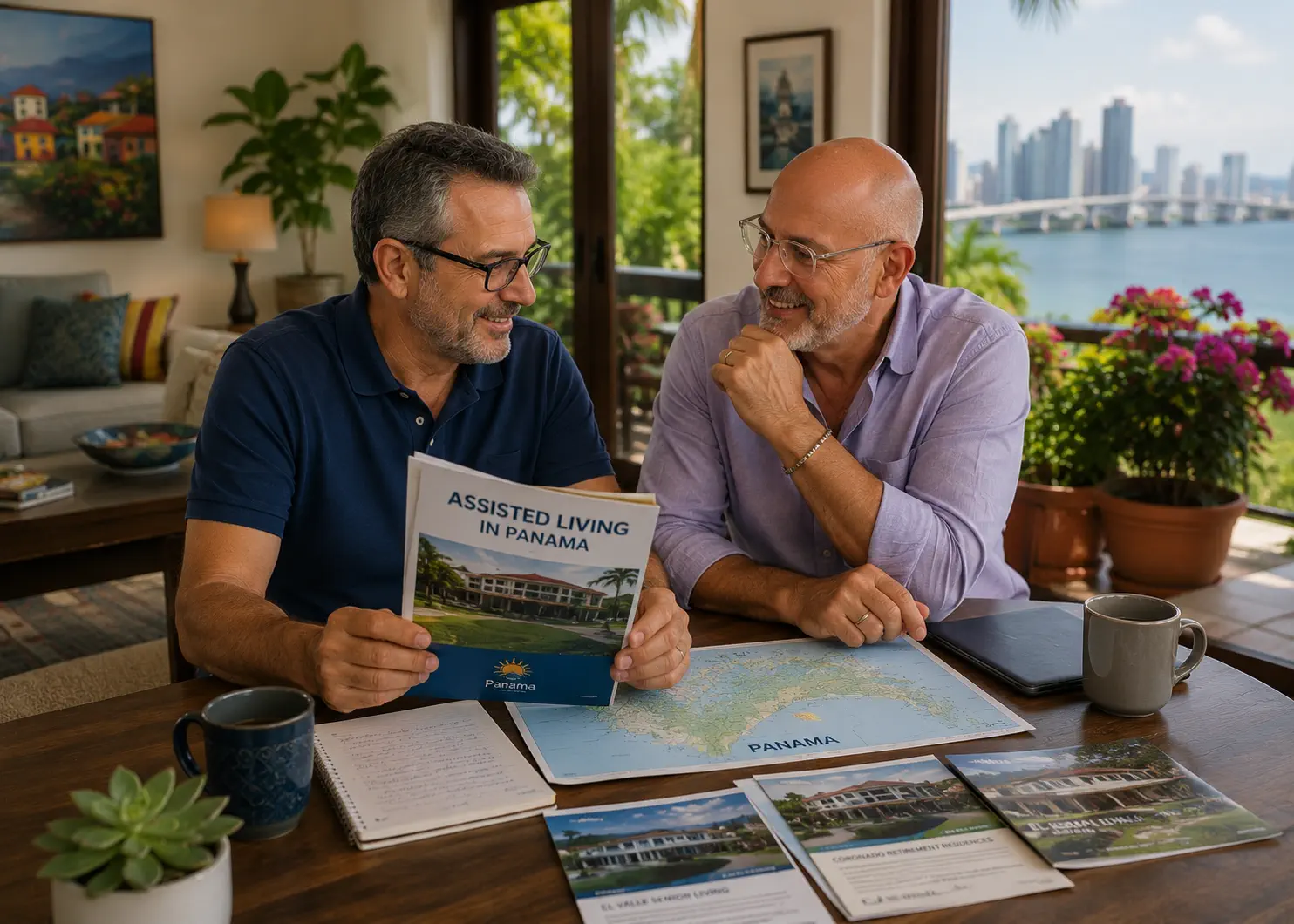
Healthcare in Panama · Part 5 of 8
Assisted Care in Panama by Location: A Region-by-Region Guide and Hiring Checklist
You’ve decided Panama is where you’re aging. Now the practical question: where, and with whom?
 Brian & Kent · GayExpatsPanama.com · Updated April 2026
Other parts of this series covered the landscape — the cultural context, the four main pathways, what things actually cost, and how Panama’s healthcare system does and doesn’t help with assisted care costs. This article is for the next step. You have done the research, you are committed to Panama, and now you need to know what is actually available where you are planning to live — and how to evaluate it. Because assisted care in Panama is not evenly distributed. Where you live has a direct effect on what options you will have, how quickly you can access them, and what you will pay.
Healthcare in Panama: The Complete Expat Guide
Eight articles covering every healthcare decision a Panama expat needs to make — from choosing insurance before you move to knowing when it's time to go back to the US for care.
- Health Insurance & Costs: An Honest Guide for U.S. Expats
- Healthcare by Location: What You Can Count On in Every Region
- Medical Emergencies, Medicare & What Every Expat Needs to Plan
- Aging Well in Panama: Assisted Living Options for Expats
- Assisted Care by Location: A Region-by-Region Guide & Hiring Checklist You are here
- When Do You Go Back? The Question Every Panama Expat Will Eventually Ask
- LGBTQ+ Healthcare: PrEP, PEP, HIV Care, Affirming Doctors & Privacy
- Prescription Medications in Panama
Panama City: The Most Options, the Highest Costs
If maximum access to assisted care resources matters to you — and at some point it will — Panama City is where that access is best. The private hospital system here is world-class by Latin American standards. The specialist community is concentrated here. And the private assisted care market, while still small, has its most developed presence in the capital.
Insignia Panama
Panama City · Private Assisted Living
The flagship private assisted living facility in the country. Located in El Cangrejo (Bella Vista), it offers independent living, assisted living, and dedicated memory care — all under one roof, with 24/7 professional nursing, personalized care plans, medication management, and a full dining and activities program. If you or a partner needs residential care in Panama City, this is the most credible option currently operating. insigniapanama.com · +507-6936-1708 — contact directly for current pricing and availability.
Harmony House
Panama City · Boutique Residential Care
A smaller residential option positioning itself as a home-like environment that emphasizes dignity and emotional wellbeing alongside medical support. Worth contacting if a less institutional setting appeals over a larger facility.
For in-home care in Panama City, the full range of agencies operates here. Vitae Salud, Domi Salud, and Abundant Live PTY all place professional caregivers in homes across the city. Expect the higher end of the Panama scale — $1,500–$2,500/month for agency-placed care, up to $2,000/month for a fully licensed professional nurse.
The Cost Trade-Off
Panama City is the most expensive place to live in Panama, and assisted care costs track with that. If your budget is tighter, the comparison with Boquete or the Chiriquí highlands is worth running carefully before you commit to a location.
Boquete and the Chiriquí Highlands: A Real Expat Infrastructure
Boquete has one of the largest and most established expat communities in Panama — and that community has been aging in place long enough that a small but genuine assisted care infrastructure has developed around it.
Villa Esperanza
Alto Boquete · Private Residential Care · $1,200–$1,600/month
Two small facilities in Alto Boquete, each accommodating 12–15 residents in a home-like setting with English-speaking ownership. Atmosphere is closer to a family home than a facility, which suits some people better than a larger institution. Shared or private rooms available. Dalisla Sanchez · +507-6678-1278
For in-home care in Boquete, the expat community network is your first resource. The community is well-established enough that word-of-mouth referrals for reliable caregivers circulate through expat social channels — Facebook groups, community events, and the informal infrastructure of a town where many people have already navigated this. Start local before going to a Panama City agency, because local knowledge often produces better matches.
The Distance Factor
For anything beyond routine care needs — specialized medical procedures, complex geriatric management, advanced memory care — David is about 45 minutes away (nearest hospital), with Panama City the next stop for more specialized care. In a medical emergency, that distance matters. It is manageable, but it needs to be in your planning from day one.
Coronado and the Pacific Beach Corridor
The beach communities west of Panama City — Coronado, El Valle de Antón, Penonome — are popular with expats looking for a more relaxed pace within reasonable distance of the capital. Assisted care infrastructure is thinner here than in Panama City or Boquete, but not absent.
Corridor Coverage
Panama Home Care specifically covers this region — from Chame to Penonome and El Valle de Antón. They offer in-home nursing, bilingual doctor home visits, and caregiver support with an explicit focus on expat clients. Clínica Hospital San Fernando has a satellite facility in Coronado — the only JCI-accredited private hospital network with a presence outside Panama City. For serious or specialized care, you are still looking at Panama City, roughly an hour away on the Pan-American Highway.
Bocas del Toro: Beautiful, But Plan Carefully
Bocas is genuinely lovely, and it has a real expat community. It also has the most limited medical and assisted care infrastructure of any major expat destination in Panama.
Know What You Are Signing Up For
The hospital in Bocas Town handles emergencies and basic care, but complex medical needs require travel — often a flight or multi-hour journey — to reach Panama City. Professional in-home care agency infrastructure is essentially absent. If your care needs become serious, you will likely need to relocate. Go in knowing that, and build your contingency plan from day one — not as an afterthought.
The Interior: Chitré, Las Tablas, and the Veraguas Corridor
The interior provinces have expat communities that are smaller but growing — drawn by lower costs and authentic Panamanian small-town life. Chitré and Santiago have hospitals, and Chitré has a developing private medical sector. But private assisted living facilities are essentially nonexistent, and professional in-home care agencies do not serve this region consistently. The realistic plan for the interior: in-home care through personal hiring (feasible and affordable), combined with a clear decision point at which you would move — either to Panama City or back home — if needs escalate beyond what you can manage locally.
A Note for Same-Sex Couples
Panama does not recognize same-sex partnerships, and that legal reality has direct implications for assisted care that straight couples do not face. If one partner is hospitalized or incapacitated, the other has no automatic legal standing to make medical decisions. Every same-sex couple in Panama should have a healthcare power of attorney for each partner, a general power of attorney, and advance directives for each person — all properly notarized under Panamanian law. A Panama-based attorney who has worked with same-sex expat couples is the right person to set this up. We cover the full picture in our Medical Emergency Planning guide.
The Hiring Checklist: What to Ask Before You Commit to Anyone
Whether you are evaluating a home care agency or a residential facility, the questions below will tell you more than any brochure will. The answers matter.
For Home Care Agencies
For Residential Facilities
Before You Sign Anything
Plan Before You Need To
The expats who navigate this stage of life most gracefully are almost always the ones who planned for it while they did not need to.
They built relationships with local agencies. They had the legal documents in place. They had visited the facilities and knew what they were choosing. They had had the direct conversation with their partner about what they each wanted — while they could still have that conversation clearly. None of that is morbid. It is the same responsible thinking that goes into a will or a health insurance decision. The window to make those plans calmly is right now — while the stakes of getting it wrong are low and the options are open. Panama can be a good place to grow old. It is a better place to grow old if you have done the work.
Sources & Verification
- Official: Panama does not legally recognize same-sex partnerships; no automatic medical decision-making standing for an unmarried or legally unrecognized partner.
- Community: Region-by-region facility and agency details (Insignia Panama, Harmony House, Villa Esperanza, Panama Home Care, Clínica Hospital San Fernando’s Coronado satellite, Vitae Salud, Domi Salud, Abundant Live PTY) and general infrastructure characterizations by location — synthesized from provider information and expat community reports.
Facts and prices in this article last verified: April 2026.
Healthcare in Panama: The Complete Expat Guide
- 01 Health Insurance & Costs: An Honest Guide for U.S. Expats
- 02 Healthcare by Location: What You Can Count On in Every Region
- 03 Medical Emergencies, Medicare & What Every Expat Needs to Plan
- 04 Aging Well in Panama: Assisted Living Options for Expats
- 05 Assisted Care by Location: A Region-by-Region Guide & Hiring Checklist
- 06 When Do You Go Back? The Question Every Panama Expat Will Eventually Ask
- 07 LGBTQ+ Healthcare: PrEP, PEP, HIV Care, Affirming Doctors & Privacy
- 08 Prescription Medications in Panama
Brian & Kent
A gay couple based in St. Petersburg, Florida, researching and relocating to Panama in real time. Brian is applying for a Pensionado visa. Kent is the primary researcher. The research is current, the attorney meetings are recent, and the prices are from this year.