Pensionado Visa
Your FBI Background Check for Panama — How to Get It, Fast
What the Identity History Summary actually is, how to request it online at edo.cjis.gov, where to get fingerprinted, and what happens next.
 Brian & Kent · GayExpatsPanama.com · April 2026 Research Trip
Panama requires a criminal background check as part of the Pensionado visa application. For Americans, that means an FBI Identity History Summary — the federal criminal record that covers your entire history across all 50 states. Getting it sounds bureaucratic and slow. It wasn’t. I had mine in my email inbox roughly 15 to 20 minutes after leaving the post office. Here is exactly how that happened.
This post covers the FBI check: what it is, how to request it online, how the USPS fingerprinting process works, what the report looks like, and how to get it apostilled for use in Panama. The next post in this series covers the apostille itself — what it is, why it exists, and all your options for getting documents authenticated.
Panama Pensionado Visa Series
Everything we've learned going through the Panama Pensionado visa process ourselves — the attorney, the documents, the appointments, and what actually happened on filing day.
- The Panama Pensionado Visa: Simpler Than You Think
- Can Gay Couples Get the Panama Pensionado Visa Together? What Actually Changes
- No, You Can't Just Fly to Panama and File Your Pensionado Visa Yourself
- Finding Your Panama Attorney: The Right Firm Changes Everything
- Your Pension Letter: The Document Panama Needs — and What Social Security Actually Sends You
- Your FBI Background Check for Panama — How to Get It, Fast You are here
- What Is an Apostille — and Why You Need One for Panama
- The Medical Certificate: What to Expect at Your Panama Visa Exam
- Your Panama Immigration Appointment: What to Expect on Filing Day
- My Panama Permanent Residency Was Approved — The Actual Timeline, Day by Day
What the FBI Identity History Summary Actually Is
The official name is the FBI Identity History Summary, sometimes called an IdHS or, less formally, a “rap sheet.” It is a fingerprint-based record that compiles criminal history information maintained by the FBI’s Criminal Justice Information Services (CJIS) Division — the agency that operates the national fingerprint database.
The report draws from federal, state, and local law enforcement submissions. If you were arrested anywhere in the United States, if you served in the military, if you went through federal employment or naturalization fingerprinting — that information may appear. If you have a clean record, the report comes back confirming no record exists. That’s the document Panama needs.
For visa and residency applications — which is exactly our situation — the FBI Identity History Summary is the standard U.S. federal criminal background check. Panama asks for it because they need to verify that the people applying to live there haven’t brought a serious criminal history with them. Reasonable.
Validity Window — Don’t Get This Wrong
Panama requires that all documents submitted for a visa application be dated within the previous six months. That six-month clock starts from the date the FBI issued your report — not the date you get it apostilled, not the date you hand it to your attorney. Plan accordingly. Request your report close enough to your intended filing date that it won’t expire before your attorney can submit — but not so far out that you’re scrambling to apostille it in time. If you get the report and then take three months to finalize other paperwork, you may be ordering a second one.
The Online Request Process — Start at edo.cjis.gov
The fastest way to get your FBI Identity History Summary is through the FBI’s own online portal at edo.cjis.gov. This is where I started, and the process was straightforward.
Go to edo.cjis.gov and enter your email
The site asks for your email address to get started. You’ll receive a PIN by email to verify your address and access the application. Do not use a spam folder email — you need that PIN to proceed.
Complete the Identity History Summary request form
The online form collects your personal information: name, date of birth, address, Social Security number, and the reason for the request (immigration/visa is the relevant category). Fill this out accurately — discrepancies between your application and your fingerprints will slow things down.
Pay the FBI fee — $18
The FBI charges $18 for the Identity History Summary request — that is the confirmed fee Brian paid. The USPS may charge a separate service fee for the fingerprinting appointment itself; confirm the amount when you book your location. Verify current fees at edo.cjis.gov before submitting, as government fees can change.
Receive your confirmation email — and the USPS link
After completing the online request, you’ll receive a confirmation email with a link (or code) to register with the U.S. Postal Service fingerprinting program. Print this confirmation. You will need it at the post office. Without it, the postal clerk cannot process your fingerprints.
Find a USPS location that offers fingerprinting
Not every post office does this. The USPS link from your confirmation email will show participating locations near you. Hours for fingerprinting services are typically Monday through Friday, 9:00 a.m. to 2:00 p.m. — the window is narrower than regular post office hours. Confirm before you drive.
Go to the post office with your printed confirmation and a photo ID
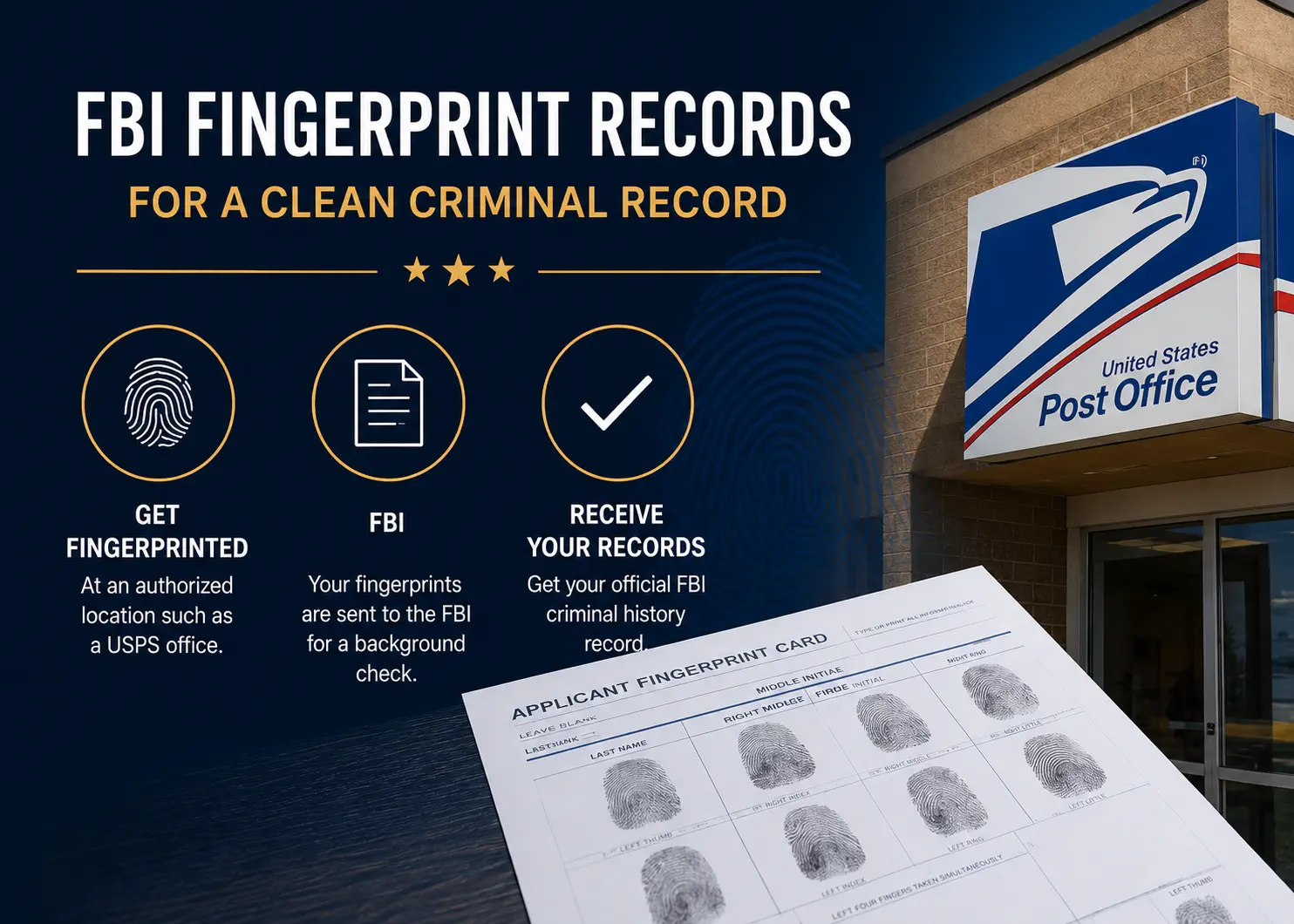
Bring the printed confirmation email, a valid government-issued photo ID (driver’s license or passport), and your payment. The fingerprinting itself takes minutes — it’s electronic, not ink-on-card. They scan your prints, submit them directly to the FBI’s CJIS Division.
Receive your report by email
When I left the post office, my report arrived in my email approximately 15 to 20 minutes later. That is not a typo. The electronic submission goes directly to the FBI and the response comes back fast. The emailed report is a PDF. Print it — that printed document is what you take to get apostilled.
I left the post office, checked my phone in the parking lot, and the report was already there. The whole thing — from the online request to the PDF in my inbox — took less than a week including the time it took me to find a post office with fingerprinting hours that worked.
What I Actually Experienced at the Post Office
The fingerprinting clerk was in a meeting when I arrived. That happens. I waited. Eventually she came out, we went through the process, and the whole thing was fine. This is not a complaint — it’s a genuine note: USPS fingerprinting is done by a specific person, not the general counter staff, and that person’s availability isn’t always predictable.
Make an Appointment if You Can
Some USPS fingerprinting locations offer appointments; others are walk-in only. Call ahead. If the location takes appointments, make one — it’s the difference between waiting 20 minutes for a meeting to end and walking straight through. The FBI confirmation email will have contact information for the location you’ve registered with.
Bring your printed confirmation. The clerk needs that document. Emailing it to yourself and showing her your phone will not work the same way. Paper, printed, in hand.
The Cost Breakdown
FBI Background Check — What We Paid
What You Get — and What to Do With It
The report itself is a straightforward PDF from the FBI. It lists your name, the date it was issued, and either a summary of any record found or a statement that no record exists. For most people applying for the Pensionado visa, it will be the latter.
Print it. That printed document is what you apostille — you’re not apostilling the PDF file, you’re apostilling the physical paper. The apostille is attached to or printed on the document itself.
To apostille the FBI report, you go through the U.S. Department of State Office of Authentications in Washington, D.C. — not a state Secretary of State office. The FBI report is a federal document, and only the federal government can apostille federal documents. Your options are: mail it yourself to D.C. (six to eight weeks, approximately $82 total), use a third-party expediting service (seven to ten business days, $100–$120), or in some cases bring the printed report to the Panamanian Consulate for direct authentication.
We printed the emailed report, took it to the Tampa Panamanian Consulate, and had it authenticated there. The process was smooth. See the next article in this series for the full details on that visit and all your apostille options.
Other Ways to Get Fingerprinted — Skip the Post Office If You Prefer
The USPS route is what we used, and it worked. But it is not the only option, and for some people it may not be the most convenient one. The FBI authorizes a network of private fingerprinting companies to capture and submit prints directly on your behalf — the same fingerprints, the same FBI database, the same report. The difference is speed, convenience, and cost.
The three names you’re most likely to recognize:
IdentoGO (identogo.com) is the largest fingerprinting network in the country, operated by IDEMIA. It has locations in every state, including many inside UPS Stores and standalone centers. You enroll online, schedule an appointment, show up with your ID, and the report comes back electronically. Turnaround is typically 24 to 48 hours. Cost runs approximately $50 to $80.
Fieldprint (fieldprintfbi.com) has locations nationwide and is widely used for federal employment and professional licensing background checks. Schedule online, get fingerprinted, receive the report electronically — usually within 24 to 48 hours. Cost is in the $50 to $90 range.
The UPS Store — many locations offer FBI fingerprinting through a service called Certifix Live Scan. Enroll online at certifixlivescan.com, which generates a QR code you bring to your nearest participating UPS Store. Check the Certifix site to find one near you and confirm current hours before you go.
Cost vs. the USPS Route
The private fingerprinting services cost more than going directly through the FBI via the post office — roughly $50 to $90 versus the $18 FBI fee plus whatever the USPS charges. What you get in return is a guaranteed appointment, a location that does nothing but fingerprinting, and typically faster results. If the nearest participating post office is inconvenient or the fingerprinting hours don’t work for your schedule, IdentoGO or a UPS Store location is a straightforward alternative.
One more option worth knowing about: your Panamanian attorney can often handle the apostille process on your behalf — likely at an additional cost. We handled it ourselves at the Tampa consulate, which worked out well and cost less. But if you’re coordinating everything through your attorney and want to hand off the paperwork logistics entirely, it’s worth asking about during your initial meeting. Carolina Tejada Vaprio at Morgan & Morgan will be able to tell you what they offer and what they charge.
For Couples
Each person applies separately. Two people, two fingerprinting appointments, two FBI reports, two apostilles. There is no shortcut here. Budget time for both, and do not assume that scheduling one means the other is handled. If one partner’s report takes longer for any reason, the other’s can still proceed independently.
Same-sex couples: this is one of the many steps you each complete on your own. Panama does not recognize same-sex marriage for immigration purposes, so each partner files a fully independent application — see our dedicated article earlier in this series, Can Gay Couples Get the Panama Pensionado Visa Together?, for the full picture.
The Short Version
Go to edo.cjis.gov. Enter your email, complete the form, pay the $18 FBI fee, and you’ll receive a confirmation email with a USPS registration link. Find a participating post office near you with fingerprinting hours. Go in, bring your printed confirmation and a photo ID, get fingerprinted electronically. Your report arrives by email — in my case, within 15 to 20 minutes of leaving the building. Print that report. Then apostille it through the U.S. Department of State, the Tampa consulate, a third-party expediting service, or your attorney. Bring the apostilled original to your attorney before the six-month clock expires.
The whole process, once you know how it works, is genuinely not that bad. If the post office route doesn’t appeal, IdentoGO and the UPS Store network both offer the same fingerprinting through a more predictable appointment system. Do the fingerprinting right, watch the six-month deadline, and this piece of the paperwork puzzle takes care of itself.
Sources & Verification
- Official: edo.cjis.gov as the correct FBI Identity History Summary online request portal; the confirmed $18 FBI processing fee; the six-month validity window Panama requires on submitted documents.
- Reported: IdentoGO and Fieldprint as legitimate FBI-approved Channelers, with turnaround (24–48 hours) and cost ranges ($50–$80 and $50–$90 respectively) confirmed against multiple current (2026) sources; the UPS Store/Certifix Live Scan option.
- Firsthand: Brian’s own FBI Identity History Summary request, USPS fingerprinting appointment, ~15–20 minute report turnaround, and the Tampa Panamanian Consulate apostille visit.
- Not yet verified: The specific apostille cost figures (DIY mail-to-D.C., third-party expediting service) — flagged for the full treatment in the dedicated apostille article next in this series.
Facts in this article last verified: July 2026.
Panama Pensionado Visa Series
- 01 The Panama Pensionado Visa: Simpler Than You Think
- 02 Can Gay Couples Get the Panama Pensionado Visa Together? What Actually Changes
- 03 No, You Can't Just Fly to Panama and File Your Pensionado Visa Yourself
- 04 Finding Your Panama Attorney: The Right Firm Changes Everything
- 05 Your Pension Letter: The Document Panama Needs — and What Social Security Actually Sends You
- 06 Your FBI Background Check for Panama — How to Get It, Fast
- 07 What Is an Apostille — and Why You Need One for Panama
- 08 The Medical Certificate: What to Expect at Your Panama Visa Exam
- 09 Your Panama Immigration Appointment: What to Expect on Filing Day
- 10 My Panama Permanent Residency Was Approved — The Actual Timeline, Day by Day
A gay couple in St. Petersburg, Florida, researching and relocating to Panama in real time. Brian’s permanent residency was approved in July 2026; Kent is the primary researcher. Everything on GayExpatsPanama.com comes from their direct experience — the attorney meetings, the paperwork, the consulate visits, the prices. The research is current because they’re still doing it.