Pensionado Visa
What Is an Apostille — and Why You Need One for Panama
The 1961 treaty that turned a bureaucratic nightmare into a single stamp, and what it means for your relocation paperwork.
 Brian & Kent · GayExpatsPanama.com · April 2026 Research Trip
When our attorney Carolina Tejada Vaprio at Morgan & Morgan handed us the document checklist for the Pensionado visa application, one word kept appearing next to the most important items: apostille. We had a vague sense it meant “officially stamped by someone official,” which turns out to be roughly accurate — but understanding exactly what it is, where the requirement comes from, and how to get it done changed how we planned our paperwork timeline.
This post covers the apostille: what it is, why it exists, and the options available to you as an American preparing documents for Panama. The previous post in this series covers the FBI criminal background check specifically — because getting that document and getting it apostilled are two separate processes worth walking through in detail.
Panama Pensionado Visa Series
Everything we've learned going through the Panama Pensionado visa process ourselves — the attorney, the documents, the appointments, and what actually happened on filing day.
- The Panama Pensionado Visa: Simpler Than You Think
- Can Gay Couples Get the Panama Pensionado Visa Together? What Actually Changes
- No, You Can't Just Fly to Panama and File Your Pensionado Visa Yourself
- Finding Your Panama Attorney: The Right Firm Changes Everything
- Your Pension Letter: The Document Panama Needs — and What Social Security Actually Sends You
- Your FBI Background Check for Panama — How to Get It, Fast
- What Is an Apostille — and Why You Need One for Panama You are here
- The Medical Certificate: What to Expect at Your Panama Visa Exam
- Your Panama Immigration Appointment: What to Expect on Filing Day
- My Panama Permanent Residency Was Approved — The Actual Timeline, Day by Day
What an Apostille Actually Is
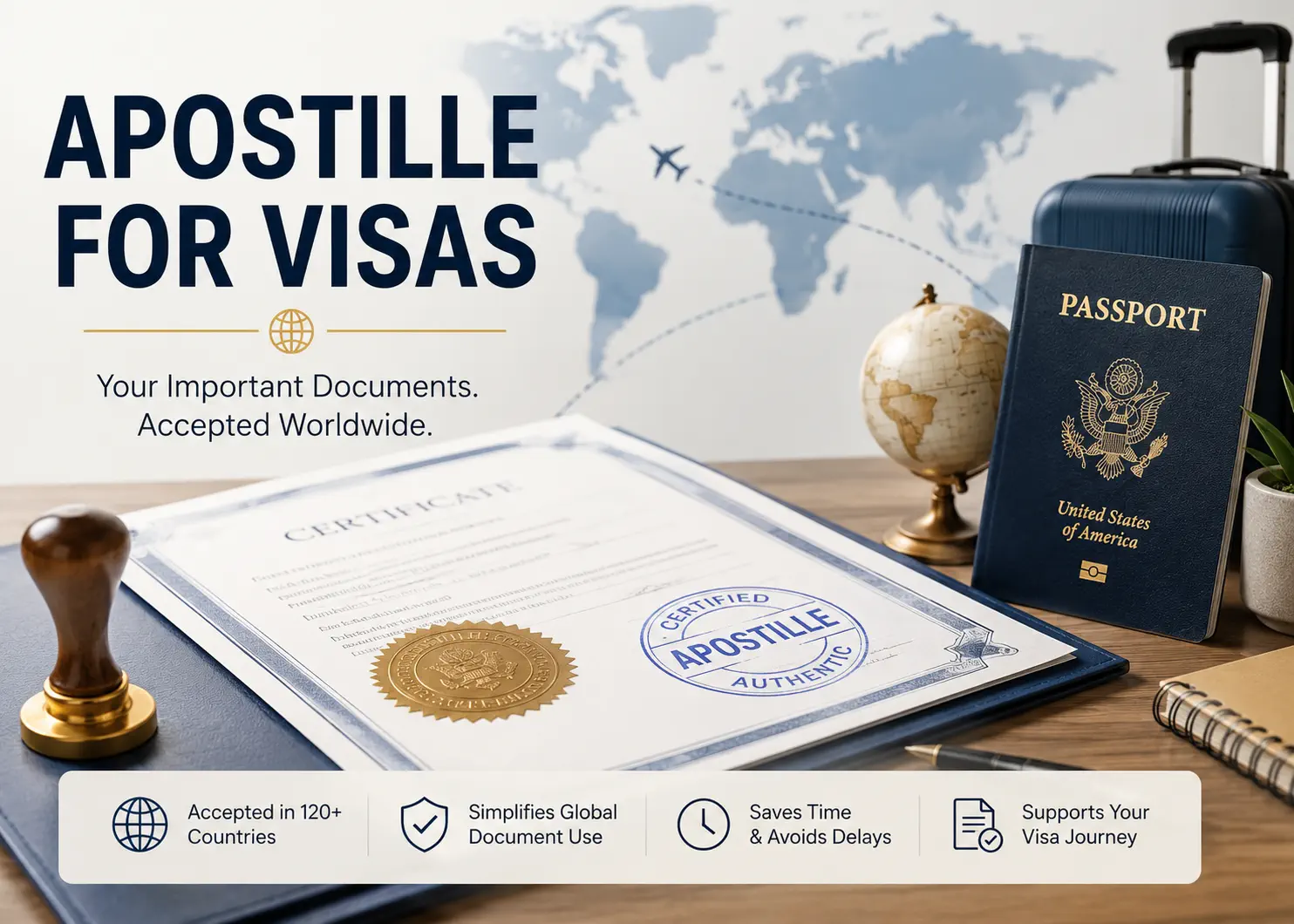
An apostille is a certificate that authenticates a public document for use in another country. Specifically, it verifies that the signature, the capacity of the signer, and the seal or stamp on a document are genuine and come from the stated issuer. What it does not do is verify the content of the document — the apostille says the signature is real, not that what’s written is true.
The word comes from French — apostille means a marginal or bottom note, derived from the Latin post illa, meaning “after those words.” In practice it’s a standardized certificate, always titled in French as Apostille (Convention de La Haye du 5 octobre 1961), attached to or printed on the original document. It contains ten numbered fields: the country, document type, signer’s name, capacity, seal information, location, date, issuing authority, certificate number, and the issuing official’s signature.
The apostille certifies the signature is real — not that what’s written is true. That distinction matters more than you’d expect.
Before the apostille system existed, using a document issued in one country in another country required a chain of authentications: local notarization, state certification, federal certification, and then legalization by the embassy or consulate of the destination country. Each step took time and cost money. The process was slow, inconsistent, and different for every country-to-country combination. The apostille replaced that chain with a single certificate recognized by every member nation.
The 1961 Hague Convention — Where This All Came From
The apostille was created by the Convention of 5 October 1961 Abolishing the Requirement of Legalisation for Foreign Public Documents — universally referred to as the Apostille Convention or the Hague Apostille Convention. It was drafted by the Hague Conference on Private International Law, an intergovernmental organization that has been harmonizing international legal procedures since 1893.
The Convention entered into force on January 24, 1965. The United States became a party in 1980 and began issuing apostilles for public documents on 15 October 1981. Today 129 countries are parties to the Convention. That covers essentially every country Americans are likely to be dealing with for retirement or work abroad — including Panama, which is a full member.
Why This Matters for You
Because both the United States and Panama are Hague Convention members, a U.S. apostille is all Panama needs to accept your American documents. You do not need consular legalization on top of the apostille. If a document already carries an apostille seal, it will not require additional authentication from a Panamanian consulate.
The Convention specifies which types of documents qualify for apostilles: documents from courts or tribunals, administrative documents, notarial acts, and official certificates placed on documents signed by private individuals. What it does not cover: documents executed by diplomatic or consular agents themselves, and administrative documents dealing directly with commercial or customs operations. For Pensionado purposes, the documents you’re apostilling — criminal background checks, pension letters, birth certificates — all qualify.
Who Issues Apostilles in the United States
In the U.S., the apostille system works on a three-tier structure based on where a document originates.
State-issued documents — birth certificates, marriage licenses, court records, notarized documents — are apostilled by the Secretary of State (or equivalent office) in the state where they were issued. A Florida birth certificate gets apostilled by the Florida Secretary of State. A Texas marriage license gets apostilled by the Texas Secretary of State. You cannot mix states: the apostille must come from the state of origin.
Federal documents — including FBI background checks, Social Security letters, federal court records, and naturalization certificates — are apostilled by the U.S. Department of State’s Office of Authentications in Washington, D.C. State-level Secretary of State offices cannot apostille federal documents. This is an important distinction that catches people off guard: even if you live in Florida and the Florida Secretary of State could apostille your birth certificate in days, your FBI report has to go through D.C.
| Document Type | Who Issues the Apostille | Where to Submit |
|---|---|---|
| Birth certificate | Secretary of State of the issuing state | State of birth |
| Marriage certificate | Secretary of State of the issuing state | State where married |
| FBI criminal background check | U.S. Department of State, Office of Authentications | Washington, D.C. only |
| Social Security pension verification | U.S. Department of State, Office of Authentications | Washington, D.C. only |
| Notarized private document | Secretary of State where notarized | State where notarized |
Your Four Options for Getting It Done
Option 1 — Your Local Panamanian Consulate (What We Did)
For state documents — and in some cases federal documents — the nearest Panamanian consulate can authenticate documents directly. This is a separate service from the apostille but accomplishes the same goal: making your American document legally recognized in Panama. The consulate physically verifies the signature and seal of the issuing authority.
We used the Panamanian Consulate in Tampa. It is at 6107 Memorial Highway, Suite C, Tampa, FL 33615 — phone (813) 242-0310. Hours are Monday through Thursday 9:00 a.m. to 3:30 p.m. and Friday 10:00 a.m. to 3:00 p.m.
Tampa Consulate — What We Learned
The honest account: we tried to reach the Tampa consulate by phone and email before going. Nothing. No answer, no response. We drove to the office. The woman at the desk asked if we had an appointment. We told her we’d tried but couldn’t get through. She said: “OK, you’re third in line.” Everything went smoothly from there. The staff were efficient and pleasant. This is not a horror story — it just requires showing up.
Don’t Count on Phone or Email
Every Panamanian consulate in the U.S. has a mixed reputation for phone and email responsiveness. For time-sensitive document needs, budget for an in-person visit. Factor that into your logistics if you’re not driving distance from a consulate.
Panamanian consulates in the United States are located in Washington D.C., Miami, Tampa, New Orleans, Houston, Philadelphia, New York, Los Angeles, and Springdale, Arkansas. If you are not near one of these cities, the Embassy of Panama page (embassyofpanama.org) and the U.S. State Department’s consular contact list both have current addresses and contact details. Find your nearest one and plan accordingly.
Option 2 — U.S. Department of State, Office of Authentications (DIY)
For federal documents, including the FBI criminal background check, the official apostille comes from the U.S. Department of State Office of Authentications in Washington, D.C. You can submit directly by mail. The federal fee is $20 per document. Budget for expedited shipping both ways — roughly $31 each way via USPS Priority Mail Express — which brings the DIY total to approximately $82 per document, not counting the cost of the background check itself.
The catch is time. As of 2026, the Department of State’s own estimate for standard mail processing is six to eight weeks or longer. If you are working toward a visa filing deadline, that timeline can create real pressure. Submit early.
Panama Requires Documents Within Six Months — Not Twelve
General international practice sometimes gives an FBI criminal background check up to 12 months of validity for immigration purposes elsewhere. Panama is not one of those countries. As established throughout this series, Panama requires that documents submitted for a visa application — including your FBI report — be dated within the previous six months from issue, not twelve. Get your report and apostille it close to your intended filing window, but not so early that it expires before your attorney can submit. This is the single most consequential deadline in the whole document-gathering process — don’t let a general “12 months” figure you see elsewhere lead you to submit something Panama will reject as expired.
Option 3 — A Third-Party Apostille Service
Several well-reviewed private services specialize in obtaining federal apostilles on your behalf. They physically go to the Department of State for you, which can cut the turnaround time significantly. The trade-off is cost: service fees typically run $75 to $100 on top of the $20 government fee, plus shipping. For an FBI background check apostille, budget $100 to $120 total through a reputable service.
The advantage is speed and not having to manage the logistics yourself. If you have already received your FBI report electronically (as we did), many services accept a PDF upload — you email the document, they print it, submit it, and ship the apostilled original back to you.
Services with consistent positive reviews for this work include Monument Visa, ROCA Document Authentications, and National Apostille. We have not personally used any of them — and recommend verifying current pricing and turnaround times directly before ordering, as these change.
Option 4 — Your Panamanian Attorney
Panamanian immigration attorneys can handle the apostille process on your behalf — likely at an additional fee on top of their visa filing costs. We handled ours directly at the Tampa consulate, which was straightforward and kept costs down. But if you’d rather hand off the paperwork logistics entirely and let your attorney manage the chain, it’s worth asking about during your initial meeting. Confirm what they charge before assuming it’s included in their base fee.
What the Apostille Does Not Do
This is worth stating plainly because it trips people up: an apostille does not validate the content of your document. It confirms that the issuing authority’s signature and seal are genuine. A criminal background check with an apostille tells Panama that the FBI actually issued it — not that everything in it is accurate or complete.
This also means the apostille will not substitute for a document that doesn’t exist. If Panama requires a pension verification letter and yours doesn’t use the exact wording “pension paid for life,” no amount of apostilling fixes that. Get the underlying document right first, then apostille it.
For Same-Sex Couples
Each person files their own separate visa application — and those applications don’t have to be for the same visa type. Brian is filing for the Pensionado visa now; Kent will file for a Qualified Investor visa in a few years once we’ve sold our house. Whatever the visa, each application is independent and requires its own complete set of apostilled documents. There is no joint application, no shared paperwork, and no shortcut. See our dedicated article earlier in this series, Can Gay Couples Get the Panama Pensionado Visa Together?, for the full picture.
The Quick Version — Apostille for Panama
Panama is a Hague Convention member, so a U.S. apostille is legally sufficient — no additional consular legalization required once you have it. State documents go through the Secretary of State of the issuing state. Federal documents, including the FBI report, go through the U.S. Department of State in D.C. — and Panama needs that document dated within six months, not twelve. The Tampa Panamanian Consulate works for in-person document authentication if you prefer that route, is walk-in friendly, and is staffed by genuinely helpful people — just don’t bother trying to reach them by phone first. The previous post in this series covers the FBI background check process in full detail: how to request it online, how fingerprinting works through the U.S. Postal Service, what the report looks like, and what to do with it once you have it.
Sources & Verification
- Official: The Hague Apostille Convention — signed 5 October 1961, entered into force 24 January 1965, the U.S. became a party in 1980 and began issuing apostilles 15 October 1981, with 129 current member countries including Panama — confirmed across multiple current (2026) sources.
- Official: Panama’s requirement that submitted visa documents, including the FBI Identity History Summary, be dated within six months of issue — confirmed consistently across this series’ Articles 1, 5, and 6.
- Firsthand: The Tampa Panamanian Consulate visit, address, phone, hours, and the walk-in/no-phone-response experience, and the DIY and third-party apostille cost figures ($82 DIY, $100–$120 third-party).
- Not yet verified: Specific third-party apostille service names (Monument Visa, ROCA Document Authentications, National Apostille) — mentioned as reported options, not personally used or vetted by us.
Facts in this article last verified: July 2026.
Panama Pensionado Visa Series
- 01 The Panama Pensionado Visa: Simpler Than You Think
- 02 Can Gay Couples Get the Panama Pensionado Visa Together? What Actually Changes
- 03 No, You Can't Just Fly to Panama and File Your Pensionado Visa Yourself
- 04 Finding Your Panama Attorney: The Right Firm Changes Everything
- 05 Your Pension Letter: The Document Panama Needs — and What Social Security Actually Sends You
- 06 Your FBI Background Check for Panama — How to Get It, Fast
- 07 What Is an Apostille — and Why You Need One for Panama
- 08 The Medical Certificate: What to Expect at Your Panama Visa Exam
- 09 Your Panama Immigration Appointment: What to Expect on Filing Day
- 10 My Panama Permanent Residency Was Approved — The Actual Timeline, Day by Day
A gay couple in St. Petersburg, Florida, researching and relocating to Panama in real time. Brian’s permanent residency was approved in July 2026; Kent is the primary researcher. Everything on GayExpatsPanama.com comes from their direct experience — the attorney meetings, the paperwork, the consulate visits, the prices. The research is current because they’re still doing it.