Gay Life in Panama
Is Panama Safe for Gay Men? Crime Data and Our Honest Take
The honest answer starts with an uncomfortable fact: nobody official is actually counting. Here’s what the data does and doesn’t show, what Panama’s own LGBTQ+ organization is tracking instead, and how we’re planning around it.
 Brian & Kent · GayExpatsPanama.com · Updated August 2026
“Is Panama safe for gay men?” sounds like a question with a data-backed answer. It isn’t, and the reason why is itself the most important thing we found while researching this. Panama’s government does not track anti-LGBTQ+ violence as its own category — not quietly, not incompletely, but explicitly and by its own admission. So before we get to what we do know, we want to be upfront about what nobody actually measures.
Gay Life in Panama Series
What it's actually like to be a gay man moving to and living in Panama — the legal reality, the safety picture, the culture, and how to actually meet people.
- LGBTQ Life in Panama
- Is Panama Gay Friendly? The Honest Answer
- Is Panama Safe for Gay Men? Crime Data + Our Honest Take
- Panama City vs. Boquete for Gay Couples: Why We Picked the City
- Should Gay Couples Move to Panama? An Honest Answer
- Will I Be Lonely in Panama?
- Grindr, Scruff, and Meeting Guys in Panama City
Panama’s General Crime Picture
Start with the baseline, because it applies to every resident and visitor regardless of who they are. Panama’s national homicide rate was about 14.6 per 100,000 residents in 2025, essentially flat from roughly 12.9 in 2024 — moderate by Central American standards, and well below Honduras, El Salvador, or Venezuela. The U.S. State Department rates Panama a Level 2 travel advisory (“Exercise Increased Caution”), the same tier as much of Western Europe for different reasons — it’s not a high-alarm rating. Violence is heavily concentrated geographically: over 60% of 2025’s homicides occurred in Panamá province, with another 20% in Colón, and both are driven substantially by transnational drug trafficking rather than street crime against residents or tourists.
Panama’s Crime Baseline — What’s Actually Tracked
Ordinary opportunistic crime — pickpocketing, residential break-ins, the occasional express kidnapping where someone is held for a few hours and forced to empty an ATM — is real and documented, and it applies to everyone. None of that is what makes this question hard to answer for gay men specifically. The hard part is the last row in that table.
The Data Gap Nobody Talks About
Here’s the finding that shaped how we wrote this whole article. The U.S. State Department’s human rights reports on Panama for 2022 and 2023 both stated plainly that the Panamanian government provided no estimate of the number of violence cases reported against LGBTQI+ individuals — not a low number, not an estimate with caveats, no number at all. Then, in the 2024 report (released August 2025 under a revised reporting framework), the State Department removed violence against LGBTQ+ individuals as an evaluated category entirely, along with gender-based violence and several other categories present in prior years.
What This Actually Means
There is currently no official government or U.S. State Department dataset that tells you how many gay men in Panama were assaulted, robbed, or killed because they were gay, in any recent year. Every number in this article past this point comes from Panama’s own LGBTQ+ advocacy organization — because they’re the only ones counting at all.
This isn’t an oversight we’re inferring — Panama’s LGBTQ+ organizations have said the same thing directly, in a formal United Nations submission. In September 2025, AHMNP (Asociación Hombres y Mujeres Nuevos de Panamá) and several allied organizations submitted recommendations to the UN’s Universal Periodic Review of Panama, explicitly citing a “lack of official data” resulting in what they called “institutional invisibility,” and formally requesting that Panama’s Penal Code be reformed to recognize bias motivated by sexual orientation, gender identity, or expression as an aggravating factor in sentencing — a classification that does not currently exist in Panamanian law.
What Panama’s Own LGBTQ+ Organization Is Tracking Instead
AHMNP is Panama’s oldest and only formally recognized LGBTQ+ association, founded in 1996. In the absence of government tracking, its own count is the closest thing to real data that exists. According to AHMNP’s president, Ricardo Beteta, the organization’s internal count found five gay men and two transgender people killed in Panama in 2024, with several of those cases connected to initial contact made through a dating app — reporting that appeared in La Prensa, one of Panama’s major newspapers, in November 2025. Beteta has also stated publicly that these killings are frequently misreported in the press as ordinary robberies or personal disputes rather than being investigated or recorded as bias-motivated crimes, because Panamanian law has no hate crime classification to record them under in the first place.
We want to be precise about what these numbers do and don’t tell you. Seven documented cases in a single year is a real, serious pattern for a country of roughly 4.4 million people — and simultaneously, it’s a small enough absolute number, from a single non-governmental source with no independent verification body cross-checking it, that we can’t responsibly convert it into a rate or compare it directly to countries with formal hate-crime tracking systems, like Mexico or Colombia, without manufacturing a false sense of precision. What we can tell you honestly: multiple independent sources — AHMNP, Panamanian press, and international reporting — describe the same underlying pattern of violence that goes uninvestigated as what it is.
The Legal Backdrop That Shapes All of This
We covered Panama’s legal status for gay people in more depth in Is Panama Gay Friendly? The Honest Answer, but the safety-relevant pieces are worth restating here, and one of them surprised us with how current it still is. As of a Thomson Reuters Foundation report published in late January 2026, Panama’s National Police disciplinary code still formally lists homosexuality as a “grave offense” grounds for dismissal — a rule that predates decriminalization and has never been repealed, even though the State Department notes no confirmed instances of it actually being enforced. The same report documents gay and bisexual Panamanian men still being functionally excluded from blood donation, LGBTQ+ people still lacking any legal protection from discrimination in education, healthcare, or employment, and the 2023 Supreme Court ruling against same-sex marriage still standing.
On paper vs. in practice
None of this means police are actively hunting gay men — there’s no evidence of that, and it isn’t what Panamanian activists are describing either. It means the legal and institutional starting point is one where anti-gay bias isn’t a crime, isn’t tracked, and carries no extra weight in an investigation. That’s the environment any violence happens inside of, which is exactly why AHMNP is pushing for it to change.
Visitors vs. Residents: Two Different Risk Pictures
Worth separating two different things this data actually points to. General Panama crime — the pickpocketing, the occasional express kidnapping, the residential break-ins — isn’t targeted at gay men specifically, and the baseline advisory (Level 2, moderate for the region) applies the same way it would to any traveler or resident. That’s the risk picture for a short visit doing ordinary tourist things.
The pattern AHMNP is describing is different and more targeted: violence connected to being identified as gay, frequently — per their reporting — beginning through contact made on a dating app. That’s a risk that scales with how long you’re there and how you’re meeting people, not one that shows up walking around Casco Viejo in daylight. We wrote a full breakdown of what we actually do to manage that specific risk — meeting in public first, never discussing money, being deliberate about what a dating app’s distance feature can reveal — in Grindr, Scruff, and Meeting Guys in Panama City, and we’d point anyone asking this safety question there next.
Our Honest Take
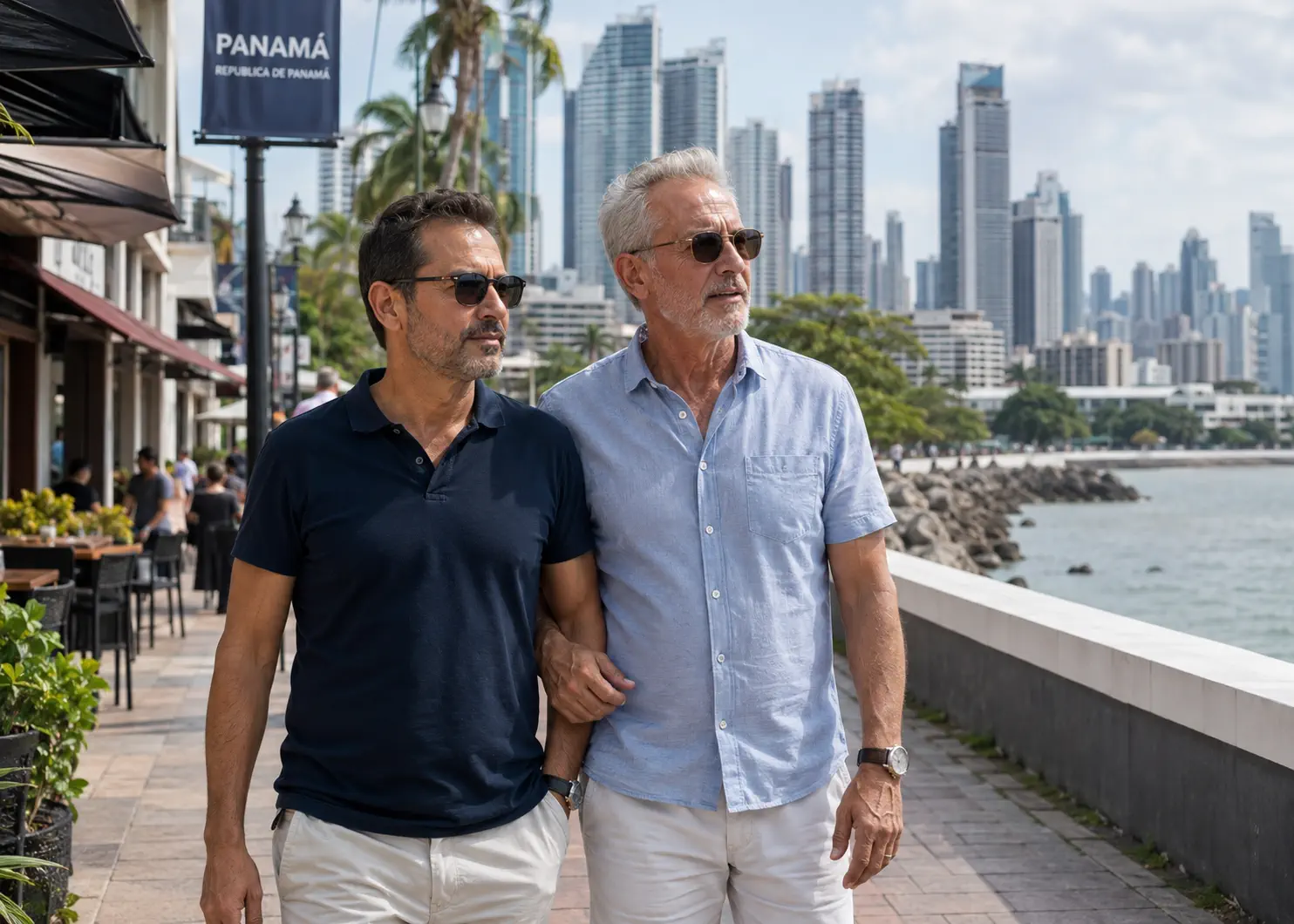
Firsthand: in twelve days in Panama City in April 2026, walking as a visibly together gay couple through restaurants, the Metro, hardware stores, and attorney offices, we experienced zero friction. That’s a real data point, and it’s consistent with what we’ve heard from other gay expats already living there. It is not the same thing as this data gap not mattering. Both things are true at once: day-to-day life in Panama City has been, in our direct experience and by most accounts we trust, easy and low-friction for an out gay couple — and there is a real, documented, currently untracked pattern of targeted violence that a small number of gay men in Panama have died from, disproportionately connected to how they met someone.
We’re moving anyway, with our eyes open about both halves of that. If you’re weighing a longer stay or a move, and any of this touches on health planning as well as physical safety, we’d also point you to our PrEP in Panama guide — a different kind of safety question, but one that comes up in the same conversation for a lot of readers.
What we’re actually doing about it
Nothing dramatic: meeting people from apps in public first, not sharing financial details with someone we just met, staying aware in the same general way we would in any unfamiliar city, and treating “this person wants me at their place immediately” as a reason to slow down rather than a compliment. None of it changes how we live. All of it costs nothing.
Sources & Verification
- Firsthand: Twelve days in Panama City, April 2026, as a visibly together gay couple, and our own ongoing approach to app-based safety.
- Official: U.S. Department of State, Country Reports on Human Rights Practices: Panama, 2022, 2023, and 2024 editions (the 2024 edition, released August 2025, removed violence against LGBTQ+ individuals as an evaluated category); U.S. Department of State Panama Travel Advisory (Level 2, current as of March 2026); OSAC Panama Country Security Report.
- Reported: La Prensa Panamá, November 2025, on AHMNP’s internal count of LGBTQ+ deaths in 2024 and dating-app-related violence; Thomson Reuters Foundation / Context News, January 2026, on current police disciplinary code language and blood donation restrictions; El Siglo, on AHMNP president Ricardo Beteta’s statements regarding uninvestigated anti-gay violence.
- Reported: AHMNP (Asociación Hombres y Mujeres Nuevos de Panamá) formal submission to the UN Universal Periodic Review of Panama, September 2025, describing the absence of official LGBTQ+ violence data as “institutional invisibility.”
- Reported: Panama national homicide rate and general crime statistics — OSAC, Statista/InsightCrime, and World Bank/UNODC data.
- Not yet verified: There is no independently audited count of anti-LGBTQ+ violence in Panama from any source, government or otherwise. AHMNP’s figures are the best available, not a verified official statistic, and we’ve tried to be clear throughout this article about that distinction.
Facts and prices in this article last verified: August 2026.
Gay Life in Panama Series
- 01 LGBTQ Life in Panama
- 02 Is Panama Gay Friendly? The Honest Answer
- 03 Is Panama Safe for Gay Men? Crime Data + Our Honest Take
- 04 Panama City vs. Boquete for Gay Couples: Why We Picked the City
- 05 Should Gay Couples Move to Panama? An Honest Answer
- 06 Will I Be Lonely in Panama?
- 07 Grindr, Scruff, and Meeting Guys in Panama City
Brian & Kent
We’re relocating from St. Petersburg, Florida to Panama City, Panama. Brian is a former attorney with permanent residency approved via the Pensionado visa; Kent, a PharmD, is pursuing the Qualified Investor Visa and does most of the on-the-ground research. Everything on this site comes from our own research, our own attorney meetings, and our own mistakes.