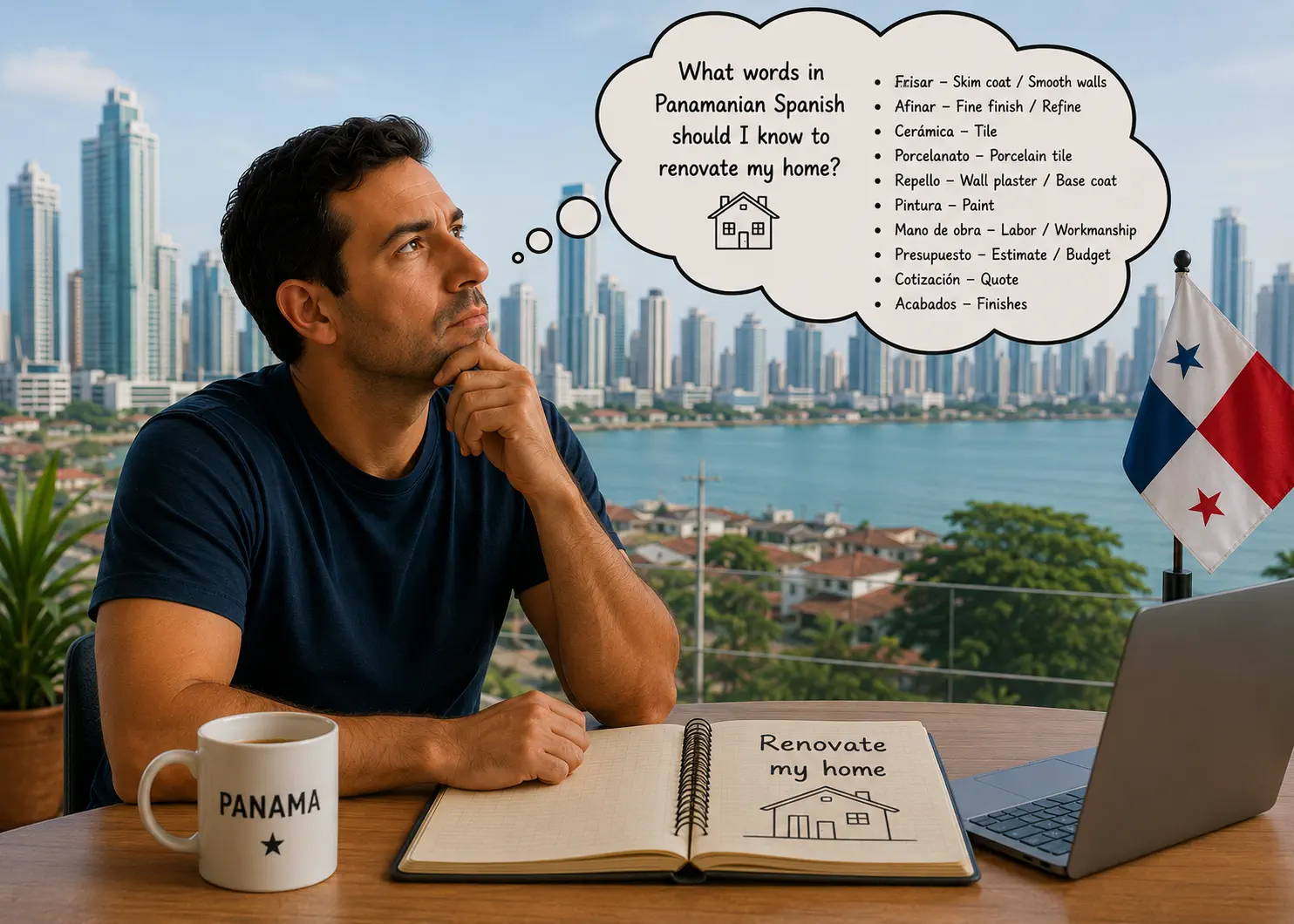
Buying & Remodeling a Home in Panama — Part 9 of 10
Construction Spanish for Panama: The Words That Actually Matter on a Job Site
Panama has its own construction vocabulary — shaped by U.S. influence, local trade customs, and decades of concrete-block building. Some of it is nothing like what you learned in Spanish class, and some of it is nothing like what they use in Spain or Colombia. This is the guide we wished we’d had before the first contractor showed up.
 Brian & Kent · GayExpatsPanama.com · April 2026 Research Trip
Here is something nobody tells you before your first contractor meeting in Panama: the Spanish you learned — from an app, a class, or years of watching Almodóvar — may not get you through a conversation about concrete block, repello, and whether the plomero finished the rough-in before the albanil started closing walls. Panama’s construction vocabulary has been shaped by a century of U.S. presence, a tradition of concrete-block construction, and trade customs that differ meaningfully from Spain, Mexico, and Colombia. This article is a practical working reference, organized by when you’ll need each term: before the project, during it, and at the end.
A note on the Spanish itself: Panamanians drop the final s from many words in casual speech, so los bloques becomes lo’ bloque’. The ch often softens to sh. And Panama is one of the few Spanish-speaking countries where usted — the formal “you” — is the default even between people who know each other well. Use usted with your contractor and workers. It signals respect, which matters.
Buying & Remodeling a Home in Panama Series
Ten articles covering construction methods, materials, contractors, and the practical realities of remodeling a home in Panama.
- The House Is Made of What? Panama Construction 101 for Americans
- Wires, Pipes & the Jackhammer Problem
- Repello, Zinc & Plycem: The Panama Materials Vocabulary You Need
- Remodeling for Energy Efficiency in Panama: What the Rules Actually Require
- What You Must Know Before You Buy to Remodel
- Who's Licensed to Swing a Hammer in Panama?
- Finding Reliable Labor in Panama: What Actually Works, What Doesn't, and What Nobody Tells You in Advance
- Paying Contractors in Panama: Cash Culture, Receipts & the Protections You Do (and Don't) Have
- Panama Construction Spanish: The Vocabulary Guide for Expat Homeowners You are here
- The Attorney Question: When You Need One, When AI Helps, and What It Actually Costs
Spain Spanish Won’t Always Work Here
If you’ve renovated in Spain, set aside some of what you learned. In Spain they use fontanero for plumber; in Panama it’s plomero. A piso in Spain is a floor/apartment; in Panama it can mean the floor surface, but context matters and suelo is also used. Azulejo (decorative tile) is understood, but Panamanians are more likely to say simply baldosa or cerámica. None of this is catastrophic — but it’s the difference between being understood immediately and needing three tries.
The People on Your Project
Before any vocabulary about materials or methods, you need to know who’s who. Panama’s construction hierarchy is specific, and knowing what to call each person — and what they’re responsible for — is the foundation of every other conversation you’ll have.
| Spanish (Panama) | English | What They Actually Do |
|---|---|---|
| maestro de obrasAlso just: el maestro | Master builder / foreman | The most important person on your project. Not a licensed contractor — a skilled tradesperson who manages the crew, reads plans, and makes day-to-day decisions. The maestro is your primary point of contact on site. |
| contratista | Contractor | The person (or firm) you have a contract with. May or may not be the same as the maestro. On smaller residential projects, often the same individual. |
| albanilPlural: albaniles | Mason / bricklayer | Core trades worker — lays block, mixes and applies cement, builds walls. The backbone of Panama’s concrete-block construction. Most residential structural work is done by albaniles. |
| plomero | Plumber | Handles water supply lines, waste lines, and fixtures. Not fontanero — that’s the Spain usage and will get you a blank look on a Panama job site. |
| electricista | Electrician | Handles wiring, panels, outlets, and fixtures. For any permitted work, should have idoneidad — a professional credential issued by the JTIA (see the contractor licensing article earlier in this series). |
| pintor | Painter | Interior and exterior painting. Often a separate subcontractor from the main crew, brought in at the end. |
| carpintero | Carpenter / cabinetmaker | Woodwork, cabinetry, doors, and trim. The term covers both rough carpentry and finish cabinet work — clarify which you need. |
| ceramistaAlso: azulejero | Tile setter | Sets floor and wall tile. Often a specialist separate from the general albanil crew. Tile work quality varies enormously — this is a good place to invest in finding someone skilled. |
| obreroAlso: peón | Laborer / helper | General unskilled labor — mixing cement, moving materials, cleanup. Peón is more informal; both are used without any derogatory connotation in Panama. |
| ingeniero / arquitecto | Engineer / Architect | For permitted work, plans must be stamped by one of these. Both are licensed through the JTIA (Junta Técnica de Ingeniería y Arquitectura) — see the contractor licensing article earlier in this series. Foreign credentials are not accepted for plan submission. |
| inspector | Inspector | Municipal building inspector. More relevant for new construction; may appear for permitted renovation work. Having your maestro present during inspections is standard. |
Before the Project: Contracts and Pricing
The vocabulary of negotiation matters as much as the vocabulary of construction. These are the terms you’ll encounter from the first conversation through the signing of a contract — and the ones that cause the most confusion when they’re misunderstood.
| Spanish (Panama) | English | Notes |
|---|---|---|
| cotizaciónAlso: presupuesto | Quote / estimate | Cotización is a formal written quote. Presupuesto (budget/estimate) is used interchangeably but often implies more of an overall budget figure. Always ask for a cotización por escrito — a written quote. |
| mano de obra | Labor cost | The cost of work, separate from materials. Every quote should break this out explicitly. “¿Incluye mano de obra y materiales?” — “Does this include labor and materials?” is often the first question to ask. |
| materiales incluidos / aparte | Materials included / separate | Critical distinction. Many Panama contractors quote mano de obra sola (labor only) and expect you to supply materials. Others quote everything together. Confirm which before you compare quotes. |
| contrato | Contract | The written agreement. Essential. “¿Podemos firmar un contrato?” — “Can we sign a contract?” should never be a difficult question to ask or answer. |
| adelantoAlso: anticipo | Deposit / advance payment | The upfront payment before work begins. Keep this to 10–20% maximum. “El adelanto es del 15%” — “The deposit is 15%.” |
| pago por avance | Progress payment | Payment tied to a milestone being reached. This is the structure you want. “Pagamos por etapas según el avance de la obra.” |
| retención | Retention / holdback | The final percentage held until all work is complete and defects corrected. Not always used in informal contracts — you have to negotiate it in. |
| recibo / factura | Receipt / invoice | Factura is a formal invoice from a registered business. Recibo is a receipt — what you’ll more often get from individual tradespeople. Always ask for one. “¿Me puede dar un recibo?” |
| cédula | National ID number | Every Panamanian has one. Should appear on any contract or formal receipt. Asking for it is standard practice, not an insult. |
| garantía | Warranty / guarantee | “¿Cuál es la garantía del trabajo?” — “What’s the warranty on the work?” Should be defined in the contract. Typical informal expectation is 30–90 days on workmanship. |
| cambio de ordenAlso: orden de cambio | Change order | Any modification to the agreed scope. In Panama informal construction, change orders are often verbal — which causes almost all budget disputes. Insist on written documentation for every change. |
| cronograma | Schedule / timeline | “¿Tiene un cronograma de trabajo?” — “Do you have a work schedule?” If the answer is entirely vague, that’s information about how this person manages projects. |
| llave en mano | Turnkey / all-in | Contractor handles everything — design, permits, labor, materials — and delivers a finished project. Convenient, but means less visibility into individual costs. Common in new construction; rare for small renovations. |
Construction Phases — Knowing Where You Are
Panama uses a specific set of terms to describe construction phases. These come up constantly when contractors explain scope, price, or what’s included in their quote. Misunderstanding them leads to mismatched expectations about what you’re actually buying.
| Spanish (Panama) | English equivalent | What it means in practice |
|---|---|---|
| obra grisShell and core stage | Structural / rough-in complete | Walls up, roof on, plumbing and electrical roughed in, but no finishes. Block walls are visible; repello (plaster coat) may or may not be included depending on the contractor. When buying a property “en obra gris,” this is what you get. |
| acabados | Finishes | Everything that makes a space livable: tile, paint, fixtures, cabinetry, doors. The most variable cost category. “¿Los acabados están incluidos?” is one of the most important questions in any Panama renovation quote. |
| obra blanca | Finished / move-in ready | All finishes complete. Paint, tile, plumbing fixtures, electrical fixtures, doors installed. The finished product. |
| demolición | Demolition | Removal of existing structure, walls, tile, or fixtures. Often quoted separately. Always clarify who handles escombros (rubble/debris removal) and at what cost. |
| remodelación | Renovation / remodel | The general term for renovation work. Used broadly — it can mean anything from a cosmetic refresh to structural changes. |
| reparación | Repair | Fixing something specific — a leak, a crack, a broken fixture. Scope is implied to be limited; use this word to signal a smaller job. |
| instalación | Installation | “La instalación de la cerámica” — the installation of the tile. Often quoted separately from materials: “mano de obra de instalación.” |
The Obra Gris Trap — Read This Before Buying
If you purchase a property described as en obra gris in Panama, you are buying a shell. No tile. No paint. No kitchen. No bathroom fixtures. No interior doors. Possibly no plaster on the walls. The cost to take a property from obra gris to fully finished (obra blanca) can easily equal or exceed what you paid for it, depending on your finish standards. This is not hyperbole — it is the experience of many expats who bought “cheap” and discovered what “cheap” meant. Always ask exactly which phase a property or quote represents.
Materials: What They’re Called Here
Panama builds almost exclusively in concrete block. The vocabulary of materials reflects this — and diverges from Spain, which has more timber construction, and from Mexico, which uses different regional names for many of the same things.
| Spanish (Panama) | English | Notes |
|---|---|---|
| bloqueAlso: bloque de concreto | Concrete block | The primary structural wall material in Panama, available in 4″ and 6″ thickness. Both 16″ and 18″ lengths are genuinely sold as separate products — Hopsa stocks a 4″x8″x16″ block and a distinct 4″x8″x18″ block side by side, and manufacturer Panablock’s own spec sheet for their standard 4″ block lists a nominal length of 18″ (17-5/8″ actual). Confirm which specific product your supplier is quoting rather than assuming one length. Quality varies significantly between suppliers — inspect each shipment. Block quality in Panama is generally lower than U.S. equivalent. |
| repelloPronounced reh-PAY-oh | Plaster / stucco coat | The cement mortar coat applied over block walls to create a smooth surface before painting or tiling. Standard finish in Panama — you will hear this word constantly. “¿El repello está incluido?” should be in every scope conversation. |
| varillaAlso: hierro, rebar | Rebar / reinforcing bar | Steel reinforcing rod placed in block cells and poured with concrete for structural strength. “La varilla del #4″ means #4 rebar (1/2” diameter). Earthquake-prone construction in Panama requires proper rebar placement — not optional. |
| concreto / hormigón | Concrete | Concreto is the common term in Panama. Hormigón is used in Spain and understood but sounds formal. Cemento technically means cement (the powder) but is often used loosely to mean concrete — clarify which is meant when it matters. |
| cemento | Cement (powder) | The dry ingredient. Available in bags (sacos). “Un saco de cemento” — a bag of cement. Mixed with sand and water to make mortar for block joints; mixed with aggregate to make concrete. |
| arena | Sand | Mixed with cement for mortar and plaster. “Arena fina” (fine sand) for repello and tile adhesive; “arena gruesa” (coarse sand) for structural concrete mixes. |
| baldosa / cerámica | Floor / wall tile | Baldosa is the common term for any ceramic or porcelain tile. Cerámica is used interchangeably. Porcelanato specifically means porcelain tile — generally higher quality and price. Azulejo is understood but more often refers to decorative or wall tile specifically. |
| porcelanato | Porcelain tile | Denser, harder, and more water-resistant than standard ceramic. Used for floors, wet areas, and anywhere requiring durability. Notably more expensive than standard cerámica. At Hopsa (priced in person, April 2026), porcelain tile ran approximately $10.99/m² — see the materials vocabulary article earlier in this series. |
| pegaAlso: adhesivo, bondex | Tile adhesive / thinset | Pega is the colloquial Panama term for tile adhesive/thinset mortar. Bondex is a brand name widely used generically, like “Kleenex.” “La pega para cerámica” — tile adhesive. |
| fragua / lechada | Grout | Fragua is more common in Panama. Lechada is also used. “¿De qué color va la fragua?” — “What color is the grout going to be?” Worth specifying in writing — it affects the finished look considerably. |
| Plycem | Fiber cement board | A brand name used generically in Panama for fiber cement board (similar to Hardiboard in the U.S.). Used for shower bases, as tile backing, replacing plywood, and sometimes as siding. Widely available at all hardware stores — see the materials vocabulary article earlier in this series. |
| M2 / Covintec | Insulated foam panel | A structural panel — foam core with wire mesh on each side — sprayed with repello to form walls. Faster to erect than block; increasingly common in Panama, especially for interior partitions and secondary structures. |
| cielo rasoAlso: plafón | Ceiling / dropped ceiling | “El cielo raso” — the finished ceiling. Dropped ceilings are common in Panama, especially in older buildings. Plafón refers to ceiling panels. |
| pintura | Paint | “Pintura de agua” (latex/water-based) vs. “pintura de aceite” (oil-based). For Panama’s humid climate, mold-resistant paint (pintura antimoho or antihongo) is worth specifying on any exterior or bathroom surface. |
| impermeabilizante | Waterproofing membrane | Critical in Panama’s climate. Applied to roofs, terraces, and wet areas before tiling. “¿Pusieron el impermeabilizante antes de pegar la cerámica en el baño?” — the question to ask before any bathroom tile goes down. |
| tubería | Pipe / plumbing | “Tubería de agua” (water supply pipe); “tubería de aguas negras” (waste pipe). PVC is standard for both in Panama residential construction. |
| cable / cableado | Electrical wire / wiring | “El cableado eléctrico” — the electrical wiring. Panama uses the U.S. electrical standard (110V/60Hz), which is one less adjustment for American expats. Wire gauge still matters — confirm your electricista is using the correct gauge for each circuit. |
| panel eléctricoAlso: breaker, tablero | Electrical panel / breaker box | Breaker (the English word) is used as-is in Panama construction conversation — this is one of many English loanwords on a Panama job site. “El breaker de 20 amperios” is perfectly standard speech. |
| tomacorriente | Electrical outlet | The standard Panamanian word. Not enchufe (Spain) or contacto (Mexico). “¿Cuántos tomacorrientes van en la cocina?” — “How many outlets are going in the kitchen?” |
| interruptorAlso: switch (English used) | Light switch | Interruptor is correct; switch (English) is widely used and completely understood. Do-It Center sells them as switch on the packaging. We priced one for $2.99 — vs. $13.88 at a U.S. Home Depot for the same item — see the materials vocabulary article earlier in this series. |
| grifo / llave de agua | Faucet / tap | Grifo is used in Panama; llave (key/tap) is also common. “La llave del lavamanos” — the bathroom sink faucet. Grifo works fine and is the more formal term. |
| sanitarios | Bathroom fixtures (toilets, sinks) | The collective term for toilet + sink + accessories. “Vamos a cambiar los sanitarios del baño principal” — “We’re going to replace the main bathroom fixtures.” |
| inodoro | Toilet | The standard formal term. Poceta is also used in Panama (more Caribbean influence). Either is understood. |
Tools — What They Call Things at Do-It and Novey
Panama’s main hardware chains include Do-It Center, Novey, Cochez, and Comasa. Staff at these stores often speak enough English to help, but knowing the Spanish names for what you need saves significant time — and the ability to ask your maestro to pick something up is genuinely useful.
| Spanish (Panama) | English | Notes |
|---|---|---|
| taladro | Drill | Standard term across Latin America. “Taladro de impacto” — hammer drill. Essential for concrete block work. |
| esmeril / amoladora | Angle grinder | Used constantly on Panama job sites — for cutting block, rebar, and tile. Esmeril or amoladora are both used. |
| nivel | Level | “Está a nivel” — it’s level. “No está a nivel” — it’s not level. Four words you will use more than almost any others on a Panama job site. |
| plomada | Plumb bob | For checking that walls are truly vertical. “La pared está a plomo” — the wall is plumb. |
| llanaAlso: paleta | Trowel | For applying repello and cement mortar. “Llana dentada” — notched trowel, used for tile adhesive. |
| andamio | Scaffolding | “¿Necesitan andamio?” — “Do they need scaffolding?” Panama scaffolding is often improvised from wood planks and pipe — functional but less engineered than U.S. standards. |
| metro / cinta métrica | Tape measure | Panama uses metric. When discussing dimensions with your contractor, use meters and centimeters. Bringing up feet and inches creates conversion confusion on site. |
Panama Uses Metric — And It Matters
Every material in Panama is sold by the meter or square meter. Tile is priced per metro cuadrado (m²). Pipe is measured in centimeters diameter. Rebar in millimeters or the U.S. number system (#3, #4). When you’re discussing dimensions, use metric or you’ll get a confused look and an incorrect conversion. Quick reference: 1 square meter = approximately 10.76 square feet.
During Construction: The Phrases That Stop Problems
These aren’t vocabulary words — they’re the sentences that change outcomes on a job site. Learning to say them clearly and at the right moment is worth more than a hundred words of passive vocabulary.
Before You Close — Say These Before Any Wall Gets Covered
Quality Checks — Use These During and After Each Phase
Schedule and Scope — For When Things Start to Drift
At the End: Completion and the Punchlist
The punchlist — the list of remaining items to fix before final payment — exists in Panama construction too, though not always by that name. Knowing how to discuss it is how you avoid paying in full before everything is actually done.
| Spanish (Panama) | English | When to use it |
|---|---|---|
| lista de pendientesAlso: lista de detalles | Punchlist | The list of remaining items. “Antes del pago final, vamos a revisar la lista de pendientes juntos.” — “Before the final payment, we’re going to go through the punchlist together.” |
| entrega | Handover / completion | “La entrega del proyecto” — project handover. The moment when you formally accept the work as complete. Do not sign anything at entrega unless the lista de pendientes is cleared. |
| acta de recepción | Completion/acceptance document | A written document confirming you’ve accepted the completed work. Used more in formal contracts; you may need to draft your own for informal arrangements. |
| defecto / falla | Defect / fault | “Hay un defecto en la pintura de esta pared” — “There’s a defect in the paint on this wall.” Document defects in writing — WhatsApp messages with photos count. |
| retoque | Touch-up | Small finishing corrections. “Necesitan unos retoques antes de que acepte la entrega.” — “You need some touch-ups before I accept the handover.” |
| corrección / arreglo | Correction / fix | “Esta corrección está bajo garantía” — “This fix is under warranty.” Useful when something fails after handover. |
| pago final | Final payment | “El pago final se hace cuando todos los pendientes estén resueltos.” — “The final payment happens when all punchlist items are resolved.” Say this before work begins, not after. |
The English Loanwords Panama Uses — And Spain Doesn’t
One genuinely useful feature of Panamanian construction vocabulary is its comfort with English loanwords. The U.S. influence from the Canal Zone left a permanent mark. These are words you can say in English — or close to it — and be understood immediately on a Panama job site.
English Words Used Natively in Panama Construction
“Panama has been saying el breaker and el switch since before you were born. Don’t be embarrassed to use the English word — it’s already Panamanian.”
Materials Quality: The Words That Mark the Difference
When discussing materials with a contractor, Panama has a specific vocabulary for quality levels that will appear in quotes, in hardware stores, and in negotiations. Knowing these terms lets you specify — and verify — what you’re actually getting.
| Spanish (Panama) | English | What it signals |
|---|---|---|
| de primera | First quality / top grade | The highest quality available. “Cerámica de primera” — first-quality tile with no visible defects. Always confirm this is what arrives. |
| de segunda | Second quality / seconds | Tiles or materials with minor visible defects — chips, color variation, slight warping. Sold at a discount. Legitimate for utility areas; not acceptable for visible living spaces without your explicit knowledge. |
| rectificado / rectificada | Rectified (tile) | Tile that has been machine-cut to precise dimensions after firing. Allows for tighter grout lines. Preferred for large-format tile installations. Worth the price premium for main living areas. |
| ficha técnica | Technical data sheet / spec sheet | The product specification document. Gives you absorption rate, hardness, slip resistance, and dimensions. Asking for the ficha técnica signals you know what you’re doing — and makes contractors less likely to substitute materials. |
| resistencia | Resistance / strength rating | “Resistencia al tráfico” — traffic resistance rating for tile. Class 4 or 5 for floors; Class 3 acceptable for light residential. Don’t use wall tile on floors — a common Panama substitution to watch for. |
| absorción | Water absorption | Ceramic tile absorbs more water than porcelain. For bathrooms, kitchens, and anywhere wet in Panama’s climate, low-absorption tile (porcelanato or vitrified ceramic) is the right choice. |
| garantía del fabricante | Manufacturer’s warranty | Separate from the contractor’s guarantee. Most branded materials sold in Panama (paint, fixtures, tile) have manufacturer warranties — ask for the documentation at time of purchase. |
The Substitution Phrase That Protects You
One of the most common contractor problems in Panama is material substitution — you specified one thing and something cheaper got installed. The phrase that addresses this: “Si van a cambiar algún material del que acordamos, necesito aprobación previa por escrito.” — “If you’re going to change any material from what we agreed, I need prior written approval.” Say this at contract signing. It doesn’t insult anyone; it signals that you’re organized. Organized clients get more careful contractors.
A Field Reference: The 20 Words You’ll Use Every Day
If you remember nothing else from this article, these are the twenty terms that will come up on nearly every construction day in Panama. Print this section. Put it in your phone. Refer to it before site visits.
The Daily 20 — Panama Construction Job Site
One final note: use usted with everyone on site, not tú. Panama defaults to formal address even in casual settings — it is not stiff, it is simply respectful. A gringo who uses usted correctly signals that they’ve made an effort to understand the culture. That small signal has an outsized effect on how the rest of the project goes.
Sources & Verification
- Firsthand: Construction vocabulary and phrases gathered directly during our April 2026 Panama City research trip, cross-referenced against our own prior renovation experience in the U.S. and Spain.
- Reported: Prices for porcelain tile and switch/faceplate components cross-reference the materials vocabulary article earlier in this series (Hopsa and Do-It, priced in person, April 2026).
- Reported: Standard concrete block length — both 16″ and 18″ versions are genuinely sold as separate products in Panama: Hopsa’s online catalog lists a 4″x8″x16″ (10x20x40cm) block and a distinct 4″x8″x18″ (10x20x45cm) block; manufacturer Panablock’s published ficha técnica for their standard 4″ block lists a nominal 18″ length (17-5/8″ actual, 45.72cm nominal). This resolves the apparent conflict with the materials vocabulary article earlier in this series — both figures are accurate for different products, not a contradiction.
Facts and prices in this article last verified: July 2026.
Brian & Kent
We’re a gay couple based in St. Petersburg, Florida, researching and relocating to Panama in real time. Brian is applying for a Pensionado visa. Kent does most of the research. Everything on this site is from direct experience — the prices are current, the attorney meetings are recent, and the mistakes are ours.