Buying & Remodeling a Home in Panama — Part 3 of 10
Repello, Zinc & Plycem: The Panama Materials Vocabulary You Need
You’ll hear these words at every hardware store, on every job site, and in every contractor quote. Here’s what they mean, what they cost, and what they tell you about the property you’re considering.
 Brian & Kent · GayExpatsPanama.com · April 2026 Research Trip
The first time a Panamanian contractor quotes you a job, you will encounter a set of words that don’t translate directly into anything from a U.S. hardware store or a Florida renovation project. Repello. Zinc. Bloque. Plycem. Carriola. M2. Some of these are generic terms for categories of material. Some are brand names so dominant they’ve become the generic term — the way Americans say “Sheetrock” when they mean drywall. All of them matter if you’re going to have an intelligent conversation about what a renovation actually involves and what it should actually cost.
This is the third article in our series on Panamanian construction. The previous two covered what Panamanian homes are made of and how systems run through them. This part is the working glossary — the vocabulary you need before you walk into Do-It or Hopsa, before you sit across from a contractor, and definitely before you make an offer on a property you’re planning to renovate. Prices in this article come from three places: our own April 2026 observations at Hopsa and Do-It, the Panamanian government’s Contraloría General direct cost database, and the INEC retail construction materials price index. Where we don’t have a current verified price, we say so directly rather than guess.
Correction — Material Prices Have Moved Since Our Original Figures
When this article first ran, we cited INEC’s January 2024 index showing zinc, rebar, PVC pipe, and electrical cable all falling in price year-over-year. We’ve since checked INEC’s more recent data (February 2026) and found the trend has reversed: zinc No. 26 corrugated galvanized is now up 15.8% and half-inch rebar is up 4.4% year-over-year. The January 2024 figures below were accurate for that period, but they should not be read as current pricing. Get a fresh quote from Hopsa or Correagua before budgeting a roof or structural project.
Buying & Remodeling a Home in Panama Series
Ten articles covering construction methods, materials, contractors, and the practical realities of remodeling a home in Panama.
- The House Is Made of What? Panama Construction 101 for Americans
- Wires, Pipes & the Jackhammer Problem
- Repello, Zinc & Plycem: The Panama Materials Vocabulary You Need You are here
- Remodeling for Energy Efficiency in Panama: What the Rules Actually Require
- What You Must Know Before You Buy to Remodel
- Who's Licensed to Swing a Hammer in Panama?
- Finding Reliable Labor in Panama: What Actually Works, What Doesn't, and What Nobody Tells You in Advance
- Paying Contractors in Panama: Cash Culture, Receipts & the Protections You Do (and Don't) Have
- Panama Construction Spanish: The Vocabulary Guide for Expat Homeowners
- The Attorney Question: When You Need One, When AI Helps, and What It Actually Costs
The Core Materials — What Everything Is Made Of
Bloque de Concreto
Concrete block / CMU — the structural unit of almost every Panamanian wall
The concrete masonry unit is the single most important material in Panamanian residential construction. Exterior and interior walls, load-bearing and partition — almost everything starts with the bloque. Panama uses its own sizing conventions. The most common residential blocks are the No. 4 (4-inch wide) for interior partitions and the No. 6 (6-inch wide) for exterior or structural walls, both typically 8 inches tall and 18 inches long — slightly different proportions from the U.S. standard 8×8×16 CMU.
Blocks are stacked in courses with mortar, reinforced with vertical rebar through the hollow cores, and the cores are filled with concrete slurry — this is what makes a Panamanian block wall dramatically stronger, and heavier, than a simple mortared block fence. The exterior surface gets repello (see below). What you see on a finished Panamanian wall is never the block itself — it’s always the plastered finish over it.
Why it matters for renovation: When a contractor says “we’ll add a wall,” they mean real concrete block construction — materials, mortar, rebar, concrete fill, and then separate repello work. That’s four distinct material inputs before a single coat of paint.
These per-unit prices come from Panama’s own government price index (INEC/Contraloría, January 2024), cross-checked against Panablock’s online pricing:
Concrete Block — Panama Price Reference
Repello
reh-PEH-yo — the plaster coat that finishes every concrete block wall
Repello is cement plaster — a mixture of Portland cement, sand, and water — applied by hand or machine directly over concrete block to create a smooth, paintable surface. It’s what makes a block wall look like a wall instead of a pile of masonry units. Applied in one or two coats to a total thickness of roughly 10–20mm (about 3/8 to 3/4 inch), repello is troweled to a smooth finish, allowed to cure for several days, and then painted.
This is also the finish material that gets applied after any wall-chasing or repair work. Every time you open a chase for new electrical or plumbing, the final step before painting is replastering the chase closed with fresh repello and feathering it smooth into the surrounding wall. A skilled repello worker — called a repellador — is a specific trade. In Panama, the expectation is that this finish is genuinely smooth and flat. A poor repello job telegraphs itself immediately under any raking light.
Why it matters for renovation: “Repello” appearing in a contractor quote means plastering labor, which is a separate line item from the electrical or plumbing work that required it. Budget both.
Zinc
SINK — what Panamanians call corrugated metal roofing sheets, regardless of actual composition
When a Panamanian says “techo de zinc” they mean corrugated metal roofing — but the material is almost always galvanized steel, not zinc. The term has stuck even as the actual product evolved. Modern Panamanian zinc roofing is typically galvanized steel sheet, calibre 24–26 (gauge), available in standard corrugation (canal corriente) or wider corrugation (canal ancho), in galvanized silver or in factory-painted colors. Hopsa, one of Panama’s main building suppliers, manufactures their own Superzinc line and also carries colored prepainted sheets — reds, blues, greens are common on residential roofs.
Sheets are sold by the linear foot or by full-length pieces — common lengths are 10, 12, 16, 18, and 22 feet. Width is approximately 40 inches (about 1 meter) per sheet, with some overlap at installation. The carriola — a galvanized steel purlin — is the structural horizontal member the zinc sheets attach to. Carriolas come in various gauges; Hopsa offers their own “Tecnología Avanzada” (TA) carriola designed to interlock cleanly.
Why it matters for renovation: If a property has an aging zinc roof, the failure mode is almost always at the fasteners and ridge cap, not the panels themselves. Budget for fastener replacement and resealing before full re-roofing. And if you want to add insulation under an existing zinc roof, reflective foil underlayment (aislante reflectivo) sits between the carriola and the zinc panel and significantly reduces radiant heat gain.
Here’s what we’ve confirmed on pricing, drawing on Hopsa’s online store and the government’s January 2024 price index — with the reversal noted above kept in mind:
Zinc Roofing — Panama Price Reference
Zinc Pricing Is Volatile — Get a Current Quote
Panama’s government price index showed corrugated galvanized zinc (No. 26) falling 21.6% year-over-year as of January 2024, then rising 15.8% year-over-year by February 2026 — one of the most volatile single-material price swings in the construction sector. Whatever roofing estimate you’ve seen, however recent, get a fresh quote from Hopsa or Correagua before budgeting a roof replacement.
The Wall Finish Alternatives
Plycem
PLY-sem — fiber cement board; the practical alternative to block walls for interior partitions
Plycem is a brand name — made by The Plycem Company, part of the Elementia Group — that has become a generic term in Panama for fiber cement board, much the way Sheetrock is used for drywall in the U.S. The actual product is a sheet panel made from Portland cement, sand, chalk, and cellulose fiber reinforcement. It’s manufactured in Costa Rica and widely available across Central America.
Plycem comes in several product lines. The most relevant for renovation work are the wall board (for interior partitions over steel studs), the exterior board (for exterior cladding or wet areas), and the Plyrock system (a seamless wall system with hidden joints, used in higher-end builds). In Panama, you’ll most often encounter Plycem as the interior wall panel in newer commercial construction, some upscale residential builds, and increasingly in renovation projects where an American-trained contractor is doing the work — because it behaves more like drywall: cuttable with a scoring knife or power saw, screwable to steel studs, and tapeable to a smooth finish.
The key differences from drywall: Plycem is heavier and harder, doesn’t disintegrate in moisture, won’t grow mold the way paper-faced gypsum can, and is genuinely termite-proof. The tradeoff is that it’s more expensive than drywall, heavier to handle, and requires carbide-tipped cutting tools rather than a simple utility knife.
Why it matters for renovation: If you find Plycem walls in a property, you’re dealing with something closer to wood-frame renovation logic — surface-mounted boxes, screwed studs, serviceable wall cavities. That’s a meaningful renovation advantage over solid block, and worth knowing before you write an offer.
This comparison draws on Plycem’s own manufacturer documentation:
| Property | Plycem (Fiber Cement) | Drywall (Gypsum) | Concrete Block |
|---|---|---|---|
| Moisture resistance | Excellent — does not absorb | Poor — paper face molds | Excellent |
| Termite resistance | Complete | Paper face at risk | Complete |
| Renovation access | Moderate — cuttable with right tools | Easy — standard tools | Hard — requires chasing or jackhammer |
| Running new wiring | Through stud cavities — manageable | Through stud cavities — easy | Wall chasing required |
| Relative cost | More than drywall, less than block wall | Least expensive | Most expensive to modify |
| Common in Panama | Newer construction, commercial spaces | Rare — not suited to climate | Standard residential |
M2 / Covintec
EM-dos — a structural wall panel of EPS foam with welded wire mesh, sprayed with repello
M2 is the local generic name; Covintec is the best-known brand. The panel is a sheet of expanded polystyrene (EPS) foam — the same material as a coffee cup, but in thick structural panel form — sandwiched between and bonded to welded wire mesh on both faces. The finished panel is slotted onto rebar stubs at the foundation, assembled into walls, and then both faces are sprayed with cement repello. The result looks and feels like a plastered concrete wall but is dramatically lighter, faster to build, and — crucially — has real insulating value from the EPS core.
A Panamanian engineering society advisor was quoted making the thermal case directly: that M2/Covintec walls run noticeably cooler than block walls because of the foam core’s insulating effect. That quote comes from a 2015 Panamá América piece — genuine, but old enough that we haven’t independently reverified it with the original source, and it’s backed up separately by Covintec’s own manufacturer literature and Ecotec Panama, the local distributor. Covintec is also seismically rated and approved for multi-story construction.
The renovation implication of M2 is interesting: the foam core can be cut or burned with a gas torch to create channels for electrical and plumbing before the repello is applied. On new M2 construction, running services is significantly easier than in solid block. On existing M2 walls after repello is applied, you can still chase the foam layer (it’s much softer than concrete block) but you need to know you’re in an M2 building and not a block building to do it safely.
Why it matters for renovation: An M2 property is not a block property. The wall chasing is easier, the insulation is better, and the overall thermal performance is meaningfully different. If a property listing says “M2 construction” or “sistema Covintec,” file that as a positive — especially in a non-air-conditioned space.
The Infrastructure Materials
PEX
PECKS — cross-linked polyethylene flexible pipe; now the standard for water supply lines in new construction
PEX is not a Panamanian word — it’s the same product name used in the United States and Europe. We covered PEX in depth earlier in this series. For the vocabulary reference: PEX is the flexible plastic pipe used for hot and cold water supply lines in newer Panamanian residential construction. It’s color-coded (red for hot, blue for cold in most installations), runs without soldering or gluing, connects with crimp or push-fit fittings, and can be snaked through tighter paths than rigid copper because it bends.
What to look for: In an older home, ask specifically whether supply lines have been updated. If a plumber has been in the building in the last decade, there’s a good chance any repaired sections are PEX even if the original runs are copper or galvanized. A mix of materials isn’t automatically a problem but you want to know what you have.
Carriola
cah-ree-OH-lah — galvanized steel purlin; the structural horizontal member a zinc roof attaches to
A carriola is the galvanized steel channel or hat-section profile that spans horizontally between roof rafters or columns, creating the surface the zinc roofing sheets screw or nail into. The quality and spacing of carriolas determines how well a zinc roof performs over time — too widely spaced and the panels flex, the fasteners work loose, and leaks follow. Standard residential practice uses single carriolas; Hopsa also sells a “TA” (Tecnología Avanzada) double-carriola system that interlocks and provides a more rigid deck.
Why it matters for renovation: When evaluating a zinc-roofed property, ask about carriola spacing and condition alongside the panels themselves. A roof with good panels on deteriorated carriolas is a re-roofing job waiting to happen. The carriolas are the structural skeleton of the roof system.
Aislante Reflectivo
eye-SLAHN-teh reh-fleck-TEE-voh — reflective foil insulation; what goes under a zinc roof to cut radiant heat
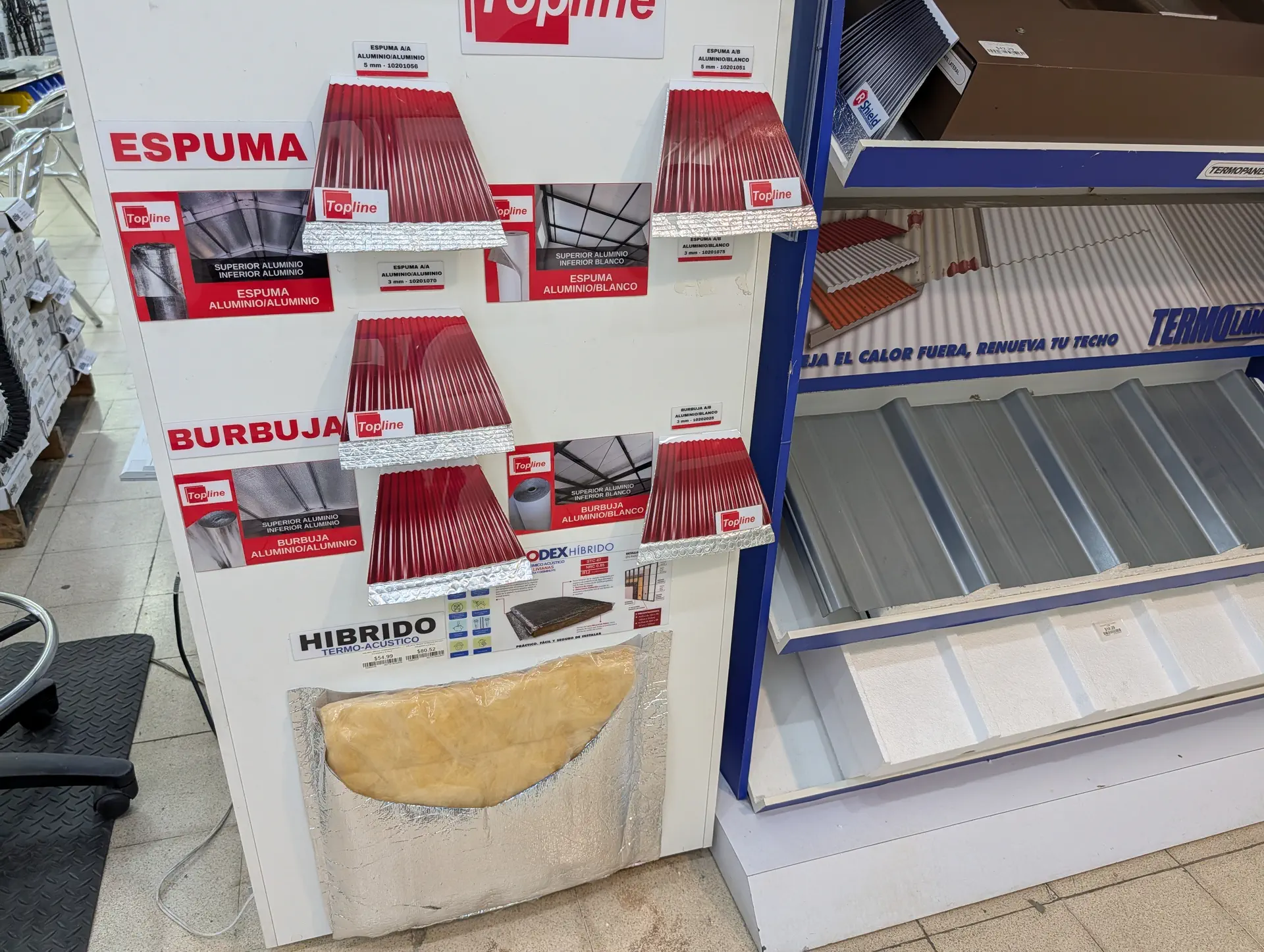
Reflective foil insulation is a thin layer of aluminum-faced material — sometimes a single foil sheet, sometimes a double bubble/foil assembly — installed between the carriolas and the zinc panels. It works by reflecting radiant heat rather than absorbing it, keeping the interior significantly cooler. Hopsa stocks the RShield and Topline brands. This is not the same as the thick fiberglass or foam insulation used in U.S. attic applications — it’s purpose-built for tropical metal-roof construction where the priority is blocking solar radiant gain rather than holding conditioned air inside.
The absence of reflective underlayment in a zinc-roofed property is worth noting in renovation planning. It’s relatively inexpensive to install when a roof is already coming off, and significantly harder and more disruptive to add after the fact. If you’re re-roofing anyway, this is a “definitely include it” line item.
Varilla de Acero
vah-REE-yah — steel rebar; the reinforcement inside every block wall and concrete slab
Varilla means rebar. It runs vertically through the hollow cores of block walls (filled with concrete slurry after placement), horizontally in bond beams at regular courses, and throughout every poured concrete slab. Panama’s INEC price index tracks a 30-foot section of half-inch rebar (varilla de media pulgada) as one of its core materials in the construction basket.
Why it matters: You won’t usually deal with rebar directly in a renovation unless you’re adding new walls or breaking an existing slab. But understanding that the rebar is there inside every block wall explains why wall chasing requires care — hit a vertical rebar with a wall chaser and you’ve just created a structural problem, not just a cosmetic repair.
The Stores: Where You’ll Actually Buy Things
Panama has two primary building material retailers that an expat renovator will deal with repeatedly. Understanding what each carries shapes how you approach sourcing.
Hopsa
HOP-sah — Panama’s largest building materials distributor; the Home Depot equivalent for structural and roofing materials
Hopsa (hopsa.com) is the major structural materials supplier. They manufacture their own zinc roofing (Superzinc), stock concrete block, carry tile and flooring including the 24×24 porcelain tile we priced at ~$10.99/m² in April 2026, sell PVC drainage pipe, and have a full range of roofing components (carriolas, aislante, ridgecap). Hopsa operates multiple locations across the Panama metropolitan area and has a functional online store where you can view products and get to-the-door delivery quotes. If a contractor mentions going to Hopsa, they mean structural and roofing materials.
Do-It (Do-It Center)
Do-It — the hardware store chain; finishes, fixtures, electrical, plumbing, paint, and tools
Do-It (doitcenter.com.pa) is where you go for finish materials, fixtures, electrical supplies, plumbing fittings, paint, and tools. It’s the closer analog to a U.S. hardware store in day-to-day feel. We found Do-It prices on electrical components significantly cheaper than their U.S. equivalents — the dual wall switch and faceplate we priced in April 2026 ran $2.99–$5.99 versus $13.88+ at a U.S. Home Depot equivalent. If a contractor is quoting electrical or plumbing materials, clarify whether Hopsa or Do-It pricing is the basis — they serve different material categories.
Kent’s Note — The Store Arithmetic
In the U.S., I’m used to one store for almost everything renovation-related. In Panama, you need to know which store carries what category or you’ll end up at the wrong place. Think of it this way: Hopsa is where the concrete, roofing, and tile come from. Do-It is where the outlets, light fixtures, and PVC fittings come from. There’s some overlap but not enough to skip learning both.
One practical note: Do-It operates an online store and delivery system for Panama City that’s functional and has real inventory. We used it to price-check materials before visiting in person. Hopsa’s online store similarly lets you confirm stock before making a trip to a location that may be a 20-minute Uber from wherever you’re staying. Use both websites before you walk into either store — it’ll save you a round trip.
The Numbers That Matter: A Panama Materials Reference
Everything we’ve priced directly or sourced from verified 2024–2026 Panamanian government and retailer data, all in USD. Panama is a dollar economy — no conversion required. Given how much these prices have moved since January 2024 (see the correction above), treat the percentage changes below as a record of volatility, not a current discount.
Panama Construction Materials — Reference Points
A Word on Material Price Volatility
Several key construction materials in Panama saw significant price swings between 2022 and 2026 — zinc alone moved from a 21.6% year-over-year decline (Jan 2024) to a 15.8% year-over-year increase (Feb 2026). Any renovation budget based on data older than a few months should be repriced with current supplier quotes before you commit to a number. We are doing exactly this for our own planning and will publish updated numbers as we gather them.
The One Vocabulary Win That Matters Most
If you take one thing from this article into your property search and contractor conversations, make it this: the difference between a block-wall property and a Plycem or M2 property changes your renovation calculus significantly. Ask that question early. The material the interior walls are made of — solid block, Plycem over steel stud, or M2 panel — tells you more about what a renovation will cost and how long it will take than almost any other single variable.
“The most useful thing you can do before making an offer on a renovation property is knock on the walls — and know what sound you’re listening for.”
A solid block wall gives a dense, almost dead thud. Plycem over steel studs gives a hollow knock similar to U.S. drywall. M2 gives something in between. None of these sounds tells you everything, but they get you to the right question: what am I actually working with, and what’s it going to take to move a wire through it?
The next installment of this series puts it all together as a pre-purchase checklist. The specific questions to ask, the inspections to insist on, the red flags that cost nothing to identify before you’re under contract, and the budget framework we’re actually building for our own property search.
Sources & Verification
- Firsthand: Tile and electrical component pricing at Hopsa and Do-It, priced in person, Panama City, April 2026.
- Official: Índices de Precios al por Menor de los Principales Materiales de Construcción (IPMC), Instituto Nacional de Estadística y Censo (INEC) / Contraloría General de la República — January 2024 report (block, zinc, rebar, PVC, cable, carriola figures).
- Official: INEC IPMC report, February 2026 — used to check whether the January 2024 price movements were still current (they were not; zinc and rebar have since reversed to year-over-year increases).
- Reported: M2/Covintec thermal performance claim attributed to a Sociedad Panameña de Ingenieros y Arquitectos (SPIA) advisor, as reported by Panamá América — original reporting dated 2015; we have not independently reverified this quote with the source.
- Reported: Plycem product specifications and manufacturing origin (Costa Rica) — manufacturer and distributor documentation, 2026.
- Not yet verified: Installed 4″ block wall cost (~$18–25/m²), gray cement bag price (~$12–16), and pre-mixed concrete cost (~$156–168/m³) are drawn from older retailer and government cost-database references, not confirmed with a current supplier quote.
Facts and prices in this article last verified: July 2026.
Brian & Kent
Brian and Kent are a gay couple based in St. Petersburg, Florida, currently researching a move to Panama in real time. Brian is applying for the Pensionado visa. Kent is the primary researcher — and the one who has now priced tile at Hopsa, switches at Do-It, and wants to go back to both stores with a proper shopping list. GayExpatsPanama.com is the honest record of what they find.