Buying & Remodeling a Home in Panama — Part 1 of 10
The House Is Made of What? Panama Construction 101 for Americans
Before you swing a hammer — or hire someone who will — understand why everything you learned about home construction in the U.S. applies to almost nothing here.
 Brian & Kent · GayExpatsPanama.com · April 2026 Research Trip
When we built our bar in Spain, we thought we understood what it meant to work with non-American construction methods. We were wrong — and Panama is making us rethink things all over again. The walls are solid. The ceilings are dropped. The roofs are corrugated metal. And if you want to move a wire, you’re probably going to need a jackhammer.
This is the first article in a series we’re writing as we plan our own move and potential renovation. We’re not contractors. But Kent has done serious remodel work in U.S. homes, we’ve built a commercial space in Spain, and we’ve been looking at enough Panamanian properties to start forming real opinions. This first article is about understanding what you’re looking at before you buy.
⚠ Before You Buy to Renovate
Panama’s construction methods are fundamentally different from U.S. stick-frame construction. If you’re buying with renovation plans, the differences aren’t cosmetic — they affect your budget, your timeline, and what’s actually possible without a major structural project. Read this series before you make an offer.
Buying & Remodeling a Home in Panama Series
Ten articles covering construction methods, materials, contractors, and the practical realities of remodeling a home in Panama.
- The House Is Made of What? Panama Construction 101 for Americans You are here
- Wires, Pipes & the Jackhammer Problem
- Repello, Zinc & Plycem: The Panama Materials Vocabulary You Need
- Remodeling for Energy Efficiency in Panama: What the Rules Actually Require
- What You Must Know Before You Buy to Remodel
- Who's Licensed to Swing a Hammer in Panama?
- Finding Reliable Labor in Panama: What Actually Works, What Doesn't, and What Nobody Tells You in Advance
- Paying Contractors in Panama: Cash Culture, Receipts & the Protections You Do (and Don't) Have
- Panama Construction Spanish: The Vocabulary Guide for Expat Homeowners
- The Attorney Question: When You Need One, When AI Helps, and What It Actually Costs
The First Thing to Understand: There Is No Drywall
In the United States, the interior of almost every home is drywall — a thin sheet of gypsum board nailed to wood studs. It’s light, cheap, easy to cut, easy to patch, and comes down with a utility knife. Panama’s walls are none of those things.
The standard residential wall in Panama City is concrete masonry unit (CMU) block — the same basic concept as a concrete block or cinder block in the U.S., though the sizes and mix vary. These blocks are stacked, reinforced with steel rebar, filled with concrete slurry, and finished with repello — a smooth concrete plaster that’s troweled over the surface and then painted. What you see on the walls of most Panamanian homes is painted plaster over solid concrete block. It looks smooth. It sounds completely different when you knock on it.
We first encountered this in Spain when we built our bar. The contractor looked at us like we’d asked for something exotic when we mentioned drywall. In Spain, they used blocks made specifically there — a different size and density than U.S. CMU — and the walls went up the same way: courses of block, mortar, rebar, fill, plaster. Panama uses the same approach. The logic is identical: in a humid tropical climate, drywall collects moisture, grows mold, and eventually disintegrates. Concrete does not.
“When you knock on a wall in a Panamanian home, it knocks back. That’s not a problem — that’s the point.”
Walls, Inside and Out
In U.S. construction, the exterior walls are usually load-bearing wood or metal studs, and the interior walls are non-load-bearing partitions that can be moved relatively freely. In Panama, this distinction mostly disappears. Both exterior and interior walls are commonly built from concrete block.
This has significant renovation implications. In a U.S. home, opening up a floor plan — removing a wall between the kitchen and living room, for instance — is often a weekend project if the wall isn’t load-bearing. In a Panamanian home, removing an interior wall is a masonry demolition project. You’re not pulling drywall. You’re breaking concrete.
Before You Assume a Wall Can Move
In a Panamanian home, assume every wall is structural until a local engineer tells you otherwise. Even non-structural block walls require demolition tools to remove — not just a pry bar and a utility knife. Budget accordingly, and get local professional assessment before any wall removal is factored into your renovation plans.
There is one significant exception, and it’s becoming more common: Plycem board, a fiber-cement sheet product manufactured regionally (its distributor base is centered in Costa Rica) and used similarly to drywall for interior partitions in newer construction and commercial spaces. We’ve seen it used extensively in newer Panama City commercial interiors — the shopping malls, some restaurant buildouts — and in higher-end residential construction. It handles moisture better than standard drywall, costs more, and is still harder to work with than U.S. gypsum board, but it at least can be cut with conventional tools. If your renovation involves a newer building or a commercial-to-residential conversion, ask specifically whether the interior walls are block or Plycem board. The answer changes your budget considerably.
The Ceiling Situation
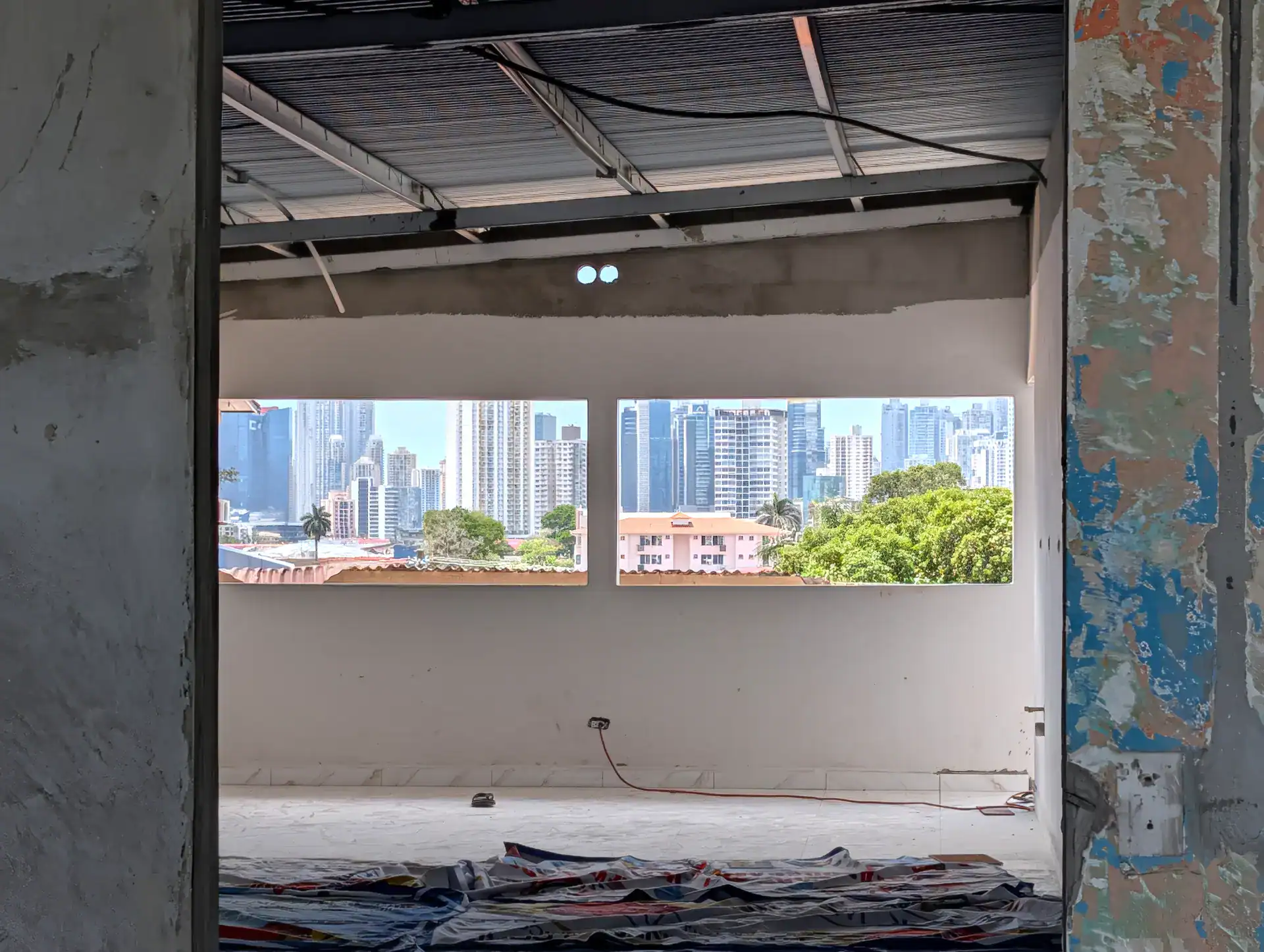
One thing that struck us immediately looking at properties in Panama City: the prevalence of drop ceilings. Not just in commercial spaces — in apartments, in condos, in homes. A suspended grid of ceiling tiles, dropped 8 to 18 inches below the structural slab above.
There are a few reasons for this, and they’re worth understanding if you’re evaluating properties or planning renovations.
In Spain, we learned about ceiling cavities the hard way.
When we built the bar in Spain, the ceiling was constructed using pre-made ceramic tiles with a substantial amount of plaster applied on top, which bonded them to the ceiling and created a small void between the tile surface and the structure above. That void was how we ran our electrical and cable conduit. It was fussy, messy, and involved a lot of careful threading, but it worked. Panama’s drop ceiling accomplishes something similar — it creates a service cavity above the visible ceiling surface where electrical conduit, plumbing runs, and HVAC supply can be routed without cutting into the concrete slab above.
In a concrete-slab building, you don’t have the option of running wiring between joists the way you would in a wood-frame home. The structure above is poured concrete. If you want to move electrical, you either run it through a chase in the slab (if one exists and goes the right direction), you surface-mount conduit on the wall, or you work through the ceiling cavity. Drop ceilings exist, in large part, to make this possible.
What to Look for When Viewing Properties
When you’re viewing a property and you see a drop ceiling, look up into any gaps or access panels. What you find in that cavity tells you a lot: clean modern conduit and PEX tubing is a good sign; a rat’s nest of old electrical with mystery wiring changes tells a different story. If there’s no access panel at all, add that to your negotiation list — you’ll need to get up there eventually.
Moisture is the other reason.
Panama’s humidity is not abstract. It averages around 80% overall, running lower in the dry season (roughly the high 60s to high 70s percent) and climbing into the 90s during the rainy season. In that environment, a painted concrete ceiling directly under a corrugated metal roof is a condensation surface. Drop ceilings provide an air gap that reduces the transfer of that temperature differential to the interior surface, which reduces sweating and eventual water staining. They’re not insulation in the American sense — there’s no R-value being claimed — but they perform a real function in the climate.
The Roof: Corrugated Metal Is Not a Budget Signal
In the United States, a corrugated metal roof on a residential structure usually means one of two things: an agricultural building, or a distressed property. In Panama, corrugated metal — commonly called zinc locally, since it’s typically a zinc-coated galvanized steel sheet — is the standard residential roofing material across all income levels. Higher-end homes may use clay or concrete tile, but metal is the norm, and it’s used that way for good reasons.
Corrugated metal sheds Panama’s heavy tropical rain extremely well. It’s durable in the humid climate. It handles the inevitable expansion and contraction from temperature swings. And it’s far less expensive to install and replace than tile. If you’re evaluating a home and the roof is corrugated metal, do not automatically read that as a sign of deferred maintenance. The question isn’t what material — the question is what condition.
The Roof Inspection Question Nobody Asks
American buyers often skip detailed roof inspection on metal-roof properties because they see metal and assume durability. In Panama, the details matter: check the fasteners (corroded or stripped fasteners are the common failure point, not the panels themselves), the ridge cap and flashing around any penetrations, and the condition of the purlins — the horizontal framing members the metal attaches to, which in some older construction are wood and subject to rot and termite damage.
Insulation under metal roofs.
Here is the honest answer: in most standard Panamanian residential construction, there isn’t much. The focus is on airflow and shade rather than sealed, insulated building envelopes. High ceilings, deep roof overhangs to block direct sun, cross-ventilation, and ceiling fans do more work here than they would in a U.S. home. Air conditioning handles what passive ventilation doesn’t.
The concrete block walls provide what’s called thermal mass — the material absorbs heat slowly during the day and releases it slowly at night, moderating interior temperatures somewhat. This works reasonably well in Panama’s relatively stable temperature range. What it doesn’t do is perform like blown-in fiberglass or closed-cell foam insulation in a U.S. home.
Some better-quality construction adds reflective foil underlayment between the metal roof and the interior — it reduces radiant heat gain significantly. If you’re buying and the property has this, note it. If you’re renovating and the roof is coming off anyway, adding it is worth the marginal cost.
Floors: Concrete and Tile, All the Way Down
The floor situation in Panama is, by comparison, the simplest part of this picture. Foundations and structural floors are poured concrete slabs. Finish flooring is almost universally ceramic or porcelain tile — it stays cooler than wood or carpet in the heat, it handles humidity without warping, and when a section cracks or a tile breaks, it’s replaced rather than refinished. We priced 24×24 porcelain tile at Hopsa in April 2026 at approximately $10.99 per square meter — that’s about 10.7 square feet of floor for under $11.
Panama Floor Materials — April 2026 Prices
Wood flooring exists in Panama but it’s a specialty item — more expensive, harder to source, and genuinely worse suited to the climate. Carpet is essentially absent from residential construction. If you are attached to wood floors, you’re buying into a more expensive renovation path. If you can embrace tile, you’re working with the grain of the local construction culture.
The Big Picture: What You’re Working With
When you add it up, a standard Panamanian home is built on a concrete slab, wrapped in concrete block walls, covered with a corrugated metal roof, finished on interior surfaces with plaster, tiled underfoot, and cooled by ceiling fans, cross-ventilation, and window A/C units. Drop ceilings in many spaces provide a service cavity and temperature buffer. Interior partitions are concrete block or, in newer construction, fiber-cement board.
This construction approach has real advantages over the U.S. wood-frame standard in a tropical climate. Concrete resists pests, including termites, far better than wood-frame construction does — though we haven’t independently verified how Panama’s specific termite pressure compares to the U.S. South, so take that comparison as our impression rather than a documented fact. It doesn’t rot. It’s extremely durable once built correctly. It is also significantly harder to modify once built.
The Core Renovation Reality in Panama
In a U.S. wood-frame home, “opening up” a space often means a few hours with a reciprocating saw and a trip to the lumber yard. In a Panamanian concrete-block home, it means a jackhammer, a structural engineer’s sign-off, rebar cutting, and concrete patching — followed by replastering the finished surface. This isn’t a reason not to renovate. It is a reason to budget and plan very differently than you would in the U.S.
Part 2 of this series goes inside the walls: electrical, plumbing, and the specific challenges of running new systems through solid concrete construction — including what we learned about PEX in Spain and why we’re relieved to find it’s now common in Panama too.
Sources & Verification
- Firsthand: Our own commercial construction experience building a bar in Spain (block, plaster, and ceiling-cavity wiring), plus walking and evaluating properties in Panama City during our April 2026 research trip.
- Firsthand: Porcelain tile pricing at Hopsa, Panama City, priced in person, April 2026.
- Reported: Concrete masonry unit (CMU) block-and-plaster construction as the residential default across Central America and Panama — general construction industry sources, 2026.
- Reported: Plycem fiber-cement board as a regionally manufactured drywall alternative used in Central American construction — manufacturer and distributor documentation, 2026.
- Reported: “Zinc” as the colloquial regional term for zinc-coated corrugated galvanized steel roofing — general roofing industry sources, 2026.
- Reported: Panama’s average humidity (~80% overall, higher in the rainy season) — multiple independent climate data sources, 2026.
- Not yet verified: Our comparative impression that Panama’s termite pressure is more severe than the U.S. South is anecdotal, not something we’ve confirmed against pest-control or entomological data.
Facts and prices in this article last verified: July 2026.
Buying & Remodeling a Home in Panama Series
- 01 The House Is Made of What? Panama Construction 101 for Americans
- 02 Wires, Pipes & the Jackhammer Problem
- 03 Repello, Zinc & Plycem: The Panama Materials Vocabulary You Need
- 04 Remodeling for Energy Efficiency in Panama: What the Rules Actually Require
- 05 What You Must Know Before You Buy to Remodel
- 06 Who's Licensed to Swing a Hammer in Panama?
- 07 Finding Reliable Labor in Panama: What Actually Works, What Doesn't, and What Nobody Tells You in Advance
- 08 Paying Contractors in Panama: Cash Culture, Receipts & the Protections You Do (and Don't) Have
- 09 Panama Construction Spanish: The Vocabulary Guide for Expat Homeowners
- 10 The Attorney Question: When You Need One, When AI Helps, and What It Actually Costs
Brian & Kent
Brian and Kent are a gay couple based in St. Petersburg, Florida, currently researching a move to Panama. Brian is applying for the Pensionado visa. Kent is the primary researcher — and the one who has spent enough weekends with a reciprocating saw to know the difference between drywall and a concrete block. GayExpatsPanama.com is the honest record of what they find.