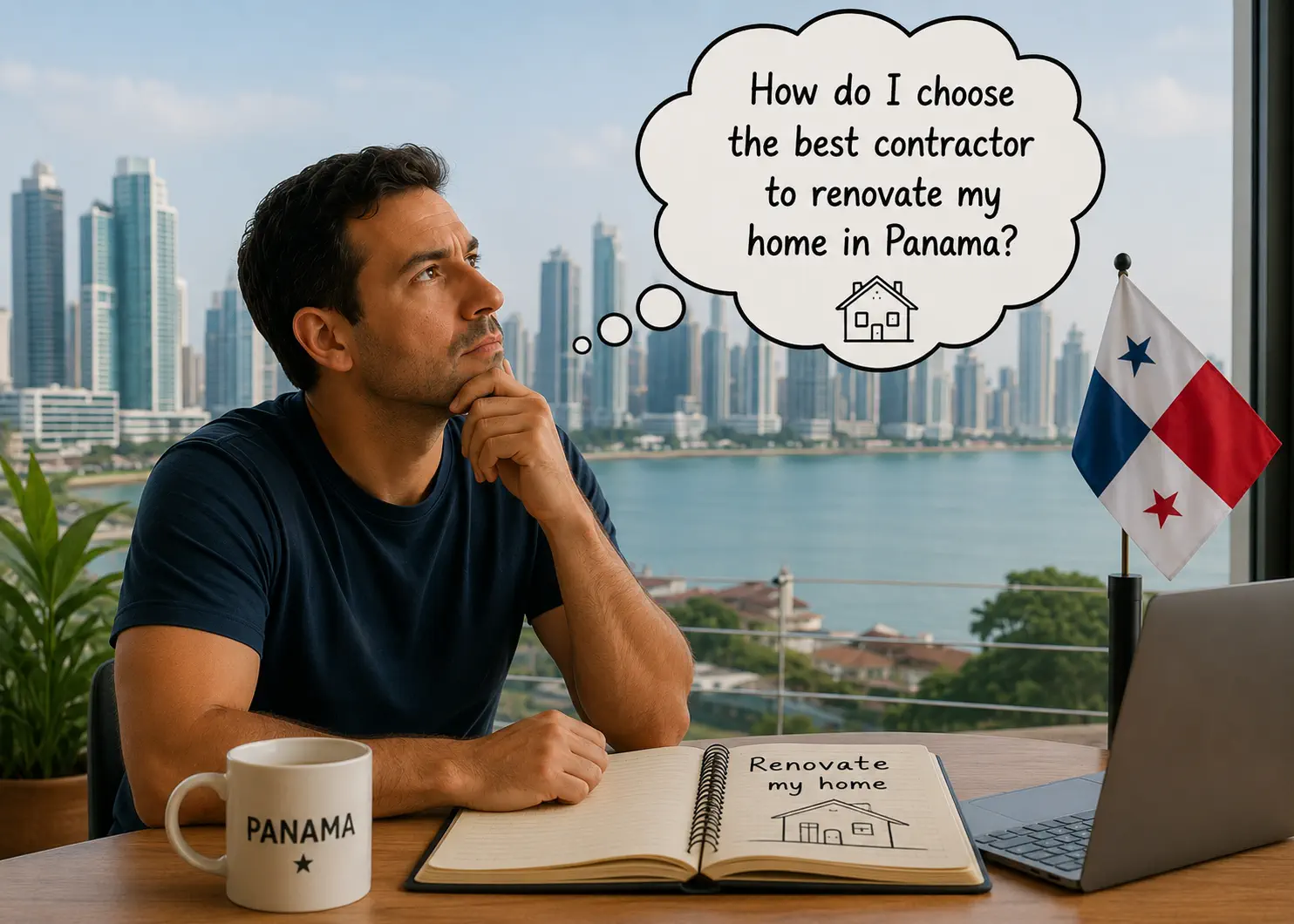
Buying & Remodeling a Home in Panama — Part 7 of 10
Finding Reliable Labor in Panama: What Actually Works, What Doesn’t, and What Nobody Tells You in Advance
The expat Facebook group told you to “just ask for recommendations.” That’s the beginning of the process, not the end. Here’s how to actually vet who shows up at your door.
 Brian & Kent · GayExpatsPanama.com · April 2026 Research Trip
We’ve hired contractors in Palm Springs, in St. Petersburg, and in Spain. Each market had its own rhythm — who to ask, how to verify, what a reliable reference actually sounds like versus a polite one. Panama has its own rhythm too, and some of it is genuinely different from anything we’d encountered before. The process of finding good labor here isn’t complicated. But it has specific failure points that can cost you significantly if you walk in with American assumptions.
This article is about how to actually find someone good — not just how to post in a Facebook group and hope. By the time you finish reading, you should know where to look, what to ask, how to read the answers you get, and what warning signs look like before money changes hands.
Buying & Remodeling a Home in Panama Series
Ten articles covering construction methods, materials, contractors, and the practical realities of remodeling a home in Panama.
- The House Is Made of What? Panama Construction 101 for Americans
- Wires, Pipes & the Jackhammer Problem
- Repello, Zinc & Plycem: The Panama Materials Vocabulary You Need
- Remodeling for Energy Efficiency in Panama: What the Rules Actually Require
- What You Must Know Before You Buy to Remodel
- Who's Licensed to Swing a Hammer in Panama?
- Finding Reliable Labor in Panama: What Actually Works, What Doesn't, and What Nobody Tells You in Advance You are here
- Paying Contractors in Panama: Cash Culture, Receipts & the Protections You Do (and Don't) Have
- Panama Construction Spanish: The Vocabulary Guide for Expat Homeowners
- The Attorney Question: When You Need One, When AI Helps, and What It Actually Costs
Where We Started: How We Find Contractors in the U.S.
In Palm Springs, we found our best contractor the same way most people in that community did: we asked neighbors who’d had recent work done and whose results we could actually see. Not “do you know anyone?” — that gets you a vague name and a shrug. Specifically: “Who did your kitchen? Can I look at it? Would you hire them again?” That last question is the one most people skip, and it’s the most important. People are reluctant to actively recommend someone they’d have reservations about using a second time.
We followed that with a Google search — not to find new names, but to verify the ones we had. Complaints on Yelp, on the Better Business Bureau, on local Facebook neighborhood groups. The BBB is worth checking even if you’re skeptical of it, because a contractor who has resolved complaints properly is actually a better signal than one with no record at all. We did the same thing in St. Petersburg. The tools were slightly different; the logic was identical.
In Spain, we relied almost entirely on personal referrals from other expats in our community, plus a visit to completed projects before we committed to anyone. We showed up at someone’s renovated apartment and looked at the tile work, the grouting, the caulk lines. If the contractor did sloppy finish work where it showed, we didn’t need to see more.
The Panama Version of That Process
The good news: the same underlying logic applies in Panama. Personal referrals from people who’ve had recent work done are your best starting point. Verifying those referrals is still essential. Visiting completed work, where possible, still beats any amount of online research. What changes is where you find the referrals, how you interpret what people tell you, and — critically — what due diligence looks like when there’s no BBB, no state licensing board, and no standardized way to check credentials.
Where to Actually Find Names
Facebook groups are the primary expat resource in Panama, and for this purpose they genuinely work — with conditions. The groups with the most useful signal for contractor recommendations are the ones tied to specific neighborhoods or buildings, not general expat groups. A large, general expat Facebook group is less useful than a smaller group tied to your specific building, condo development, or neighborhood. Those smaller communities have direct experience with local contractors, recent projects, and ongoing relationships. The recommendation carries weight because the person giving it lives nearby and will be seen regularly.
Facebook Groups Worth Joining for Panama Contractor Intel
When you post asking for a contractor recommendation, be specific. “Does anyone know a good contractor?” will get you a pile of names with no context. “We need a licensed plumber for bathroom rough-in work in a Bella Vista condo — anyone used someone recently they’d hire again?” gets you useful responses. The more specific the question, the more specific — and therefore verifiable — the answers.
A Word About Facebook Group Advice
You often don’t know who the person posting actually is, whether they currently live in Panama, or how long ago their experience was. Some people posting in expat forums are brand new to the country themselves. Others have a hidden agenda — a referral fee arrangement with the contractor they’re recommending, or a real estate interest. This doesn’t make Facebook useless. It makes it a starting point that requires verification, not an ending point that doesn’t.
Asking the Right Questions of References
This is where most people stop doing due diligence too early. Getting a name from a Facebook group is easy. What you do next matters more.
Contact the person who gave the recommendation — directly, not in the thread. Ask them: What specifically was the work? How did it go? Were there problems? How did the contractor handle them? Would you hire this person again for a larger project? That last question, again, is the one that separates a polite social recommendation from a real one.
In Panama specifically, add these: Did the contractor communicate well enough in English for you to manage the project? Did workers show up consistently? Were there any disappearing acts mid-project? Any surprises with materials or billing?
Ask to See the Work
If someone in your building recommends a contractor who tiled their kitchen, ask if you can take a look. This is not an imposition — it takes ten minutes and tells you more than any reference call. Look at grout lines, caulk at edges, tile alignment at corners, and how the work meets the floor. Finish quality is where shortcuts show. A contractor who does excellent visible work almost certainly does sound structural work behind it. The reverse is also true.
The Credential Gap — and What to Do About It
In Palm Springs, we checked contractor licenses through the California State License Board website — a five-minute search that told us whether the license was current, whether it was bonded, and whether there were any disciplinary actions. In Florida, the same search exists through the DBPR. These tools are so straightforward that most Americans take them for granted.
Panama has no equivalent for most residential tradespeople. Engineers and architects are licensed through the JTIA — covered in the contractor licensing article earlier in this series — and you can verify that. But the tile setter, the plumber doing residential rough-in, the electrician rewiring your panel, the painter, the general laborer — most of them have no license requirement and therefore no license to check. You are evaluating the person in front of you, not a credential they hold.
This shifts the entire weight of vetting onto references and completed work. It also makes the question of how long someone has been working in your area — and who they’ve worked for — considerably more important than it would be in the U.S.
The Two Things That Actually Function as Credentials in Panama
1. Verifiable completed work. Not photos on a phone. Actual projects you can visit or contact the owner about. A contractor who’s done three kitchens in your building has a track record you can walk down the hall and inspect.
2. A cédula they’re willing to show you. Every Panamanian national has a cédula — a national identity number. Ask for it. Panama’s Tribunal Electoral does offer identity-verification services, but the comprehensive lookup (the Servicio de Verificación de Identidad) is built for registered institutions like banks and insurers rather than a casual public search — so don’t expect to run a full background check yourself. What you can realistically do is use the cédula number as a consistency check: does the name match, does the person hesitate to produce it, does it match what references independently tell you. A contractor who won’t show you their cédula at all is a contractor who has something to hide.
The Language Barrier — More Complex Than You Think
Most English-speaking expats approach the language barrier in Panama construction as a translation problem: I need to communicate my instructions, the worker needs to understand them, we need to get the words right. That’s real, but it’s the simpler half of the issue. The harder half is cultural.
Panamanians are well-documented conflict avoiders. This is not a criticism — it’s a cultural value that produces warm, harmonious social interaction and genuine kindness. But on a construction site, it creates a specific problem: a worker who doesn’t understand your instructions, or who sees a problem developing, may say nothing rather than risk an uncomfortable conversation. Not because they don’t care. Because “no” and “I don’t understand” and “that’s going to be a problem” are socially uncomfortable in ways that aren’t universal.
“A worker who doesn’t understand your instructions may say nothing rather than risk an uncomfortable conversation. Not because they don’t care — because disagreement is socially costly in ways that aren’t universal.”
The practical consequence: a worker who nods and says “sí” may be agreeing that he heard you, not that he understood you, and certainly not that he’s going to do exactly what you described. This is not deception. It is a different communication convention. The fix is to ask him to show you what he’s going to do before he does it — not “did you understand?” (always yes) but “show me where the outlet goes” or “walk me through how you’re going to run this pipe.” Demonstration beats confirmation every time.
The Specific Words That Matter
Even with limited Spanish, learning construction vocabulary specific to your project pays disproportionate returns. You don’t need to be conversational. You need to be able to say “that’s not level” (eso no está a nivel), “that joint needs more cement” (esa junta necesita más cemento), “this doesn’t match the plan” (esto no coincide con el plano), and “stop — let me look at this before you continue” (para — déjame ver esto antes de continuar). Four phrases used at the right moments can prevent four expensive mistakes.
Google Translate’s camera mode — point your phone at Spanish text and read it in English in real time — is genuinely useful for reading invoices, contracts, and hardware store product specs. DeepL often produces more idiomatic Spanish than Google for anything you’re drafting to send to a contractor in writing. Use both.
Kent’s Note — On Learning the Language of the Site
When we were in Spain, I made a point of learning what construction was happening each day before we arrived on site. Not so I could supervise — the workers knew their craft better than I did. So I’d have the vocabulary when I needed it. If I knew they were going to be setting tile, I looked up “lechada” (grout) and “nivelado” (leveled) the night before. It’s not fluency. It’s targeted preparation, and it changes the dynamic on site from “confused American” to “person who’s paying attention.” That second version gets taken more seriously.
The Multi-Project Reality
Here’s something that surprises most new expat renovators in Panama: the crew that was on your site every day last week may show up two days this week and none the next. This is not a personal failing on your part. Panamanian construction workers routinely work across multiple projects simultaneously. Your renovation is one of several jobs your maestro has going. This is the norm, not the exception.
In the U.S., this would be a contract violation worth escalating. In Panama, it is the baseline reality that your contract and payment schedule need to account for, not something to be surprised by. If you need consistent daily presence — because you’re on a tight timeline, or because the work requires sequential phases that can’t be interrupted — that has to be explicitly negotiated before work begins, not assumed.
The solution that works: milestone-based payments that only release when specific work is complete, not on a calendar schedule. A contractor who gets paid when the tile is down has more incentive to get the tile down than one who gets paid every Friday regardless of progress. Your money is your scheduling leverage. Use it deliberately.
Reading the Warning Signs Before You Commit
Some signals are reliable predictors of problems, regardless of how good a contractor’s references are or how warm the initial meeting is.
He can start immediately
A contractor who says he can start Monday on a significant project probably doesn’t have enough other work. The good ones in Panama — the ones with strong reputations — are often booked several weeks out. “I can start immediately” can mean availability you’re benefiting from, or it can mean something about his current demand. Ask why. The answer tells you something.
He won’t give you references from the last six months
Old references are better than none, but a contractor who’s been working steadily should have recent clients. If the most recent project he can point you to was eighteen months ago, ask what he’s been doing since. A vague answer is a signal.
He’s significantly cheaper than every other quote
Panama construction costs are genuinely lower than U.S. costs. But within the local market, a quote that’s 40% below the other two you received either means different scope, different materials, or a plan to make it up somewhere else — usually through change orders, material substitution, or stopping work partway through and asking for more money to continue. Three quotes is a minimum. The middle one is usually closest to reality.
He pushes back on a written contract
This is the single clearest disqualifier. “We don’t need a contract, I’m reliable, my word is good” is a sentence that should end your consideration of that contractor immediately. Reliable contractors in Panama work with written contracts. They know it protects them too. The ones who resist it have a reason to resist it, and that reason is not in your interest.
The Most Common Pattern in Panama Renovation Losses
Based on what we’ve read across expat forums and firsthand accounts: the most common contractor problem in Panama is not deliberate fraud. It’s an expat who hired based on a Facebook recommendation without further vetting, paid a large upfront deposit because it felt rude to negotiate, and had no contract because it seemed unnecessarily formal for a friendly arrangement. When the work slowed and the contractor became harder to reach, there was no leverage and no documentation. The fix for all of this exists before you hire, not after.
The Relationship Factor — This Part Is Different From Home
Here’s something we didn’t fully expect: in Panama, the relationship with your contractor matters in a more direct way than it typically does in the U.S. In Palm Springs, we had a professional relationship with our contractor — cordial, respectful, transactional. In Panama, the relationship is part of the system. A contractor who likes working for you, who feels respected and fairly treated, is more likely to pick up the phone when you call, to flag problems proactively, and to return for corrections after the job is nominally done.
This doesn’t mean you should be a pushover. Contracts still matter. Payment schedules still matter. Being on site still matters. But the way you interact on a day-to-day basis is part of the project management, not separate from it. Greeting the workers by name, showing genuine interest in the work, bringing coffee — these are not soft touches. They are practical tools that affect outcomes.
One experienced expat builder we encountered put it this way after several houses in Latin America: the biggest mistake he made on his first project was treating it like a U.S. construction relationship — showing up to inspect, leaving when satisfied, returning when something went wrong. The second time, he was on site constantly and treated the workers more like collaborators than subcontractors. The difference in quality and schedule adherence was significant.
A Checklist Before You Hire Anyone
Pre-Hire Verification — Don’t Skip These
The Bottom Line
Finding reliable labor in Panama is genuinely possible. The trades are skilled, the relationships can be excellent, and the cost relative to quality is favorable. What Panama doesn’t have is the institutional scaffolding that makes contractor vetting easier in the U.S. — no licensing board to call, no BBB equivalent, no bond to claim against. What it does have, in abundance, is a tight-knit expat community that talks constantly and has strong opinions about who is and isn’t worth hiring.
Use that community properly — not as a crowd-sourcing service for names, but as a starting point for verification. Ask specific questions. Follow up in person. Visit the work. Read the warning signs before you hand over the deposit. And once you’ve found someone good, treat that relationship like the asset it is. In a market with no credential system, a contractor with a strong reputation has earned it the hard way. So have you.
One More Thing About Facebook Groups
If a name comes up repeatedly across multiple groups and multiple conversations — unprompted, from people who clearly have no connection to each other — that’s a signal worth taking seriously. The Panama expat community is smaller than it looks online. Word of mouth about both good and bad contractors travels fast and tends to be accurate. A contractor with a genuine reputation has usually earned it across many projects. A contractor who only appears once, in a single thread, from a single enthusiastic poster, deserves more scrutiny before you proceed.
Sources & Verification
- Firsthand: Our own contractor-vetting process in Palm Springs, St. Petersburg, and Spain, and our April 2026 research on how the equivalent process works in Panama.
- Official: Panama’s Tribunal Electoral operates an identity-verification service, but its comprehensive lookup (Servicio de Verificación de Identidad) is built for registered institutions rather than general public use; the public-facing verificate.te.gob.pa tool is oriented toward voting-location lookup, not employer background checks.
- Community: Facebook group dynamics, typical warning signs, multi-project labor scheduling norms, and cultural communication patterns on Panamanian job sites — synthesized from expat community accounts and general observation, not from a single authoritative source.
Facts and prices in this article last verified: July 2026.
Brian & Kent
We’re a gay couple based in St. Petersburg, Florida, researching and relocating to Panama in real time. Brian is applying for a Pensionado visa. Kent does most of the research. Everything on this site is from direct experience — the prices are current, the attorney meetings are recent, and the mistakes are ours.