Panama Residency · Firsthand
My Panama Permanent Residency Was Approved — The Actual Timeline, Day by Day
Ninety-eight days from the attorney’s office to an approved permanent residency resolution. Here is every date, every stage of the government workflow, and the tracking tool that let me watch my own file move through it.
 Brian & Kent · GayExpatsPanama.com · July 2026
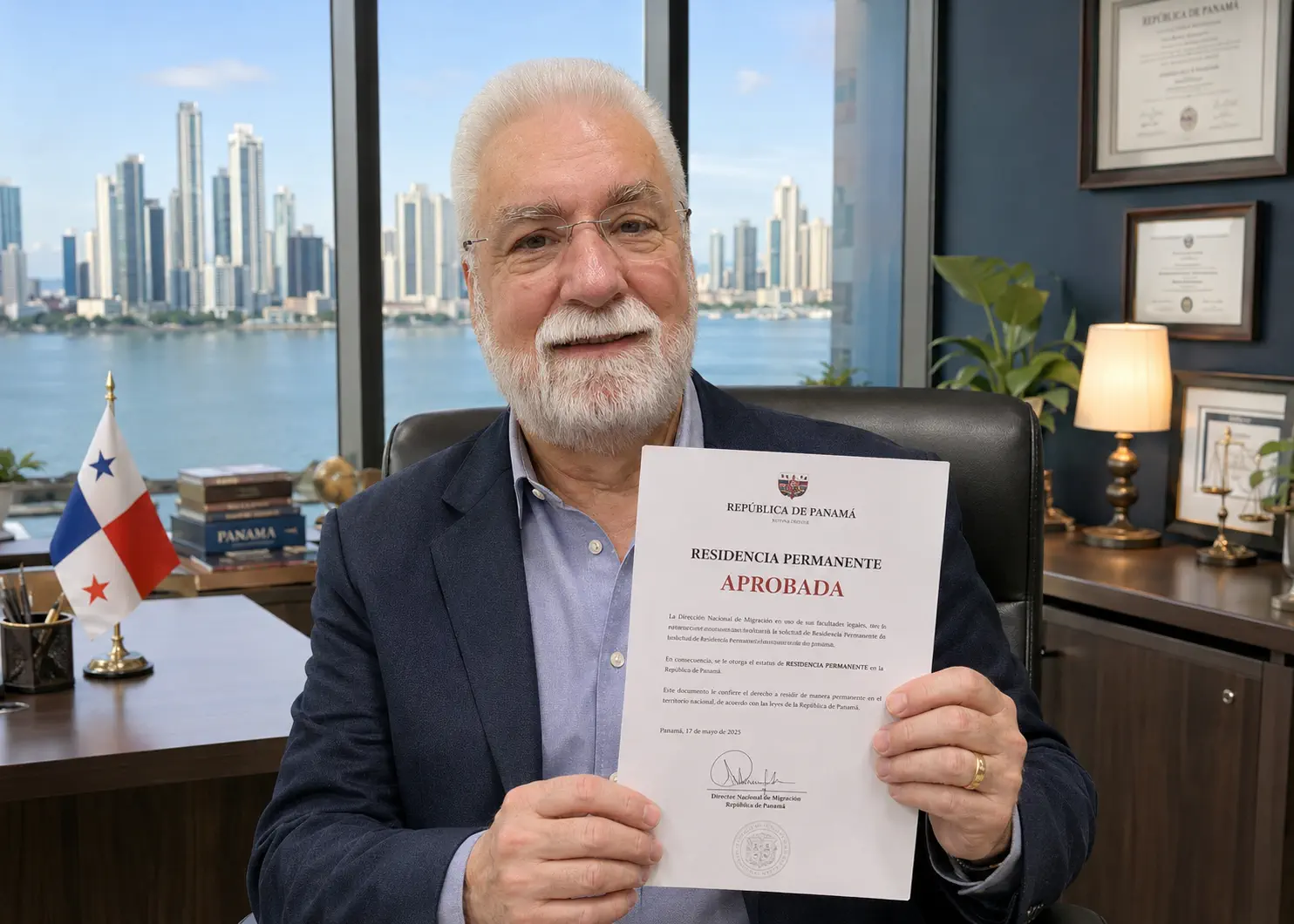
On Friday, July 24, 2026, Carolina Tejada Vaprio at Morgan & Morgan forwarded me a copy of my approved Panamanian permanent residency. We had first sat down in her office on April 13. The firm filed on April 17. The resolution was signed and stamped on July 15. That is the whole arc, and I can give you every date in it — because Panama’s immigration authority publishes a public tracking portal that shows exactly which stage a file is sitting in, and I checked mine throughout. What that record shows is something I have not seen written down anywhere in English: the wait is not spread evenly across the process. Nearly ninety percent of it happens at a single stage, and once your file clears that stage, everything else finishes in about a week.
The Timeline, Start to Finish
Here are the dates. I am one applicant, filing a Pensionado-based application through a large full-service firm, so treat this as one real data point rather than a promise about your own case — but it is a real one, with nothing rounded or estimated.
My Panama Residency Timeline — 2026
The Tracking Portal Nobody Tells You About
This is the part I most want other people to have, because I have not found it documented in English anywhere, and it turned three months of silence into something I could actually watch.
When my temporary residency was approved, I took a photograph of the stamped paper. On it were two numbers, labelled with a T and a C. Those two numbers are what you need. Then:
- Go to Panama’s immigration procedures portal at tramites.migracion.gob.pa.
- Click Consultas de Trámites en General.
- Enter your T number, then your C number. Numbers only — leave the letters off.
- You get a status report showing the resolution state, the resolution date, and a stage-by-stage record of where your file has been and when it moved.
The report is in Spanish and it is not pretty, but it is precise. It shows a table headed Recorrido — the route — listing each task in order with a start date and a completion date. A stage with a start date and no completion date is the stage your file is sitting in right now.
Photograph the Stamped Paper
Take a clear photo of the stamped document when your temporary residency is approved, and make sure the T and C numbers are legible. Without them you cannot use the portal. It costs nothing to do and there is no convenient way to recover the numbers later if you did not capture them.
Don’t Publish Your Numbers
Your T number, C number, and resolution number identify your specific file. Don’t post them in expat forums, Facebook groups, or anywhere public — and if you share a screenshot of your status report, redact them first. I’ve deliberately left mine out of this article for the same reason.
The Eight Stages — and Where the Time Actually Goes
My file passed through eight stages between filing and notification. Here is the sequence, with the elapsed time at each step.
| # | Stage (as shown in the portal) | What it means | Elapsed |
|---|---|---|---|
| 1 | Recepción de Documentos | Documents received | Same day (Apr 17) |
| 2 | Expediente y Folios | File assembled and paginated | 4 days |
| 3 | Recepción Expedientes (Análisis) | Queued, waiting to reach an analyst | 78 days |
| 4 | Análisis de Expediente | File actually analysed | Same day (Jul 8) |
| 5 | Verificación de Resolución | Resolution drafted and checked | 2 days |
| 6 | Resolución por Firma | Awaiting signature | 5 days |
| 7 | Ponche y Sello | Punched and sealed | Same day (Jul 15) |
| 8 | Notificaciones | Notification issued | Same day (Jul 15) |
Eighty-nine days from filing to a stamped, signed resolution. Seventy-eight of them — about 88 percent — were spent at stage three, simply waiting for the file to reach an analyst’s desk. Once it did, on July 8, the analysis itself was completed the same day, and the entire remaining process took seven days.
It is not a slow process. It is a fast process behind a long queue. Knowing which one you are in changes how the wait feels.
That distinction matters more than it might sound. If you are watching your file sit at stage three for eleven weeks with no movement, the natural assumption is that something has gone wrong — a missing document, a problem with your paperwork, a question nobody told you about. In my case nothing had gone wrong at all. The file was complete and correct and simply had not been picked up yet. Being able to see that, rather than guess at it, was worth a great deal.
How It Started: One Meeting, Then Nothing to Do
We met Carolina at Morgan & Morgan’s offices in Costa del Este on April 13 — in person, in the MMG Tower. She reviewed what we had, explained what would happen next, and that was essentially my entire active involvement in the process. While we were there, we filmed a short conversation with her about how the Pensionado visa actually works.
Carolina Tejada Vaprio on the Pensionado visa — filmed at Morgan & Morgan’s offices, Costa del Este, April 2026.
The firm filed four days later, on April 17. From that point forward, everything happened directly between Morgan & Morgan and Immigration. Immigration never contacted me — not once. No requests for additional documents, no clarifying questions, no interviews. If you are used to a system where an agency writes to you directly, this takes some adjusting to. Your attorney is your interface with the process, and if the filing is complete, there is genuinely nothing for you to do but wait.
The Social Security benefit verification letter, which some people worry about, went through without any issue at all. I expected it would. Morgan & Morgan deal with US applicants constantly and know how the SSA and FBI systems work on the American side, which is a meaningful part of what you are paying for.
The Apostilles We Didn’t Need to Get Ourselves
Morgan & Morgan told us we did not need to apostille our documents — they would handle it. We did it anyway, because the consulate is thirty minutes from us and we thought it might speed things up. In hindsight, given that 78 of my 89 days were spent in a queue that had nothing to do with document preparation, it almost certainly made no difference to the timeline. If your firm offers to handle apostilles, letting them do it is a reasonable choice.
Approval Is Not the Finish Line: Four Documents, Not One
This is the part that is genuinely confusing from the outside, and the part I most misunderstood before going through it. “Getting residency” is not one event. It is a sequence of four distinct things, and the words people use for them are used loosely enough to cause real confusion.
- Temporary residency card. Issued earlier in the process. I have held this throughout. The approval letter, not the card, is what has the T and C numbers you use for tracking.
- Permanent residency approval. A paper resolution — the document Carolina forwarded me on July 24. This is the legal grant of permanent residency. It is done, and it is what this article is about.
- Permanent residency card. Not yet. You convert the paper approval into an actual card, and this requires being physically in Panama. I go back in November.
- eCédula. After the permanent card. This is the national identity document, and it is the one that matters most in daily life.
The Approval Expires If You Don’t Convert It
My understanding — and I want to be clear this is my language, not legal language — is that if you do not convert the permanent residency approval into the permanent residency card, the approval becomes void. There is no fixed statutory deadline between receiving the paper approval and obtaining the card, and I am told you have a few months of leeway. But do not treat the paper as the end of the process and file it away. Ask your own attorney what the practical window is for your case and follow their advice, not mine.
Worth saying plainly: I could go back to Panama right now and complete this. Nothing is forcing the delay. We chose November because we had the time and wanted to travel on the shoulder between the rainy and dry seasons — which is a comfort preference, not a procedural requirement. If you want your card sooner, you can go sooner.
Why the eCédula Matters More Than the Law Says It Should
Panama’s Pensionado programme is well known for its discounts — on flights, hotels, restaurants, medical services, utilities, and more. The legal position, as we understand it, is that entitlement to those discounts follows from your residency status.
The practical position is different. We have been told repeatedly that many businesses want to see an eCédula, because that is the document their staff recognise and are trained to accept. A paper resolution or an unfamiliar card may be legally sufficient and still get you a blank look at the counter. This is the gap between what the law says and what happens at a pharmacy till, and it is why the eCédula sits at the end of the sequence as the thing actually worth having.
I will report back on how that plays out once I have mine. If the reality turns out to be more forgiving than we have been told, I will say so.
Why We Chose a Large Firm — and What It Cost
We chose Morgan & Morgan deliberately. The reasoning was that a large full-service firm would have the staff and resources to get the filing complete and correct the first time, minimising back-and-forth between the attorneys and Immigration. In our case it eliminated it entirely — there was no back-and-forth at all.
There was a second reason, and it was specific to us. As gay men and as a couple, we wanted a firm that could handle everything we would eventually need — immigration, property, corporate structures, estate planning — with people who understood our situation and would not have to be educated about it each time. That was worth paying for.
The legal fee for me alone, covering the visa and the eCédula, was $4,000 as of mid-2026. That is higher than many firms charge, and I want to be straightforward about publishing it: this is one fee, for one applicant, at one firm, at one point in time, and your quote will differ. Get your own. But we have a rule on this site against saying something is affordable or expensive without attaching a number, and it would be inconsistent to publish a detailed process account and then go vague on the one figure everyone wants.
Was it worth it? For us, yes — a clean filing, no requests for additional documents, no complications, and a firm we can keep using as our situation gets more complex. Someone with a simpler set of needs and more patience for administrative friction could reasonably choose differently, and pay less.
Our Attorney
Several readers have asked for Carolina’s details after we mentioned her, so here they are.
Our Immigration Attorney
Carolina Tejada Vaprio
Senior Associate | Morgan & Morgan
ca*************@*****or.com | www.morimor.com
MMG Tower, 23rd Floor | Ave. Paseo del Mar | Costa del Este
Panama City, Republic of Panama
T: +507 265-7777
We Are Not Compensated for This Referral
We receive nothing from Morgan & Morgan for mentioning them — no referral fee, no commission, no arrangement of any kind. We are a client that paid full price. We mention Carolina because readers ask, and because our own experience was good. If that ever changes, we will say so on the page.
A reader who found Carolina through us wrote after their first call with her:
“Thank you guys for the referral! We had a video-conference with Carolina and she was simply awesome!! We are heading down in October for 6 months to prep our residency. Thank you again for the attorney referral!! Cheers!!”
That matches our own experience of her, and it is the pattern we have heard from others: people come away from the first video call feeling that she understood what they actually needed rather than delivering a generic pitch.
What I’d Tell Someone Starting This Tomorrow
- Photograph the stamped temporary residency paper and keep the T and C numbers somewhere safe. They are your only route into the tracking portal.
- Check the portal, but not daily. Once a file enters the analysis queue it can sit for months with no change. Weekly is plenty, and it will save you a lot of pointless refreshing.
- Expect silence from Immigration. They deal with your attorney, not with you. Silence is the normal condition, not a warning sign.
- Don’t read the queue as a problem. Eleven weeks at stage three meant nothing was wrong. It meant my file had not been opened yet.
- Let the firm handle the apostilles if they offer. Ours offered; we did it ourselves; it made no difference.
- Plan and budget the return trip for the permanent card and the eCédula. Approval does not finish the job, and the second trip is a real cost most timelines leave out.
- Ask your attorney how long your approval stays valid before you must convert it into a card. Do not assume it sits there indefinitely.
I will update this article in November when I have the permanent residency card, and again when the eCédula is in hand — including how long each step took and whether the discounts actually work the way we have been told. Those dates will go in the same timeline card at the top of this page.
Sources & Verification
- Firsthand: Every date in this article comes from my own application — the April 13, 2026 meeting at Morgan & Morgan’s Costa del Este offices, the April 17 filing, the eight-stage workflow record retrieved from Panama’s immigration tracking portal, the July 15 signed resolution, and the copy received from my attorney on July 24, 2026.
- Official: The stage-by-stage workflow record and resolution status are drawn directly from Panama’s Servicio Nacional de Migración public procedures portal (tramites.migracion.gob.pa), Consultas de Trámites en General, queried using the T and C numbers from my own stamped temporary residency document.
- Firsthand: The $4,000 legal fee, for one applicant, covering visa and eCédula legal work, quoted and paid mid-2026. Individual quotes will vary by firm and circumstances.
- Reported: That the permanent residency approval must be converted into a permanent residency card or it ceases to be valid, and that there is no fixed statutory deadline but a practical window of a few months. This is our understanding as conveyed to us, described here in plain language rather than legal terms. Confirm the position for your own case with your attorney.
- Community: That many Panamanian businesses want to see an eCédula before applying Pensionado discounts, regardless of the underlying legal entitlement. Reported to us consistently; we will verify it firsthand once the eCédula is issued.
- Not yet verified: Whether the 78-day analysis queue is typical, seasonal, or specific to our filing. This is one application’s record, not a dataset. Treat it as a real data point rather than a predicted timeline.
Facts and dates in this article last verified: July 2026. Next update expected November 2026.
Brian & Kent
A gay couple based in St. Petersburg, Florida, moving to Panama in real time. Brian’s permanent residency was approved in July 2026; Kent will pursue the Qualified Investor Visa. We write about what we’re actually doing and what we actually find — with the real dates, the real numbers, and the parts that didn’t go the way we expected.