Our Story & April 2026 Trip – Part 13 of 16
Day Ten — An Early Walk, the Sunday Ciclovía, a Market Full of Pineapples, and the Canal at Last
Kent discovers the Metro doesn’t run until 7am on Sundays and starts walking anyway. The Cinta Costera turns out to be closed to cars — on purpose, every Sunday. The produce market delivers. And we finally see the Panama Canal, which costs $5 more than it should for a Gatorade.
 Brian & Kent · GayExpatsPanama.com · April 2026 Research Trip
Sunday. All days feel more or less the same when you’re not working a regular schedule, which is either a preview of retired life or a mild form of sensory deprivation depending on your perspective. On this particular Sunday, I had a plan. Earlier in the trip we’d been near the Mercado San Felipe Neri — the produce market adjacent to the old fish market — but hadn’t gone in. Today was the day.
I let Brian know the evening before that I’d be heading out early and solo. He had no objection to this arrangement. We both remember Day Five’s fish market well enough to know that a produce market two blocks away from it was not going to be Brian’s morning.
The walk downtown — and the Sunday the city gave to itself
Kent’s early morning — Cinta Costera, Chinatown arch, and the market
I walked to the Metro station at 6:15am, carrying my usual optimism, and found the gates closed. A quick check of the Metro website confirmed it: Sunday service doesn’t start until 7am. I was faced with two options: walk to Tim Hortons and wait 45 minutes like a sensible person, or start walking toward old town in the Sunday morning cool. I started walking. This is a pattern.
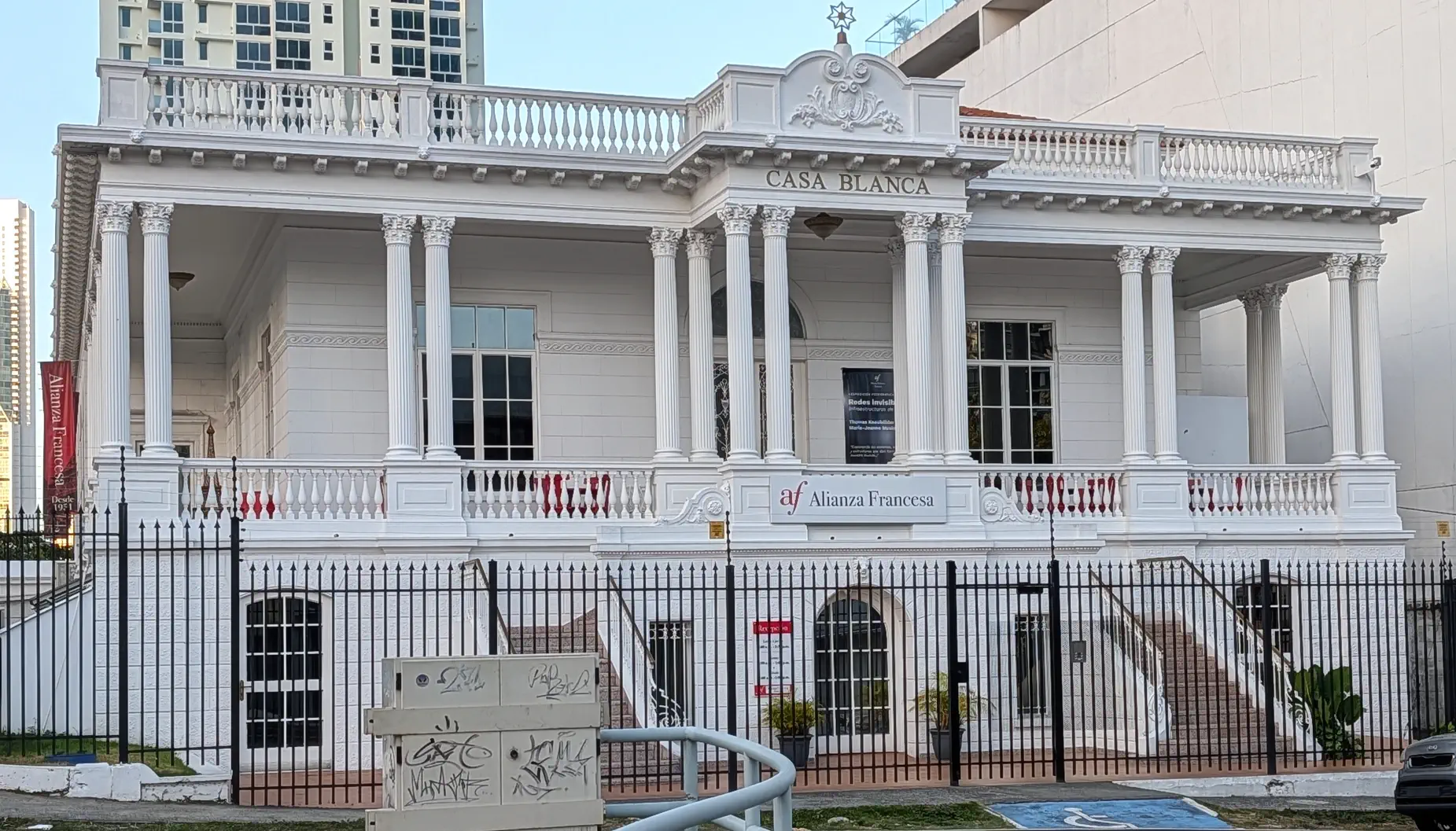
Casa Blanca — the Alianza Française de Panamá. One of the buildings you pass on the walk toward old town that makes the route considerably more pleasant than it might otherwise be.
The route took me past the Riba Smith near the hotel — familiar territory — and then through a stretch of condos and commercial buildings that gradually gave way to government offices and embassy buildings as I approached downtown. The character of the street shifts noticeably on that walk. So does the number of people sleeping rough in doorways and on benches. I want to name that directly: I noticed it, and my first reaction was the kind of discomfort that comes from too many years of American cities where visible poverty is either invisible by design or actively policed. In Panama it was simply there, in a neighborhood I was walking through, and nobody was bothering anybody. A useful reminder that my discomfort was mine to work through, not a signal that anything was wrong.
I took a left toward the Cinta Costera — the coastal greenbelt running between Avenida Balboa and Panama Bay — and emerged from the building canyons into one of the better surprises of the whole trip.
The Sunday ciclovía — every week, no car in sight
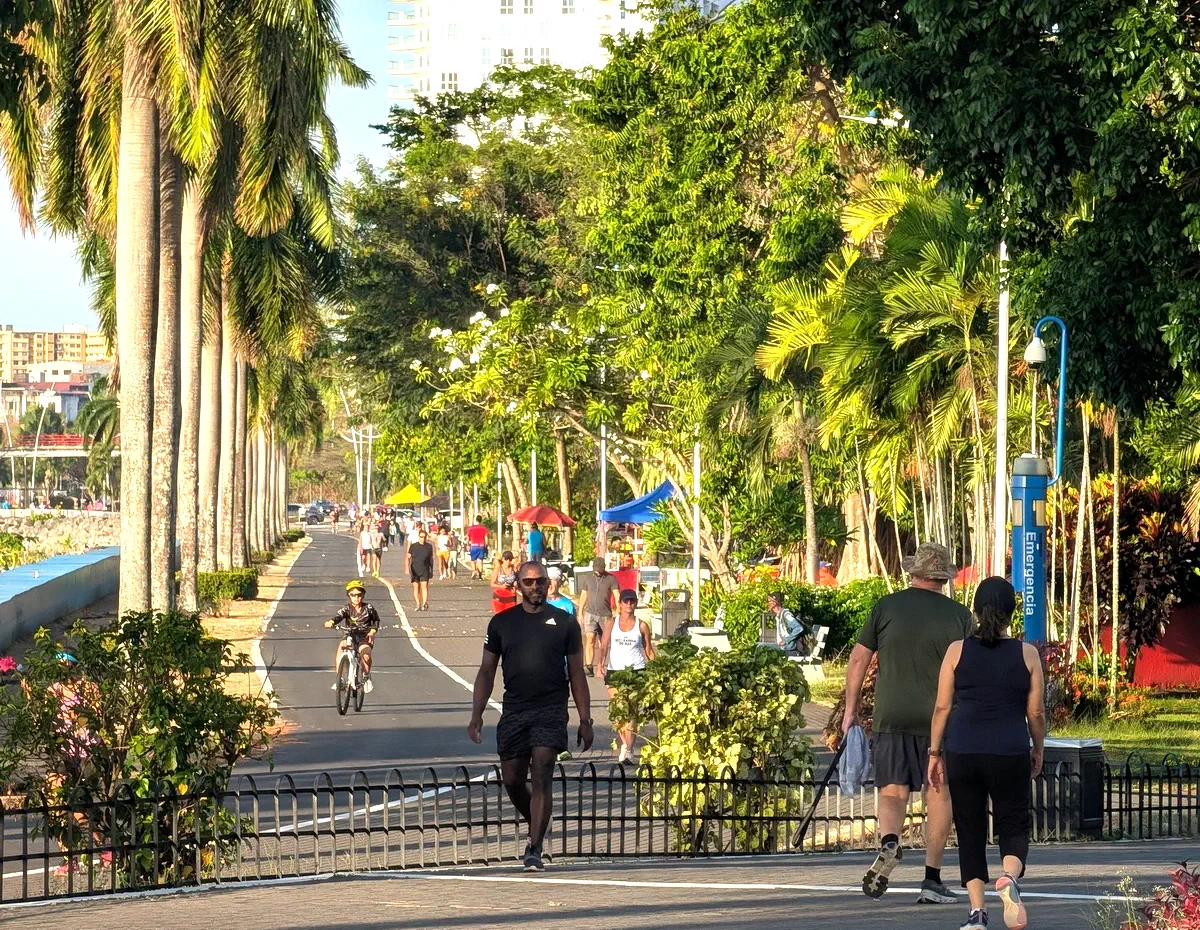
The Cinta Costera on a Sunday morning — six lanes of Avenida Balboa given entirely to cyclists, joggers, walkers, rollerbladers, and people doing absolutely nothing in particular by the water. Every week, 6am to noon.
Avenida Balboa — normally a six-lane highway running along the waterfront — was completely closed to cars. In its place: hundreds of people cycling, jogging, walking, rollerblading, doing yoga in small groups, families with children on small bikes, older couples holding hands walking at the edge of the bay. This is not a special event. Every Sunday morning from 6am to noon, the city closes a full lane of Avenida Balboa and the Cinta Costera becomes what urban planners call a ciclovía — the road returned to people, at least for a morning.
It was one of the most genuinely wholesome things I’ve witnessed in a long time. Panama City is a fast, modern, ambitious city. On Sunday mornings, at least on the waterfront, it slows down and gives itself permission to just be. Free bike rentals are sometimes available at the north end if you get there early enough. Exercise classes run along the route. Juice vendors set up near the Panama sign.
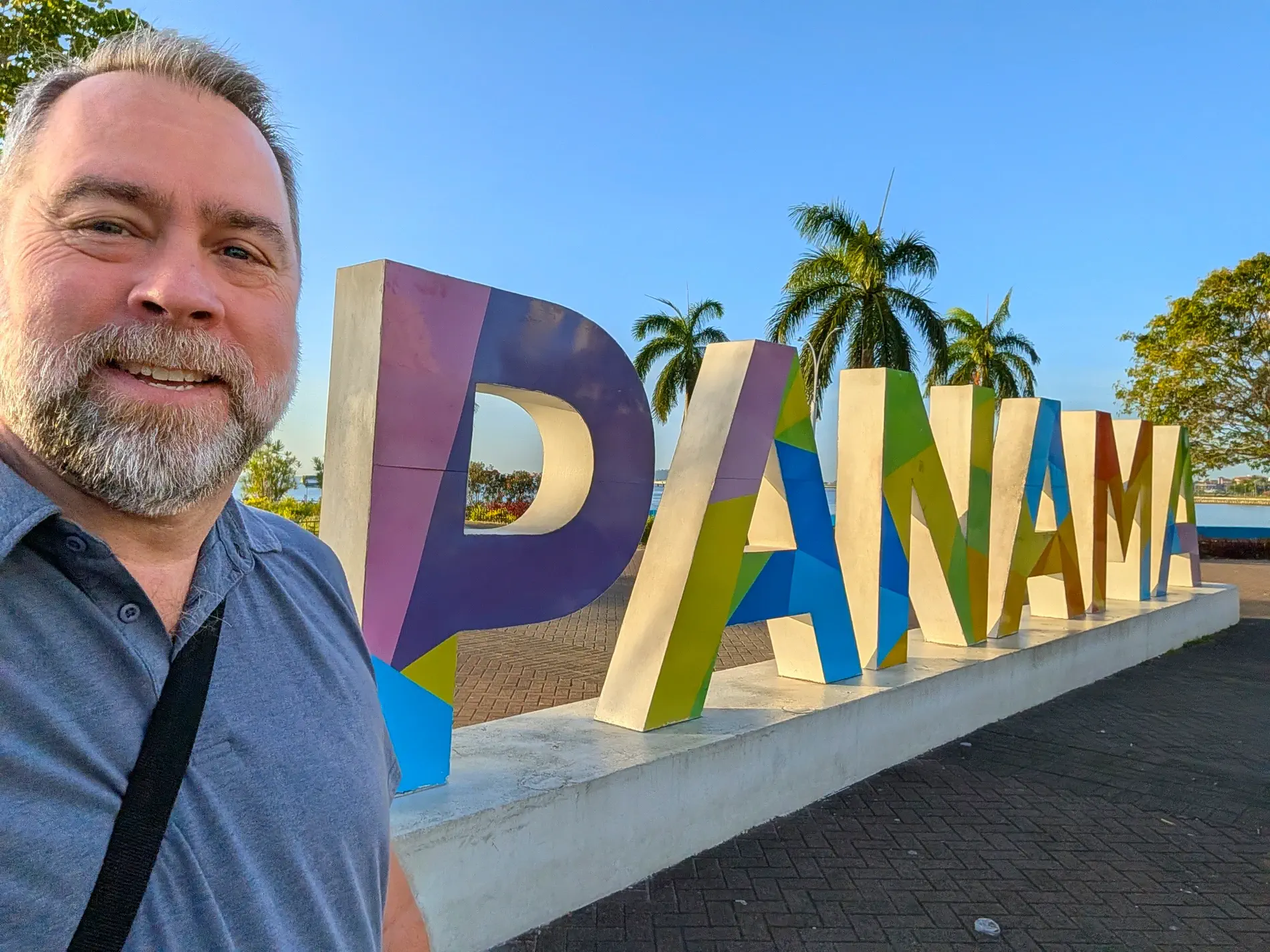
Obligatory Panama sign photo. The Cinta Costera’s most visited photo stop, on a Sunday morning with no cars anywhere on the highway behind it. A completely different experience from any other day of the week.
The Sunday ciclovía — what you need to know
Every Sunday, 6am to noon: Avenida Balboa closes to regular traffic along the Cinta Costera. The route runs from Punta Paitilla all the way through to near Casco Viejo — roughly 15 kilometers of waterfront. Free bikes are sometimes available at the north end; arrive early if you want one. The views of the skyline from the water side are exceptional. Go early to beat both the heat and the crowds. This is one of the best free things to do in Panama City and almost nobody outside the city knows about it.
Chinatown — what remains
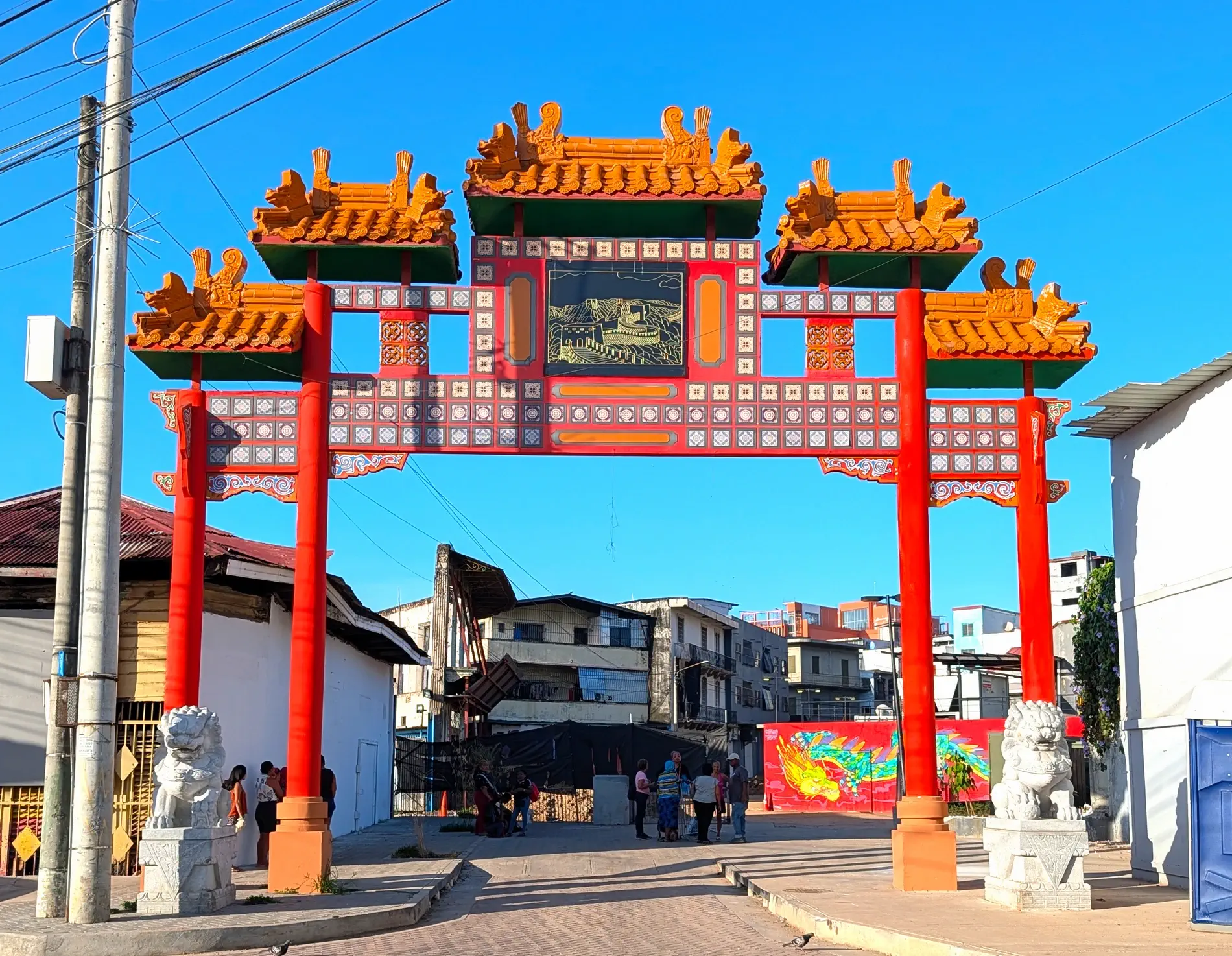
The Chinatown arch — what remains of a community that shaped a significant part of Panama City’s identity and commercial history. The neighborhood itself is long gone; the arch stays.
Continuing past the fish market — past, not through, I have learned — I reached the decorative arch that marks what was once Panama City’s Chinatown. The Chinese community has been part of Panama since the construction of the transcontinental railroad in the 1850s, when tens of thousands of Chinese laborers came to work. The community grew, established a neighborhood, and shaped the city’s food, commerce, and culture in ways that are still visible. The neighborhood itself is gone now, absorbed into the surrounding urban fabric. The arch stays, marking a space that no longer exists as a place but hasn’t been entirely forgotten either.
Mercado San Felipe Neri — the produce market
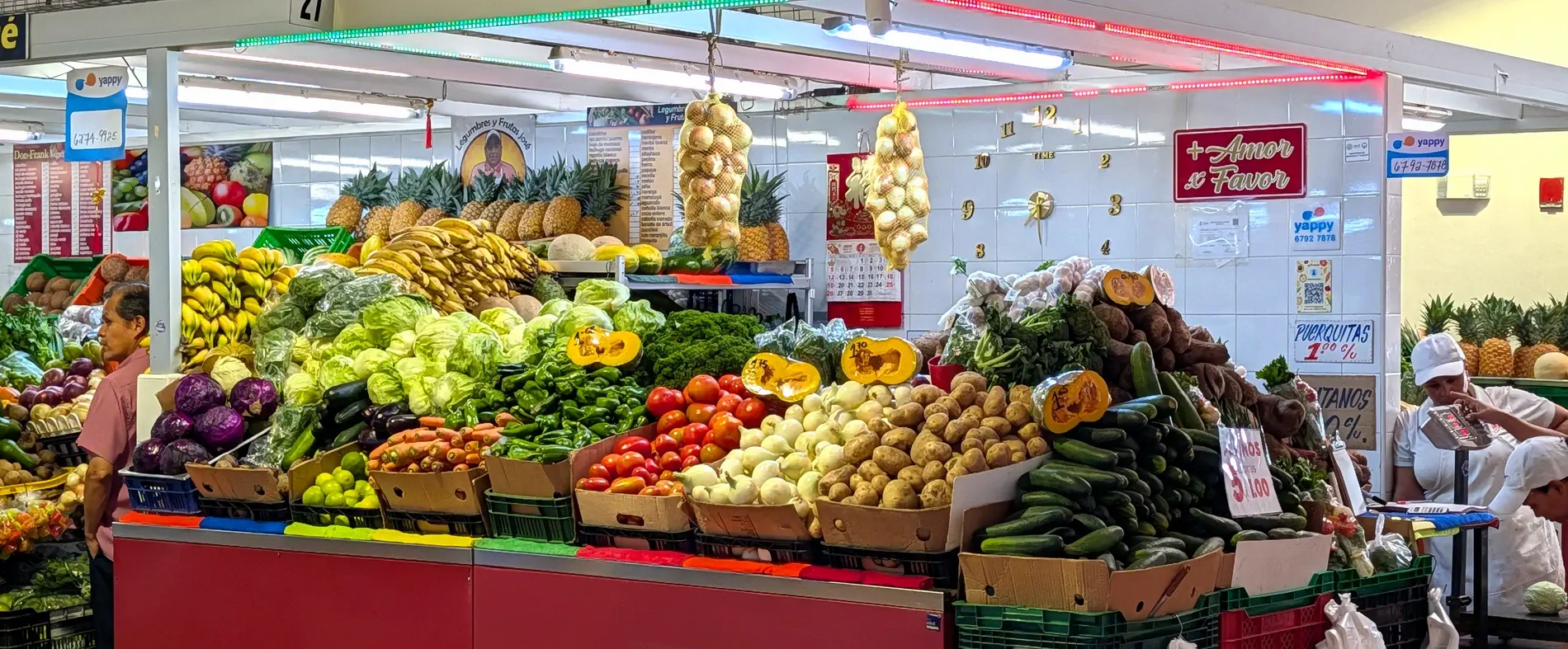
The produce section at Mercado San Felipe Neri — pineapples, citrus, peppers, squash, beans, spices. The kind of market that makes you want to have a kitchen to cook in immediately.
I entered the market from the meat section. First thing: air conditioning. Unexpected and very welcome. At this hour — early Sunday morning — roughly half the stalls were open, but every single one of them, open or closed, was spotless. The scent of bleach in the air is not romantic, but in a market context it is deeply reassuring. Everything was fresh, well-presented, and clearly taken seriously by the people running it.
The meat section carried everything, and I mean everything, that is not from the sea. Every part of every animal, without the grocery store’s habit of trimming and packaging things into comfortable anonymity. It is a proper market, not a performance of one. There is no waste here. I find that genuinely admirable.
From there into the produce section, which was the reason I’d walked forty-five minutes to get here. Stalls overflowing with fruit and vegetables in a way that supermarket produce sections simply cannot replicate: golden pineapples, vivid peppers in green and red, citrus that looked actually juicy, multiple varieties of squash, onions, potatoes, beans. Several stalls were selling spice blends in zip-lock bags — cumin, achiote, dried chilies, things I couldn’t identify but wanted to. The whole section had a warmth to it, a mix of sweet ripeness and earthy spice that filled the air in layers.
I stopped in front of a pineapple display and stood there longer than was strictly necessary. We’ve been eating a lot of pineapple this trip and for good reason — Panamanian pineapples smell the way pineapple is supposed to smell. You know the kind. You can detect a perfectly ripe one from three stalls away. That’s what this was.
I could not smell the cilantro from that far away, which was fine with me. I cannot eat it.
Mercado San Felipe Neri — practical notes
The market is near Casco Viejo, two blocks from the fish market. Take an Uber directly to the entrance — it is too far from the nearest Metro station to walk comfortably in the heat. Go early: Sunday morning before 9am is ideal, when the stalls are freshest and the temperature is manageable. The meat market and the produce market are adjacent sections — air conditioned, clean, well-organized. Bring a bag; there are no supermarket-style carriers here.
I walked back out along the Cinta Costera, went a bit further out over the water to catch the skyline from across the harbor, and then took the Metro home from near Casco Viejo to meet Brian for breakfast.
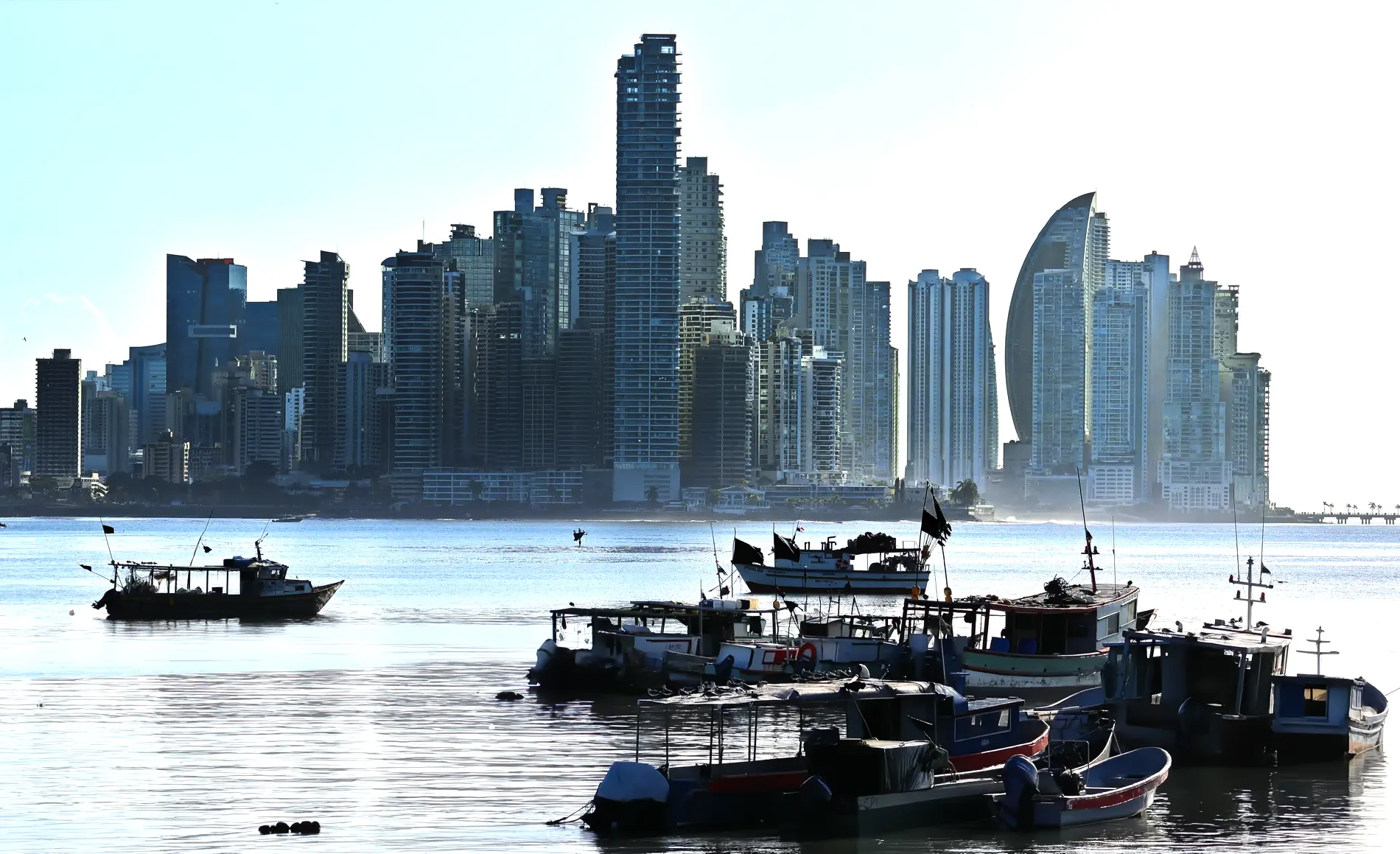
The Panama City skyline from the water side of the Cinta Costera. More than anywhere else on this trip, this view reminds you that you are in a genuinely significant city.
The canal — finally
After McDonald’s and Tim Hortons (the routine holds), we spread a map on the table and made a decision that had been ten days coming: today we go to the Panama Canal. We took the Metro to Albrook station, navigated the bus terminal, and called an Uber from there to the Miraflores Locks Visitor Center. The ride gave us our first proper look at the Balboa, Diablo, and City of Knowledge neighborhoods — areas not served by the Metro that we hadn’t been able to see otherwise. Green, residential, interesting. They go on the list for a future trip.
Miraflores Locks Visitor Center — what it costs
We paid $17.22 each. Brian noted, not for the first time, what his Pensionado card will do to that number: $1.50. The difference between $17.22 and $1.50 for the same visitor center entry is one of the more striking illustrations of the Pensionado visa’s daily value. We are working on it.
We walked out to the observation platform overlooking the locks. Brian overheated and went back inside fairly quickly — the platform is exposed and the sun was direct. I stayed to take photographs and waited with some optimism for a ship transit. No luck. None were scheduled until later in the afternoon. The locks sat still and enormous and impressive, doing nothing in particular, while I appreciated their scale and then went inside to rejoin Brian.
We each had a Gatorade. $5.00 each. We are telling you so you don’t have to experience this yourself.
The canal has an excellent movie — narrated by Morgan Freeman, which does carry a certain authority — about the construction of the canal. It is well-made and worth watching. Having done the Canal Museum earlier in the week, we noticed that the film focuses primarily on the engineering achievement and is lighter on the full political history: the French attempt, the Canal Zone, the Torrijos-Carter Treaties, the transfer of control. The museum covers all of that. Our strong recommendation: Canal Museum first, canal second. In that order, with verified ship transit times, and with your own drinks.
Planning a canal visit — what we’d do differently
Go to the Canal Museum in Casco Viejo first — it gives you the full historical context that makes the actual canal more meaningful. Check the ACP (Panama Canal Authority) website for ship transit schedules before you go — seeing a vessel navigate the locks is worth planning around. Bring your own water and snacks. $5 for a Gatorade inside the visitor center is the most expensive drink of this entire trip, including the cocktails at Alejandro’s.
We left glad to have seen it. Ten days into a trip to Panama, seeing the Panama Canal felt both overdue and worth every day we waited.
The HamMan Sauna — Panama’s only gay sauna, reviewed honestly
We had promised our readers a visit to HamMan Sauna, and a promise is a promise. This was the afternoon for it.
Getting there was easy: Metro to the Lotería station, about two and a half blocks on foot from there. The location is straightforward and the place is not hard to find.
HamMan Sauna & Spa
Gay sauna · Bella Vista · Panama City’s only gay sauna
Let’s start with what it does right: it is clean. Noticeably, reliably clean. That’s not a small thing for a gay sauna and we want to give it that credit clearly.
The facilities: lockers but no individual changing cabins. A jacuzzi, a cool pool, a dry sauna, and a wet steam sauna. A dark room — a single square room with a curtain over the entrance. A “maze” in the wet sauna that is generously described as a maze by those who use the term. The pool was cool and genuinely refreshing after a day out in April heat, and on that basis alone it delivered something valuable.
The bar: they advertise an “Open Bar,” which in Panamanian hospitality means the bar is open — not complimentary drinks, as the term tends to imply in the U.S. and Europe. We ordered drinks. The bartender could not give us a price. He told us we’d find out at checkout. Two well drinks totaled $16.52. Unclear pricing for drinks at a venue where you’re not carrying your wallet is a system worth knowing about in advance.
The atmosphere: Panama is a conservative country, and that cultural context extends into the sauna. The clientele ranged from early 20s to late 60s and were friendly and genuinely willing to talk to each other — which is actually more than you can say for some European gay saunas where everyone maintains an elaborate fiction of mutual invisibility. But the overall energy is restrained in a way that will feel unfamiliar to anyone used to saunas in Europe or major U.S. cities. Less playful, more careful.
One detail worth mentioning: there are cameras in several interior locations. We note this not as a criticism but as information you’d probably want before visiting.
The honest verdict: if you want a gay sauna in Panama City, this is where you go — because it is the only one. The pool alone made the visit worthwhile after our day in the heat. If you’re traveling from a city with a well-established sauna culture and arriving with European or major U.S. city expectations, calibrate those expectations accordingly. It is what it is: the one option in a conservative country doing something that conservative countries don’t generally prioritize. It functions. It’s clean. It’s not going to change your life.
HamMan Sauna — practical information
Evening in — the right call
After a day that started before sunrise and included a four-kilometer walk, the produce market, the canal, and a sauna, neither of us had any ambition left for going out to dinner. I walked to Riba Smith and assembled dinner: bread, cheese, ham, chips, pineapple, and a small banana cake that neither of us could really explain but both of us were glad to have. $18.70 total. We made sandwiches and ate them in the room.
Riba Smith — evening dinner assembled at home
Tomorrow is the day Brian gets his temporary residency card. Ten days of research, one attorney meeting, one health certificate, and a Monday appointment at Immigration. Let’s see how this goes.
— Brian & Kent
Sources & Verification
- Firsthand: Day ten of our April 2026 trip — Kent’s Sunday morning walk along the Cinta Costera and through Mercado San Felipe Neri, the Miraflores Locks visit ($17.22 general / $1.50 Pensionado / $5.00 Gatorade), the HamMan Sauna visit and its $16.52 bar tab, and the Riba Smith evening meal ($18.70).
- Reported: The history of Chinese immigration to Panama via the 1850s transcontinental railroad construction, and the canal’s political history (the French attempt, the Canal Zone, the Torrijos-Carter Treaties) as covered in the Canal Museum, referenced here but not re-detailed.
Facts and prices in this article last verified: July 2026.
Our Story & Panama Journey Series
- 01 Almost 40 Years, 12 Homes — and We’re Doing It Again
- 02 We Lost Everything in Spain. We’re Still Glad We Went.
- 03 Going to Panama — and You’re Coming With Us
- 04 Day One: Wheelchairs, Wind, and a Metro Lesson
- 05 Day Two: The Shorts Crisis and the World’s Biggest Mall
- 06 Day Three: Grocery Prices, Neighborhoods, and a $12 Drink
- 07 Day Four: The Attorney, the Doctor, and the Pensionado Visa
- 08 Day Five: The Fish Market, Multiplaza, and Maluka
- 09 Day Six: Neighborhoods, Hardware Stores, and a Fixer-Upper
- 10 Day Seven: Breakfast, Laundry, and Furniture Shopping
- 11 Day Eight: The Canal Museum, La Cresta, and Casco Viejo
- 12 Day Nine: Hato Pintado, Carrasquilla, and Hardware Stores
- 13 Day Ten: Miraflores Locks, the Ciclovía, and Hamman
- 14 Day Eleven: Getting the Pensionado Residency Card
- 15 Day Twelve: What Panama Actually Taught Us
- 16 Day Thirteen: Going Home — Is Panama Still the Answer?
Brian & Kent
We’re documenting the real process of researching and moving to Panama — costs, neighborhoods, the gay scene, and Brian’s Pensionado visa in real time. Questions? he***@*************ma.com