Our Story & April 2026 Trip – Part 11 of 16
Day Eight — A Pre-Sunrise Climb, the Canal Museum, and Three Uber Attempts in the Heat
Kent conquers the stairs to La Cresta at 6am while Brian sleeps. Then together they spend a morning at one of the best museums in Central America, discover exactly what a Pensionado card is worth at the ticket window, and spend an afternoon getting ghosted by two Uber drivers in Casco Viejo.
 Brian & Kent · GayExpatsPanama.com · April 2026 Research Trip
Every morning for the past week, riding the glass elevators at the hotel — eighteen stories of exposed vertical travel that Brian endures with a composure I find impressive given his feelings about heights — I’ve been looking at the same thing: a ridge running parallel to Via España, a neighborhood sitting on top of it, and what appears to be an extremely long set of stairs connecting them to the street below. I’d been clocking those stairs all week. On day eight, I finally went up them.
La Cresta — the 6am reconnaissance
Kent’s early morning dispatch — La Cresta neighborhood
Brian has a bad back. The stairs were always going to be a solo project. I set an alarm for 6:15am, slipped out of the room without waking him, and made my way down to the street. I did not leave a note explaining where I was going. Brian tracked me on his phone. We have different communication styles.
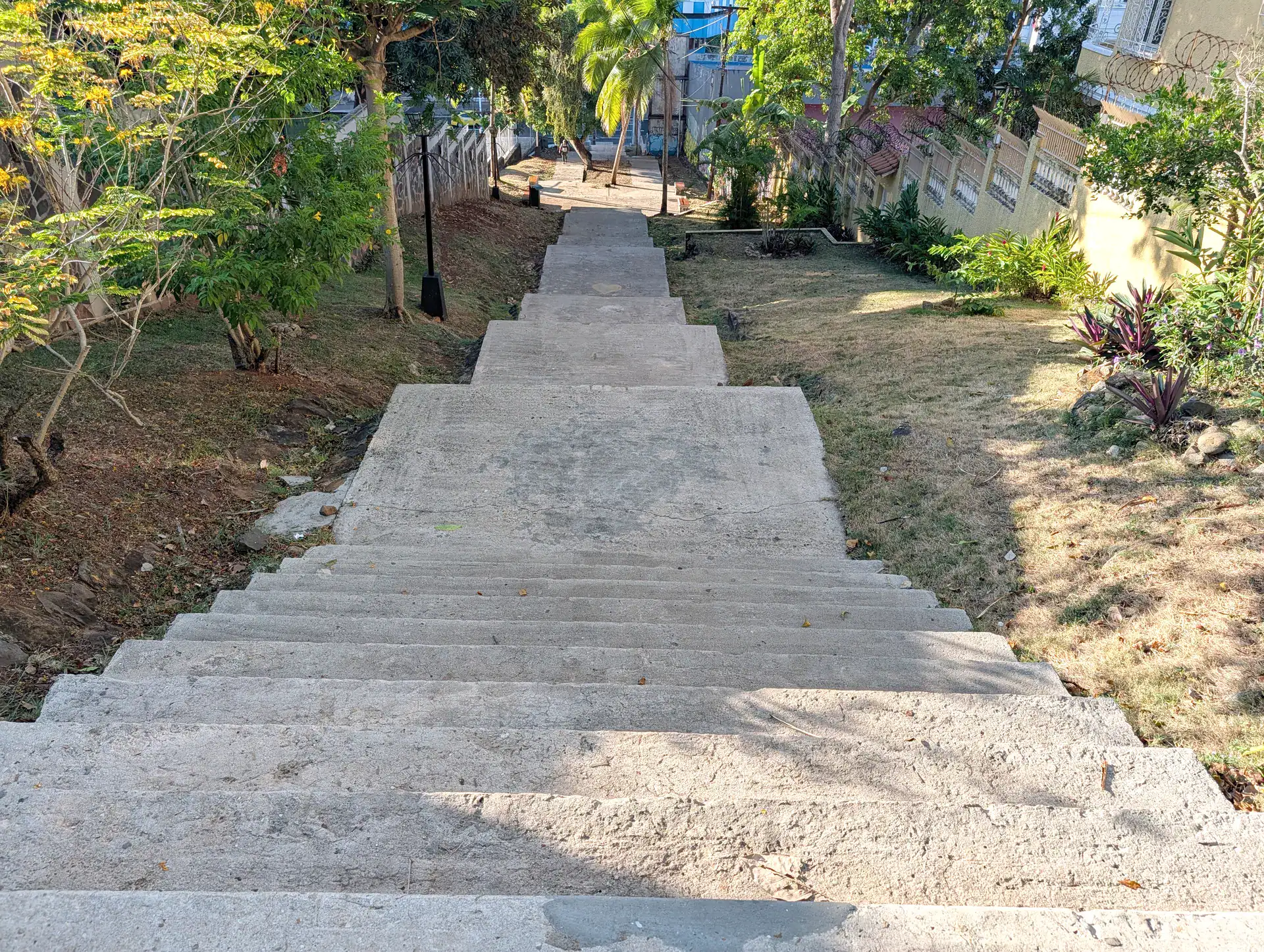
The stairs to La Cresta — as long as they look from below, and longer once you’re in them. Worth it at 6am. Not worth it at any other time of day.
The only reason this was even remotely reasonable was the hour. Just before sunrise, the temperature had dropped to about 75°F with an actual breeze — a revelation after a week of upper 80s with full humidity. I started climbing. They kept going. At some point I had the very brief thought that calling an Uber to go up a hill would be embarrassing, which was enough motivation to keep moving.
At the top: La Cresta. The neighborhood runs along the ridge, with all the streets parallel to the main drag below — easy to navigate, no getting lost. Being elevated and surrounded on all sides by the city while feeling completely separated from it gives La Cresta a quality that’s genuinely unusual. It is simultaneously central and entirely removed from everything.
The architecture — my kind of neighborhood
The housing stock here is exactly the kind I’ve been hunting for all week. Large single-family homes, built by the looks of them in the 1970s and early ’80s, split between two styles: mid-century modern — flat roofs, cantilevered porches, deep overhangs, clean lines — and Spanish colonial revival, with ornate ironwork, red clay tile roofs, and decorative arches. Both styles have aged well in Panama’s climate. Most have been maintained carefully over decades, and you can sense that the families who live there have been there for at least a generation.
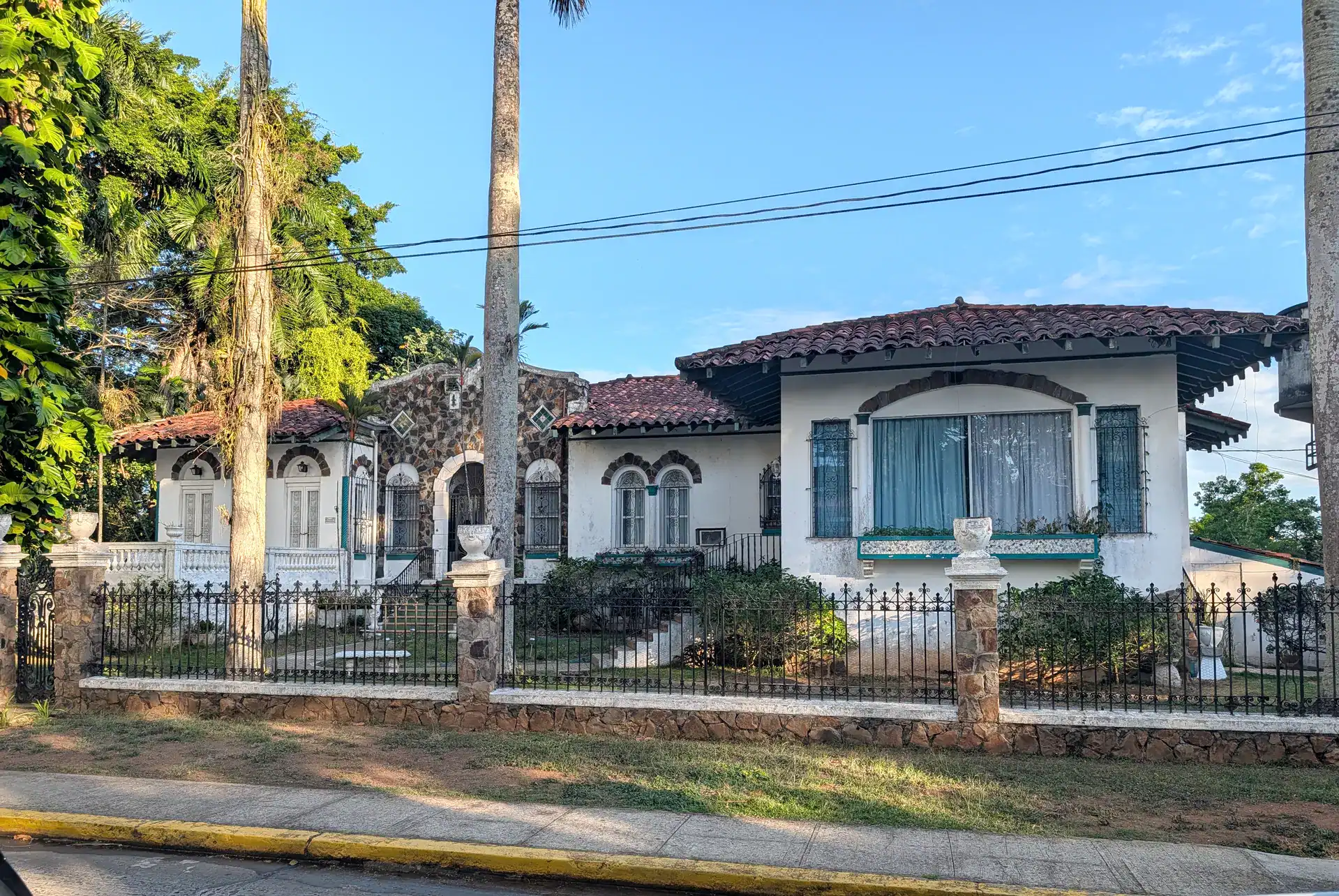
Spanish colonial revival in La Cresta — red clay tiles, ornate ironwork, decorative arches. Most of the homes here have been maintained with genuine care over decades.
Several homes were mid-renovation — gutted shells with construction work clearly underway. I arrived before the crews, so no chatting my way into a site tour this time. But based on what I could see, the finished results are going to be exceptional. These are not quick flips. Someone is investing seriously in bringing these houses back.
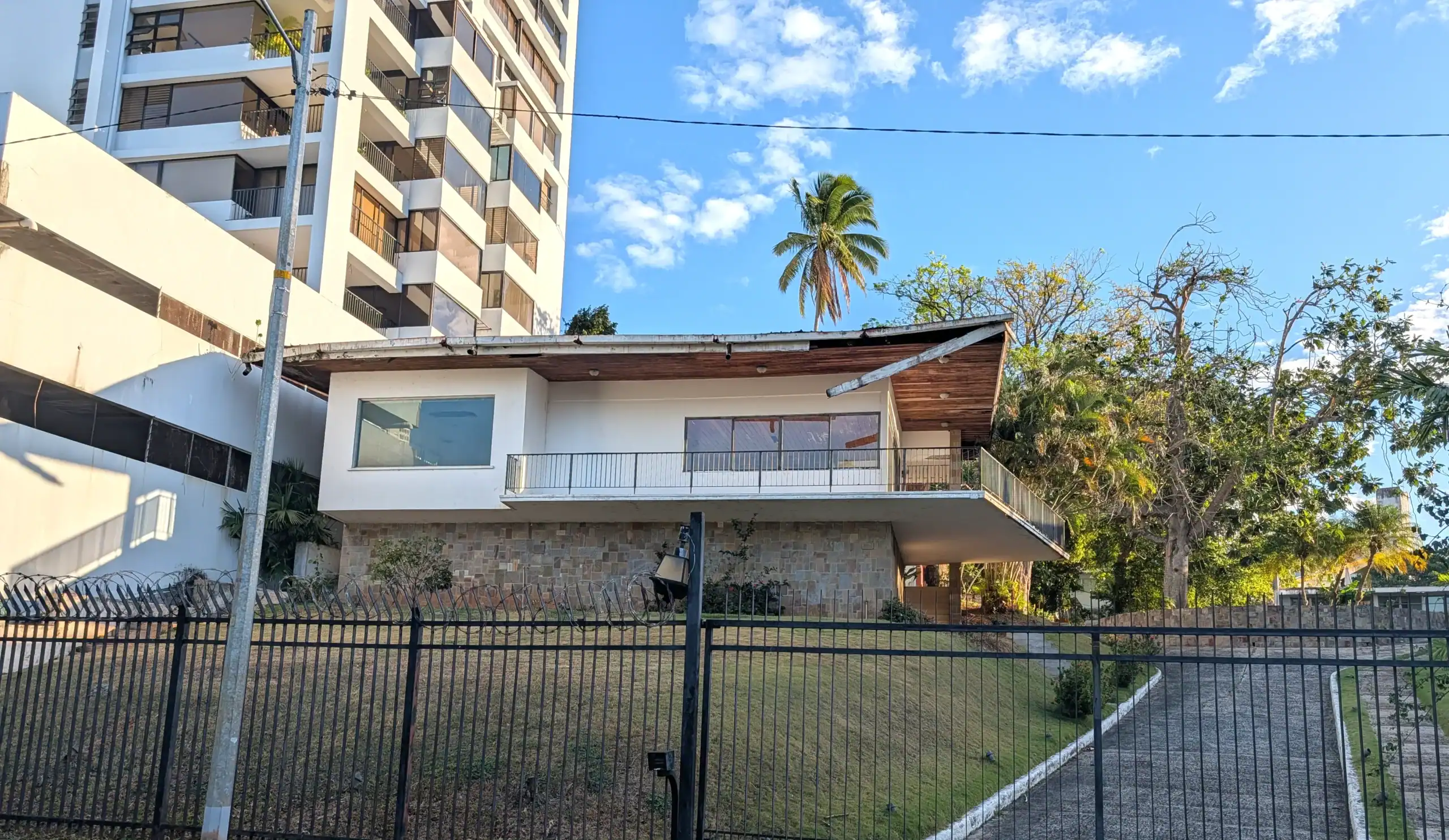
The house we could see from the hotel elevator — sharing a gated lot with two other homes, with a high-rise condo built directly against it. One of those situations where the timing of the condo’s construction was clearly not good news for the homeowner.
One detail that will stay with me: three homes in a shared gated area, all appearing vacant, none with for-sale or for-rent signs. No explanation visible from the street. I genuinely hope they don’t become the site of another condo tower. The ridge has enough of those already.
The honest reality check
If I were ten or fifteen years younger, I would be on Zillow right now looking for La Cresta listings. The neighborhood has everything I look for: character, scale, mature landscaping, a real sense of community, and views of the downtown skyline with slices of Pacific between the buildings. Being here at sunrise, with the city waking up below and a cool breeze coming off the ridge, it felt like finding something.
But here is what La Cresta does not have, and it matters: no businesses. None. No grocery store, no café, no pharmacy, no hardware store. The stairs are the only meaningful pedestrian connection to the city below. I cannot picture myself hauling groceries up those stairs on a regular basis. I cannot picture Brian walking down them to get an iced coffee. The views are extraordinary. The logistics are not.
We’ll keep looking at neighborhoods at street level.
If you want to visit La Cresta
Go before 7am. The stairs from Via España are manageable in the cool of early morning and genuinely punishing by mid-morning. The neighborhood itself is flat once you’re at the top — easy walking. Allow an hour for a proper loop. There is nothing to buy up there, so bring water.
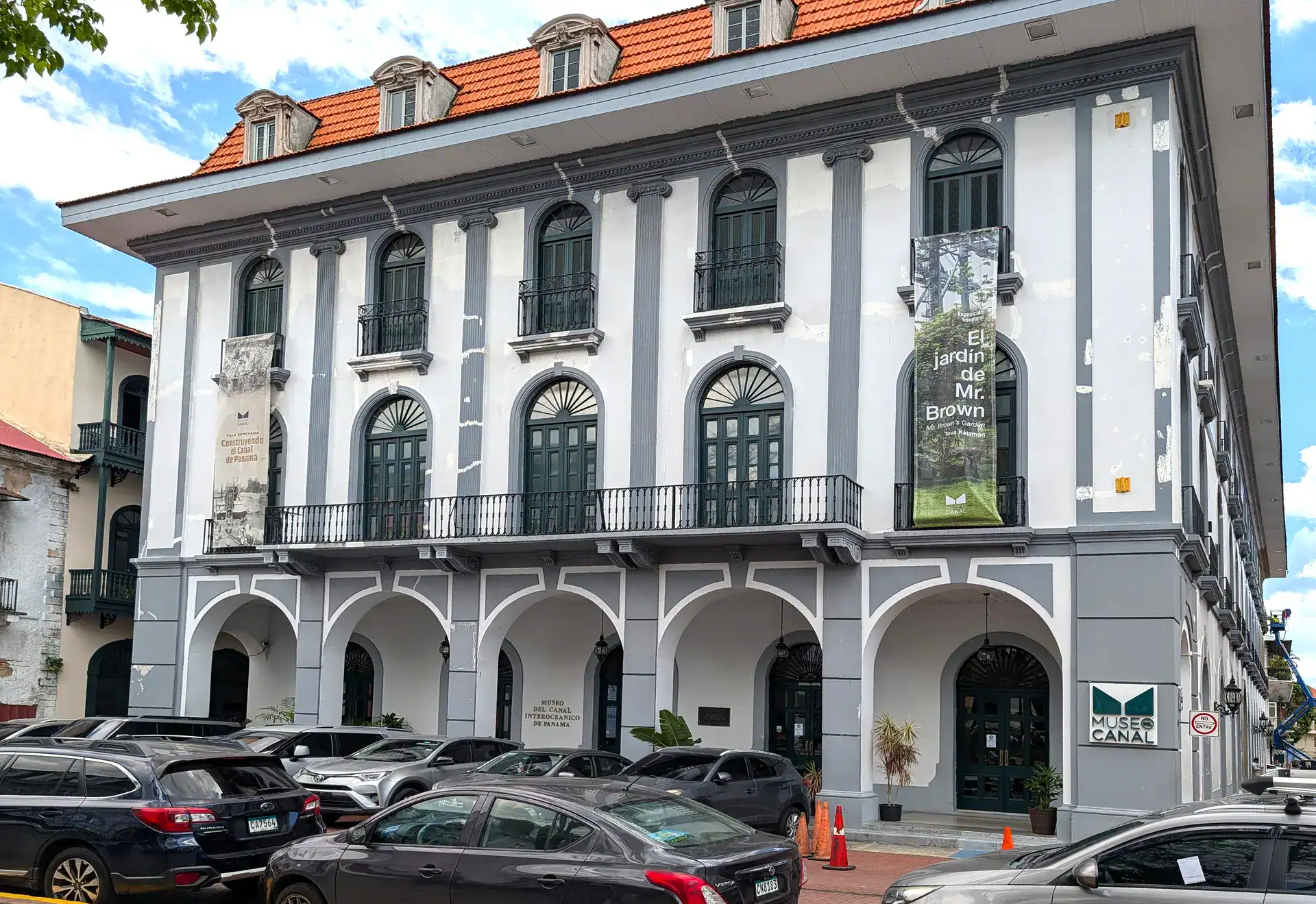
The Canal Museum — better than either of us expected
After I got back, showered, and confirmed that Brian had in fact tracked my phone and knew exactly where I’d been, we did our McDonald’s and Tim Hortons routine and made a decision: today was the Canal Museum rather than visiting the canal itself. We’d been talking about it since before the trip. Day eight was finally the day.
We took an Uber directly to Casco Viejo. This was the right call. The museum is deep inside the old town and genuinely far from the nearest Metro station — further than the fish market haul on Day Five, and we learned our lesson from that. Uber to the door.
Museo del Canal Interoceánico — entry prices
Brian does not yet have his Pensionado card — the visa process is underway, but we’re not at card stage yet. The ticket window made the math very clear: once he has it, his entry price drops from $15.00 to $2.50. That is a $12.50 difference for a single museum visit. It is one of the most concrete illustrations we’ve encountered of what the Pensionado card actually does in daily life. We paid $15.00 each and went in.
About the Museo del Canal Interoceánico
The museum is housed in a building that has been central to Panama’s history for over a century. Originally the Grand Hotel, it became the headquarters for Ferdinand de Lesseps’ French canal company in the 1880s — the same company that attempted and ultimately failed to build a sea-level canal through the isthmus before engineering and yellow fever combined to defeat them. That failure cost thousands of lives and set the stage for the American effort that followed.
The building is now a beautifully restored colonial structure on the Plaza de la Catedral in the heart of Casco Viejo. The exhibits move chronologically through eleven rooms, beginning with the pre-Columbian peoples of the isthmus and moving through Spanish colonization, the overland trade routes, the California Gold Rush and its effect on Panama, the first transcontinental railroad, the French canal attempt, and the American construction project that succeeded where France had failed.
Key artifacts include the original Torrijos-Carter Treaties of 1977 — the documents that set in motion the transfer of the canal to Panamanian control, completed on December 31, 1999. Also on display: the famous Nicaraguan volcano stamp, which deserves its own explanation. When the U.S. Senate was debating whether to build the canal through Panama or Nicaragua, opponents of the Nicaragua route distributed a stamp showing a Nicaraguan volcano actively erupting to senators, effectively arguing that volcanic instability made Nicaragua too risky. Panama won the contract partly because of a postage stamp. The stamp is here, in a display case, doing exactly nothing at this point — but it is one of the stranger footnotes in diplomatic history and worth knowing about before you see it.
The exhibit on “Mr. Brown” — a true story about the last few years of a man living an ordinary life adjacent to the Canal Zone — is one of the more humanizing sections of the museum. The Canal Zone was a strip of U.S.-controlled territory on both sides of the canal where Americans lived essentially as they would in the United States, separated from Panamanian society in ways that created real and lasting tension. The exhibit gives that tension a human face.
The included film gives a completely different perspective — personal, quiet, emotional in a way that straightforward historical documentation rarely achieves. It is worth staying for. Signs and labels are in both Spanish and English throughout. Bilingual guides are available, and audio guides can be rented for $5.00.
Kent walked in expecting a competent regional history museum. He walked out having called it one of the best museums he’s visited anywhere. That is not a low bar — Kent has been to a lot of museums. The Canal Museum cleared it by a significant margin.
We’ve been through this whole trip thinking primarily about Panama as a place to live. The museum reminded us what Panama actually is — the place where the world’s trade routes run. That context changes how you see everything else.
Plan your visit — practical notes
Budget at least two hours, more if you’re genuinely interested in the history. The film alone is worth 30 minutes of that. Take an Uber directly to the museum entrance — the nearest Metro stop requires a walk comparable to the fish market trek. If you have a Pensionado card, the $2.50 admission is one of the best value propositions in Panama City. Photography for personal use is generally allowed; flash photography is restricted to protect the artifacts. The museum is closed Mondays.
Casco Viejo — and the Uber situation
After the museum we stepped out into Casco Viejo proper. It was afternoon by now and cooking — no other word for it. But the neighborhood earns its UNESCO World Heritage designation and we wanted to at least walk it briefly.
Casco Viejo’s central plaza on a weekday afternoon — the scale and the colonial architecture give you a sense of what this neighborhood was and is becoming again.
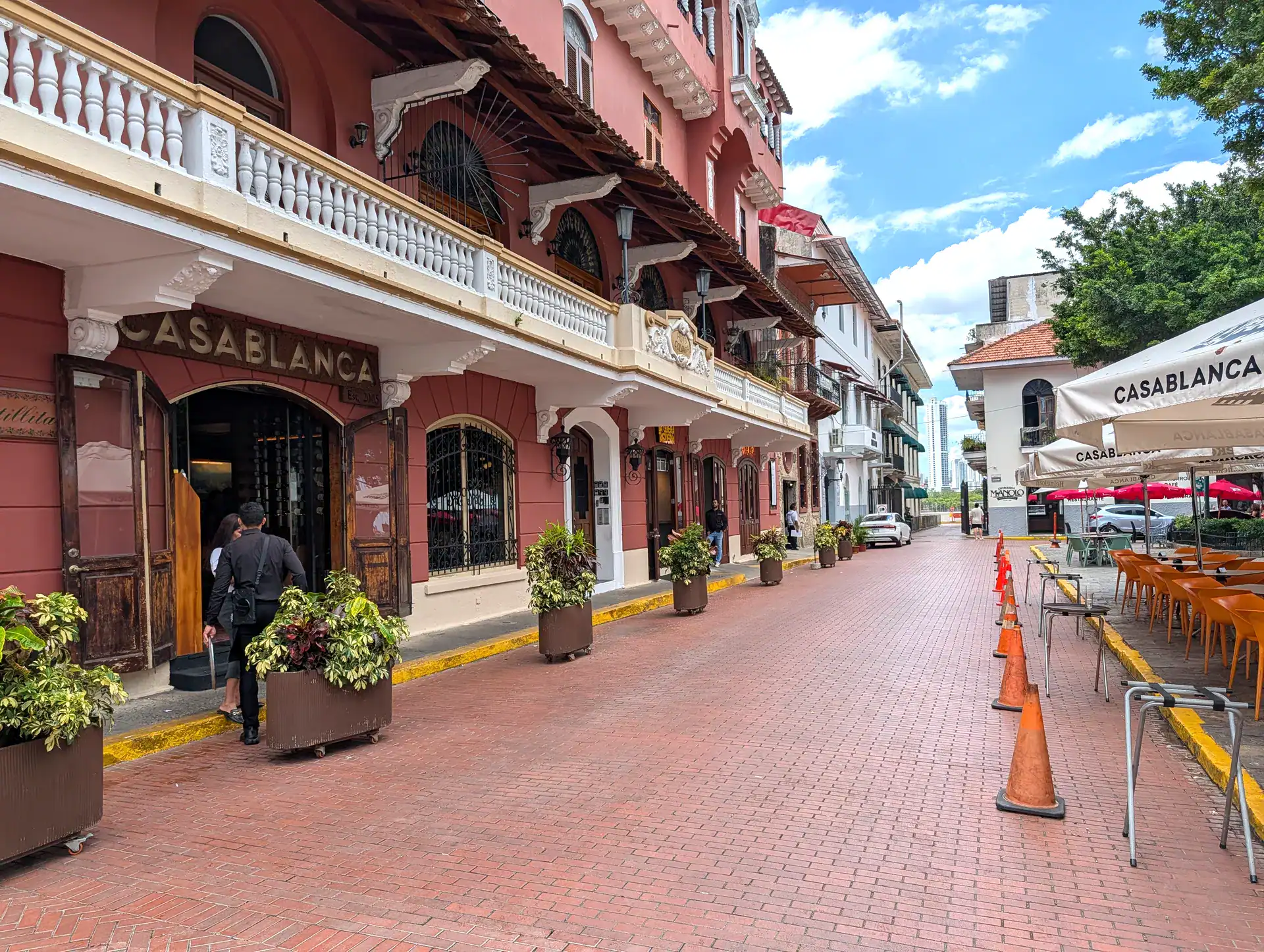
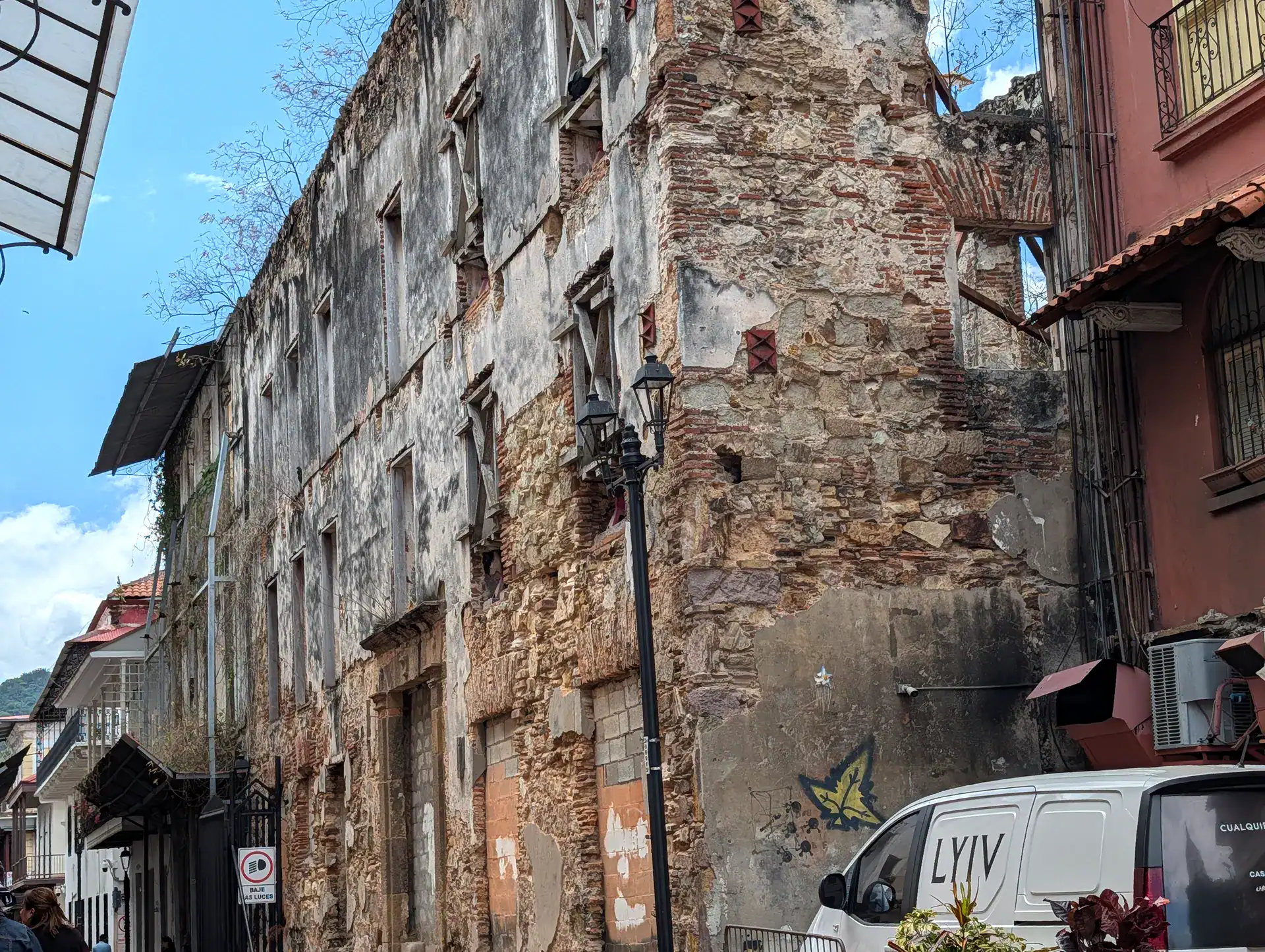
The full spectrum of Casco Viejo in one block — a beautifully restored street on the left, and on the right a building that is currently nothing but walls, waiting for someone to decide what it becomes next.
Casco Viejo is one of those neighborhoods that is very clearly in the middle of becoming something. The fully restored blocks are genuinely beautiful — colonial architecture maintained or returned to its original quality, boutique hotels, restaurants, a real sense of what this place was when it was the center of a city’s life. Then one street over you’ll find a building that is a shell, walls only, vegetation growing through the gaps. The contrast is not subtle. The neighborhood is working through its own restoration in real time, block by block.
Come to Casco Viejo early
We’d say this about a lot of Panama City, but here it matters especially. The old town in the early morning — before 9am, before the heat has fully arrived and before the tourist activity picks up — is a completely different experience. The light through the colonial buildings, the quiet plazas, the cobblestone streets without crowds. Plan for early. We saw it in the afternoon and it was still worth it. But we’ll go back at sunrise.
When we decided it was time to leave, we called an Uber. The first driver accepted the ride, then cancelled before entering the old town. The second driver accepted the ride, drove past Kent waving his arms at the kerb, and cancelled. A third driver, who stopped to explain what had likely happened, suggested the first two probably picked up a cash fare for more money and abandoned our ride. The third driver took us back to the hotel. Brian, at this point, had moved through several stages of overheating and arrived at the one where he stops being quiet about it. The driver did not comment on this, which was professional of her.
Uber in Casco Viejo — what to expect
Getting an Uber out of Casco Viejo can take multiple attempts. The old town is popular with tourists, cash fares are common, and drivers apparently sometimes prefer a guaranteed cash fare to an app ride. Budget extra time when leaving — especially in the afternoon heat when you most want to leave immediately. It is not personal. It is just Casco Viejo Uber physics.
Evening in
Back at the hotel, we made an executive decision: the day had been excellent and we were done. I went to Riba Smith and picked up bourbon, 7-Up Zero, and pineapple chunks. Brian had turned the A/C down a full degree in the twenty minutes I was gone — a move that I have stopped trying to understand and have begun simply accepting as one of life’s constants. Then I walked to Wendy’s, got two chicken sandwiches, and we had dinner in the room watching television.
Day eight — what we spent
The Canal Museum is a genuine must. If you visit Panama City and don’t go, you will have missed something. We are going back with our Pensionado cards for $2.50 each and we will pay for the audio guide that time. There is more in there than one visit fully absorbs.
Day nine coming up.
— Brian & Kent
Sources & Verification
- Firsthand: Day eight of our April 2026 trip — Kent’s sunrise walk through La Cresta, our Canal Museum visit with prices read from the ticket window ($15.00 general, $2.50 Pensionado, $5.00 audio guide), the Casco Viejo walk, and the three-attempt Uber exit.
- Reported: The historical background in the museum box — the Grand Hotel and de Lesseps history, the Torrijos-Carter Treaties, the Nicaraguan volcano stamp story, and the Canal Zone context — as presented in the Museo del Canal Interoceánico’s own exhibits and signage, April 2026.
Facts and prices in this article last verified: July 2026.
Our Story & Panama Journey Series
- 01 Almost 40 Years, 12 Homes — and We’re Doing It Again
- 02 We Lost Everything in Spain. We’re Still Glad We Went.
- 03 Going to Panama — and You’re Coming With Us
- 04 Day One: Wheelchairs, Wind, and a Metro Lesson
- 05 Day Two: The Shorts Crisis and the World’s Biggest Mall
- 06 Day Three: Grocery Prices, Neighborhoods, and a $12 Drink
- 07 Day Four: The Attorney, the Doctor, and the Pensionado Visa
- 08 Day Five: The Fish Market, Multiplaza, and Maluka
- 09 Day Six: Neighborhoods, Hardware Stores, and a Fixer-Upper
- 10 Day Seven: Breakfast, Laundry, and Furniture Shopping
- 11 Day Eight: The Canal Museum, La Cresta, and Casco Viejo
- 12 Day Nine: Hato Pintado, Carrasquilla, and Hardware Stores
- 13 Day Ten: Miraflores Locks, the Ciclovía, and Hamman
- 14 Day Eleven: Getting the Pensionado Residency Card
- 15 Day Twelve: What Panama Actually Taught Us
- 16 Day Thirteen: Going Home — Is Panama Still the Answer?
Brian & Kent
We’re documenting the real process of researching and moving to Panama — costs, neighborhoods, the gay scene, and Brian’s Pensionado visa in real time. Questions? he***@*************ma.com