Our Story & April 2026 Trip – Part 16 of 16
Day Thirteen — Home, and Whether Panama Is Still the Answer
We flew home. Being back felt more comfortable than expected — more than Brian was prepared for. Kent noticed, asked the question, and they talked it through. Here’s how that conversation ended.
 Brian & Kent · GayExpatsPanama.com · April 2026 Research Trip
The alarm on Kent’s phone went off at 5:00am. Wash, shave, shower. At the hotel entrance before 5:45am, the Uber driver already waiting at the curb. The streets of Panama City at that hour are quiet in a way they never are during the day — empty lanes, traffic signals cycling through their colors for nobody, the city in the brief window before it wakes up. We arrived at the airport more than three hours before our flight.
We knew from experience: leave early and sail through, or leave at a reasonable hour and sit in rush hour traffic watching the minutes tick down. The early alarm was the right call.
Our Story & Panama Journey Series
Articles sharing our story, our earlier life abroad, and the day-by-day experience that helped us decide whether Panama was right for our future.
- Almost 40 Years, 12 Homes — and We’re Doing It Again
- We Lost Everything in Spain. We’re Still Glad We Went.
- Going to Panama — and You’re Coming With Us
- Day One: Wheelchairs, Wind, and a Metro Lesson
- Day Two: The Shorts Crisis and the World’s Biggest Mall
- Day Three: Grocery Prices, Neighborhoods, and a $12 Drink
- Day Four: The Attorney, the Doctor, and the Pensionado Visa
- Day Five: The Fish Market, Multiplaza, and Maluka
- Day Six: Neighborhoods, Hardware Stores, and a Fixer-Upper
- Day Seven: Breakfast, Laundry, and Furniture Shopping
- Day Eight: The Canal Museum, La Cresta, and Casco Viejo
- Day Nine: Hato Pintado, Carrasquilla, and Hardware Stores
- Day Ten: Miraflores Locks, the Ciclovía, and Hamman
- Day Eleven: Getting the Pensionado Residency Card
- Day Twelve: What Panama Actually Taught Us
- Day Thirteen: Going Home — Is Panama Still the Answer? You are here
Getting to the Airport
Getting to Tocumen International Airport
Getting to the airport — what we’d tell you
The Metro does connect to Tocumen, but hauling luggage through turnstiles and navigating two line changes at that hour is more effort than it’s worth. Uber is the right answer. Leave earlier than you think you need to — rush hour traffic in Panama City is serious and the airport is far enough that getting caught in it creates real stress. Budget $25–$30 for the ride with tip.
Copa check-in is in Terminal 2. The Copa lounge, if you’re flying business, is clean and sharp — though the food selection runs considerably narrower than U.S. airline lounges. Have coffee there. Eat on the plane.
The flight home
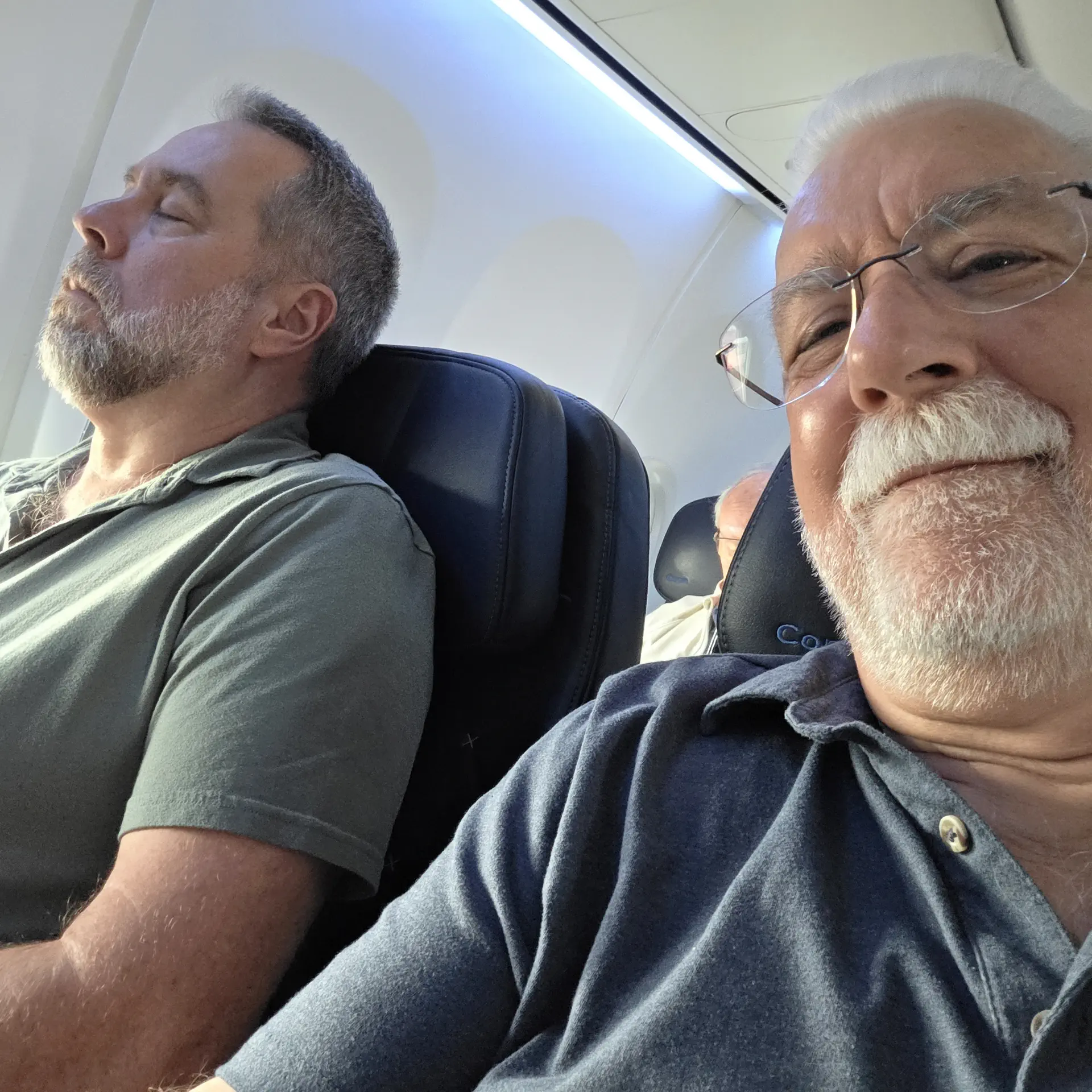
Kent, approximately four seconds after takeoff. I have been trying to learn this skill for decades. Progress remains elusive.
The flight was uneventful. Kent fell asleep immediately after takeoff with the efficiency of someone who has made peace with air travel at a cellular level. I watched the Caribbean pass underneath us and processed. We landed, cleared customs, collected our bags, and drove home to St. Petersburg.
And then something happened that I hadn’t expected.
The feeling I wasn’t ready for
It felt good to be home.
Not just comfortable in the way that your own bed is always comfortable after a trip. Genuinely, substantively good. The familiar streets. The air conditioning we’d set ourselves. The specific quiet of our own space. I wasn’t braced for how much I’d missed it.
I went quiet. I process things internally — Kent has known this for nearly forty years and has developed a patient system for noticing when I’m inside my own head about something. That evening, he checked in.
You’re quiet. Is everything okay?
I said yes. He waited.
Do you still want to move to Panama?
I said I’m fine. I needed time to process. I process a lot in my head and I was giving myself the space to do it. That’s different from having doubts.
Kent, being Kent, then asked the follow-up question: did I want to reconsider Spain or the Canary Islands again?
Spain and the Canary Islands — one more conversation
We’ve had this conversation before. We had it in Phoenix, and in St. Petersburg, and in various configurations over the years since we left Marbella. The Spain option has never fully left the table. So we talked through it again, properly, with the same framework we’ve applied before.
| Option | The case for | The honest problems |
|---|---|---|
| Madrid | World-class city. Culture, food, nightlife, LGBTQ+ rights among the best in Europe. We know the country. | Summer heat is genuinely brutal — worse than Panama City in July and August. Small condos, no single-family housing in central areas. High prices. Euro-denominated in a way that makes dollar income work less well. |
| Canary Islands | Mild climate year-round. Spanish culture without mainland prices. Beautiful landscape. | Water scarcity issues that are getting more serious, not less. Produce quality lower than the mainland — most shipped in. Overall cost of living higher than Panama. No Panama Canal residency shortcut. |
| Panama | Dollar economy. Straightforward Pensionado visa Brian has already started. World-class private healthcare. Direct flights from Florida. Gay scene that exists and is growing. Cheaper produce and hardware. Tim Hortons. | The heat. Spanish language still in progress. Same-sex couples navigate the legal system differently. Not Europe. |
We went through it methodically. Madrid summers are worse than Panama — unmercifully hot for longer, without Panama’s reliable afternoon rains to break it. Spain’s cost of living has risen significantly since we were last there. The kind of house we want — a proper single-family home with a garden — is effectively impossible to find in central Madrid at a price that works for us. The Canary Islands are more affordable but the water situation is real and worsening, and the produce being shipped in is exactly the kind of thing we noticed and appreciated in Panama, in reverse.
The conversation ended where it always ends. Panama still makes the most sense. Not by a narrow margin — by a clear one.
The days after
Over the following days, we kept coming back to it. Not with anxiety — just in the way that decisions of this size don’t settle all at once. We’d bring it up over dinner, or on a walk, or while watching something on television. Each time the conversation was shorter than the last. Each time the conclusion was the same.
At some point it stopped being a question we were checking and started being a thing we simply knew. Panama is right. The trip confirmed what the research had suggested. The residency card in Brian’s wallet makes it real in a way the spreadsheets and the Google Maps walkthroughs never quite did.
Now we just want to get there faster.
Why we’re not moving now
This is the question we get, and it deserves a direct answer.
We’ve run the numbers carefully — not just for the first few years, but for the long term. People in our family have lived into their nineties. Planning for a retirement that could span thirty or more years is a different calculation than planning for one that spans fifteen. We want to build our financial reserves to a level that supports the life we want in Panama without having to watch every dollar, even at the end of the runway. That discipline costs us a few years of being somewhere we’d rather be. It buys us decades of genuine comfort instead of years of managed anxiety.
The timeline is three to five years, barring major market disruptions. That’s not a hedge. It’s a plan.
Where we are now — the honest version
Brian has his temporary Pensionado residency card. Kent’s application follows. We have a neighborhood shortlist, a trusted attorney, a working knowledge of the grocery stores, hardware stores, and gay bars of Panama City, and a Tim Hortons where they know our order. The April 2026 trip did exactly what a research trip is supposed to do: it turned a well-researched hypothesis into something we’ve actually lived.
We’ll go back at the end of the rainy season to see what Panama looks like when it’s not April. We’ll keep documenting everything here — practical costs, specific neighborhoods, health insurance, electricity, the reality of the move when it comes. The trip diary is done. The story isn’t.
Sources & Verification
- Firsthand: Departure day, April 2026 — the Uber to Tocumen ($20.73 plus $5.00 tip), the flight home, and the conversation between Brian and Kent about Panama versus Spain and the Canary Islands, drawing on our own years living in Marbella.
- Reported: General claims about Madrid summer heat, Canary Islands water scarcity, and Canary Islands produce sourcing — from our own research and prior knowledge of Spain, not fact-checked against current sources as part of this article.
Facts and prices in this article last verified: July 2026.
Brian & Kent
We’re a gay couple in St. Petersburg, Florida, planning a move to Panama in the next three to five years. This site is everything we’re learning along the way, documented in real time. Questions? he***@*************ma.com
Permanent visa in hand and a foot in each place. Now how to let go of the familiar and jump into the adventure! It is also my challenge.
Kathy – congratulations. How exciting. Our experience in dealing with letting go was to jump into your new life, and make friends with whom you can talk about the transition. If they are expats, they’ll have had a similar experience. Let us know how it goes. Best wishes.