Our Story & April 2026 Trip – Part 14 of 16
Day Eleven — Brian Gets His Temporary Residency Card
The day we came to Panama for. Long pants, a packed immigration office, three rows of musical chairs, and a card that prints out of a small machine while you watch. Then Tim Hortons, obviously.
 Brian & Kent · GayExpatsPanama.com · April 2026 Research Trip
The day had arrived. Eleven days into the trip, one attorney meeting, one health certificate, one set of apostilled documents, and a passport that had been out of my possession for a week — and today was the day I was going to walk out of the National Immigration Service building as a temporary resident of Panama.
First, though. McDonald’s. And Tim Hortons. Some things are non-negotiable even on important days.
Then back to the hotel to change out of my shorts and into long pants. Government buildings in Panama require long pants for men. I have made my feelings about this known consistently throughout this trip. I put them on. We ordered our Uber for 8:45am for a 9:30am appointment.
Our Story & Panama Journey Series
Articles sharing our story, our earlier life abroad, and the day-by-day experience that helped us decide whether Panama was right for our future.
- Almost 40 Years, 12 Homes — and We’re Doing It Again
- We Lost Everything in Spain. We’re Still Glad We Went.
- Going to Panama — and You’re Coming With Us
- Day One: Wheelchairs, Wind, and a Metro Lesson
- Day Two: The Shorts Crisis and the World’s Biggest Mall
- Day Three: Grocery Prices, Neighborhoods, and a $12 Drink
- Day Four: The Attorney, the Doctor, and the Pensionado Visa
- Day Five: The Fish Market, Multiplaza, and Maluka
- Day Six: Neighborhoods, Hardware Stores, and a Fixer-Upper
- Day Seven: Breakfast, Laundry, and Furniture Shopping
- Day Eight: The Canal Museum, La Cresta, and Casco Viejo
- Day Nine: Hato Pintado, Carrasquilla, and Hardware Stores
- Day Ten: Miraflores Locks, the Ciclovía, and Hamman
- Day Eleven: Getting the Pensionado Residency Card You are here
- Day Twelve: What Panama Actually Taught Us
- Day Thirteen: Going Home — Is Panama Still the Answer?
Getting there — the Northern Corridor advantage
The National Immigration Service — Servicio Nacional de Migración — doesn’t have a street address. Its location is a Plus Code: 2F98+PH2, Vía Ricardo J. Alfaro. You type that into Google Maps and it takes you directly to the front door. If you’re not familiar with Plus Codes and why Panama uses them, we’ve written about that here — the short version is that many buildings in Panama have no street number, and Plus Codes are the solution.
Rush hour traffic between the hotel and Immigration was what rush hour traffic in Panama City always is: significant. Our Uber driver made an executive decision: the Northern Corridor Auto Vista toll road. While every other car sat in stop-and-go gridlock on the surface streets, we sailed through at the speed limit. We arrived early, which is exactly how you want to arrive at a government immigration appointment.
Getting to Immigration — practical notes
The National Immigration Service address is Plus Code 2F98+PH2 on Vía Ricardo J. Alfaro. Go in the morning. Allow extra time for rush hour traffic — if your driver suggests a toll road to bypass the gridlock, say yes without hesitation. Your attorney will typically have a staff member meet you there and guide you through the process; make sure that’s arranged before you arrive. The building is packed and navigating it alone on your first visit would be significantly harder.
Inside the Immigration office — what it’s actually like
The National Immigration Service was packed. I want to be specific about this: packed in the way that makes you briefly wonder if everyone in Panama who has ever needed anything from the government decided to need it on the same Monday morning. The outdoor waiting area was full. The entrance area was full. Inside was full. There was a lot of movement — people going in multiple directions, documents being carried, voices in Spanish, officials at windows. It was both chaotic and well organized.
This is where having an attorney’s staff member present is the difference between confusion and a clear path through. Our attorney at Morgan & Morgan had sent Marcos to meet us. He knew exactly where to go and in what order, which I did not. We started on the right as you enter, where Marcos took our paperwork to the document intake window. The clerk reviewed it, did something official that I couldn’t entirely follow, stamped the papers, and gave them back. Then Marcos wove us through the crowd to a staircase heading down.
The lower level has lines running in multiple directions for various services. Marcos took us down a corridor to the correct line — the one for photos and temporary residency cards. And then began what I can only describe as a slow, methodical, strangely formal game of musical chairs.
The chairs
The system works like this: there is an outer row of chairs leading toward a door. As one person goes through the door into the interior office, everyone in the outer row stands up and moves one seat closer to the door. Every single time. Not a shuffle — an actual stand-up-and-move-one-seat exercise, repeated over and over, for about fifteen minutes.
I thought, as I moved through the outer chairs: nearly there. Then I went through the door into the interior office, looked around, and found three rows of four chairs — twelve more chairs arranged in a grid. I both sighed and laughed simultaneously. An American couple were ahead of me. As a chair opened up, I caught the woman’s eye and gestured — go, there’s a seat. She went. He followed when another opened. We were all in this together.
About thirty minutes from the start of the outer line to reaching a desk. Not unreasonable for a government immigration office in a busy city.
The actual card — thirty years in thirty seconds
The cubicles are arranged around the perimeter of the interior office. You’re called to a desk. The official reviews your paperwork, checks your file number, examines your passport, types for a while. Then: “Remove your glasses.” A click. Your photo is taken. A few moments pass. Your name is called. You walk to another officer sitting in front of approximately five printers. A small card slides out of one of them. You sign a book. You are handed the card.
That’s it. That’s the moment. Temporary resident of Panama.
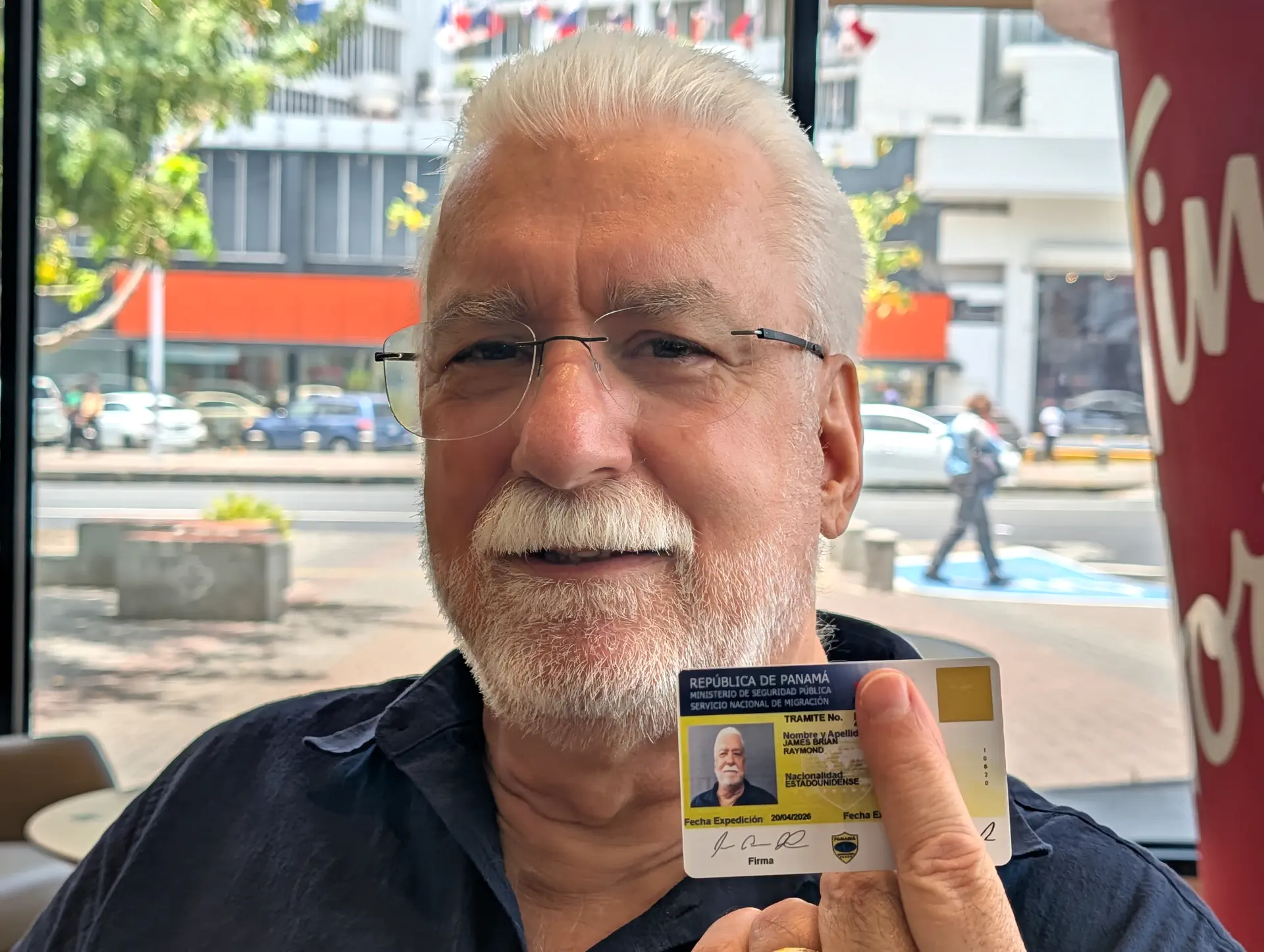
The card. Brian. Tim Hortons. The only logical place to celebrate anything on this trip.
Pensionado visa — the timeline
Monday: attorney meeting, documents submitted. Tuesday: passport registered with the Immigration Authority. Wednesday–Thursday: coordination and filing of the residency permit petition. Friday/Monday: photo appointment, temporary residency card issued. Approximately five months from here to the permanent residency card.
Outside, into the crowd, and something honest
I walked out into the crowd. Kent is taller than most people in a Panama City immigration office, which made finding him straightforward. We got an Uber back to the hotel. I changed out of the long pants immediately — a ritual that has taken on the quality of a small celebration at this point.
And then something shifted slightly, in a way I want to name directly because I think it will resonate with other couples going through this process.
I’m a resident of Panama. Kent isn’t. We’ve been together for nearly forty years and everything is done together. This process is separate. That’s unsettling in a way that isn’t fully resolved by logic.
Because Panama does not legally recognize same-sex partnerships, each partner in a couple must qualify for and apply for residency independently. Two complete applications, two sets of documents, two sets of fees, two separate processes. There is a real and practical upside — each partner ends up with fully independent legal standing in Panama, which matters for long-term planning. But in the moment of walking out of an immigration office holding a card that says your name, while your partner of forty years is standing in the crowd waiting because his application comes later — it lands with a weight that the practical logic doesn’t fully address.
Kent’s process will follow. We know this. It doesn’t change the feeling entirely.
For same-sex couples — what to know about this process
Each partner applies separately and independently, and each must meet the qualifying requirements on his own. The good news: the process is the same for both, and independent legal standing is actually a meaningful benefit for long-term Panama life. The less comfortable reality: you will go through milestone moments separately that you’ve navigated together for your entire relationship. Budget emotionally for that, not just financially.
Celebration, properly — Tim Hortons and then some
Even though we’d had coffees already that morning, we went back to Tim Hortons. At this point the staff knew us. We walked in and the order was being rung up before they’d finished saying hello. Sometimes the drinks were poured before the receipt printed. After eleven days in Panama City — at the same counter, at roughly the same time every morning — we were regulars. In a city we don’t live in yet, in a country where one of us now has a residency card and the other doesn’t, we were known somewhere. That felt like something.
The card — what it means in practice
Dinner — Concolon, and the lesson about expectations
For dinner we tried Concolon, a Panamanian restaurant tucked behind a large Hilton. Traditional food, proper Panamanian cooking, the kind of place we’d been meaning to get to all week.
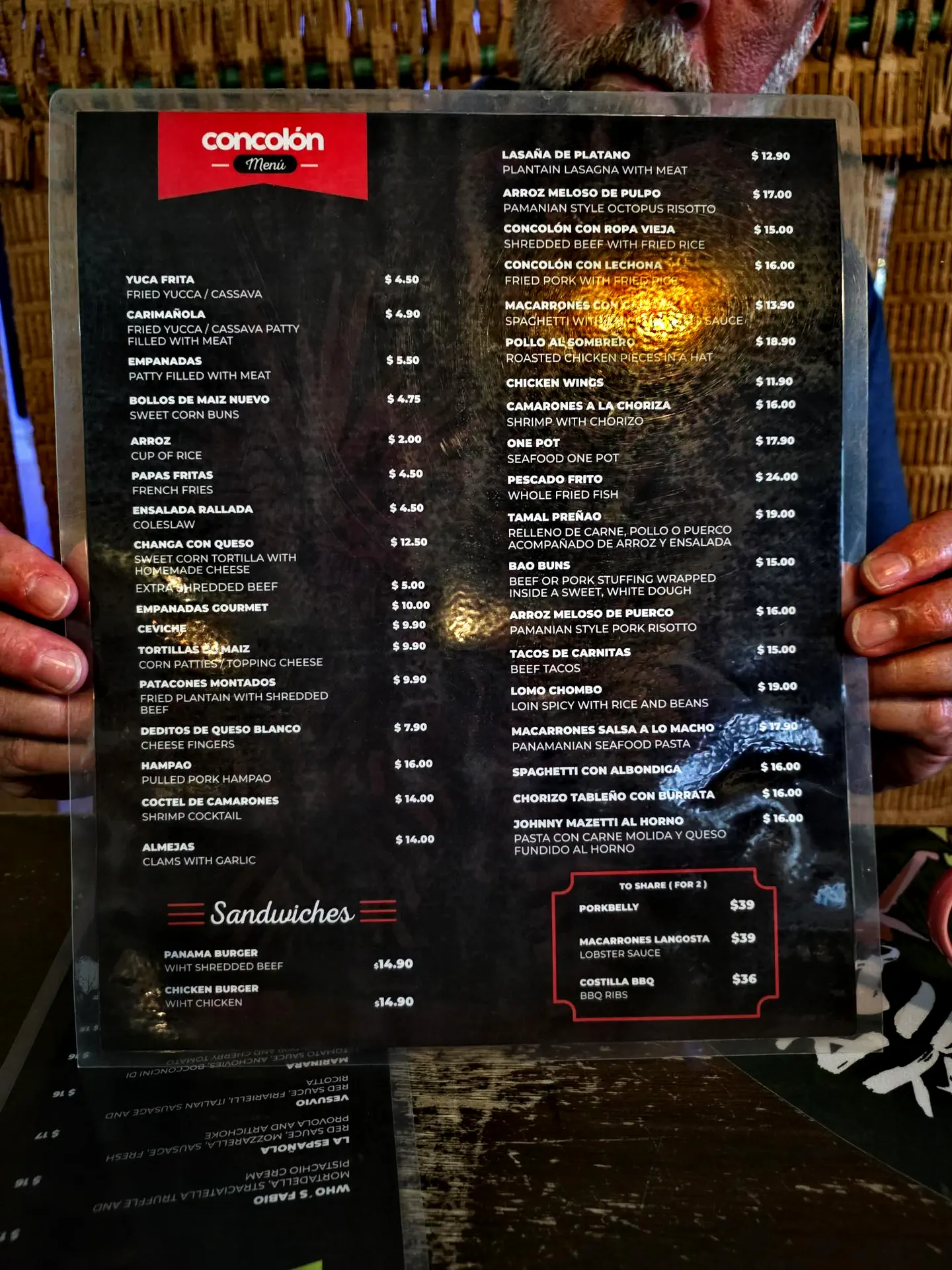
The Concolon menu. Apologies for the glare — the food, however, was worth the photo difficulties.
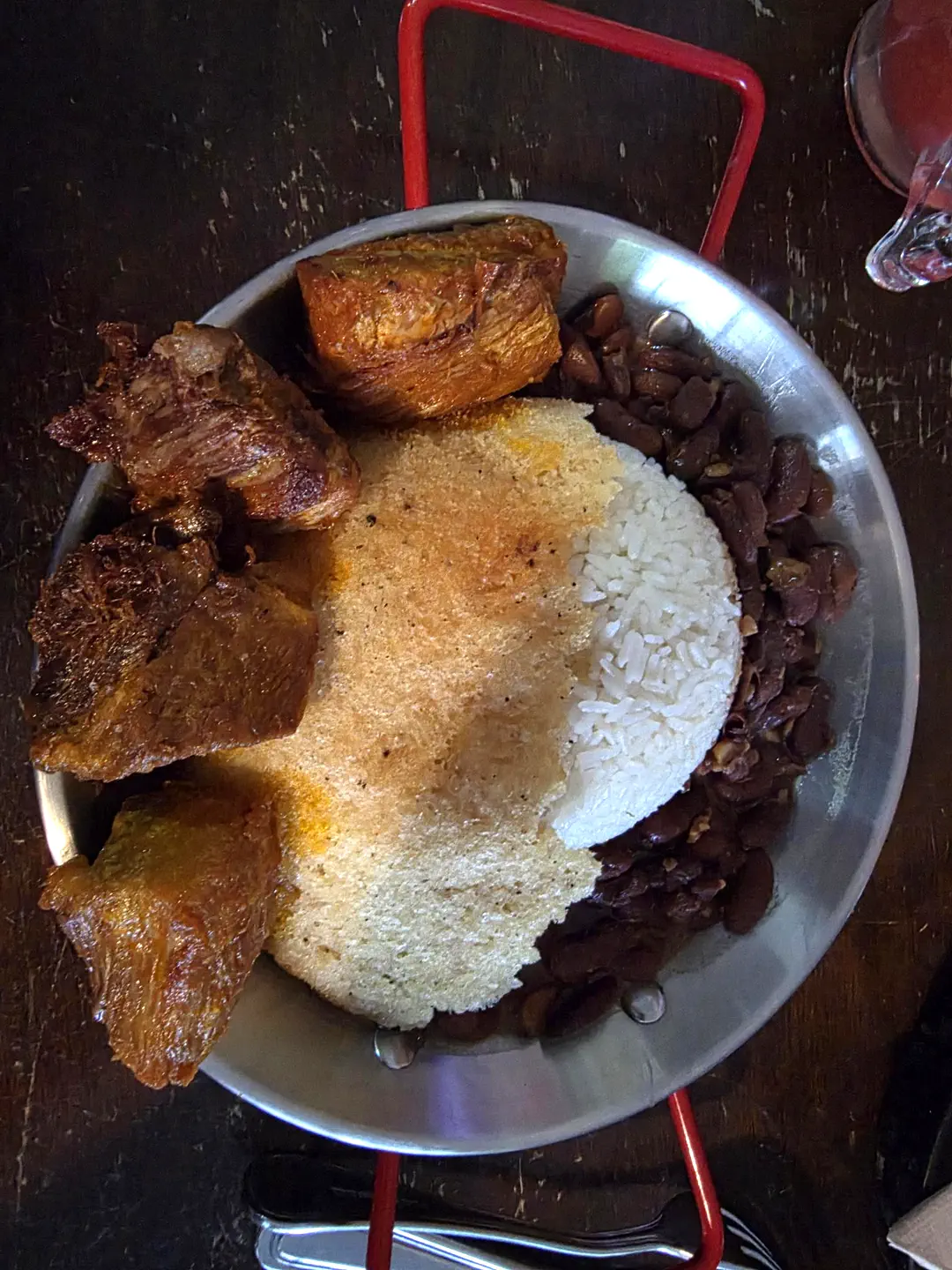
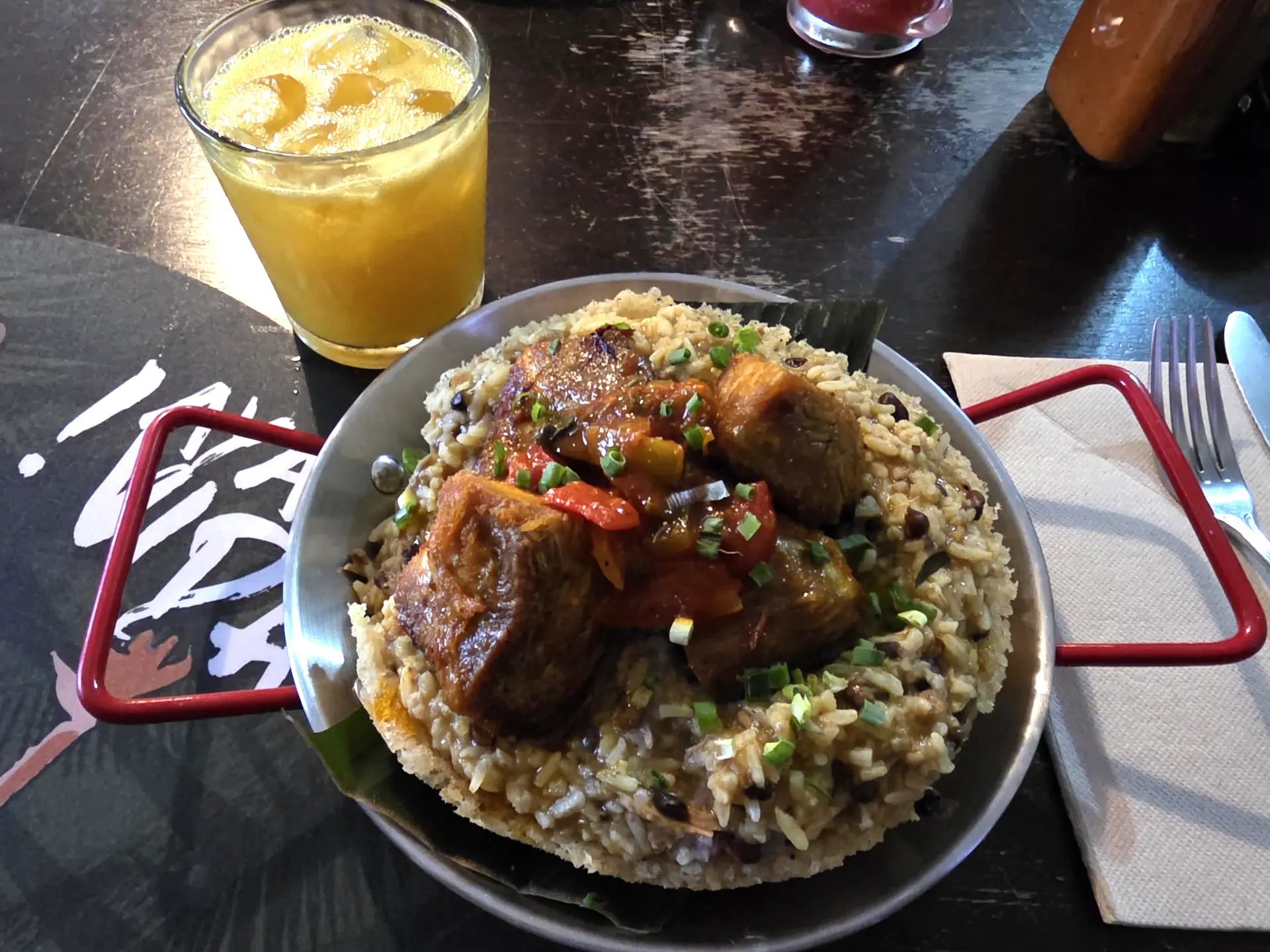
Left: Brian’s Concolon Con Lechona — fried pork with fried rice. Right: Kent’s Arroz Meloso De Puerco — Panamanian style pork with rice. One of these was significantly better than the other. We both agreed on which one.
Kent had the Arroz Meloso De Puerco — Panamanian style pork with rice, described on the menu as a risotto, which it isn’t exactly, but the flavor was genuinely excellent. I had the Concolon Con Lechona — fried pork with fried rice, which sounded straightforward and was indeed straightforward. The pork had good flavor. The rice was bland. I had been expecting something closer to Chinese-style fried rice, which was my error entirely. I was sitting in a Panamanian restaurant ordering Panamanian food and expecting a Chinese preparation. Panama is not obligated to meet that expectation, and it did not. Lesson absorbed. Kent’s dish was better and I would order it next time.
Concolon
Panamanian cuisine · Behind the Hilton · Panama City
Traditional Panamanian cooking in a proper sit-down setting. The Arroz Meloso De Puerco is the recommendation based on one visit — rich, savory, the kind of dish that tastes like it was made by someone who has been cooking it for a long time. Pricing at the higher end of local restaurants ($16 per main, $59.12 total for two mains and two cocktails) but the quality is there.
Concolon — what we paid
Mangle — the right way to end this particular day
After dinner we walked to Mangle, which has become our default happy hour stop and which we found through a recommendation from someone we’d chatted with on Scruff. A good crowd at 6pm without being packed. Music at exactly the right volume — present but not intrusive, which is harder to get right than most bars seem to realize. Staff who are professional and attentive without being overbearing. After eleven days of heat and walking and paperwork and musical chairs at a government immigration office, sitting at a good bar in Panama City with a cocktail in hand and nowhere to be felt exactly correct.
Afterwards, back to the hotel. Kent started packing. We’d accomplished what we came for. Tomorrow was our last full day.
Sources & Verification
- Firsthand: Brian’s temporary residency card issuance at the National Immigration Service, Vía Ricardo J. Alfaro, April 2026 — the process, wait times, and card pickup described here as we experienced them, plus all prices paid (Concolon, metro, Pensionado discount rates observed at Canal Museum and Miraflores).
- Attorney-confirmed: The Pensionado filing timeline and the approximately five-month path from temporary to permanent residency card — Carolina Tejada Vaprio, Morgan & Morgan, during Brian’s April 2026 application.
- Not yet verified: The permanent card timeline is an estimate until Brian’s card is actually issued — we’ll update this article with the real elapsed time when it arrives.
Facts and prices in this article last verified: July 2026.
Brian & Kent
We’re documenting the real process of researching and moving to Panama — including Brian’s Pensionado visa, in real time. Brian’s residency runs on Social Security; Kent, our primary researcher, applies for the Qualified Investor Visa after our Florida home sells. Questions? he***@*************ma.com