Buying & Remodeling a Home in Panama — Part 10 of 10
The Attorney Question: When You Need One, When AI Helps, and What It Actually Costs
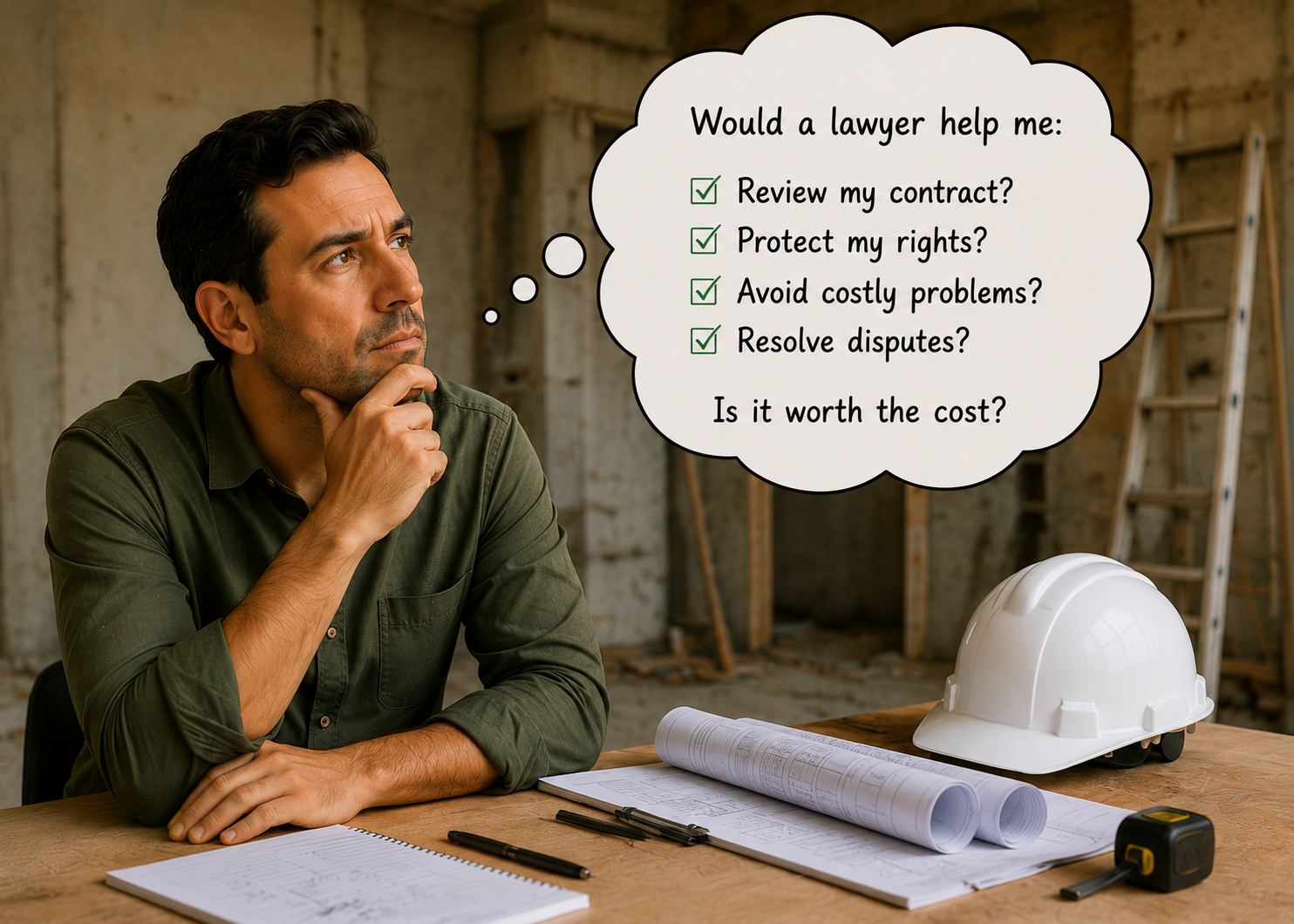
Nobody wants to talk about attorneys. They cost money, they slow things down, and they make the whole enterprise feel more complicated than it needs to be. Here’s why that instinct will cost you more than the attorney would have.
 Brian & Kent · GayExpatsPanama.com · April 2026 Research Trip
Let’s get the obvious objections out of the way. Attorneys are expensive. They slow things down. Contractors might balk at working with clients who “lawyer up.” You don’t want to be the paranoid foreigner who treats every handshake like a deposition. And honestly, for a simple paint job or a tile replacement, involving an attorney would be absurd. All of that is true, and none of it changes the following: for any significant renovation project in Panama, going in without legal guidance is one of the most expensive decisions you can make. Not might make — will make, eventually, if you do enough projects here.
Brian is a former attorney. He knows Panamanian law the way most Americans know Napoleonic Code — in theory, he understands what a contract is supposed to do; in practice, he has no standing in a Panamanian courtroom and cannot tell you whether a specific clause is enforceable under Panamanian civil law or whether it’s the kind of loose language that Panamanian courts routinely interpret against the party that drafted it. That’s not false modesty. That’s the honest assessment. Even lawyers need lawyers in jurisdictions they don’t practice in. When we renovate in Panama — and this will be our last home purchase, so we plan to get it right — we will use an attorney. Full stop.
Buying & Remodeling a Home in Panama Series
Ten articles covering construction methods, materials, contractors, and the practical realities of remodeling a home in Panama.
- The House Is Made of What? Panama Construction 101 for Americans
- Wires, Pipes & the Jackhammer Problem
- Repello, Zinc & Plycem: The Panama Materials Vocabulary You Need
- Remodeling for Energy Efficiency in Panama: What the Rules Actually Require
- What You Must Know Before You Buy to Remodel
- Who's Licensed to Swing a Hammer in Panama?
- Finding Reliable Labor in Panama: What Actually Works, What Doesn't, and What Nobody Tells You in Advance
- Paying Contractors in Panama: Cash Culture, Receipts & the Protections You Do (and Don't) Have
- Panama Construction Spanish: The Vocabulary Guide for Expat Homeowners
- The Attorney Question: When You Need One, When AI Helps, and What It Actually Costs You are here
The Language Problem Is Not What You Think It Is
Most expats frame the attorney question around translation: “I don’t speak Spanish well enough to read a contract, so I need someone to translate it.” That’s real, but it’s the smaller half of the problem. You could be fluent in Spanish and still be completely lost reading a Panamanian construction contract, because legal Spanish — particularly as it applies to Panamanian civil law, which derives from a civil-law tradition rather than common law — uses terms and constructs that mean specific things in Panamanian courts, not things you’d infer from their plain-language meaning.
Here’s a concrete example. A contract might say the contractor has thirty days to correct deficiencies after entrega provisional (provisional handover). That sounds reasonable. What you need to know is how Panamanian courts interpret entrega provisional — whether the clock starts when work stops, when you sign something, or when the contractor declares completion — and what happens if neither party formally triggers the provisional handover clause. An attorney knows. You don’t, and a translator won’t tell you either.
The Spanish Contract Controls — Always
Panama’s official language is Spanish, and under Panamanian law, contracts must be in Spanish to be fully legally enforceable. If a contractor provides you with a bilingual contract — Spanish on the left, English on the right — read this carefully: in any dispute, the Spanish version is what Panamanian courts will interpret. The English version is a courtesy, not a legal document. This means that even if the English column says something different from the Spanish, you are bound by the Spanish. An attorney who can confirm that the Spanish says what you think it says is not a luxury. It is the point.
There is no legal requirement for a contractor to provide an English version of a construction contract in Panama. Some will, as a courtesy to expat clients. Many won’t. The obligation is yours to understand what you’re signing.
What Happens When You Don’t Have One
The most common horror story in Panama expat renovation forums is some version of this: a contractor received a large deposit, began work, and then slowed to a stop. The homeowner couldn’t reach anyone. The contractor eventually resurfaced, claimed unexpected material costs, and asked for more money before continuing. The homeowner had no written contract, or a contract they hadn’t fully understood, with no milestone-based payment triggers and no termination clause. They had no leverage and no clear legal path forward.
Recovery in that situation means civil litigation in Panama — historically slow, with a major 2023 procedural reform underway that’s intended to speed things up (see the contractor licensing article earlier in this series) — and the cost of pursuing a contractor through court can exceed the amount in dispute. This is not speculation. It is the consistent account of expats who’ve gone through it, from Boquete to Bella Vista.
“The cost of pursuing a contractor through Panamanian court often exceeds the amount in dispute. That’s not a reason to give up — it’s a reason to never need the court in the first place.”
An attorney, hired before the project begins, drafts or reviews the contract in a way that builds your leverage into the document — milestone-based payments, a termination clause, a retention provision, defined change order procedures. The contractor who walks away early doesn’t just break a promise; he breaches an enforceable contract with a mechanism for recovery. That’s a fundamentally different situation, and the attorney who created it probably charged you a few hundred dollars.
What Kent Found During Our Site Visits
Kent’s Notes — What the Houses Were Actually Telling Us
During our April 2026 research trip, I visited several properties in Panama City and talked with two independent construction workers about what we were seeing. Almost every home we toured had a renovation list — not because the properties were bad, but because that’s the reality of buying older housing stock in a tropical climate.
Electrical service was the first thing I started looking at carefully. Several homes had panels that appeared outdated or inadequately sized for how the spaces were being used. Getting an electrician to evaluate before you make an offer — not after — is the right call. In Panama, electrical standards differ from the U.S. even though the voltage is the same, and what looks fine may not be up to what an insurer or a future buyer will expect.
Mini-splits were everywhere, which is correct for Panama’s climate. The problem: almost nobody could tell me the SEER rating or the age of the units. Some compressors looked like they’d been running for well over a decade. A mini-split that old and running continuously in Panama’s heat is approaching end of life. Replacing units adds up fast across a whole property, and SEER ratings matter for operating costs — an aging low-SEER unit running long hours daily costs meaningfully more than a modern high-SEER unit over time.
Jalousie windows — the louvered glass-slat style — are common in older Panama construction. They’re not airtight, they’re not particularly secure, and they’re incompatible with keeping air-conditioned air inside. Replacing them with modern aluminum-framed sliding or casement windows is a legitimate renovation line item that’s easy to underestimate. When you look at a home and see six jalousie windows, you’re looking at a project.
Bathrooms in many of the properties needed upgrading — not cosmetic work but actual fixture replacement, re-tiling, and in some cases replumbing. All of this adds up. We want to know exactly what we’re buying before we sign anything. That means professional inspections, and it means an attorney reviewing every document before money moves.
When Do You Actually Need an Attorney?
The honest answer is: it depends on how much money is at stake, how complex the work is, and how confident you are in your ability to understand what you’re signing. Here’s a practical framework.
| Project type | Attorney involvement | Why |
|---|---|---|
| Touch-up paint, minor repairs, single fixture replacement — under $500 | Not needed | Low stakes, short timeline, no complex contract. Use AI to review any written agreement. |
| Tile replacement, single bathroom update, electrical panel upgrade — $500–$5,000 | AI review of contract; consider attorney if any red flags | Enough money to hurt if things go wrong. AI can translate, identify key clauses, and flag unusual terms. Attorney needed if the contractor’s contract is non-standard or you can’t verify their credentials. |
| Kitchen renovation, full bathroom gut, multi-room tile or flooring — $5,000–$20,000 | Attorney review strongly recommended | Stakes justify the cost. Attorney ensures milestone payments, termination clause, materials specs, and warranty terms are enforceable. One good contract review pays for itself the first time it prevents a dispute. |
| Whole-unit or whole-house renovation, addition, structural changes — $20,000+ | Attorney essential — for both review and drafting | This is the level where expats lose significant sums. Attorney should draft or substantially revise the contract, not just review it. If permits are involved, attorney should confirm the permit chain is clean. |
| Purchase of a property requiring renovation — any amount | Attorney required — this is non-negotiable | Title search, encumbrances, HOA restrictions, permit history, existing liens — none of these are visible to you and all of them affect what you can do with the property. Use the same attorney for the purchase and the renovation scope review. |
What Will a Panamanian Attorney Actually Cost?
This is the question everyone wants answered before they’ll consider it. These figures are our own estimate based on general Panama legal-market impressions for expat-focused bilingual attorneys — we have not obtained a formal quote schedule from a specific firm for construction contract review specifically, so treat this as a planning range rather than a confirmed price list.
Panama Attorney Fees — Construction & Renovation Context (Estimated Range)
The practical takeaway, even accounting for the uncertainty in these numbers: a flat-fee contract review for a midsize renovation is likely to land somewhere in the low hundreds of dollars — a small fraction of most renovation budgets. The question is less whether you can afford an attorney, and more whether you can afford what happens if you skip one and things go sideways. Get an actual quote from a specific firm before budgeting against these figures.
Ask for a flat fee whenever possible. For discrete tasks like reviewing a specific contract or drafting a payment schedule addendum, flat fees are common at Panamanian firms that work with expats. Hourly billing makes sense for ongoing representation or uncertain-scope work. At most firms, you can negotiate which applies to your situation before committing to anything.
One Attorney, Multiple Uses
If you’re already working with a Panamanian attorney on your visa — which you are, because the Pensionado visa requires one — ask whether they handle construction contract review. Many do, or can refer you to someone in their firm who does. Using the same attorney for your visa and your first renovation means they already know your situation, your property, and your intentions. That context saves time and usually saves money. We’re doing exactly this — Carolina Tejada Vaprio at Morgan & Morgan has already been briefed on our renovation timeline as part of our overall relocation planning.
Will Contractors Refuse to Work With You If You Have an Attorney?
This concern comes up constantly in expat forums, and it deserves a direct answer: no. A contractor who refuses to work with a client who has legal representation is telling you something important about how he intends to operate the project. That response is not a warning about your behavior — it’s a warning about his.
Professional, experienced contractors in Panama work with written contracts and client attorneys regularly, particularly on larger projects and in expat-heavy markets like Bella Vista, El Cangrejo, and Casco Viejo. The contractor who gets nervous when you mention your attorney is almost always the same contractor who gets evasive when you ask for milestone payments and receipts. These are not coincidences. The good contractors — the ones with verifiable track records and satisfied clients — welcome a well-drafted contract. It protects them too.
Where AI Actually Helps — and Where It Doesn’t
This is the genuinely new part of the answer, and we want to be specific about it rather than vague.
For small-to-midsize projects where a full attorney review isn’t warranted, AI tools — Claude, ChatGPT, and similar — are now legitimately useful for contract analysis. Here’s what they can actually do well: translate a Spanish contract into clear English, identify the key clauses and what each party is obligated to do under them, flag unusual or potentially problematic language (missing warranties, ambiguous change order provisions, no termination clause), summarize the payment schedule and timeline, and explain what specific legal terms mean in plain language.
Upload a Spanish contractor’s agreement to an AI assistant, ask it to translate the document, summarize all obligations by party, identify any clauses that are unusual or that favor one party, note any missing provisions that are standard in construction contracts, and flag anything you should clarify before signing. You’ll get a clear, organized analysis in minutes. It won’t be legal advice — AI cannot represent you in a dispute, cannot appear in a Panamanian court, and cannot give you advice tailored to your specific legal situation with the authority of a licensed professional. But for a small tile job where you’ve already verified the contractor’s references and cédula, that level of analysis may be exactly what you need and nothing more.
What AI Cannot Do
AI cannot tell you whether a specific clause is enforceable in a Panamanian court. It cannot advise you on how a Panamanian judge would likely interpret ambiguous language. It cannot represent you if the contractor walks off the job and you need to recover your deposit. It cannot file a civil claim or negotiate a settlement on your behalf. And it cannot know about facts specific to your property — existing liens, permit history, HOA restrictions — that an attorney with access to the Public Registry can look up in an afternoon. AI is a first line of analysis and a useful tool for the smaller projects where the cost of an attorney would be disproportionate. For major projects, it’s a supplement to legal counsel, not a replacement.
How to Use AI for Contract Review — A Practical Prompt
When you upload a contractor’s contract to an AI assistant, be specific about what you want. A prompt like this gets you a useful result: “This is a residential construction contract in Spanish. Please: (1) translate the full document into clear English, (2) summarize each party’s obligations and the payment schedule, (3) identify any clauses that seem unusual, one-sided, or that could create problems for the homeowner, (4) note any standard construction contract provisions that appear to be missing, and (5) flag any terms I should ask an attorney to explain before signing.”
The output won’t be a legal opinion. But it will be a structured, readable analysis that puts you in a much stronger position for the conversation with either your contractor or your attorney. You’ll know what questions to ask. In Panama, knowing the right questions is most of the battle.
Our Personal Calculus — Why We’re Using an Attorney
We are hoping that this next home is our last purchase. That changes the math significantly. When you’re buying a property to hold for twenty years, to live in fully, to renovate to your own standards — getting it right from the beginning isn’t caution. It’s basic logic.
During Kent’s property visits in April, we compiled a renovation list that grew with every showing. Outdated electrical panels. Mini-splits of unknown age and efficiency. Jalousie windows that need replacing throughout. Bathrooms that need more than cosmetic work. Every one of these is a budget item, and when you add them together across even a moderately priced Panama City property, you’re looking at a renovation budget that makes the cost of proper legal review effectively invisible as a line item — though we want to stress we haven’t priced a specific project yet, so we’re not publishing a total dollar figure until we have real contractor quotes.
We also know — because we’ve renovated in two other countries and read everything we could find about renovating in Panama — that the failure points are predictable. Large deposits. Vague contracts. No change order discipline. No termination clause. These are the mechanisms by which expats lose money here, and they are all solvable at the contracting stage, by an attorney whose fee is small relative to what it protects.
Brian spent decades as an attorney. He knows better than most people how much trouble you can avoid with a well-drafted contract — and how little protection you have without one. The fact that he’s a former attorney makes him more likely to use one here in Panama, not less. Because the thing all lawyers actually know is this: being right isn’t the same as being protected. A good contract is what turns right into protected.
The Series in a Single Paragraph
This series has covered a lot of ground: what to inspect before you buy, how tiles and finishes work here, how to find and vet contractors, what the permit process looks like, what things actually cost, how paying contractors works in a cash economy, how to find reliable labor, and how to speak the language of a job site. The attorney question sits underneath all of it. Everything else in this series helps you manage a renovation. A good attorney and a well-drafted contract help you survive one that goes wrong. In a country where the legal safety net for expat homeowners is thinner than you’re used to, that distinction matters enormously.
Finding the Right Attorney
Not every Panamanian attorney is equally useful for this purpose. You want someone who is bilingual (English and Spanish, fluently), has experience with construction contracts specifically (not just real estate or immigration), and has worked with expat clients. Ask your visa attorney for a referral. Ask in expat Facebook groups — specifically, ask who has reviewed a construction contract and had a good experience, not just who people have heard good things about.
Established bilingual expat-focused firms in Panama City include Morgan & Morgan (where our attorney Carolina Tejada Vaprio practices), Kraemer & Kraemer, Pardini & Asociados, and several smaller boutique practices. Initial consultations at most of these firms are free or low-cost. Use the consultation to explain your project and ask specifically: have you reviewed residential construction contracts for expat homeowners? How would you structure the fee for a contract review? Can you recommend a flat-fee arrangement?
The Question That Screens Attorneys
When you speak with a prospective attorney, ask this: “If a contractor receives a 30% deposit and stops work after two weeks, what are my practical options for recovery in Panama?” A good attorney will give you a specific, realistic answer — describing the civil litigation timeline, the likelihood of recovery based on what documentation you have, and the cost-benefit of pursuing it. A less useful attorney will give you a vague reassurance about your legal rights. The former is who you want. The latter will cost you just as much and help you much less.
The Bottom Line
Nobody wants an attorney in the room. That’s understandable. Attorneys slow things down, they cost money, they make everything feel more formal than a renovation with a friendly maestro needs to be. All of that is real. And then things go wrong — they sometimes do, in Panama, as everywhere — and the person who skipped the contract review is the one spending years chasing a contractor through civil court.
Use AI for the small projects. Use it to translate contracts, understand obligations, and flag the clauses worth asking about. It’s genuinely useful and dramatically better than going in blind. But for any project of meaningful size — and certainly for anything involving structural changes, permits, or a property purchase — have a licensed Panamanian attorney with construction experience review what you’re signing. The cost is modest relative to the project. The protection is real. And unlike the contractor who disappears with your deposit, the attorney can be held accountable if things go wrong.
That’s everything we’ve got for now on the attorney question. Across this series, we’ve tried to give you the real version of Panama renovation — not the brochure version, not the disaster version, but the honest, specific, occasionally uncomfortable account of what it actually takes to do this right. We’re still in the middle of it ourselves. When we get into the project — and if we learn things worth adding to this series — we’ll write about that too.
Sources & Verification
- Firsthand: Brian’s background as a former U.S. attorney (informing what he can and can’t assess about Panamanian contracts), and Kent’s April 2026 property-viewing notes on electrical, mini-split, jalousie window, and bathroom conditions.
- Attorney-confirmed: Carolina Tejada Vaprio at Morgan & Morgan is our attorney of record and has been briefed on our renovation timeline as part of overall relocation planning.
- Official: Spanish-language contracts govern over English translations in Panamanian courts, and civil litigation has historically been slow, with a 2023 procedural reform (Law 402, covered in the contractor licensing article earlier in this series) intended to improve timelines.
- Not yet verified: All specific attorney fee ranges, mini-split replacement costs, and renovation-budget estimates in this article are our own planning estimates, not confirmed quotes from a specific firm or contractor. Treat them as a starting point for your own research, not a price list.
Facts and prices in this article last verified: July 2026.
Brian & Kent
We’re a gay couple based in St. Petersburg, Florida, researching and relocating to Panama in real time. Brian is applying for a Pensionado visa. Kent does most of the research. Everything on this site is from direct experience — the prices are current, the attorney meetings are recent, and the mistakes are ours. Brian is a former attorney. He is using one anyway.