Panama Electricity Guide
Jalousie Windows and Single-Pane Glass: The Hidden Electricity Cost in Many Panama Homes
Your AC is working against a window that was designed before air conditioning existed. That gap has a dollar amount.
 Brian & Kent · GayExpatsPanama.com · April 2026 Research Trip
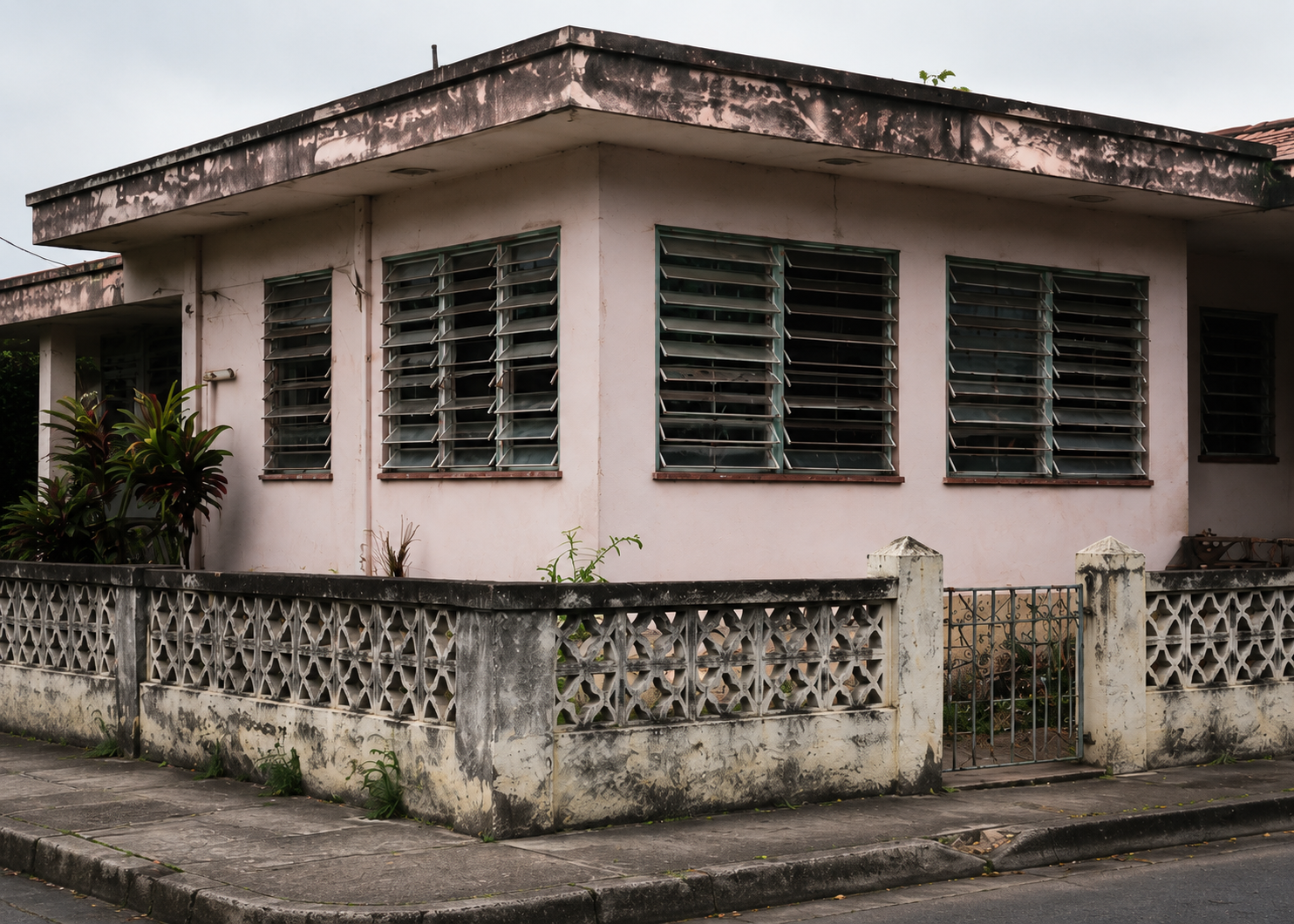
Walk through almost any older building in Panama City and you will find them: those horizontal glass slats cranked open in a bank, angled out to catch the breeze. Jalousie windows — also called louvered windows — were the sensible solution for tropical living before air conditioning arrived. They ventilate beautifully. They are a thermal disaster the moment you close your doors and turn on the AC. And they are far more common in Panama’s housing stock than most buyers and renters realize before they sign.
Panama Electricity Guide
Everything we've learned about electricity in Panama — rates, reliability, wiring hazards, mini splits, solar, and what to check before you buy.
- Panama Electricity Guide for Expats: Rates, Reliability & the Billing Trap That Triples Your Bill
- Voltage, Plugs & Appliances: The One Big Advantage American Expats Have
- Wiring, Inspections & Electrical Hazards in Older Panama Homes
- Mini Splits, Solar, Windows, and the Home Buyer's Electricity Checklist
- Jalousie Windows and the Hidden Electricity Cost You are here
- SEER Ratings: What to Buy — and What to Avoid
- Gas Appliances & the $4.37 Cylinder Most Expats Miss
- Solar Panels: What the Math Actually Says
- Panama's Clean Energy Grid: What Expats Need to Know
- Power Outages, UPS Systems & Backup Power
Single-pane glass is the less obvious version of the same problem. It does not announce itself the way jalousies do. It looks like a normal window. It just transfers heat at roughly ten times the rate of a modern double-pane unit with a low-emissivity coating. In Panama’s climate — where the delta between outside heat and inside comfort is 15 to 20 degrees Fahrenheit every hour of every day — that thermal performance gap runs your air conditioning constantly and adds meaningfully to your electric bill every month.
This is not a cosmetic issue. It is a mechanical one. And in Panama, where you pay for electricity at rates that rival or exceed the U.S., windows are one of the most financially consequential features of any property.
What Jalousie Windows Actually Do — and Why That’s a Problem
Jalousie windows were invented in the early 20th century and became wildly popular in the Caribbean, Central America, Florida, and Hawaii through the 1940s and 1950s. The design is brilliant for its original purpose: horizontal glass slats, typically 3–4 inches wide, controlled by a hand crank that rotates them from closed to fully horizontal. When open, they catch cross-breezes at low angles and allow ventilation even in light rain. They were designed for a life without air conditioning.
The problems begin the moment you close them and turn on the AC.
Air Leakage: The Core Issue
Jalousie windows cannot seal. The slats overlap but do not lock together in any meaningful sense — there are gaps along every edge of every slat, and those gaps are open to the outside. Even a well-maintained, freshly adjusted jalousie window leaks air at rates far exceeding any other residential window type. A standard modern window is rated for air leakage below 0.30 cubic feet per minute per square foot (cfm/ft²). A jalousie window in good condition typically leaks at 1.0–1.5 cfm/ft². A worn or poorly adjusted one can reach 2.0 cfm/ft² or more. That is five to seven times more air infiltration than any replacement window you would buy today.
In practical terms: every cubic foot of hot, humid outside air that infiltrates your home must be cooled and dehumidified by your air conditioner before your room reaches setpoint. Your AC is not fighting the ambient temperature in your apartment. It is fighting a continuous inflow of 88°F, 80%-humidity outdoor air coming through the gaps in your windows — every minute the system runs.
No Thermal Barrier
The glass in a jalousie window is single-pane — there is no double-pane insulated unit that could create any meaningful thermal separation between inside and outside. The glass conducts heat directly. On a sun-exposed elevation in Panama City, the glass surface temperature of a jalousie window in afternoon sun can reach 120°F (49°C). That glass radiates heat into your room the same way a baseboard heater does, and your air conditioner works against it continuously.
Security
This is less relevant to the electricity conversation but worth noting: the glass slats in a jalousie window can be lifted out of their retaining clips from outside without breaking glass or forcing a lock. It takes about thirty seconds. They are not secure windows, which matters in any urban context.
The Dollar Estimate
The U.S. Department of Energy estimates that windows account for 25–30% of residential heating and cooling energy use. In Panama, where you cool 24 hours a day, 365 days a year, that share skews higher. A home with jalousie windows on sun-facing elevations running an undersized or constantly-cycling air conditioner is plausibly paying 30–40% more on electricity than the same home with sealed, double-pane, low-E windows. On a $150/month electric bill, that is $45–$60 per month — $540–$720 per year — going out through the window gaps. Literally.
Single-Pane Glass: The Quiet Version of the Same Problem
Many Panama apartments and houses were built with conventional-looking aluminum-frame windows that are single-pane clear glass. They look normal. The frames open and close like modern windows. They seal better than jalousies — there are no slat gaps. But the glass itself is doing almost no insulating work.
A single pane of clear glass has a U-factor (the standard measure of heat transfer, explained fully below) of approximately 1.0–1.2. A double-pane window with a basic low-E coating runs 0.25–0.35. That means the single-pane window transfers three to five times more heat per square foot per hour than its replacement. In Panama, where the temperature differential between your 74°F interior and 88°F exterior runs continuously, that ratio is costing you money every hour, every day.
Single-pane glass also transmits solar heat with almost no resistance. A standard uncoated single pane has a Solar Heat Gain Coefficient (SHGC) of around 0.85 — meaning 85% of the solar radiation striking it enters your home as heat. A modern low-E double-pane unit targeted for hot climates has an SHGC of 0.20–0.25. The difference is the equivalent of pointing a space heater at your room versus having a well-shaded window. Your AC compensates. You pay for it.
Understanding Window Thermal Ratings
Before you talk to anyone about replacing windows, you need to understand the four numbers that actually matter. These are standardized ratings from the National Fenestration Rating Council (NFRC), and any reputable window product will have them on its label.
U-Factor: The Insulation Rating
U-factor measures the rate of heat transfer through the entire window — glass, frame, and all — in BTUs per hour per square foot per degree Fahrenheit of temperature difference. Lower is better. Think of it as the inverse of R-value: a U-factor of 0.25 equals an R-value of 4. A U-factor of 1.0 equals R-1. The range you will encounter in practice:
| Window Type | Typical U-Factor | Heat Transfer Rate |
|---|---|---|
| Jalousie window (closed) | 1.0–1.3 | Essentially no insulation — plus massive air leakage |
| Single-pane clear glass | 0.90–1.10 | Minimal insulation; conducts heat freely |
| Single-pane with tint or film | 0.75–0.90 | Slight improvement in solar gain; minimal insulation |
| Double-pane clear glass | 0.45–0.55 | Meaningful step up; still no low-E benefit |
| Double-pane with low-E coating | 0.25–0.35 | Good performance; target for Panama replacement |
| Double-pane low-E with argon gas fill | 0.22–0.30 | Excellent; best value for tropical climate |
| Triple-pane with low-E and argon | 0.15–0.22 | Best available; cost rarely justified in Panama |
For Panama, target a U-factor of 0.30 or below. The additional cost of going from 0.35 to 0.25 is modest on a per-window basis, and in a year-round cooling climate the performance difference compounds every month.
SHGC: Solar Heat Gain Coefficient
SHGC measures what fraction of solar radiation striking the window enters your home as heat. It runs from 0 (blocks everything) to 1 (blocks nothing). In Panama — where you are cooling continuously, where there is no winter sun to welcome, and where east- and west-facing elevations receive intense direct sun for hours every day — SHGC is arguably more important than U-factor for your electricity bill.
| Window Type | Typical SHGC | Solar Heat Admitted |
|---|---|---|
| Single-pane clear glass | 0.82–0.86 | 83–86% of solar radiation enters as heat |
| Single-pane tinted glass | 0.55–0.70 | Better, but still high for all-day AC climate |
| Double-pane clear glass | 0.70–0.76 | Two panes, same solar problem |
| Double-pane, hard-coat low-E | 0.35–0.45 | Significant improvement; still not ideal for tropics |
| Double-pane, soft-coat low-E (solar control) | 0.20–0.27 | Target for Panama — blocks 75–80% of solar heat |
| Spectrally selective low-E | 0.17–0.22 | Best available; admits daylight, rejects infrared |
For Panama, target SHGC 0.25 or below on any sun-facing elevation. On a north-facing window that receives no direct sun, you can be slightly less aggressive — 0.35 or below is reasonable. Do not buy double-pane clear glass and assume you have solved the solar problem. You have not. The second pane adds insulation (lower U-factor) but does almost nothing for SHGC without a low-E coating.
Air Leakage Rating
Measured in cubic feet per minute per square foot (cfm/ft²). Lower is better. The standard to require is 0.30 cfm/ft² or below — this is the threshold most energy codes use, and most quality modern windows beat it. Casement and awning windows (hinged to swing open) typically achieve 0.10 cfm/ft² or better because compression seals engage when the window closes. Sliding windows and single-hung windows tend toward the 0.20–0.30 range. Ask for this number on the NFRC spec sheet. Any window without a rated air leakage number should be viewed skeptically.
Visible Transmittance (VT)
VT measures how much visible daylight the window admits, from 0 to 1. Aggressive solar-control coatings that drive SHGC below 0.20 sometimes also reduce visible light, giving windows a tinted appearance and darker interiors. The trade-off is real: a window with SHGC 0.17 and VT 0.35 blocks a lot of heat but also produces a noticeably darker room. For most Panama City apartments, a VT of 0.40–0.55 paired with SHGC 0.22–0.27 is the practical sweet spot — excellent solar control without turning your apartment into a cave. Ask the supplier for both numbers.
Panama Window Target Ratings — What to Shop For
Window Types Available in Panama — What You’ll Actually Find
Aluminum Frame Windows: The Default in Panama
Aluminum is the dominant frame material across Panama and most of Central America and the Caribbean. The reasons are practical: aluminum does not rot, warp, swell, or corrode in tropical humidity the way wood does. It is structurally strong, allowing slim sightlines and large glass areas. It handles UV exposure for decades without degrading. And it is available locally from numerous suppliers and fabricators in Panama City.
The problem with aluminum is thermal conductivity. Metal conducts heat approximately 1,000 times faster than glass. An aluminum frame with no thermal break is essentially a heat pipe from outside to inside — or from your cooled interior to the hot exterior, which is the same problem from the opposite direction. In a cooling climate like Panama, a non-thermally-broken aluminum frame continuously conducts heat from the hot outdoor air into your interior, warming your space and adding load to your AC.
The solution is a thermally broken aluminum frame. A thermal break is a piece of low-conductivity material — typically reinforced polyurethane or rigid vinyl — inserted between the interior and exterior aluminum sections of the frame, physically separating the two metal portions. It is not visible from the outside. It does not change the window’s appearance. It dramatically improves the frame’s thermal performance and raises the whole-window U-factor meaningfully. In Panama, require thermally broken aluminum frames on any replacement window you purchase. It is not optional.
Casement Windows
Hinged on one vertical side and cranked open outward. The compression seal — when the window closes, the sash presses firmly against the frame on all four sides — gives casement windows the lowest air leakage of any operable window type, typically 0.10 cfm/ft² or better. They provide excellent ventilation when open (the sash acts as a scoop, catching crossbreezes), and when closed they seal tightly. For Panama, casement windows are the best combination of ventilation capacity and sealed thermal performance. The crank mechanism adds one more moving part, but modern hardware is durable and simple to replace.
Awning Windows
Hinged at the top and cranked open at the bottom, swinging outward. Like casements, they use compression seals and achieve very low air leakage. The geometric advantage: they can be left open in rain without admitting water, because the outward-swinging bottom creates an overhang. For Panama’s rainy season — where afternoon downpours can appear in minutes — an awning window provides natural ventilation even during light rain without getting the interior wet. Excellent for bathrooms, kitchens, and secondary spaces where ventilation matters most.
Sliding Windows
One or two sashes that slide horizontally in a track. Common in Panama because they are simple, require no hardware maintenance, and fit standard rough openings easily. The trade-off: sliding windows seal on a brush or foam gasket rather than a compression seal, so air leakage is higher — typically 0.20–0.30 cfm/ft². They also collect debris in the tracks and require cleaning to maintain their modest seal. Acceptable for spaces where thermal performance is less critical, but not the first choice for primary living areas in a home trying to optimize electric bills.
Single-Hung and Double-Hung Windows
Vertical sliding sashes. Common in North America but less prevalent in Panama. Single-hung has a fixed upper sash and a movable lower sash; double-hung allows both to move. Sealing depends on the weatherstripping quality — good modern double-hung windows achieve 0.20–0.25 cfm/ft², but the category ranges widely by quality. If you find these on a property, confirm whether the weatherstripping is intact and functional before assuming the windows perform as rated.
Fixed/Picture Windows
Non-operable glass panels, sealed on all four sides. No moving parts means no air leakage — they achieve essentially 0.0 cfm/ft² and seal perfectly. If you have a view you want to preserve or a large glass area that will never need to open, a fixed double-pane low-E unit is the most thermally efficient option available. The limitation is obvious: no ventilation. In Panama, where natural airflow matters on lower electric bill days, all-fixed windows are rarely the right answer for an entire home, but a fixed unit on a view-facing elevation paired with operable casements on side walls is a sensible design.
Impact-Resistant Windows
Panama is not a primary hurricane zone, but it is not immune to significant wind events, and impact-resistant windows offer security benefits that are meaningful in urban Panama City. Impact windows use laminated glass — two panes with a polymer interlayer — that, when struck, cracks but does not shatter or separate from the frame. The glass also provides useful UV filtration and sound reduction. Impact-rated units are available with low-E coatings and thermally broken frames, so the hurricane-resistance designation does not preclude good thermal performance. They cost significantly more — typically 30–50% above equivalent non-impact units — but for a ground-floor or easily accessible apartment or a home where security is a concern, the combined value may justify the premium.
Vinyl Frame Windows
Vinyl (PVC) frames have excellent thermal performance — vinyl is a poor conductor of heat, so there is no thermal bridge issue that requires a break — and are competitively priced. The concern in Panama is longevity. Standard vinyl degrades under intense UV exposure over time, yellowing and becoming brittle. Panama City receives intense equatorial UV year-round. High-grade, UV-stabilized vinyl is available and performs better, but it is less common in Panama’s market than in North America. If you encounter vinyl windows here, verify the grade and ask for UV stability documentation before committing. Wood is essentially off the table in Panama — it warps, rots, and requires constant maintenance in a climate this humid.
What Window Replacement Costs in Panama
We did not price window replacement during our April 2026 trip — it was not on the agenda, and we would not publish numbers we did not verify. What the market data and expat experience suggest for Panama City:
| Window Type | Estimated Installed Cost (Panama) | Notes |
|---|---|---|
| Aluminum frame, double-pane low-E, casement or sliding | $200–$450 per window | Most common replacement option; get thermally broken frame |
| Thermally broken aluminum, double-pane low-E + argon | $350–$650 per window | Recommended minimum for primary living spaces |
| Impact-resistant laminated, double-pane low-E | $600–$1,200 per window | Security + thermal; good for ground floor or accessible units |
| Custom or oversized units (balcony sliders, picture windows) | $800–$2,500+ | Highly variable; get multiple quotes |
A typical Panama City apartment with eight to twelve standard-size windows is looking at $3,000–$7,000 for a quality full replacement job with thermally broken aluminum double-pane low-E units — assuming standard sizes and no structural complications. A house with more windows and larger openings scales accordingly. Get a minimum of three quotes, confirm thermal break on the aluminum frame, and ask to see the NFRC data sheet for the glass unit.
Panama Does Not Always Label Windows the Way the U.S. Does
Not every window sold by Panama fabricators carries a formal NFRC rating label. Local manufacturers produce custom aluminum frame windows that may not have been independently tested. Ask specifically for the glass unit specification — the glazing company that supplies the insulated glass unit (IGU) to the fabricator can usually provide U-factor and SHGC data. If a supplier cannot tell you the U-factor and SHGC of the glass they are selling you, that is a meaningful warning sign about how they are sourcing it.
Low-E Coatings: What They Are and Why They Matter
Low-emissivity (low-E) coatings are thin metallic layers applied to one or more surfaces of the glass within a double-pane unit. They are invisible to the eye. Their job is to reflect infrared radiation — the heat component of sunlight — while allowing visible light through. Two types matter for Panama:
Hard-coat low-E (also called pyrolytic or passive low-E) is baked into the glass surface during manufacturing. It is durable and can be used on single-pane glass or as the outer surface of a double-pane unit. It has a higher SHGC (around 0.35–0.45) and is better suited to climates that benefit from some solar heat gain. Not ideal for Panama.
Soft-coat low-E (also called sputtered or solar-control low-E) is applied in a vacuum to the inner surface of the glass within the sealed unit — it cannot be exposed to air, which is why it lives inside the double-pane cavity. It achieves SHGC values of 0.20–0.27 and U-factors of 0.22–0.30 when combined with argon gas fill. This is what Panama needs. When you ask a supplier for a low-E window, confirm it is a soft-coat solar-control formula, not a hard-coat passive formula.
Window Film: The Interim Option
If full window replacement is not feasible — because you rent and cannot authorize structural changes, because you are in a condo building that controls window specifications, or because the upfront cost is prohibitive — window film is a legitimate partial solution. Professional-grade solar control film applied to single-pane glass can reduce SHGC from 0.85 to 0.35–0.50, a meaningful reduction in solar heat gain. It does nothing for U-factor (the insulation rating) or air leakage (the jalousie problem).
Film costs approximately $8–$18 per square foot professionally installed. A standard apartment window might be 15 square feet, putting per-window cost at $120–$270. It is not cheap, and it is not a permanent solution — quality film typically lasts 10–15 years before needing replacement. But for renters or those in buildings with restricted window modification rights, it is a meaningful improvement over doing nothing.
What to Ask Before You Rent or Buy
Before signing anything, walk the property and identify: Are there jalousie windows, and on which elevations? What is the glass type — single or double pane? Do the windows have any visible tinting or coating? Are the aluminum frames standard or thermally broken (a thermally broken frame will have a visible plastic or rubber strip running through the frame cross-section — ask the agent to show you a frame profile)? Is window replacement permitted under the lease or strata rules? The answers will not always be volunteered. Ask directly.
The Payback: Is Replacement Worth It?
The honest answer: window replacement payback periods are longer than most people want. The energy savings from replacing single-pane with double-pane low-E are real but not dramatic on a per-window basis — the U.S. Energy Star program estimates $100–$580 per year in whole-home savings from replacing single-pane windows, depending on climate and home size. Panama’s year-round cooling climate puts those savings toward the higher end of that range.
At $3,000–$6,000 for a full apartment window replacement and $300–$600 per year in electricity savings, the simple payback runs roughly 7–12 years. That is longer than the payback we describe in our solar panels article, and it is honest. What windows provide beyond the electricity savings — comfort, better sleep in a properly cooled room, lower humidity infiltration, noise reduction, security — has real value that does not show up in a kilowatt-hour calculation.
For a jalousie window replacement specifically, the calculus shifts. A jalousie window is not just costing you electricity — it is providing essentially no security, it is admitting insects, it is nearly impossible to seal against the heavy rain Panama delivers six months per year, and its moving parts require ongoing maintenance that modern fixed or casement units do not. The electricity savings on a jalousie replacement are larger than a single-to-double-pane upgrade because the air leakage penalty of jalousies is enormous. The payback on jalousie replacement, for anyone planning to stay in a property for five or more years, is almost certainly justified on the electricity savings alone — before counting comfort, security, and rain management.
Window Decision Framework — Panama
We walked through several apartments during our April 2026 trip. Jalousie windows in older Bella Vista buildings. Single-pane aluminum sliders in mid-range construction from the 1990s and 2000s. Double-pane units — with actual low-E glass — only in newer buildings and in renovated units where someone had done the work. The window situation on any specific property you are evaluating is worth fifteen minutes of investigation before you sign. Ask to see the window specs. Look at the glass cross-section. Open and close every operable unit. The electric bill you inherit when you move in is partly determined by what you find on that inspection.
Sources & Verification
- Official: U.S. Department of Energy estimate that windows account for 25–30% of residential heating and cooling energy use — one of the most consistently cited figures in building-science literature, confirmed across DOE’s own energy.gov guidance and numerous independent industry sources.
- Official: NFRC (National Fenestration Rating Council) window performance rating system — U-factor, Solar Heat Gain Coefficient (SHGC), air leakage, and Visible Transmittance (VT) — and typical performance ranges by window and glass type. Established industry standard.
- Community: Panama-specific window replacement cost tables, jalousie and single-pane air-leakage figures in cfm/ft², window film pricing, and the Energy Star “$100–$580/year” whole-home savings estimate. Consistent with published industry ranges; synthesised from expat accounts, window industry sources, and our own April 2026 property walkthroughs. We have not personally replaced windows in Panama or obtained formal installer quotes.
Facts in this article last verified: July 2026.
Panama Electricity Guide
- 01 Panama Electricity Guide for Expats: Rates, Reliability & the Billing Trap That Triples Your Bill
- 02 Voltage, Plugs & Appliances: The One Big Advantage American Expats Have
- 03 Wiring, Inspections & Electrical Hazards in Older Panama Homes
- 04 Mini Splits, Solar, Windows, and the Home Buyer's Electricity Checklist
- 05 Jalousie Windows and the Hidden Electricity Cost
- 06 SEER Ratings: What to Buy — and What to Avoid
- 07 Gas Appliances & the $4.37 Cylinder Most Expats Miss
- 08 Solar Panels: What the Math Actually Says
- 09 Panama's Clean Energy Grid: What Expats Need to Know
- 10 Power Outages, UPS Systems & Backup Power
Brian & Kent
A gay couple based in St. Petersburg, Florida, researching and relocating to Panama in real time. Brian’s permanent residency was approved in July 2026. Kent is the researcher. Everything on this site comes from what we are actually doing, paying, and figuring out — not what a brochure told us.