Panama Electricity Guide
Mini Splits, Solar, Windows, and the Home Buyer’s Electricity Checklist
The practical half of our Panama electricity guide: what to buy, what to avoid, what to look for in a home, and whether solar actually pencils out.
 Brian & Kent · GayExpatsPanama.com · April 2026 Research Trip
Our Rates, Reliability & Billing article covered the landscape: who supplies power, how billing works, and why the tiered rate structure is the thing most expats don’t fully understand until they get a $400 bill they weren’t expecting. This part is where the decisions live. If you’re planning to buy or rent in Panama, this is the section that will actually save you money.
Panama Electricity Guide
Everything we've learned about electricity in Panama — rates, reliability, wiring hazards, mini splits, solar, and what to check before you buy.
- Panama Electricity Guide for Expats: Rates, Reliability & the Billing Trap That Triples Your Bill
- Voltage, Plugs & Appliances: The One Big Advantage American Expats Have
- Wiring, Inspections & Electrical Hazards in Older Panama Homes
- Mini Splits, Solar, Windows, and the Home Buyer's Electricity Checklist You are here
- Jalousie Windows and the Hidden Electricity Cost
- SEER Ratings: What to Buy — and What to Avoid
- Gas Appliances & the $4.37 Cylinder Most Expats Miss
- Solar Panels: What the Math Actually Says
- Panama's Clean Energy Grid: What Expats Need to Know
- Power Outages, UPS Systems & Backup Power
Mini Splits: Why They’re Right for Panama (and Why Many Americans Don’t Know That)
Americans moving to Panama often have a knee-jerk suspicion of mini splits. In the US, they’re associated with apartments that couldn’t afford real HVAC, or that one weird unit in the sunroom. Central air is the baseline assumption: one system, invisible vents, the whole house at 72°F. That mental model is actively working against you in Panama.
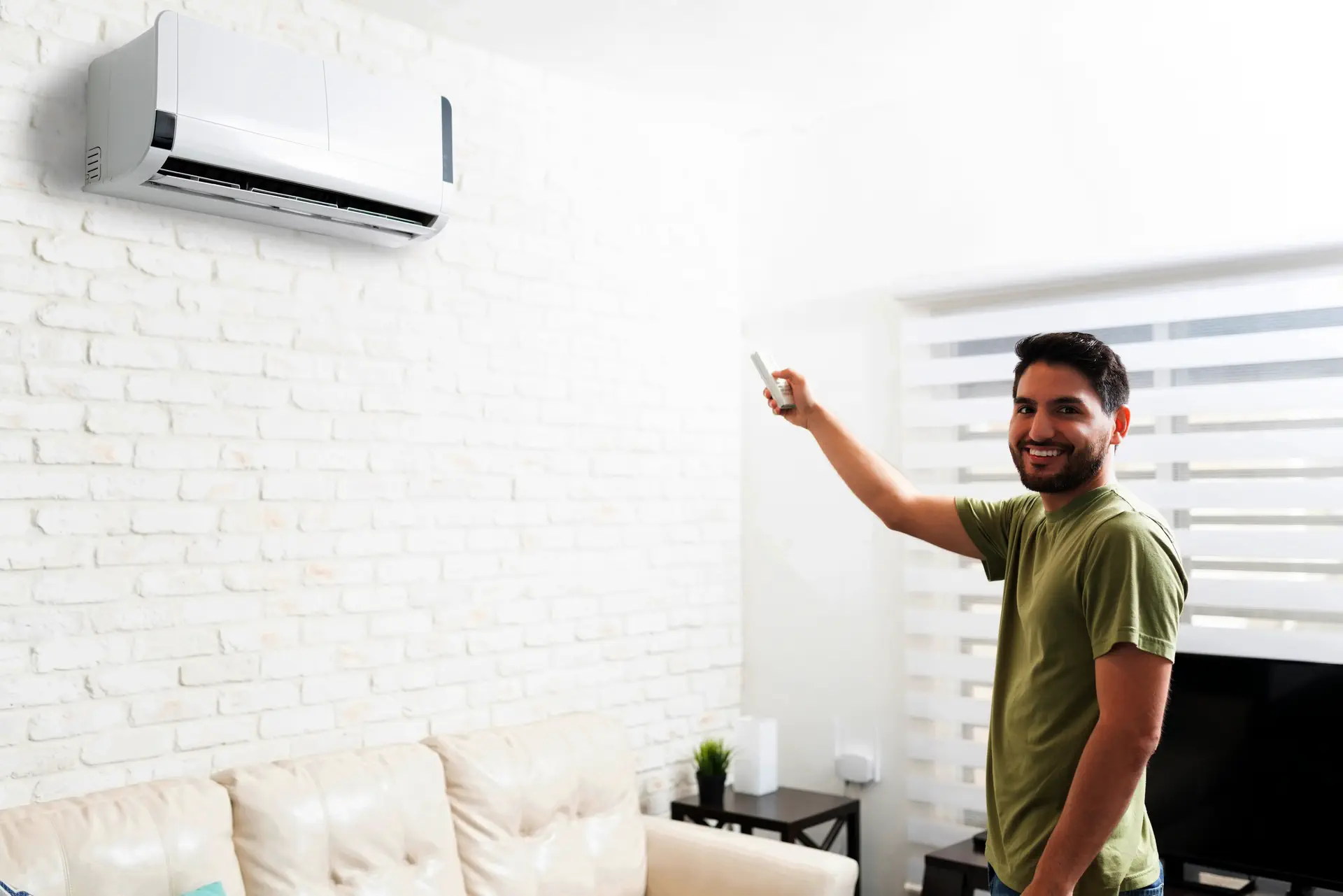
Here’s what mini splits actually are: ductless air conditioning systems with an outdoor compressor and one or more indoor air handlers mounted on the wall. No ductwork. No furnace. No forced-air distribution. Each unit cools one zone. You control each zone independently.
Why Mini Splits Win in Panama Specifically
In a US home with a gas furnace and existing ductwork, central air is often the sensible choice — you’re already paying for the infrastructure. Panama changes the calculation on three levels.
No ducts means no duct losses. The EPA and Department of Energy estimate that 20–30% of cooling energy in central air systems escapes through ductwork before it ever reaches the room. Mini splits deliver cooled air directly from the wall unit. That 20–30% loss simply doesn’t exist.
SEER ratings are significantly higher. The Seasonal Energy Efficiency Ratio measures how efficiently an AC converts electricity into cooling. Most central air units run 14–22 SEER. Mid-grade mini splits routinely hit 20–28 SEER, and top-tier units reach 30+ SEER. In Panama’s tiered billing environment, that efficiency difference can be the difference between the subsidized tier and the expensive one. We go much deeper on SEER ratings specifically — what the numbers mean, what to buy, what to avoid — in a dedicated article later in this series.
You only cool what you’re using. Central air treats the whole house as one zone. Mini splits let you turn off the bedroom units during the day and the living room unit at night. In a Panama home where you might have one or two people and four rooms, not cooling the empty ones is a meaningful saving.
“Running mini splits all day isn’t wasteful if they’re the right units. Running central air all day very often is.”
SEER: The Number That Actually Matters
Not all mini splits are equal, and the efficiency gap between a budget unit and a quality one is significant. A reliable expat in Panama who runs AC roughly 20 hours a day, six days a week, and keeps his bill under $50/month — something we’ve seen confirmed across forums — attributes the result entirely to high-SEER units and higher setpoint temperatures.
The SEER Threshold for Panama
If you’re buying a mini split for regular use in a Panama home: SEER 22 or above is the target. SEER 20 is acceptable in a pinch. SEER below 20 in a regularly occupied space is hard to justify in 2026 given what higher-efficiency units cost and what the tiered billing structure does to your bill if you’re running an inefficient unit all day.
Brand-wise: Daikin, Trane, and Panasonic produce consistently well-regarded high-efficiency residential units. This isn’t brand advocacy — it’s what shows up when you filter for SEER 22+ and verified performance data.
The Temperature Setting Variable
No guide to AC efficiency is complete without this: the temperature you set your unit to has an enormous effect on electricity consumption. A unit set to 18°C (64°F) uses dramatically more energy than the same unit set to 26°C (79°F) — some estimates put the ratio at 5:1. Panama doesn’t require 18°C. Most people are comfortable at 24–26°C in a properly sized room. Set it and forget it at a reasonable temperature, and the efficiency gains compound.
Mini Split vs. Central Air — Key Comparisons
What About Central Air Condominiums?
Some Panama City condos — particularly older buildings and larger complexes — have central air systems that are included with the HOA or charged as part of building fees. If you’re evaluating one of these, ask specific questions: What’s the SEER rating of the building’s central system? Is the system VRF (Variable Refrigerant Flow), which is substantially more efficient than traditional central air? Who pays for overconsumption? Central air in a well-maintained VRF system can be reasonably efficient. Central air in an aging building with leaking ducts is an expensive problem you inherit.
The Install Matters As Much As the Unit
A high-efficiency mini split installed incorrectly will underperform a cheap unit installed properly. The most common problem: technicians skipping the evacuation of the refrigerant line sets. Proper installation requires pulling a vacuum on the lines before charging — this removes moisture and non-condensable gases that degrade performance and shorten the system’s life. Don’t accept shortcuts on this. Ask your installer directly whether they evacuate line sets. If they look uncertain, find someone else.
The Three-Phase Electrical Question
This comes up on expat forums constantly, usually with some version of “do I need to balance my phases?” Let’s be specific.
Most residential homes in Panama have standard 240V split-phase service — two live legs at 120V each, plus a neutral. This is the same service type used in US homes. Large appliances (AC units, stoves, water heaters, dryers) connect across both legs and are therefore inherently balanced.
True three-phase service — three separate alternating currents at 120° apart — is standard for commercial and industrial buildings, not typical residential homes. If you’re in a house that draws significant power from the grid, you may have split-phase service that the utility refers to as their “BTS” (basic low-voltage) service category, which is the standard residential classification in Panama.
On “Balancing” Your Electrical Panel
The Facebook post we referenced in our Rates, Reliability & Billing article is correct that balancing loads between phases has essentially no effect on your monthly electricity cost in a standard residential setup. There are good reasons to have a balanced panel — it’s better electrical practice and reduces strain on neutral conductors — but it won’t meaningfully move your bill. If a contractor is selling you panel balancing as a cost-saving measure, that’s not the full picture.
Where three-phase service does matter: if you’re buying a property that was previously commercial, or a large home that had unusual electrical demands, confirm what service classification is actually on the account. Your bill’s top section will indicate your service category. “BTS” is standard residential; anything else warrants a question to your electrician before you buy.
Solar in Panama: Genuinely Worth Considering
Panama’s solar picture has changed significantly over the last few years, and the answer to “is solar worth it?” is increasingly “for the right person and property, yes.” We give this its own full, dedicated treatment later in this series — the numbers below are the summary version.
The Solar Resource Is Strong
Panama sits close to the equator. The area around Panama City and western Panama receives roughly 5.5–6.5 kWh of solar energy per square meter on peak days, with an annual daily average around 3 kWh/m². That’s a solid solar resource — not the Atacama Desert, but consistently strong enough to make residential solar productive.
Adoption Is Growing Fast
As of November 2025, Panama had reached approximately 188.8 MW of installed self-consumption solar capacity, spread across 6,937 active users nationwide — a 35% increase in customer count from the end of 2024, according to the Cámara Panameña de Energía Solar and Panama’s public services regulator, ASEP. Growth is concentrated in Panama province and Panama Oeste. That’s not a niche option anymore; it’s becoming mainstream.
The Tax Incentive Structure
Panama’s Law 417, enacted 27 December 2023 and effective the following fiscal year (2024), eliminates import duty, the selective consumption tax, and ITBMS on solar equipment — panels, inverters, batteries, and installation materials — amending the earlier Law 37 of 2013 incentive framework. The practical result: solar equipment in Panama is tax-exempt, which materially improves the economics versus buying through standard import channels. Net metering has existed in Panama since 2008, originally capped at 10 kW per installation and since raised to 500 kW, making self-consumption solar viable for both homes and larger commercial systems.
Grid-Tied vs. Off-Grid vs. Hybrid
Grid-tied systems sell excess power back to the utility and reduce your bill, but they shut down when the grid goes out. In Panama City where outages are usually brief, this is often the right balance — lower cost, simpler setup, bill reduction. For someone whose primary motivation is cost rather than outage protection, this is worth evaluating.
Off-grid systems power the home independently but require significant battery storage for nighttime and cloudy days. These make most sense in remote areas where grid reliability is genuinely poor — Bocas del Toro, mountain communities, rural properties.
Hybrid systems connect to the grid but include battery backup. The batteries handle outages and optimize your self-consumption. Higher upfront cost, but better protection. Increasingly popular in suburban Panama where outages are occasional but inconvenient.
Does Solar Pencil Out Financially?
For a home consuming 300–400 kWh/month — the tier where you’re crossing out of the subsidized rate — solar can reduce or eliminate the above-subsidy consumption, essentially keeping you in the cheaper tier. The payback period for a properly sized system in this scenario has been quoted at approximately five years when financed, comparable to buying a car. For homes consuming 700+ kWh/month, the payback can actually be faster because the savings at the high tier are larger.
Solar Doesn’t Replace Efficiency
Installing solar on a home with inefficient AC units, an electric water heater, and an electric dryer is putting the cart before the horse. The first moves — high-SEER mini splits, gas appliances, air-dried laundry — reduce consumption dramatically for much less investment. Solar makes more sense once you’ve already optimized consumption and want to reduce remaining dependence on the grid.
For the full breakdown — system sizing, installer selection, financing options, and a closer look at the payback math — see our dedicated Solar Panels article later in this series.
Jalousie Windows and Single-Pane Glass: The Hidden Electricity Cost
Many homes in Panama — particularly older construction and houses outside the high-rise condo market — have jalousie windows. These are the louvered glass windows with horizontal slats that tilt open for ventilation. They were designed for tropical climates before air conditioning existed. In a world where you’re running AC, they create a real and underappreciated problem. We cover this topic in full — the physics, the fixes, and the real numbers — in a dedicated article later in this series; here’s the short version.
The Physics of Jalousie Windows
When jalousie slats are fully closed, they don’t seal. There are gaps along the edges of each slat — gaps that allow continuous air exchange between inside and outside. When your mini split is running and trying to maintain 25°C inside, those gaps are letting 33°C air in and conditioned air out. The AC works harder to compensate. Your bill goes up.
There’s also solar heat gain: glass, even in horizontal slat form, admits sunlight and turns your interior into a slow cooker if there’s direct sun exposure. Standard jalousie glass has no low-E coating and no insulating layer.
What to Do About It
Replacing jalousie windows with properly sealed double-pane or impact-resistant casement windows is the highest-impact envelope improvement you can make to an older Panama home. It’s not cheap — expect real money for a full house — but the running cost reduction is meaningful and compounds every month for the life of the home.
If replacement isn’t immediate, some mitigation options: heavy cellular shades or blackout curtains on the interior reduce solar heat gain. Sealing the perimeter frame of jalousie windows where possible reduces infiltration. Neither is as effective as replacement, but both help.
Window Types — Relative Energy Performance
Gas Appliances: The Practical Win Nobody Talks About Enough
Electric water heaters, electric stoves, and electric dryers are significant energy hogs. They haven’t gotten dramatically more efficient over the decades, and in Panama’s tiered billing environment, they push consumption into the expensive tiers. We cover the full cost breakdown, tank sizing, and supplier options in a dedicated Gas Appliances article later in this series — here’s why it matters.
Propane (sold as LNG in Panama, though technically butane for the standard residential bottles) is the practical alternative. A 25-pound propane tank for a gas stove costs around $30 for expats (there’s a subsidized local price available to Panamanians). Two tanks per month — one for the stove, one for a gas dryer — runs around $60, replacing what would otherwise be a significant portion of your electric bill.
For water heating: electric resistance water heaters are the most power-hungry appliance in the home. Panama’s climate makes this more manageable than in northern climates — “cold” water from the tap in Panama is often 25°C or warmer, which isn’t actually cold. Many expats go without a water heater entirely, or install small on-demand gas units only for showers. The electricity savings are real.
On Air-Drying Laundry
Electric dryers are large, consistent electricity consumers. In Panama’s climate — warm and dry in the dry season, warm and humid but breezy in the wet season — air-drying works well. A basic drying rack or outdoor clothesline eliminates one of the top residential power draws. It’s not glamorous. It also works.
What to Look For When Buying a Home: The Electricity Checklist
Most buyers in Panama focus on location, price, and condition. Electrical considerations — which will directly affect your monthly costs for years — are often an afterthought. They shouldn’t be. Here’s what we look at.
- What service category is on the account? Ask for a recent bill. It should say “BTS” for standard residential. Anything else warrants an electrician’s eyes before closing.
- What are the last 12 months of electricity bills? Sellers know what they pay. Ask for bills. A $400/month history on a home you expected to cost $100/month to cool is information you need before you buy.
- What AC units are installed, and what are their SEER ratings? Look for the yellow EnergyGuide label or ask for model numbers you can look up. SEER below 18 on installed units is a replacement-cost conversation you should have before agreeing to a price.
- Is it central air or mini splits? Mini splits are preferable for efficiency. Central air in a VRF system can be acceptable. Central air in an older building with aging ductwork is a cost concern.
- What type of windows are installed? Jalousie windows are a running cost indicator. Single-pane fixed glass in direct sun is a solar heat gain problem. Ask about window age and whether any have been replaced.
- Is the water heater electric or gas? Electric = power hog. Gas = manageable monthly cost.
- Is the stove electric or gas? Same calculus as the water heater.
- Is there a generator, and what does it cover? In a standalone home, ask about backup power. In a condo building, ask specifically what the building generator covers — common areas only, or individual units.
- Which direction does the home face? West-facing windows and walls absorb maximum afternoon sun. This directly increases your AC load. South-facing is better. East-facing catches morning sun but the afternoon is manageable. North-facing is ideal.
- Is there existing infrastructure for solar? Some newer homes are built with conduit runs and panel space for future solar installation. If solar is on your horizon, this matters and can affect your renegotiation position.
- What’s the panel amperage and condition? A home built in the 1980s with an aging 60-amp panel is an upgrade project that should factor into your offer price. Have an electrician inspect the panel before closing — see our Electrical Wiring & Home Inspections article for the full checklist.
- Are there any estimated billing issues on the account history? Ask if the meter is accessible and whether any recent bills were estimated rather than read. Estimated billing can result in catch-up charges when the meter is finally read.
Putting It Together: What a Low-Bill Life Actually Looks Like
Let’s make this concrete. An expat who keeps their bill well under $100/month while running AC heavily in Panama is typically doing some combination of the following: two or three high-efficiency mini splits (SEER 22+) set to 24–26°C, a gas stove, no electric water heater or a small on-demand gas unit, air-dried laundry, well-sealed windows or blackout curtains on sun-exposed sides, and AC units that are kept clean and properly maintained.
The person paying $400/month is typically running an older or low-SEER AC system, possibly central air, with an electric stove and water heater, set to 20°C, in a home with jalousie windows on the west-facing side.
Neither of those is inevitable. It’s a series of choices — some of which you make when you buy or rent, some of which you make when you set the thermostat.
The Bottom Line
Panama’s electricity is genuinely affordable if you understand the system. The 300 kWh threshold is the number that matters most. Stay under it with efficient mini splits, gas appliances, and reasonable setpoint temperatures, and your electric bill in Panama can be lower than it was in the US. Ignore the tiered structure and run the equivalent of a US suburban home’s appliance set, and Panama stops feeling affordable fast.
The research on this is consistent, the math works, and the equipment is available. It just requires making deliberate choices rather than defaulting to what you knew in Florida or Ohio.
Sources & Verification
- Official: EPA and U.S. Department of Energy estimates that ductwork in central air systems loses 20–30% of cooling energy before delivery, and that ductless mini split systems are on average 20–30% more efficient than equivalent central air systems.
- Official: Panama’s Law 417 (Gaceta Oficial No. 29938-A, 27 December 2023), amending Law 37 of 2013, eliminating import duty, the selective consumption tax, and ITBMS on solar equipment (panels, inverters, batteries, installation materials), effective fiscal year 2024 — confirmed against Lexology, Arias Law, and Panamanian news coverage from the law’s enactment. Net metering in Panama has existed since 2008, originally capped at 10 kW and since raised to 500 kW.
- Official: Panama’s distributed self-consumption solar capacity reached approximately 188.8 MW across 6,937 active users as of November 2025 (a 35% year-over-year increase in customer count), per data from the Cámara Panameña de Energía Solar and Panama’s Autoridad Nacional de los Servicios Públicos (ASEP), reported across multiple Panamanian outlets including La Prensa Panamá.
- Community: Panama’s solar resource strength (5.5–6.5 kWh/m² peak, ~3 kWh/m² annual daily average), residential solar payback estimates, mini split brand recommendations and setpoint efficiency behavior, jalousie window physics, gas appliance costs, and the electricity buyer’s checklist. Synthesised from expat accounts, installer information, and our own April 2026 research; we have not yet installed solar or purchased a Panama property ourselves.
- Not yet verified: A previously cited figure of “47.27 MW added during 2024, a historic annual record” for Panama’s distributed solar capacity. We could not independently confirm this specific figure and have replaced it with the more recent, sourced November 2025 snapshot instead of repeating an unconfirmed number.
Facts in this article last verified: July 2026.
Panama Electricity Guide
- 01 Panama Electricity Guide for Expats: Rates, Reliability & the Billing Trap That Triples Your Bill
- 02 Voltage, Plugs & Appliances: The One Big Advantage American Expats Have
- 03 Wiring, Inspections & Electrical Hazards in Older Panama Homes
- 04 Mini Splits, Solar, Windows, and the Home Buyer's Electricity Checklist
- 05 Jalousie Windows and the Hidden Electricity Cost
- 06 SEER Ratings: What to Buy — and What to Avoid
- 07 Gas Appliances & the $4.37 Cylinder Most Expats Miss
- 08 Solar Panels: What the Math Actually Says
- 09 Panama's Clean Energy Grid: What Expats Need to Know
- 10 Power Outages, UPS Systems & Backup Power
Brian & Kent
We’re a gay couple based in St. Petersburg, Florida, researching and relocating to Panama in real time. Brian’s permanent residency was approved in July 2026. Kent is the primary researcher. Everything on this site is current because we’re going through it now.