Panama Electricity Guide
Wiring, Inspections & Electrical Hazards in Older Panama Homes: What Buyers and Renters Need to Know
Panama doesn’t have a mandatory home inspection culture. The seller isn’t going to mention the wiring. That’s your job — and this is what to look for.
 Brian & Kent · GayExpatsPanama.com · April 2026 Research Trip
In the United States, a home inspection is so standard that skipping one is considered reckless. In Panama, it is not standard practice at all. The seller is not legally obligated to disclose electrical defects. The real estate agent — who gets paid when the deal closes — has no particular incentive to raise the subject. And the gorgeous colonial in Casco Viejo or the affordable house in El Cangrejo with the slightly sticky breaker panel will be presented to you the same way: enthusiastically. The electrical history of that property is entirely yours to discover, and the tropical climate means that history has likely not been kind.
Panama Electricity Guide
Everything we've learned about electricity in Panama — rates, reliability, wiring hazards, mini splits, solar, and what to check before you buy.
- Panama Electricity Guide for Expats: Rates, Reliability & the Billing Trap That Triples Your Bill
- Voltage, Plugs & Appliances: The One Big Advantage American Expats Have
- Wiring, Inspections & Electrical Hazards in Older Panama Homes You are here
- Mini Splits, Solar, Windows, and the Home Buyer's Electricity Checklist
- Jalousie Windows and the Hidden Electricity Cost
- SEER Ratings: What to Buy — and What to Avoid
- Gas Appliances & the $4.37 Cylinder Most Expats Miss
- Solar Panels: What the Math Actually Says
- Panama's Clean Energy Grid: What Expats Need to Know
- Power Outages, UPS Systems & Backup Power
This post covers what the risks actually are, why the tropics make old wiring worse, how to get a proper inspection, what to look for yourself, and what to do when you find something concerning. Because you will find something concerning.
The Panama Context: Why This Is Different From Home
Panama City’s housing stock is a study in extremes. On one end: gleaming towers in Punta Pacífica and Costa del Este built in the last fifteen years, wired to modern standards, with professional management and building engineers on call. On the other: houses and apartment buildings in neighborhoods like Bella Vista, El Cangrejo, and especially Casco Viejo that date from the 1950s, 1960s, and 1970s — wired by the standards of those decades, maintained by whoever happened to be available, and subjected to decades of tropical humidity, salt air, and power fluctuations.
The expat market tends to concentrate on the charming middle: renovated older buildings, houses with character, apartments in neighborhoods with walkability and history. These are exactly the properties most likely to have electrical systems that haven’t been comprehensively addressed since the original installation.
The Inspection Reality in Panama
Unlike the US, home inspections are not a standard part of Panama’s real estate transaction process. There is no MLS, no standardized disclosure form, and no legal requirement for the seller to reveal known defects. A qualified home inspection in Panama costs approximately $100–$500 depending on property size and inspector. That cost is entirely worth it. Get one. Every time. No exceptions.
What Tropical Heat and Humidity Do to Old Wiring
Before getting into specific hazards, it’s important to understand why Panama’s climate compounds every electrical problem. Wiring insulation — the plastic or rubber coating around the conductors — degrades faster in heat and humidity than in temperate climates. What might be a manageable 30-year-old wiring system in a dry Minnesota basement can be a genuinely dangerous 30-year-old wiring system in a Panama City house that has spent decades at 85°F and 80% humidity.
Rubber-insulated wiring from the 1950s and 1960s becomes brittle with heat and age. The coating cracks. Where it cracks, you have exposed conductors. In a humid tropical environment, moisture creates pathways for current that wouldn’t exist in a dry climate — increasing the risk of shock, short circuits, and fire. Salt air in coastal and Pacific-facing locations accelerates corrosion at every connection point. A loose connection that might hold for years in Phoenix can fail in months in Panama City.
The climate doesn’t create electrical problems from nothing. It accelerates the ones that already exist and makes marginal situations dangerous faster than you’d expect.
This is not a reason to avoid older properties. It is a reason to inspect them seriously and address what you find promptly — not someday, not after you’ve been living there for six months, but before you move in or as a condition of the transaction.
The Five Wiring Hazards to Know About
1. Ungrounded Two-Prong Outlets
This is the most common electrical issue in older Panama homes, and the one most likely to greet you the moment you walk in the door. Two-prong outlets — the same flat parallel-blade configuration as a US outlet, but without the round grounding hole — were standard in Panama through the 1960s and into the 1970s. A grounded outlet provides a safe path for stray current if something goes wrong. An ungrounded outlet does not. In a modern, dry environment this is a nuisance. In a tropical environment with frequent power fluctuations, it is a real hazard for anything sensitive plugged into it.
What to do: GFCI outlets — the kind with the test and reset buttons, standard in US bathrooms and kitchens — can be installed in place of two-prong outlets even without a ground wire present, and provide meaningful shock protection. A licensed electrician can do this for a modest cost per outlet. It does not solve the underlying absence of grounding, but it is a code-acceptable and genuinely safer interim solution. In kitchens, bathrooms, and anywhere near water — this is not optional.
2. Undersized or Overloaded Panels
Older homes in Panama were wired for the electrical loads of the 1950s and 1960s: a few lights, a refrigerator, perhaps a small air conditioner. A 60-amp service panel — the standard of that era — cannot safely run two mini-split air conditioners, a washing machine, a modern kitchen, and a home office full of electronics simultaneously. Yet that is exactly what expats move in expecting to do.
The symptom is familiar: circuit breakers that trip repeatedly under normal use. The cause is an electrical system that was never designed for the load being placed on it. The fix — panel upgrade to 100 amps minimum, ideally 150 or 200 amps for a full home — is not cheap, but it is necessary. Before renting or buying any older home, find the electrical panel. Count the breakers. Check the amperage rating on the main breaker. If it says 60 amps, factor a panel upgrade into your budget before you sign anything.
Fuse Boxes: Walk Away Carefully
If the property still has a fuse box rather than a circuit breaker panel, treat this as a serious red flag requiring immediate professional evaluation. Fuse boxes are not inherently dangerous, but a 60-plus-year-old fuse box in a tropical climate that has had various tenants install whatever fuses were convenient is a different matter. Over-fusing — installing a fuse rated higher than the wiring can safely handle — is one of the most common causes of electrical fires in older homes, precisely because the fuse stops blowing before the wiring does.
3. Aluminum Branch-Circuit Wiring
In the late 1960s and early 1970s — when copper prices spiked — builders across North America, including in Panama, sometimes used solid aluminum wire for branch circuits (the wiring that runs to your outlets and switches). Aluminum wiring is not inherently catastrophic, but it expands and contracts more than copper with heat changes, which in a tropical climate means constant movement at connection points. Over time, those connections loosen. Loose connections arc. Arcing generates heat. Heat starts fires.
The risk here is not vague. A national survey conducted by the Franklin Research Institute for the U.S. Consumer Product Safety Commission found that homes built before 1972 and wired with aluminum are 55 times more likely to have at least one wire connection at an outlet reach “Fire Hazard Conditions” — defined as receptacle cover screws reaching 300°F, sparks emitted, or charring of surrounding material — than homes wired with copper. That is not a rounding error. It is the reason aluminum branch-circuit wiring gets treated as a serious finding rather than a curiosity, wherever in the world it turns up.
Aluminum wiring is identifiable by markings on the outer jacket of the cable — look for “AL” or “ALUMINUM” printed on the sheathing in attics, utility spaces, and at the panel. If the wiring is copper-colored it is copper. If it is silver-gray it is aluminum. A qualified electrician can make this determination definitively. If aluminum branch-circuit wiring is present, get a full evaluation and discuss remediation options — the most common being COPALUM crimping connectors at every junction, or replacement with copper wiring.
4. Deteriorated Insulation and DIY Modifications
Older wiring with rubber or cloth insulation — both common in construction through the 1960s — becomes brittle with age and heat. In Panama’s climate, this process is accelerated. Where insulation cracks and falls away, live conductors are exposed. Where conductors are exposed in wall cavities, you have a fire risk. Where exposed conductors are accessible, you have a shock risk.
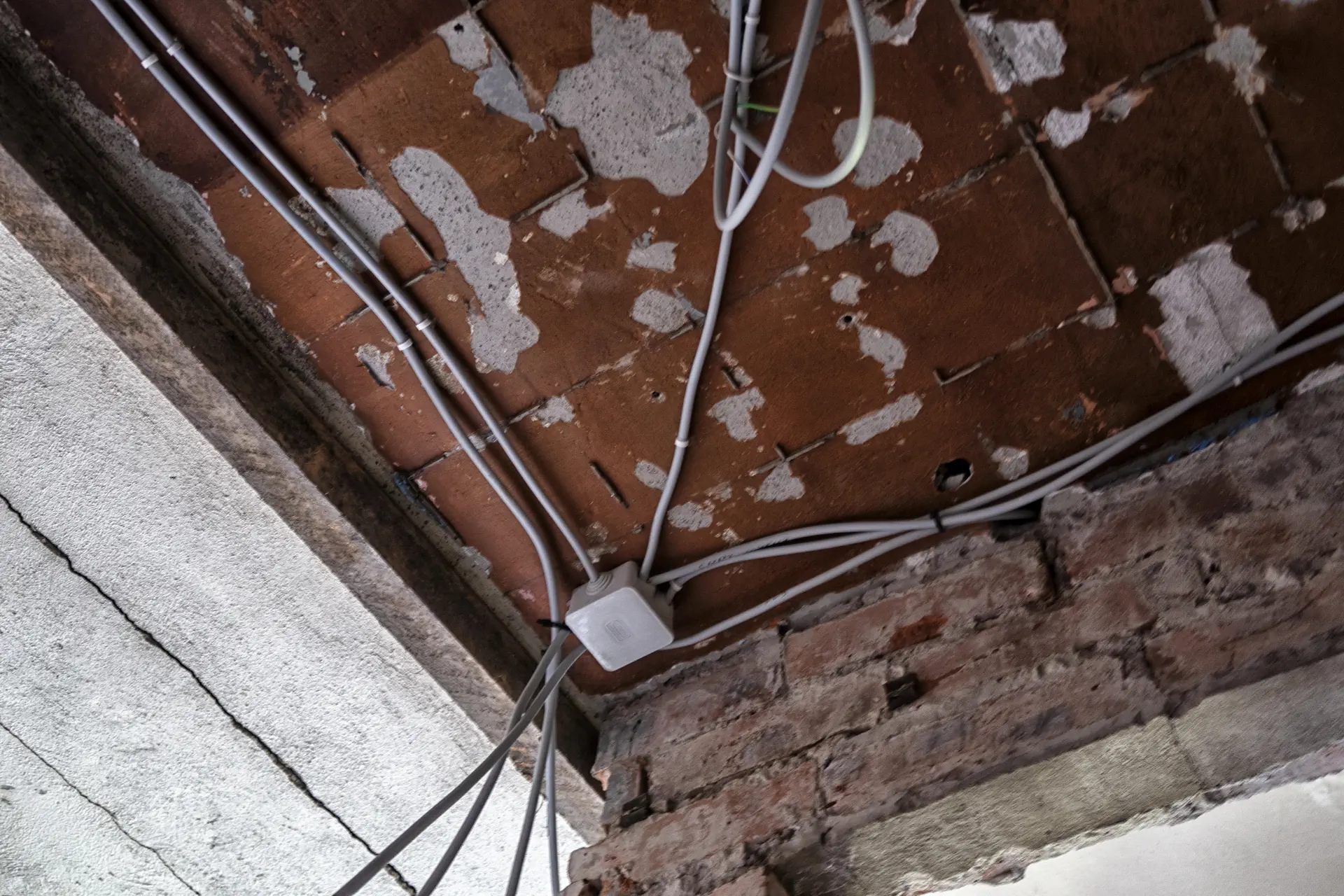
The other half of this problem is what various owners and tenants have done to the wiring over the decades. Unlicensed electrical work is not unusual in older Panama properties. Connections made outside of junction boxes. Wires spliced with masking tape instead of proper connectors. Circuits added by running new wire alongside old wire without professional installation. None of this is visible without an inspection, and all of it represents real risk.
The DIY Modification Tell
Look at outlets and switch plates. Discoloration — yellowing, browning, or actual burn marks — around outlets or switches is a sign of heat buildup from overloaded circuits or loose connections. An outlet that feels warm to the touch when nothing is plugged in is not normal. A burning smell near any outlet or panel is an immediate stop-everything-call-an-electrician situation.
5. Absent or Non-Functional GFCI Protection
Ground Fault Circuit Interrupters — the outlets with the test and reset buttons, or the equivalent breaker in the panel — are the single most important safety device in any environment where water and electricity coexist. In a tropical country where outdoor living, open-air bathrooms, and kitchen humidity are facts of life, they are not optional. In Panama’s older housing stock, they are frequently absent.
Any bathroom, kitchen, laundry area, outdoor outlet, or poolside outlet in an older Panama property should be assumed to lack GFCI protection until proven otherwise. Test every outlet with a GFCI tester (a $15 device available at any Do-It or Novey hardware store) before you accept the property as safe. If you find unprotected outlets in wet areas, installing GFCI protection is one of the cheapest and most effective electrical upgrades you can make — a GFCI outlet costs $15–$30 and can be installed in minutes by a qualified electrician.
What a Proper Home Inspection Covers
In Panama, home inspections are not standardized the way they are in the US. There is no widely established professional-association chapter operating in Panama City the way InterNACHI operates in the US, no standardized disclosure form, and no licensing requirement for home inspectors in the same sense as in the United States. This means the quality of what you get depends entirely on who you hire.
For electrical specifically, a competent inspector should cover: the service entrance and main panel condition and amperage; the presence and condition of circuit breakers or fuses; identification of wiring type (copper, aluminum, or older rubber-insulated wire); testing of all accessible outlets for proper function and grounding; verification of GFCI protection in wet areas; visible inspection of wiring in accessible spaces (attics, utility areas, under sinks); and identification of any visible DIY modifications, exposed wiring, or junction boxes without covers.
What an inspection cannot tell you is what is inside finished walls. A visual inspection is exactly that — visual. Hidden wiring in wall cavities, concealed junction boxes, and buried splices are beyond the scope of any non-invasive inspection. This is why the condition of what is visible matters so much: if the accessible wiring is in poor condition, assume the hidden wiring is no better.
Home Inspection in Panama — What to Know
What You Can Check Yourself Before Calling Anyone
You don’t need to be an electrician to identify the most obvious warning signs. Here is what to do at every property viewing before you make any decisions.
Find the electrical panel. Open it. How old does it look? Is it a fuse box or circuit breakers? If circuit breakers, is the amperage rating on the main breaker visible — and what does it say? Are the breakers labeled, and do the labels correspond to what’s in the house? Are there any signs of heat damage, corrosion, or burn marks inside the panel?
Count the two-prong outlets. Walk through the kitchen and both bathrooms specifically. If you see two-prong outlets in these areas, that’s a known gap to address.
Plug in your GFCI tester. Test every outlet in wet areas. The tester will tell you whether the outlet is wired correctly, whether it’s grounded, and whether GFCI protection is present. A $15 investment that could save your life, or at minimum your laptop.
Look at the outlets and switch plates. Any discoloration, burn marks, or cracking of the plastic faceplate indicates heat events. These are not cosmetic — they document that something has overheated at that location.
Turn things on simultaneously. Run the air conditioner, plug in a hairdryer, and turn on the kitchen lights at the same time. If a breaker trips, that circuit is already overloaded under normal residential use. That’s information you need before you sign a lease.
Smell the panel. No, really. A burning or ozone smell from the electrical panel or from any outlet is a serious warning sign that requires immediate professional evaluation. It is never normal.
Surge Protection in an Older Home Is Non-Negotiable
Panama’s grid delivers power that is less consistent than what you’re used to in the US — particularly in older neighborhoods with aging distribution infrastructure. Voltage spikes after brief outages, and brownouts followed by sudden restoration, are hard on unprotected electronics. In any older home without whole-house surge protection, your first purchase should be quality surge-protected power strips for every piece of electronics you own. A whole-house surge protector — installed at the panel by a licensed electrician — runs $150–$400 installed and protects everything simultaneously. In an older Panama home, this is not a luxury item.
The Lease Agreement and Electrical Responsibility
Panama’s rental law is clear on this point. Ley 93 de 1973 — Panama’s law governing urban rental leases — obligates the landlord (Article 28) to maintain the property in adequate hygienic and safety conditions, and to perform the repairs necessary to keep the property and its installations — which includes electrical wiring — in a condition fit for use. This is statutory, not a matter of custom, and it means you have real legal standing to demand electrical repairs for genuine safety issues — but only if you document them, raise them in writing, and understand what you agreed to before signing. Disputes between landlord and tenant that can’t be resolved directly are handled by the Dirección General de Arrendamientos, a body under Panama’s Ministry of Housing and Land Management (MIVIOT).
Before signing any lease for an older property, put the following in writing as part of your lease negotiation: confirmation that all electrical outlets in wet areas are GFCI-protected; confirmation that the electrical panel is adequate for normal residential use; and an agreement that any electrical defects identified within the first 30 days will be remediated at the landlord’s expense. A landlord who balks at all three of these reasonable requests is telling you something useful about how the tenancy will go.
Document Everything Before Move-In
On your move-in walkthrough, photograph every outlet, every switch plate, and the electrical panel — open door and all. Note the date. Send copies to the landlord by email. This is your baseline record of the property’s electrical condition when you took possession. In any dispute about damage or pre-existing conditions, this documentation is the difference between recovering your deposit and not.
Buying a Property: Due Diligence That Actually Covers Electrical
If you’re buying rather than renting, the stakes are higher and the process requires more. Panama’s purchase process involves a Promesa de Compraventa — a Promise to Purchase contract — with a deposit, typically 10% of the purchase price. Once that is signed, you are committed. This means your electrical due diligence needs to happen before the promise, not after. We cover the Promesa in full, including deposit mechanics and the due diligence contingency, in our Buying Property series.
Commission an independent home inspection and, for any property over 20 years old, a separate licensed electrician’s assessment of the electrical system specifically. Use the findings as a negotiating tool — not to walk away necessarily, but to quantify the cost of bringing the electrical system up to a safe standard and adjust the purchase price accordingly, or require the seller to complete the work before closing.
Panama’s real estate market has properties listed at 10–20% above expected selling price, with negotiation expected. An inspection report documenting a panel that needs replacement, absent GFCI protection throughout, and degraded wiring in the utility areas is a documented, credible basis for a meaningful price reduction. Use it as such.
The Renovation Reality: Older Homes Can Be Done Right
None of this means older Panama properties are unsalvageable or not worth considering. Casco Viejo’s restored colonial buildings, Bella Vista’s mid-century apartment stock, houses in El Cangrejo — these are genuinely appealing in ways that a 2019 high-rise tower is not. Character, location, walkability, price: older properties offer things that new construction often doesn’t.
What they require is honest accounting. A full electrical rewire of a medium-sized house in Panama — pulling new copper wire throughout, upgrading the panel, installing proper grounding and GFCI protection — runs somewhere in the range of $3,000–$8,000 depending on the property size and condition, based on what contractors quoted expats in the Boquete market. In Panama City, prices will be different; get three quotes from licensed electricians before committing to a number. The work disrupts occupancy for days to a week.
If you’re buying a property that clearly needs a full rewire and you’re negotiating a price that doesn’t account for that cost, you are paying for the rewire without knowing it. Better to know it, price it, and make a deliberate decision.
| Issue Found | Severity | Fix | Urgency |
|---|---|---|---|
| Two-prong outlets in wet areas | Moderate | Install GFCI outlets ($15–$30 per outlet + labor) | Before occupancy |
| 60-amp panel, frequent breaker trips | High | Panel upgrade to 100–200 amp | Before full occupancy; negotiate into purchase/lease |
| Fuse box in place of breakers | High | Full panel replacement; get electrician assessment first | Before signing anything |
| Aluminum branch-circuit wiring | High | COPALUM remediation or full rewire — licensed electrician required | Immediate professional evaluation |
| Discolored/burned outlet faceplates | High | Electrician inspection of that circuit; do not use outlet until cleared | Immediate |
| Warm outlet with nothing plugged in | High | Stop using; professional inspection of that circuit | Immediate |
| Burning smell from panel or outlets | Critical | Do not use property until inspected; call electrician same day | Today, not tomorrow |
| Visible exposed wiring in utility areas | Moderate–High | Assess age and insulation condition; cover or replace as needed | Before occupancy |
| Missing GFCI protection, bathrooms/kitchen | Moderate | Install GFCI outlets or GFCI breaker for those circuits | Before occupancy |
| No whole-house surge protection | Low–Moderate | Whole-house suppressor at panel ($150–$400 installed) or quality surge strips | Within first month |
A Note on Licensed Electricians in Panama
Electrical work in Panama is regulated — licensed electricians (electricistas certificados) are required for panel work and permitted installations. In practice, not every person who shows up offering electrical services is licensed. For any work beyond replacing an outlet, ask for credentials and references. The expat Facebook groups for your specific area — Panama City, Boquete, Coronado — are your best resource for verified referrals. Personal recommendation from another expat who has had the work done and had no subsequent problems is worth considerably more than any online listing.
Prices for licensed electrical work in Panama are substantially lower than in the United States. A panel upgrade that would cost $3,000–$5,000 in St. Petersburg will cost less in Panama City. GFCI outlet installation that would run $150 per outlet in Florida will be a fraction of that. The work is affordable. The risk of deferring it is not.
The Honest Summary
Panama’s older housing stock has real electrical issues — some of them serious. None of them are secrets; they’re the same issues that come with older construction in any tropical country where inspection and maintenance standards have been inconsistent over decades. The difference between an expat who handles this well and one who doesn’t is almost entirely about how much attention they paid before signing, and how directly they addressed what they found.
Get the inspection. Bring the GFCI tester. Open the panel. Ask the landlord about the wiring age. Put the electrical responsibilities in writing. And if you find something that makes you genuinely uneasy — a panel full of burn marks, a bathroom with no GFCI and outlets that test as ungrounded, wiring that crumbles when you look at it — that is information, and information is what you came for. Use it.
What This Series Is Actually About
Across this series, the consistent finding is that Panama’s electricity situation is manageable with awareness and modest preparation. The grid is better than feared. The voltage is compatible. The backup options are affordable. And the wiring in older homes is improvable — but only if you know what to look for and take it seriously before you are already living with it. That’s the whole point of doing this research before you move.
Sources & Verification
- Official: U.S. Consumer Product Safety Commission Publication 516, citing a national survey by the Franklin Research Institute — homes built before 1972 and wired with aluminum are 55 times more likely to have at least one wire connection at an outlet reach “Fire Hazard Conditions” (defined as receptacle cover screws reaching 300°F, sparks emitted, or charring) than copper-wired homes.
- Official: Panama’s rental law, Ley 93 de 1973, Article 28 — obligating landlords to maintain rental properties and their installations (including electrical) in safe, usable, and hygienic condition, with landlord-tenant disputes handled by the Dirección General de Arrendamientos under Panama’s Ministry of Housing and Land Management (MIVIOT).
- Community: Panama-specific wiring era characteristics, inspection cost ranges, panel upgrade and rewire cost estimates (the latter based on Boquete-market contractor quotes to other expats), and GFCI/surge-protection equipment pricing. Synthesised from expat accounts and our own April 2026 research; we have not yet purchased or rented a property in Panama ourselves.
- Not yet verified: The claim that no InterNACHI-affiliated home inspection body operates in Panama City. We could not confirm or rule this out definitively and have softened the language accordingly.
Facts in this article last verified: July 2026.
Panama Electricity Guide
- 01 Panama Electricity Guide for Expats: Rates, Reliability & the Billing Trap That Triples Your Bill
- 02 Voltage, Plugs & Appliances: The One Big Advantage American Expats Have
- 03 Wiring, Inspections & Electrical Hazards in Older Panama Homes
- 04 Mini Splits, Solar, Windows, and the Home Buyer's Electricity Checklist
- 05 Jalousie Windows and the Hidden Electricity Cost
- 06 SEER Ratings: What to Buy — and What to Avoid
- 07 Gas Appliances & the $4.37 Cylinder Most Expats Miss
- 08 Solar Panels: What the Math Actually Says
- 09 Panama's Clean Energy Grid: What Expats Need to Know
- 10 Power Outages, UPS Systems & Backup Power
Brian & Kent
We’re a gay couple relocating from St. Petersburg, Florida to Panama — researching everything in real time. Brian’s permanent residency was approved in July 2026. Kent is the one who now owns a GFCI tester. GayExpatsPanama.com is what we wish existed when we started.